France plans to test homemade HIMARS alternative by mid-2026法国计划在2026年中期测试国产HIMARS导弹的替代方案。
French officials have tasked two industry teams with developing options, while a foreign purchase is also still in the cards.
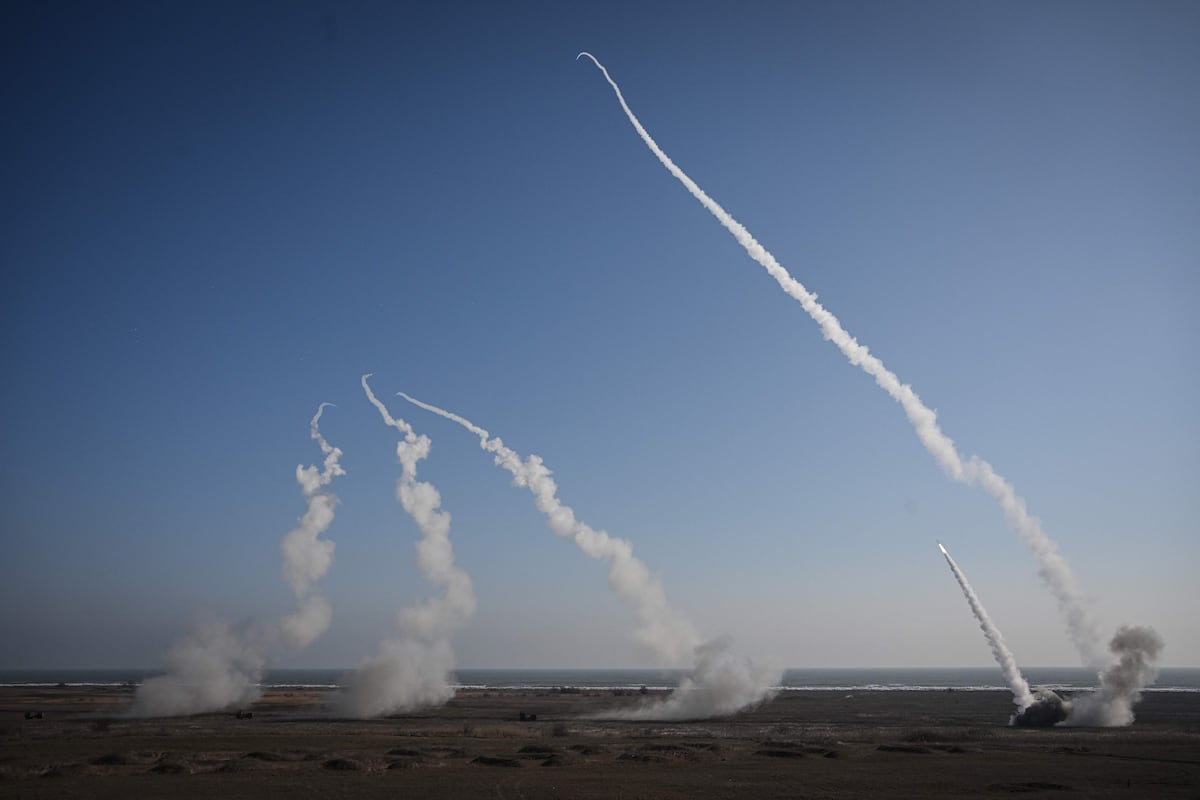
PARIS — France plans to test a domestically-developed rocket artillery system by mid-2026 as an alternative to the U.S. High Mobility Artillery Rocket System, or HIMARS, a move that could open up options for allies seeking a European capability.
The French Directorate General for Armament is looking to identify the technical solutions that will enable a demonstration firing in a year’s time, the defense-procurement agency told Defense News in a written reply to questions.
The DGA is working with a consortium of Safran and MBDA and another of Thales and ArianeGroup to develop a tactical strike capability in the 150 kilometer (93 mile) range.
Time is running out for France to replace its Lance-Roquettes Unitaire, a modified version of the M270 multiple launch rocket system, with the Army’s nine remaining systems set to reach the end of their service life in 2027.
Lawmakers and military brass have been pushing to develop a domestic option rather than buy abroad, in line with French policy for autonomy in defense matters.
“Service withdrawal of the LRU is approaching, and retention of the capability will be an issue at that point,”said Léo Péria-Peigné, a researcher at the Paris-based Institut Français des Relations Internationales specializing in armament capacity.
“The urgency is relative – we have hardly ever used this capacity in the past 30 years.”
Safran and MBDA are on track for the “ambitious” DGA schedule, confirming their target for a test firing in mid-2026, they said in a joint statement to Defense News. Thales and ArianeGroup didn’t comment on timing, with Thales saying the companies have been working as an integrated team for several months to offer a “pertinent solution” for the armed forces.
France’s 2024-2030 defense spending plan has budgeted €600 million ($663 million) for the rocket-artillery program, called Frappe Longue Portée Terrestre or FLP-T for short, with a goal of buying at least 13 systems by 2030 and 26 systems to equip a battalion by 2035.
The schedule to replace the LRU “is proceeding nominally” and within the timetable set by the defense spending law, according to the DGA.
Meanwhile, there’s still the option of a foreign purchase if things end up taking to long. That decision is on the calendar for next year, the directorate said.
The long-range tactical strike capability is “essential” and a niche that needs to be filled, French Army Chief of Staff Gen. Pierre Schill told lawmakers in an October hearing, noting that many other European countries have a rocket artillery capability.
Europe lacks a home-made HIMARS equivalent, and European armies shopping for rocket artillery in recent years either picked the U.S. option, the PULS launcher by Israel’s Elbit Systems, or Hanwha Aerospace’s Chunmoo.
Elbit is working with KNDS on a Europeanized version of PULS, while Germany’s Rheinmetall and Lockheed Martin in 2023 joined forces to develop the GMARS system.
Other than France, European countries still in the market for rocket artillery include Sweden and Norway. The Netherlands, Germany, Denmark and Spain already picked PULS, Poland acquired Chunmoo and HIMARS, while the Baltic countries, Romania and Italy are HIMARS customers. Meanwhile, the U.K. is considering expanding its fleet of M270 multiple launch rocket systems.
That leaves a narrow commercial window for French-developed rocket artillery, though a push by the European Union’s executive arm for member states to spend more of their defense budgets within the 27-nation bloc may provide a tailwind for a European solution.
Safran and MBDA said their rocket-artillery system, dubbed Thundart, is based on “mature and mastered subsystems,” and an initial operational capability could be produced before 2030.
In the already saturated marketplace, “there will be no export market for a French system that will not be ready before 2030,” said Péria-Peigné.
The DGA signed innovation partnerships with the two consortiums in November, providing a first round of financing for the FLP-T program. The partnership contract allows the procurement office to buy the system at the end of the development phase without a new competitive tender, provided the armament meets performance requirements.
The innovation partnership includes a “significant degree of self-financing” by industry, Safran Electronics & Defense CEO Franck Saudo said in a parliamentary hearing in November.
Each consortium will carry out a firing of its demonstrator, after which the French government will make a choice, the DGA said. At the end of the current 18-month contracts, the consortiums will submit a proposal that will allow the government to choose between various solutions, including off-the-shelf equipment, according to the directorate.
DGA head Emmanuel Chiva had told the Sénat foreign affairs committee in November that if the industrial partners would “work well,” the first orders might be placed in late 2025 or early 2026. That now appears to have been pushed back by several months.
Safran and MBDA said the geopolitical context and changing artillery requirements reinforce the interest of a sovereign solution for France in particular, but also for other European countries, with Thundart the only rocket artillery system designed and built in Europe, free of U.S. arms-trade restrictions, and with independent manufacturing that provides control over the production pace.
The companies started working together on designing the new system at the end of 2023, and presented a mock-up of their Thundart 227 mm long-range guided-artillery rocket at the Eurosatory defense show in June 2024, as a first step in the FLP-T program. The rocket has 150-kilometer accuracy, according to Matthieu Krouri, MBDA’s head of land combat systems.
MBDA has production capacity adapted to the size of the tactical munitions required in France’s Centre-Val de Loire region, where final assembly will take place, the companies said. For its part, Safran has “strongly” increased production of AASM Hammer guided bombs, which have a guidance kit “very similar” to that of the Thundart munition, according to the consortium.
“Safran and MBDA are convinced of the relevance of this solution and have already invested heavily in this project,” the companies said. “The collaboration between Safran and MBDA on Thundart is a long-term project, which is already well advanced.”
Meanwhile, Thales and ArianeGroup teams are “fully mobilized” to propose a sovereign fire-support system that can deal with high-value targets, either surface or point targets, Thales said, without providing further details.
The new system will replace nine M270s on a Bradley tracked chassis, one of the rare pieces of U.S.-origin combat equipment still serving with the French Army, whose force is built around French-developed and manufactured tanks, armored vehicles and tube artillery.
Replacing the decades-old LRU is a priority for the army, according to the 2025 defense budget, with a sovereign solution preferred as long as it can be achieved rapidly and with controlled costs.
Army engineers may be able extend the lifespan of the LRU by another two to three years, but not much longer, according to Péria-Peigné at IFRI.
The goal of a sovereign solution had “not been abandoned,” French Armed Forces Chief of Staff Gen. Thierry Burkhard told a National Assembly hearing in October.
Chiva said in November the LRU replacement “must be sovereign, and we are working towards this,” with the project taking some time due to the need to define Army requirements and “a certain confusion” in the requests.
The urgency of the capacity requirement may dictate having to turn to a foreign system after all, National Assembly special budget rapporteur Christophe Plassard said in October .
At the same time, HIMARS may not be a solution, as stress on production lines means delivery of the U.S system might not be possibly starting in 2027, the National Assembly’s defense committee wrote in an evaluation of the 2025 defense budget published in October.
“There is internal tension between supporters of the off-the-shelf solution and those in favor of national development,” Péria-Peigné said.
The military planning law calls for a system that could have a longer range than the LRU, in particular by allowing integration of hypersonic missiles with a range of several hundreds of kilometers. The DGA has asked both consortiums to study the cost and feasibility of including a future operational capability for strikes at ranges of 500 kilometers and 1,000 kilometers.
The rocket-artillery project is separate from the European Long-range Strike Approach, which concerns strikes at a distance of several thousands of kilometers, Burkhard said in November. Still, the envisaged future development of the FLP-T project has “strong adherence” with ELSA, according to the DGA.
Development of a long-range land-based strike capability beyond 1,000 kilometers is less urgent, with systems not expected until the 2030-2035 time frame, according a supplement to the 2025 defense budget discussing preparation for the future. Studies on strategic long-range strike were ongoing based on solutions proposed by ArianeGroup and MBDA, according to the October report.
MBDA has proposed its Land Cruise Missile, a land-based version of its company’s Missile de Croisière Naval, as a short-term solution for ELSA.
Rudy Ruitenberg is a Europe correspondent for Defense News. He started his career at Bloomberg News and has experience reporting on technology, commodity markets and politics.
巴黎——法国计划在 2026 年年中测试一款国产火箭炮系统,作为美国高机动性火箭炮系统 (HIMARS) 的替代方案。此举可能会为寻求欧洲能力的盟友开辟新的选择。
法国军备总局正在寻求确定技术解决方案,以便在一年内进行演示射击。该国防采购机构在回复《防务新闻》的书面提问时表示。
DGA正在与赛峰集团和MBDA组成的联合体以及泰雷兹集团和阿丽亚娜集团组成的联合体合作,开发射程为150公里(93英里)的战术打击能力。
法国更换其 Lance-Roquettes Unitaire(M270 多管火箭炮系统的改进型)的时间已经不多了,陆军剩余的九套系统将于 2027 年达到使用寿命终点。
立法者和军方高层一直力主发展国内武器装备,而不是从国外购买,这符合法国在国防事务上实行自主的政策。
“LRU的退役即将到来,届时能否保持这种能力将是一个问题,”巴黎法国国际关系研究所专门研究军备能力的研究员莱奥·佩里亚-佩涅说道。
“紧迫性是相对的——在过去的30年里,我们几乎从未使用过这种能力。”
赛峰集团和MBDA公司在一份联合声明中向《防务新闻》表示,两家公司正按计划推进DGA制定的“雄心勃勃”的进度安排,并确认将于2026年中期进行试射。泰雷兹集团和阿丽亚娜集团未就时间安排置评,泰雷兹集团表示,两家公司已作为一个综合团队合作数月,旨在为武装部队提供“切实可行的解决方案”。
法国 2024-2030 年国防开支计划为火箭炮项目(简称 FLP-T,即长距离陆基火箭炮)拨款 6 亿欧元(6.63 亿美元),目标是到 2030 年至少采购 13 套系统,到 2035 年采购 26 套系统以装备一个营。
据美国国防采购局称,更换 LRU 的计划“正在按部就班地进行”,并且符合国防开支法规定的时间表。
与此同时,如果进展过于缓慢,仍然可以考虑从国外采购。该部门表示,这项决定已列入明年的计划。
法国陆军总参谋长皮埃尔·希尔将军在10月份的一次听证会上告诉议员们,远程战术打击能力是“至关重要的”,是一个需要填补的空白,并指出许多其他欧洲国家都拥有火箭炮能力。
欧洲没有国产的 HIMARS 同等产品,近年来,欧洲军队在采购火箭炮时,要么选择美国的 HIMARS,要么选择以色列埃尔比特系统公司的 PULS 发射器,要么选择韩华航空航天公司的 Chunmoo。
Elbit公司正与KNDS公司合作开发PULS的欧洲版本,而德国莱茵金属公司和洛克希德·马丁公司于2023年联手开发GMARS系统。
除了法国之外,仍在寻求火箭炮的欧洲国家还包括瑞典和挪威。荷兰、德国、丹麦和西班牙已经选择了PULS火箭炮系统,波兰采购了春茂和HIMARS系统,而波罗的海三国、罗马尼亚和意大利则是HIMARS系统的客户。与此同时,英国正在考虑扩充其M270多管火箭炮系统。
这给法国研制的火箭炮留下了狭窄的商业窗口,不过欧盟执行机构推动成员国在欧盟内部(27 个国家)投入更多国防预算,这可能会为欧洲的解决方案提供顺风。
赛峰集团和MBDA公司表示,他们研发的名为“雷霆”的火箭炮系统基于“成熟且已掌握的子系统”,最早可在2030年之前实现初步作战能力。
佩里亚-佩涅表示,在已经饱和的市场中,“如果法国的系统在 2030 年之前还不能准备就绪,那么它将没有出口市场”。
11月,国防采购局(DGA)与两家财团签署了创新合作协议,为FLP-T项目提供了首轮融资。根据合作协议,只要武器装备符合性能要求,采购局即可在研发阶段结束后直接采购该系统,无需再次进行公开招标。
Safran Electronics & Defense 首席执行官 Franck Saudo 在 11 月的一次议会听证会上表示,这项创新合作包括行业“相当程度的自筹资金”。
法国国防装备总局(DGA)表示,每个联合体都将对其示范设备进行点火测试,之后法国政府将做出选择。该局还表示,在目前为期18个月的合同结束后,各联合体将提交一份方案,供政府在包括现成设备在内的各种解决方案中进行选择。
法国国防工业总局局长埃马纽埃尔·奇瓦曾在11月告诉参议院外交事务委员会,如果工业合作伙伴“合作顺利”,首批订单可能会在2025年底或2026年初下达。但现在看来,这一时间点似乎已被推迟了几个月。
赛峰集团和MBDA表示,地缘政治环境和不断变化的火炮需求强化了法国(尤其是其他欧洲国家)寻求自主解决方案的意愿,因为“雷霆”是唯一在欧洲设计和制造的火箭炮系统,不受美国武器贸易限制,并且采用独立制造,可以控制生产速度。
两家公司于2023年底开始合作设计这套新系统,并在2024年6月的欧洲防务展上展示了其“雷霆”(Thundart)227毫米远程制导火箭的模型,作为FLP-T项目的第一步。据MBDA陆战系统负责人马修·克鲁里(Matthieu Krouri)介绍,该火箭的精度可达150公里。
MBDA公司表示,其在法国中央-卢瓦尔河谷大区拥有符合所需战术弹药尺寸的生产能力,最终组装也将在该地进行。据该财团称,赛峰集团已“大幅”提高了AASM Hammer制导炸弹的产量,该炸弹的制导组件与Thundart弹药的制导组件“非常相似”。
“赛峰集团和MBDA公司都坚信这一解决方案的价值,并已在该项目上投入巨资,”两家公司表示。“赛峰集团和MBDA在Thundart项目上的合作是一个长期项目,目前进展顺利。”
与此同时,泰雷兹表示,泰雷兹和阿丽亚娜集团的团队已“全面动员”,以提出一种能够应对高价值目标(无论是地面目标还是点目标)的自主火力支援系统,但并未提供更多细节。
新系统将取代九辆安装在布雷德利履带底盘上的 M270 坦克,这是法国陆军仍在服役的少数几件美国制造的作战装备之一,而法国陆军的部队是以法国研发和制造的坦克、装甲车和管式火炮为核心的。
根据 2025 年国防预算,替换使用了几十年的 LRU 是军队的优先事项,只要能够快速实现且成本可控,就优先选择自主解决方案。
据 IFRI 的 Péria-Peigné 称,陆军工程师或许能够将 LRU 的寿命再延长两到三年,但不会更久。
法国武装部队总参谋长蒂埃里·布尔克哈尔将军在10月份的国民议会听证会上表示,寻求主权解决方案的目标“并未放弃”。
Chiva 在 11 月份表示,LRU 更换“必须是自主的,我们正在朝着这个方向努力”,由于需要确定陆军的要求以及请求中“存在一些混乱”,该项目需要一些时间。
国民议会特别预算报告员克里斯托夫·普拉萨尔在 10 月份表示,产能需求的紧迫性可能最终导致不得不求助于外国系统。
与此同时,HIMARS 可能并非解决方案,因为生产线的压力意味着美国该系统的交付可能无法在 2027 年开始,国民议会国防委员会在 10 月份发布的 2025 年国防预算评估报告中写道。
佩里亚-佩涅表示:“支持现成解决方案的人和支持国家发展的人之间存在内部紧张关系。”
军事规划法要求研制一种射程比远程可更换单元(LRU)更远的系统,特别是允许集成射程达数百公里的高超音速导弹。德国国防装备总局(DGA)已要求两个联合体研究未来在500公里和1000公里射程内进行打击的成本和可行性。
布尔哈德在11月表示,火箭炮项目与欧洲远程打击方案(ELSA)是两个独立的项目,后者涉及数千公里外的打击。不过,据德国国防军总局(DGA)称,FLP-T项目的未来发展方向与ELSA“高度契合”。
根据一份讨论未来准备工作的2025年国防预算补充文件,研发射程超过1000公里的远程陆基打击能力并非当务之急,相关系统预计要到2030年至2035年才能问世。10月份的报告显示,基于阿丽亚娜集团和MBDA提出的解决方案,战略远程打击方面的研究正在进行中。
MBDA 提出了陆基巡航导弹(该公司海军巡航导弹的陆基版本)作为 ELSA 的短期解决方案。
鲁迪·鲁伊滕贝格是《防务新闻》的欧洲记者。他的职业生涯始于彭博新闻社,拥有报道科技、大宗商品市场和政治方面的经验。