U.S. Navy Looking To Arm Its Subs With Tiny Torpedoes That Intercept Incoming Torpedoes美国海军计划为其潜艇配备微型鱼雷,用于拦截来袭鱼雷。
The compact weapons could give subs substantially greater magazine depth, a hard-kill anti-torpedo countermeasure, and more.
By Joseph Trevithick
Updated May 21, 2020 9:35 AM EDT
Tucked away in its most recent budget proposal, the U.S. Navy says that it is interested in giving its submarines the ability to launch small torpedoes. These weapons could offer added offensive firepower, as well as an all-new anti-torpedo defense interceptor capability . The mini-torpedos use a common body and future variants might also arm unmanned ships or submarines , as well as flying drones , act as naval mines, and more.
The Navy’s budget request for the 2020 Fiscal Year , which came out in February 2019, asks for more than $60 million to support the continued development of the AN/BYG-1 Submarine Payload Control System. Virtually all of the service’s existing submarines use variants of this software-driven combat control architecture to launch weapons and other payloads, via combinations of torpedo tubes, vertical launch systems, or countermeasures launchers, depending on the particular design. The Navy’s future Columbia -class ballistic missile submarines and Block IV and V
Virginia -class attack boats, as well as Australia’s future Attack -class , will also use versions of this system.
The funding for the 2020 Fiscal Year will go toward continuing work on the Advanced Processing Build 19 (APB19) software upgrade and updates to add other capabilities, known as Technology Insert 20 (TI-20). The Navy also says that the development of APB19 will support the early integration of new payloads, such as the improved anti-ship variant of the Tomahawk land attack cruise missile and improved decoys to confuse and distract incoming torpedoes.
Known existing and future variants of the AN/BYG-1 as of August 2018, from a US Navy contracting document. “688i” refers to improved Los Angeles -class attack submarines. The Royal Australian Navy announced that its future attack submarines would be known as the Attack -class in December 2018 ., USN
But the budget line also specifically mentions an “Anti-Torpedo Torpedo Compact Rapid Attack Weapons program (ATT CRAW)” as a possible new payload to integrate into the AN/BYG-1’s control systems. When asked, the Navy would not officially confirm that there are fixed plans to add either an Anti-Torpedo Torpedo or a Compact Rapid Attack Weapons capability to its submarines.
“At this point in time this effort is pre-decisional,” William Couch, a spokesperson for Naval Sea Systems Command, told The War Zone by Email. “We are investigating options to transition efforts that were executed under the ATTDS [Anti-Torpedo Torpedo Defense System] Program and other RDT&E [Research, Development, Test and Evaluation] efforts in support of the Compact Rapid Attack Weapons.”
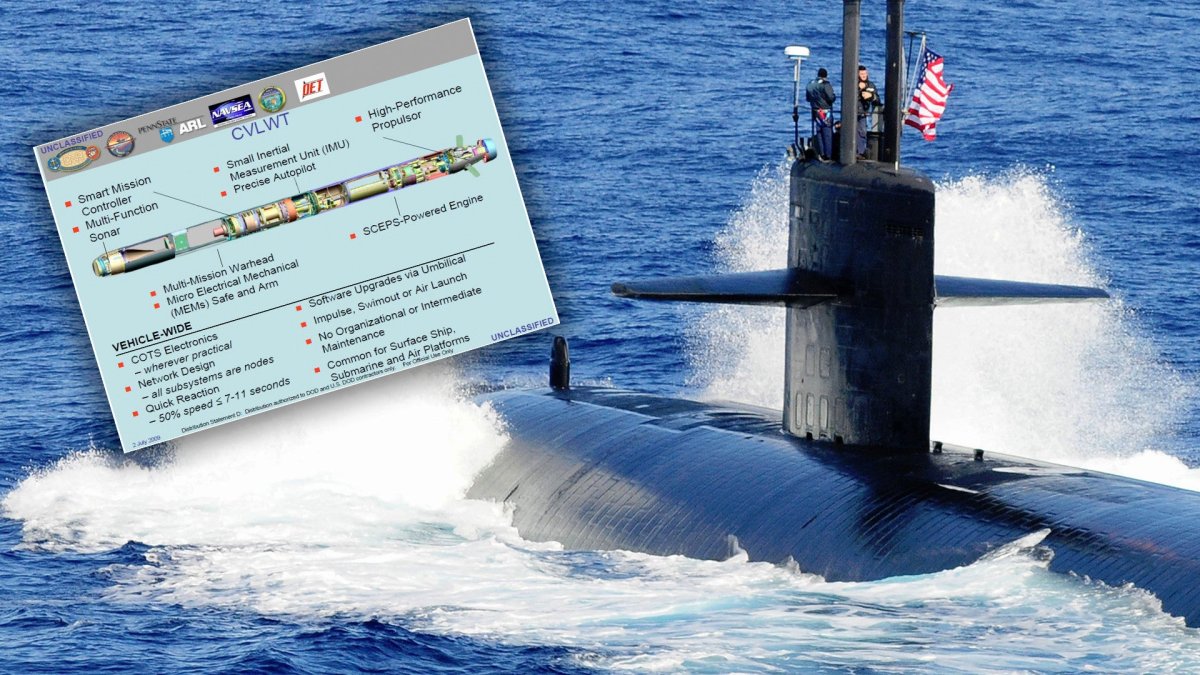
For more than a decade now, the Navy has been working on what it has referred to in the past as the Common Very Lightweight Torpedo (CVLWT). The core of the CVLWT is a “chassis” that can accommodate warheads, guidance packages, and other systems optimized for certain roles.
An overview of the Common Very Lightweight Torpedo chassis and various typical internal components., USN
The mini-torpedo has a Stored Chemical Energy Power Systems (SCEPS) power system for its propulsor in the rear. SCEPS works by bathing a solid block of lithium in sulfur hexafluoride gas, creating an extremely energetic chemical reaction that, in turn, produces steam to drive a turbine engine. In use in torpedoes for years already, this helps make the smaller CVLWT accelerate very fast, reaching fifty percent of its unspecified top speed in less than 12 seconds on average.
At six and three-quarters inches in diameter and approximately 85 inches long, the CVLWT is significantly smaller than the latest variants of the Navy’s Mk 48 heavyweight torpedo , which is the standard weapon of this type for its submarines now. The Mk 48s are around 21 inches in diameter and 228 inches long. The mini torpedo’s typical weight, around 220 pounds, is also more than 16 times lighter than its heavyweight counterpart. So we are truly talking about a tiny torpedo here.
US Navy personnel move a Mk 48 torpedo., USN
The Navy has already developed multiple variants of the CVLWT, the best known of which is the Countermeasure Anti-Torpedo (CAT), also called the Anti-Torpedo Torpedo (ATT). This is a defensive “hard-kill” interceptor that is supposed to destroy incoming torpedoes by either slamming into them or destroying them with its explosive warhead.
The interceptor also features a sonar seeker capable of operating in active and passive modes, together with a guidance package that also includes an Inertial Measuring Unit (IMU). The IMU provides data that allows the torpedo to make more precise movements, making it more maneuverable and improving its accuracy.
A diagram showing the general arrangement of the Countermeasure Anti-Torpedo (CAT) variant of the CVLWT., USN
The Compact Rapid Attack Weapon (CRAW) has much of the same hardware, the bulk of which consists of Commercial Off-The-Shelf components to help keep production costs and maintenance requirements low, according to public Navy briefings and other documentation , but is optimized as an offensive weapon against other submarines. Both variants could offer important capabilities for various American submarines.
At present, American submarines use a combination of electronic warfare jammers and acoustic decoys to defeat incoming torpedoes. This works well against threats that use active and passive sonar to home in on their targets.
More advanced torpedoes, however, which feature sensors to detect differences in water density to zero in on the wake a ship or submarine churns up as it moves, are immune to acoustic decoys and are jamming resistant. These wake-homing torpedoes have been a major impetus for the Navy to develop a hard-kill anti-torpedo interceptor in general, especially for high-value ships, such as aircraft carriers. In recent years, concerns about existing and future torpedo threats have similarly led to a push to add a torpedo interceptor capability to submarines, according to The War Zone’s trusted sources.
But the anti-torpedo torpedo concept remains very much in development. In September 2018, the Navy formally halted work on the Anti-Torpedo Torpedo Defense System (ATTDS) for surface ships. The service had already installed examples of this system on five Nimitz -class aircraft carriers and is now removing all of them.
A Nimitz-class aircraft carrier fires a CAT interceptor during a test., USN
So far, the biggest problem for the ATTDS has been creating a kill-chain short enough for the interceptor to be effective. The system needs to spot and classify the threat and then cue the anti-torpedo torpedo in a very short amount of time. The small size of the interceptor means that even if it employs its explosive warhead, rather than functioning in a hit-to-kill mode, it still has to get relatively close to the target to be effective.
In addition, at least some existing wake-homing torpedoes already employ tactics that could throw off interceptors. The latest variants of the Russian Type 53 series zig-zag toward their target in their terminal phase, making them harder to track or target.
A Soviet-era Type 53-65K torpedo, one of the first variants of this design to feature a wake-homing capability., BrokenSphere via Wikimedia
This doesn’t mean that the Navy couldn’t still add an anti-torpedo interceptor capability to its submarines in the future. As noted, the service says it is still considering doing just that and there is clearly a requirement for this kind of defensive system.
But this is also where the CRAW comes in. As an offensive weapon, the mini-torpedo could give submarines added magazine depth and additional flexibility, especially to engage smaller targets, such as unmanned surface or underwater vehicles.
A briefing slide showing a Compact Rapid Attack Weapon using the same “chassis” as the anti-torpedo torpedo (ATT)., USN
Based on the physical dimensions of the CVLWT chassis, submarines could potentially carry at least four of these weapons in the same space allocated to a single Mk 48. The boat’s crew also wouldn’t have to expend one of those heavyweight weapons in order to attack a smaller target.
The smaller CRAW would still likely need something to stabilize it inside a U.S. submarine’s standard 21- or 26-inch torpedo tubes. It might be possible to develop a system that personnel could readily install and remove, as necessary, or to permanently modify a portion of the tubes specifically for the mini-torpedoes.
Another possibility might be a discarding frame that keeps the torpedo aligned in the tube and breaks off after launch, similar to high-velocity armor-piercing tank shells that use a sabot to stabilize a sub-caliber kinetic penetrator in the barrel. But this added bulk might limit the overall space-saving qualities of the mini-torpedo.
A view of the torpedo room on the Los Angeles -class attack submarine USS Olympia , showing how cramped it is even with the Mk 48 torpedoes stowed in place., USN
The Navy could pack larger vertical launch tubes full of the mini-torpedoes, too. The up-coming Block V Virginia -class attack submarines will have each have a Virginia Payload Module (VPM) with four launch tubes that are 87-inches in diameter and deep enough to accommodate a 246-inch long Tomahawk cruise missile with a booster rocket motor.
The standard loadout the Navy envisions is six Tomahawks in each of the VPM’s four tubes. Substituting even one of these for a cluster of CRAWs could significantly increase the boat’s magazine depth for anti-submarine or anti-surface operations. This could be particularly valuable for engaging swarms of enemy unmanned surface vessels or underwater drones in the future.
A single submarine could also launch a flurry of the mini-torpedoes at a single surface or sub-surface target, which would help overwhelm its defenses. The attacker could layer the attack with smaller weapons and a standard heavyweight torpedo, as well.
A schematic of the Virginia Payload Module for the future Block V Virginia -class submarines., USN
In addition, the Navy has noted that the CVLWT chassis may be compact enough to fit inside the launchers that submarines use presently to fire countermeasure decoys. Depending on the commonality between the anti-torpedo interceptor and offensive variants, this could enable subs to carry additional multi-purpose mini-torpedoes without having to trade out more standard torpedoes or missiles.
The size of the CVLWT opens up the possibility of more novel employment, as well. From the very beginning, the Navy has been interested in arming unmanned helicopters and underwater drones with these mini-torpedoes. During the service’s Annual Naval Technology Exercise (ANTX) in 2016, Northrop Grumman demonstrated how an unmanned helicopter might employ a CRAW autonomously against a hostile submarine using targeting data from multiple offboard sources.
A helicopter acting as a surrogate for an unmanned aircraft drops a CRAW during ANTX 2016., Northrop Grumman
More recently, in February 2019, the Navy hired Boeing to build four extra-large Orca drone submarines, a stepping stone that could lead to improved designs capable of carrying out anti-submarine or anti-surface warfare missions using weapons such as the CRAW. You can read more about those efforts in detail here .
A briefing slide showing Navy plans for various size categories of unmanned underwater vehicles. The long-term plans for the large and extra-large categories both include anti-submarine and anti-surface warfare capabilities., USN
There’s the possibility that the Navy could use the CRAW as the basis for an underwater mine, too. The service already employs Mk 67 Submarine Launched Mobile Mine (SLMM), which contains a Mk 48 torpedo and anchors itself to the seabed after getting shot out of a torpedo tube. It then uses a passive sonar system to detect passing ships or submarines and then fires its homing torpedo at them.
A rendering of a notional naval mine similar to the Mk 67 Submarine Launched Mobile Mine, but employing mini-torpedoes instead of a full-size Mk 48. The gray system to the right is a separate concept for a torpedo-tube-launched “hunter” that would deploy unattended acoustic or other sensors on the seabed., USN
A smaller mine using the CRAW could be harder to detect and make it easier to rapidly lay larger minefields. A variant of the existing SLMM could potentially carry multiple mini-torpedoes and engage multiple targets, as well.
Since the CVLWT chassis offers significant scalability for a wide array of launch platforms, the Navy would have the option of combining some of these systems together in the future, as well. The service is already looking at developing new Large Payload Submarines that could serve as motherships for large underwater drones. Such a submarine could potentially deploy its own swarm of unmanned underwater vehicles armed with these mini-torpedoes.
With that common frame, the Navy might find it easier to integrate additional variants of the mini-torpedo down the road. Though the service appears to be focusing more on the CRAW version now, it could leverage that work to add an anti-torpedo interceptor capability in tandem to it as the technology necessary for that defensive system matures.
Sailors load a Mk 48 torpedo onto the Los Angeles -class attack submarine USS Topeka ., USN
Integrating payloads based on the CVLWT with the AN/BYG-1 could also help attract interest from American allies, which could help defray the costs of continued research and development of various mini-torpedos and related systems. As noted, the Australians are already set to use this control system on their Attack -class submarines, which could also just improve their ability to work together and potentially share data with American submarines and other U.S. assets during combined operations in the future. In addition, the added magazine depth that the mini-torpedoes afford could be especially pronounced for smaller submarines that many American partners operate.
The Navy says it has yet to make a final, formal decision on adding mini-torpedoes to its submarines, or any other potential launch platforms, but it is still certainly working that direction. This is also only what the Navy will say publicly and the service could be further along on this project, or in the development of related capabilities, in the classified realm . We know the upgrade work on the AN/BYG-1 control system that is going on right now and that it wants to continue with that work into next year.
The inherently multi-purpose nature of the mini-torpedoes could transform the Navy’s undersea warfare operating concepts and being able to rapidly intercept a torpedo with another torpedo would be a game changer for American submarines. This revolutionary capability could very well be on its way to becoming a reality in the next few years.
Contact the author: joe@thedrive.com
Comments couldn’t be loaded. Please refresh the page.
作者:约瑟夫·特雷维西克
更新于美国东部时间2020年5月21日上午9:35
美国海军在其最新预算提案中透露,有意赋予潜艇发射小型鱼雷的能力。这些武器不仅能增强进攻火力,还能提供一种全新的反鱼雷拦截能力。这些小型鱼雷采用通用型弹体,未来的改进型或许还能装备无人舰艇或潜艇、无人机,甚至用作水雷等等。
美国海军于2019年2月提交的2020财年预算申请中,要求拨款超过6000万美元,用于支持AN/BYG-1潜艇有效载荷控制系统的持续研发。海军现役几乎所有潜艇都使用这种软件驱动的作战控制架构的衍生版本,根据具体设计,通过鱼雷发射管、垂直发射系统或对抗措施发射器等组合方式发射武器和其他有效载荷。海军未来的哥伦比亚级弹道导弹潜艇以及Block IV和Block V型潜艇也将采用该系统。
弗吉尼亚级攻击艇以及澳大利亚未来的攻击级攻击艇也将使用该系统的版本。
2020财年的资金将用于继续推进高级处理系统19版(APB19)软件升级和更新工作,以增加其他功能,即技术插入20版(TI-20)。海军方面还表示,APB19的开发将有助于尽早集成新型有效载荷,例如改进型反舰版战斧陆攻巡航导弹以及用于迷惑和干扰来袭鱼雷的改进型诱饵。
根据美国海军一份2018年8月的合同文件,已知AN/BYG-1潜艇的现有型号和未来改进型号如下。“688i”指的是改进型的洛杉矶级攻击型潜艇。澳大利亚皇家海军于2018年12月宣布,其未来的攻击型潜艇将被命名为“攻击级”。
但预算案中也特别提到了“反鱼雷鱼雷紧凑型快速攻击武器计划(ATT CRAW)”,作为可能集成到AN/BYG-1控制系统中的新型有效载荷。当被问及此事时,海军方面并未正式确认是否已制定计划在其潜艇上增加反鱼雷鱼雷或紧凑型快速攻击武器能力。
海军海上系统司令部发言人威廉·库奇通过电子邮件告诉《战区》:“目前这项工作尚处于决策前阶段。我们正在研究各种方案,以过渡此前在反鱼雷鱼雷防御系统(ATTDS)项目下开展的工作以及其他支持紧凑型快速攻击武器的研发、测试和评估(RDT&E)工作。”
十多年来,美国海军一直在研发一种名为通用超轻型鱼雷(CVLWT)的鱼雷。CVLWT的核心是一个“底盘”,它可以容纳弹头、制导组件和其他针对特定用途优化的系统。
通用超轻型鱼雷底盘及各种典型内部组件概述,美国海军
这种小型鱼雷尾部推进器采用储能化学动力系统(SCEPS)。SCEPS的工作原理是将一块固态锂浸入六氟化硫气体中,产生极高能量的化学反应,进而产生蒸汽驱动涡轮发动机。这项技术已在鱼雷上应用多年,它能使小型CVLWT鱼雷快速加速,平均不到12秒即可达到其未公开最高速度的50%。
CVLWT鱼雷直径6又3/4英寸,长度约85英寸,比海军最新型的Mk 48重型鱼雷小得多,而Mk 48重型鱼雷是目前海军潜艇的标准武器。Mk 48鱼雷直径约21英寸,长度约228英寸。这种迷你鱼雷的典型重量约为220磅,也比其重型同类鱼雷轻16倍以上。所以,我们这里讨论的确实是一种非常小的鱼雷。
美国海军人员正在搬运一枚Mk 48鱼雷。
海军已经研发出多种CVLWT的衍生型号,其中最著名的是反鱼雷拦截器(CAT),也称反鱼雷鱼雷(ATT)。这是一种防御性的“硬杀伤”拦截器,旨在通过撞击或用其爆炸性弹头摧毁来袭鱼雷。
该拦截器还配备了可在主动和被动模式下工作的声呐导引头,以及包含惯性测量单元(IMU)的制导组件。IMU提供的数据使鱼雷能够进行更精确的运动,从而提高其机动性和精度。
图示为CVLWT反鱼雷对抗(CAT)型舰艇的总体布局。(美国海军)
根据海军公开简报和其他文件,紧凑型快速攻击武器(CRAW)拥有许多相同的硬件,其中大部分采用商用现成组件,以降低生产成本和维护需求,但它被优化为一种针对其他潜艇的进攻性武器。两种型号都能为各种美国潜艇提供重要的作战能力。
目前,美国潜艇采用电子战干扰器和声学诱饵相结合的方式来拦截来袭鱼雷。这种方法对那些使用主动和被动声呐来锁定目标的威胁非常有效。
然而,更先进的鱼雷配备了传感器,能够探测水密度差异,从而精准锁定舰艇或潜艇航行时激起的尾流,这种鱼雷不受声学诱饵的影响,并且具有抗干扰能力。这些尾流自导鱼雷极大地推动了海军研发硬杀伤反鱼雷拦截器,特别是针对航空母舰等高价值舰艇的拦截能力。据《战区》可靠消息来源称,近年来,对现有和未来鱼雷威胁的担忧也促使海军加快了为潜艇配备鱼雷拦截能力的步伐。
但反鱼雷鱼雷的概念仍处于研发阶段。2018年9月,海军正式停止了水面舰艇反鱼雷鱼雷防御系统(ATTDS)的研发工作。此前,海军已在五艘尼米兹级航空母舰上安装了该系统,目前正在全部拆除。
美国海军一艘尼米兹级航空母舰在测试中发射了一枚CAT拦截弹。
迄今为止,反鱼雷鱼雷防御系统(ATTDS)面临的最大挑战是如何构建足够短的杀伤链,以确保拦截器有效发挥作用。该系统需要在极短的时间内发现并识别威胁,然后引导反鱼雷鱼雷进行攻击。由于拦截器体积小,即使它使用爆炸性弹头而非直接命中摧毁,也仍然需要相对接近目标才能有效杀伤目标。
此外,至少一些现有的尾流自导鱼雷已经采用了能够迷惑拦截机的战术。俄罗斯53型鱼雷的最新改进型在末段飞行时会以之字形轨迹接近目标,这使得它们更难被追踪或锁定。
苏联时期53-65K型鱼雷,是该设计最早具备尾流自导能力的型号之一。(图片来自Wikimedia BrokenSphere)
但这并不意味着海军未来不能为其潜艇加装反鱼雷拦截器。正如前文所述,海军方面表示仍在考虑这样做,而且显然对这种防御系统存在需求。
但CRAW鱼雷也正是在这里发挥作用。作为一种进攻性武器,这种迷你鱼雷可以增加潜艇的弹药库深度和灵活性,尤其是在攻击小型目标方面,例如无人水面或水下航行器。
一份简报幻灯片展示了一种紧凑型快速攻击武器,该武器使用与反鱼雷鱼雷(ATT)相同的“底盘”。(美国海军)
根据 CVLWT 底盘的物理尺寸,潜艇理论上可以在与一门 Mk 48 相同的空间内携带至少四门这种武器。而且,艇员也不必为了攻击较小的目标而消耗掉一门重型武器。
较小的CRAW鱼雷在美军潜艇标准的21英寸或26英寸鱼雷发射管内可能仍然需要某种稳定装置。或许可以开发一种便于人员根据需要快速安装和拆卸的系统,或者对部分发射管进行永久性改造,专门用于这种小型鱼雷。
另一种可能性是采用一种可抛弃的框架,该框架能够保持鱼雷在发射管内的对准,并在发射后脱落,类似于高速穿甲弹使用弹托来稳定炮管内的小口径动能穿甲弹。但这种增加的体积可能会限制微型鱼雷的整体空间利用率。
这是洛杉矶级攻击型核潜艇“奥林匹亚”号的鱼雷舱照片,照片显示即使存放了Mk 48鱼雷,舱内空间仍然十分狭窄。(美国海军)
海军也可以在更大的垂直发射管中装满这种小型鱼雷。即将服役的第五批次弗吉尼亚级攻击型核潜艇将配备一个弗吉尼亚有效载荷模块(VPM),该模块包含四个直径为87英寸、深度足以容纳一枚246英寸长、带有助推火箭发动机的战斧巡航导弹的发射管。
海军设想的标准配置是在VPM潜艇的四个导弹发射管中各装六枚战斧导弹。即使只用其中一枚战斧导弹替换一组CRAW反潜导弹,也能显著提升该艇的弹药储备,从而增强其反潜或反水面作战能力。这对于未来对抗敌方大量无人水面舰艇或水下无人机尤为重要。
单艘潜艇还可以向单个水面或水下目标发射大量小型鱼雷,从而突破其防御。攻击者还可以叠加小型武器和标准重型鱼雷进行攻击。
这是未来第五批次弗吉尼亚级潜艇的弗吉尼亚有效载荷模块示意图。(美国海军)
此外,海军方面指出,CVLWT的底盘可能足够紧凑,可以安装在潜艇目前用于发射反制诱饵弹的发射器内。如果反鱼雷拦截器和进攻型鱼雷拦截器通用性较高,这将使潜艇能够在不更换现有标准鱼雷或导弹的情况下,携带更多多用途小型鱼雷。
CVLWT的庞大尺寸也为更多新颖的用途开辟了可能性。从一开始,海军就对为无人直升机和水下无人装置配备这些微型鱼雷表现出浓厚的兴趣。在2016年海军年度技术演习(ANTX)期间,诺斯罗普·格鲁曼公司演示了如何利用来自多个外部来源的目标数据,使无人直升机能够自主地使用CRAW鱼雷攻击敌方潜艇。
在2016年ANTX演习中,一架直升机作为无人机的替代品投放了一枚CRAW导弹。(诺斯罗普·格鲁曼公司)
最近,在2019年2月,美国海军聘请波音公司建造四艘超大型“虎鲸”无人潜艇,这标志着海军在改进设计方面迈出了重要一步,未来这些潜艇将能够使用诸如CRAW导弹之类的武器执行反潜或反水面作战任务。您可以在这里阅读更多关于这些工作的详细信息。
一份简报幻灯片展示了美国海军针对不同尺寸无人水下航行器的计划。大型和超大型无人水下航行器的长期计划均包含反潜和反水面作战能力。
海军也有可能以CRAW为基础研发水下水雷。海军目前已装备Mk 67型潜射移动水雷(SLMM),该水雷内置Mk 48型鱼雷,从鱼雷发射管发射后可锚定于海底。随后,它利用被动声呐系统探测过往舰艇或潜艇,并向其发射自导鱼雷。
这是一张概念性水雷的渲染图,类似于Mk 67型潜射移动水雷,但采用的是小型鱼雷而非全尺寸的Mk 48型鱼雷。右侧的灰色系统是另一种鱼雷发射管发射的“猎手”概念,它将在海底部署无人值守的声学或其他传感器。(美国海军)
使用CRAW系统的小型水雷更难探测,也更容易快速布设更大的雷区。现有SLMM的改进型也可能携带多枚微型鱼雷,并攻击多个目标。
由于CVLWT底盘具有极佳的可扩展性,能够适配多种发射平台,海军未来也可以选择将其中一些系统组合起来。海军目前正在研发新型大有效载荷潜艇,这些潜艇可以作为大型水下无人艇的母舰。这种潜艇或许能够部署一支装备有微型鱼雷的无人水下航行器群。
有了这种通用框架,海军未来或许更容易整合其他型号的迷你鱼雷。虽然海军目前似乎更专注于CRAW型鱼雷,但随着反鱼雷拦截系统所需技术的成熟,海军可以利用这项工作,同时为其增加反鱼雷拦截能力。
水兵们正在将一枚Mk 48鱼雷装载到洛杉矶级攻击型核潜艇“托皮卡”号上。(美国海军)
将基于CVLWT的有效载荷与AN/BYG-1集成,也有助于吸引美国盟友的兴趣,从而帮助澳大利亚分摊各种小型鱼雷及相关系统持续研发的成本。如前所述,澳大利亚已计划在其“攻击”级潜艇上使用这套控制系统,这不仅能提升其协同作战能力,还能在未来的联合行动中与美国潜艇及其他美国装备共享数据。此外,小型鱼雷带来的额外弹药库深度优势,对于许多美国盟友使用的小型潜艇而言尤为显著。
海军表示,尚未就潜艇或其他潜在发射平台加装小型鱼雷做出最终正式决定,但无疑仍在朝着这个方向努力。此外,这只是海军目前公开的说法,在保密领域,海军可能在该项目或相关能力的研发方面取得了更大进展。我们知道,目前正在对AN/BYG-1控制系统进行升级,并且海军计划将这项工作延续到明年。
小型鱼雷固有的多用途特性可能会彻底改变海军的水下作战理念,而能够用另一枚鱼雷快速拦截一枚鱼雷将对美国潜艇而言具有颠覆性的意义。这项革命性的能力很可能在未来几年内成为现实。
联系作者:joe@thedrive.com
评论加载失败,请刷新页面。