Pentagon chief sounds ‘alarm’ over China’s buildup, urges allies to boost defense spending五角大楼负责人对中国的军事扩张发出“警报”,敦促盟友增加国防开支。
Hegseth urged Asian allies to ramp up military spending to counter China’s growing power.
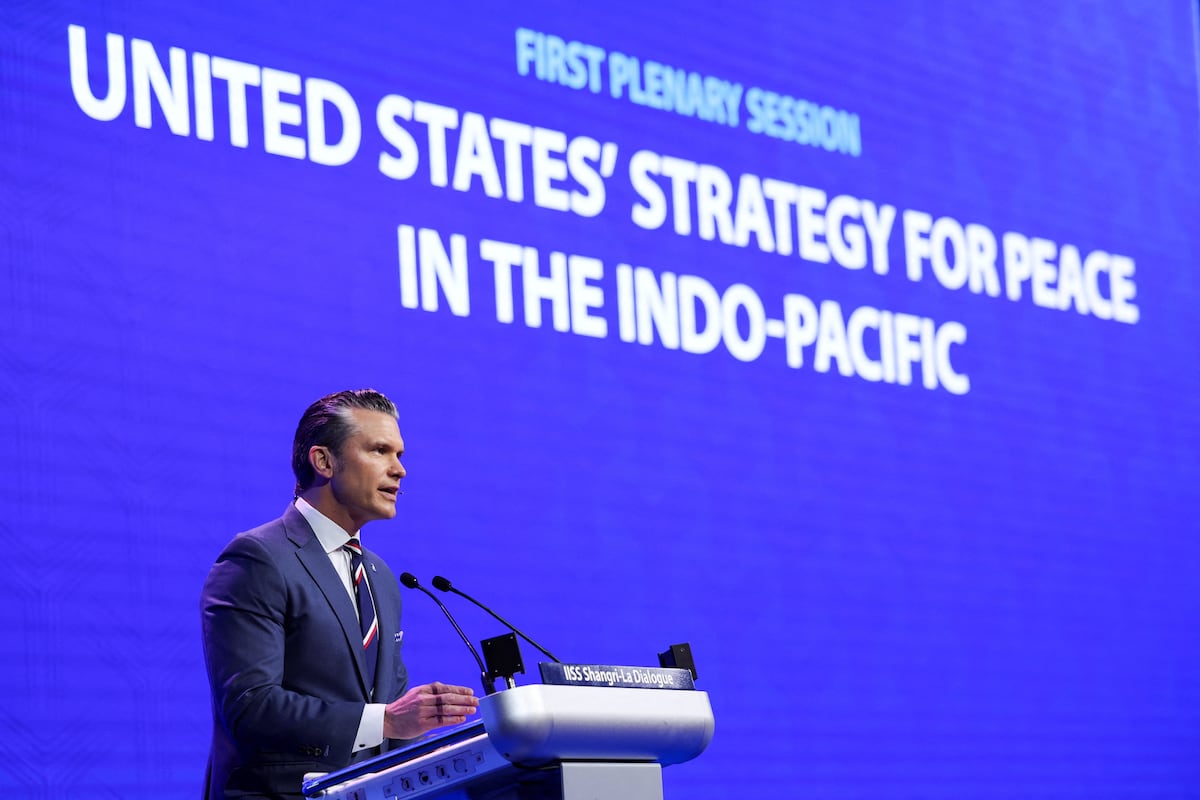
SINGAPORE — U.S. Defense Secretary Pete Hegseth urged Asian allies on Saturday to ramp up military spending to counter China’s growing power and prevent its dominance in the region, warning of “rightful alarm” over its rapid military buildup.
Hegseth, speaking at the Shangri-La Dialogue in Singapore, Asia’s premier forum for defense leaders, militaries and diplomats, said a stronger, more self-reliant network of allies is essential to deter aggression and preserve the balance of power.
“There is rightful alarm regarding China’s historic military buildup and the expansion of its military activities in the region and beyond,” he said.
“A Pacific dominated by any hegemon would unravel the regional balance of power,” Hegseth said. “No state, including China, can impose its hegemony and hold the security or prosperity of our nation and our allies in question.”
The U.S. expects its Asian allies and partners to increase defense spending to 3.5% of GDP as it pledged a $1.5 trillion investment in its military, the Pentagon chief said.
“Less Shangri-La, more ships, more subs,” Hegseth said, stressing that the region needed greater defense capability than conferences. Allies want stability, not escalation, he said.
“What they want, and what the United States delivers, is strength that is disciplined, resolve that is steady, and leadership that is confident enough to speak and walk softly while carrying a big stick.”
Hegseth also struck a measured tone on U.S.-China ties, saying relations are “better than they have been in many years,” with more frequent military-to-military engagement helping to manage tensions.
“We are meeting more frequently with our Chinese counterparts by maintaining open lines of military-to-military communication.”
Zhou Bo, a senior fellow at Tsinghua University and retired People’s Liberation Army senior colonel who was part of the Chinese delegation, described U.S.-China relations as “complicated.”
Nonetheless, he said Hegseth struck “a much better tone” this year than last, attributing the shift to Trump’s visit to China.
“Both sides have open channels of communication, the situation is not as exaggerated as the outside world makes it out to be,” Zhou said.
China, whose defense minister is skipping the dialogue for a second consecutive year, accused Hegseth last year of making “vilifying” remarks.
Hegseth echoed President Donald Trump’s long-standing demand that allies shoulder more of their own defense costs. Trump has pointedly said European and NATO partners should reduce reliance on Washington.
“The era of the United States subsidizing the defense of wealthy nations is over,” Hegseth said. “We need partners, not protectorates,” he added. “We don’t have a strong alliance unless everyone has skin in the game. No freeloading.”
Hegseth praised contributions from allies including South Korea, the Philippines, Australia, Singapore, Malaysia and Thailand, and said Japan was taking concrete steps to bolster its defenses.
Tokyo and Washington “must each pull our weight to strengthen the U.S.-Japan alliance,” he said.
Ready to restart strikes on Iran
On the Middle East conflict, Hegseth said the United States stands ready to resume strikes on Iran if diplomacy fails, as negotiators from Washington and Tehran work to bridge major differences blocking a deal.
Members of the People's Liberation Army stand as the strategic strike group displays DF-61 nuclear missiles during a military parade in Beijing, China, on Sept. 3, 2025. (Tingshu Wang/Reuters)
“Our ability to recommence if necessary ... we are more than capable,” Hegseth said. He added that Trump remains “patient” and is seeking a “strong deal” to ensure Iran does not obtain a nuclear weapon.
Trump said on Friday he would convene advisers in a secure White House setting to make a “final determination” on a proposal to end the Iran war.
Hegseth also pushed back on concerns the conflict would distract from Asia-Pacific priorities.
“We can do two things at one time.”
Arms sales decision to Taiwan is Trump’s call
In his speech, Hegseth made no mention of Taiwan, a hotspot in relations between the U.S. and China.
When asked about arms sales to the island during questions that followed, Hegseth downplayed concerns that a multi-billion-dollar package could be affected as the United States draws down its weapons stockpiles amid the Middle East conflict. “We feel very good about our stockpiles and how we use them,” he said.
Taiwan, which China views as its own territory, has been waiting for the U.S. to approve an arms sale that Reuters reported could be worth up to $14 billion.
Trump sowed uncertainty in Taipei by saying, after meeting China’s President Xi Jinping this month, that he was undecided on whether to approve the package.
Any decision on future arms sales would rest with President Trump, Hegseth said, signalling no shift in Washington’s longstanding approach despite recent engagement with Beijing.
“Those decisions will depend on the president and the nature of that relationship,” Hegseth said. “There’s been no change in our status.”
新加坡——美国国防部长皮特·赫格塞斯周六敦促亚洲盟友增加军费开支,以对抗中国日益增长的实力,并阻止其在该地区的主导地位,同时警告称,中国迅速扩充军备是“理所当然的警示”。
赫格塞斯在新加坡举行的香格里拉对话会上发表讲话,该对话会是亚洲国防领导人、军方和外交官的首要论坛。他表示,一个更强大、更自力更生的盟友网络对于遏制侵略和维护力量平衡至关重要。
他说:“人们对中国史无前例的军事建设及其在地区内外不断扩大的军事活动感到担忧,这是理所当然的。”
“任何一个霸权国家主导的太平洋都会破坏区域力量平衡,”赫格塞斯说。“任何国家,包括中国,都不能强加其霸权,并以此威胁我们国家及其盟友的安全或繁荣。”
美国国防部长表示,美国希望其亚洲盟友和伙伴将国防开支提高到GDP的3.5%,同时美国承诺向其军事部门投资1.5万亿美元。
赫格塞斯说:“少搞些香格里拉式的和平,多部署舰艇和潜艇。”他强调,该地区需要的不是会议,而是更强大的防御能力。他还说,盟友们想要的是稳定,而不是局势升级。
“他们想要的,也是美国所能提供的,是纪律严明的实力、坚定的决心,以及既能言善辩又能手握重拳的自信领导力。”
赫格塞斯对美中关系也表达了谨慎的态度,称两国关系“比多年来都要好”,更频繁的军事交流有助于缓解紧张局势。
“我们通过保持畅通的军事沟通渠道,与中国同行举行了更频繁的会晤。”
清华大学高级研究员、退役中国人民解放军上校周波是中国代表团成员之一,他形容中美关系“复杂”。
不过,他表示,赫格塞斯今年的语气比去年“好得多”,并将这种转变归功于特朗普访华。
周先生表示:“双方保持着畅通的沟通渠道,局势并没有外界渲染得那么夸张。”
中国国防部长连续第二年缺席对话,去年中国指责赫格塞斯发表了“诋毁性”言论。
赫格塞斯呼应了唐纳德·特朗普总统长期以来的要求,即盟友应承担更多自身国防开支。特朗普曾明确表示,欧洲和北约伙伴国应该减少对华盛顿的依赖。
“美国补贴富裕国家国防的时代已经结束了,”赫格塞斯说。“我们需要的是伙伴,而不是保护国,”他补充道。“除非每个人都承担风险,否则我们无法建立强大的联盟。我们不能坐享其成。”
赫格塞斯赞扬了包括韩国、菲律宾、澳大利亚、新加坡、马来西亚和泰国在内的盟友所作出的贡献,并表示日本正在采取具体措施加强其防御。
他说,东京和华盛顿“都必须各自尽一份力,加强美日同盟”。
准备重启对伊朗的打击
关于中东冲突,赫格塞斯表示,如果外交努力失败,美国随时准备恢复对伊朗的打击。与此同时,华盛顿和德黑兰的谈判代表正在努力弥合阻碍达成协议的重大分歧。
2025年9月3日,在中国北京举行的阅兵式上,中国人民解放军战略打击群展示东风-61核导弹,解放军官兵列队观看。(王婷舒/路透社)
“如有必要,我们完全有能力重启谈判,”赫格塞斯说。他还补充道,特朗普仍然“耐心等待”,并正在寻求达成一项“强有力的协议”,以确保伊朗不会获得核武器。
特朗普周五表示,他将在白宫安全场所召集顾问,就结束伊朗战争的提议做出“最终决定”。
赫格塞斯还反驳了有关这场冲突会分散亚太地区优先事项的担忧。
“我们可以同时做两件事。”
是否向台湾出售武器由特朗普决定
在演讲中,赫格塞斯只字未提台湾问题,而台湾是美中关系中的一个热点问题。
在随后的问答环节中,当被问及对岛军售问题时,赫格塞斯淡化了人们对数十亿美元军售计划可能受到影响的担忧,他认为,由于美国在中东冲突中削减武器库存,该计划可能受到影响。“我们对我们的库存以及我们使用它们的方式感到非常满意,”他说。
中国视台湾为其领土的一部分,一直在等待美国批准一项军售,路透社报道称该军售价值可能高达 140 亿美元。
特朗普本月与中国国家主席习近平会晤后表示,他尚未决定是否批准该方案,这在台北引发了不确定性。
赫格塞斯表示,未来军售的任何决定都将由特朗普总统做出,这表明尽管华盛顿最近与北京进行了接触,但其长期以来的政策方针并没有改变。
“这些决定将取决于总统以及双方关系的性质,”赫格塞斯说。“我们的地位没有改变。”