Survey finds most Malaysian manufacturers favour GST, saying SST’s cascading taxes raise costs and erode competitiveness调查发现,大多数马来西亚制造商支持消费税(GST),他们认为销售与服务税(SST)的累进税会增加成本并削弱竞争力。
KUALA LUMPUR, Sept 3 — A new survey by the Federation of Malaysian Manufacturers (FMM) has revealed that a significant majority of local manufacturers are calling for a return to...
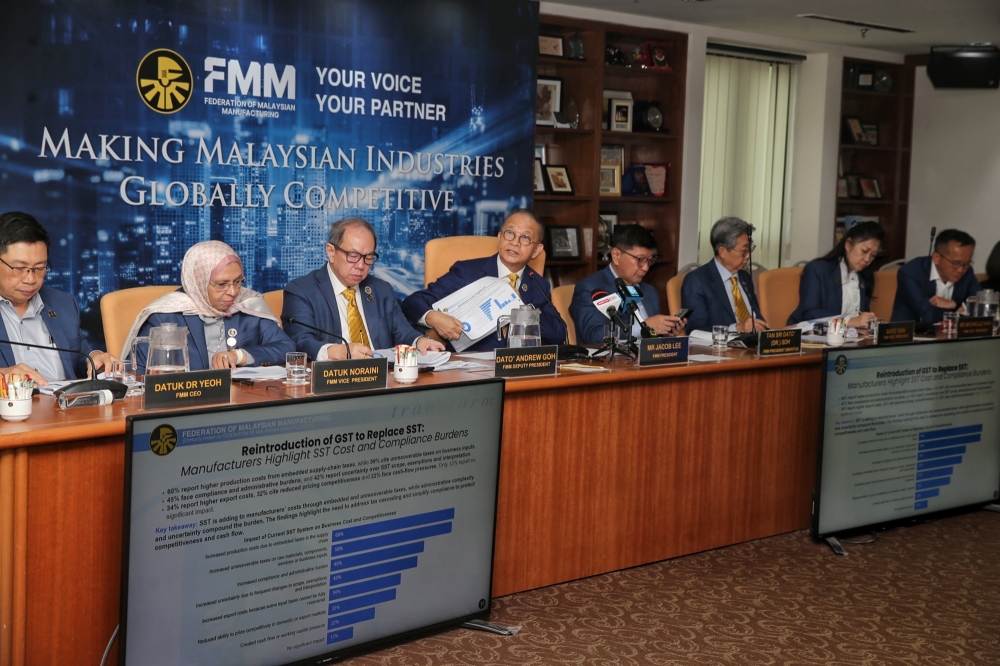
A survey by the Federation of Malaysian Manufacturers shows 61% of local manufacturers support returning to GST due to dissatisfaction with the SST system.
Manufacturers cite embedded taxes and higher production costs under SST as reasons for preferring GST, which offers input tax credit benefits.
Respondents prefer a GST rate of five per cent or below, with the majority highlighting GST's transparency and administrative advantages over SST.
KUALA LUMPUR, Sept 3 — A new survey by the Federation of Malaysian Manufacturers (FMM) has revealed that a significant majority of local manufacturers are calling for a return to the Goods and Services Tax (GST) system, citing deep-seated concerns over the current Sales and Service Tax (SST) framework.
The findings, released today at Wisma FMM, showed that 61 per cent of respondents back the reintroduction of the GST to replace the existing SST.
The shift in sentiment is driven largely by frustrations over “tax cascading” — a phenomenon where unrecoverable taxes on raw materials and business inputs become embedded in final production costs, ultimately hurting competitiveness.
According to the FMM survey, 60 per cent of manufacturers pointed to higher production costs caused by embedded taxes in the supply chain, while 59 per cent highlighted the issue of unrecoverable taxes on business inputs.
“These findings point to concerns not only over the tax burden but also over the predictability and administrative complexity of the existing system,” said FMM president Jacob Lee.
Compliance and administrative burdens were flagged by 45 per cent of respondents, while 42 per cent reported greater uncertainty due to frequent changes in tax scope, exemptions and interpretation.
According to the findings, the preference for GST appears to be rooted in its design rather than just the tax rate itself.
Some 65 per cent of manufacturers highlighted the GST’s input tax credit mechanism as a major advantage, noting that the current SST structure leaves many businesses with unrecoverable input costs.
Additionally, 52 per cent argued that the GST offers greater transparency than the current system.
On the GST rate, 68 per cent of respondents favoured a rate of five per cent or below, with 41 per cent selecting three per cent as their preferred rate.
Only a small fraction (two per cent) indicated they would be comfortable with a rate exceeding six per cent, while 20 per cent remained unsure.
Lee noted that implementing a systematic input tax credit mechanism would be far more effective than relying on the current fragmented approach of category-specific exemptions and reliefs.
Recommended reading:
Malaysian manufacturers’ Budget 2027 wish list: Lower SME taxes, billions for tech and R&D
Malaysian manufacturers still hit by West Asia war as firms shift raw‑material sourcing to Singapore, China, survey finds
US not ‘stealing Venezuelan oil,’ energy secretary insists amid multi‑billion‑dollar pact with Caracas
Malaysia must act now as 10pc US tariff not guaranteed ceiling, says industry expert
Ipoh police probe viral video of two children sitting on roof of moving MPV
Search continues for two more after second teen confirmed drowned in Kota Tinggi
马来西亚制造商联合会的一项调查显示,61%的本地制造商支持恢复消费税(GST),因为他们对销售与服务税(SST)制度感到不满。
制造商们表示,销售与服务税 (SST) 下存在隐性税收和更高的生产成本,因此他们更倾向于选择商品及服务税 (GST),因为 GST 提供进项税抵免优惠。
受访者更倾向于 5% 或更低的 GST 税率,大多数人强调 GST 比 SST 具有透明度和行政优势。
吉隆坡,9月3日讯——马来西亚制造商联合会(FMM)的一项最新调查显示,绝大多数本地制造商呼吁恢复商品及服务税(GST)制度,理由是对目前的销售及服务税(SST)框架存在根深蒂固的担忧。
今天在马来西亚金融市场大厦(Wisma FMM)发布的调查结果显示,61%的受访者支持重新引入消费税(GST)以取代现有的销售与服务税(SST)。
这种情绪的转变主要是由对“税收级联”的不满所驱动的——这种现象是指原材料和商业投入中无法收回的税收被计入最终生产成本,最终损害了竞争力。
根据FMM的调查,60%的制造商指出供应链中嵌入的税收导致生产成本上升,而59%的制造商强调了企业投入中无法收回的税收问题。
“这些调查结果不仅表明人们对税收负担感到担忧,还表明人们对现有系统的可预测性和行政复杂性感到担忧,”FMM总裁Jacob Lee表示。
45% 的受访者指出合规和行政负担,而 42% 的受访者表示,由于税收范围、豁免和解释的频繁变化,不确定性更大。
研究结果表明,人们对消费税的偏好似乎源于其设计,而不仅仅是税率本身。
约 65% 的制造商强调 GST 的进项税抵免机制是一项主要优势,并指出目前的 SST 结构导致许多企业面临无法收回的投入成本。
此外,52%的人认为商品及服务税(GST)比现行制度更具透明度。
关于消费税税率,68% 的受访者倾向于 5% 或以下的税率,其中 41% 的受访者选择 3% 作为他们偏好的税率。
只有一小部分人(2%)表示他们可以接受超过 6% 的利率,而 20% 的人仍不确定。
李指出,实施系统的进项税抵免机制将比目前分散的、针对特定类别的豁免和减免方式有效得多。
推荐阅读:
马来西亚制造商对2027年财政预算案的愿望清单:降低中小企业税收,数十亿资金用于科技和研发
调查发现,受西亚战争影响,马来西亚制造商仍在遭受冲击,企业正将原材料采购转向新加坡和中国。
美国能源部长坚称,美国并未“窃取委内瑞拉石油”,此前美国与委内瑞拉达成了一项价值数十亿美元的协议。
行业专家表示,马来西亚必须立即采取行动,因为10%的美国关税上限并非有保障。
怡保警方正在调查一段疯传的视频,视频中两名儿童坐在行驶中的MPV车顶上。
在哥打丁宜确认第二名青少年溺水身亡后,搜寻工作仍在继续,另有两名青少年仍在失踪。