Confusing ‘mum’ for ‘horse’: New book helps Chinese language teachers tackle common errors by pupils将“妈妈”误认为“马”:新书帮助汉语教师纠正学生常见错误
Discover common Chinese language errors by English-speaking pupils and strategies for educators to improve teaching and learning effectiveness in Singapore classrooms. Read more at straitstimes.com.
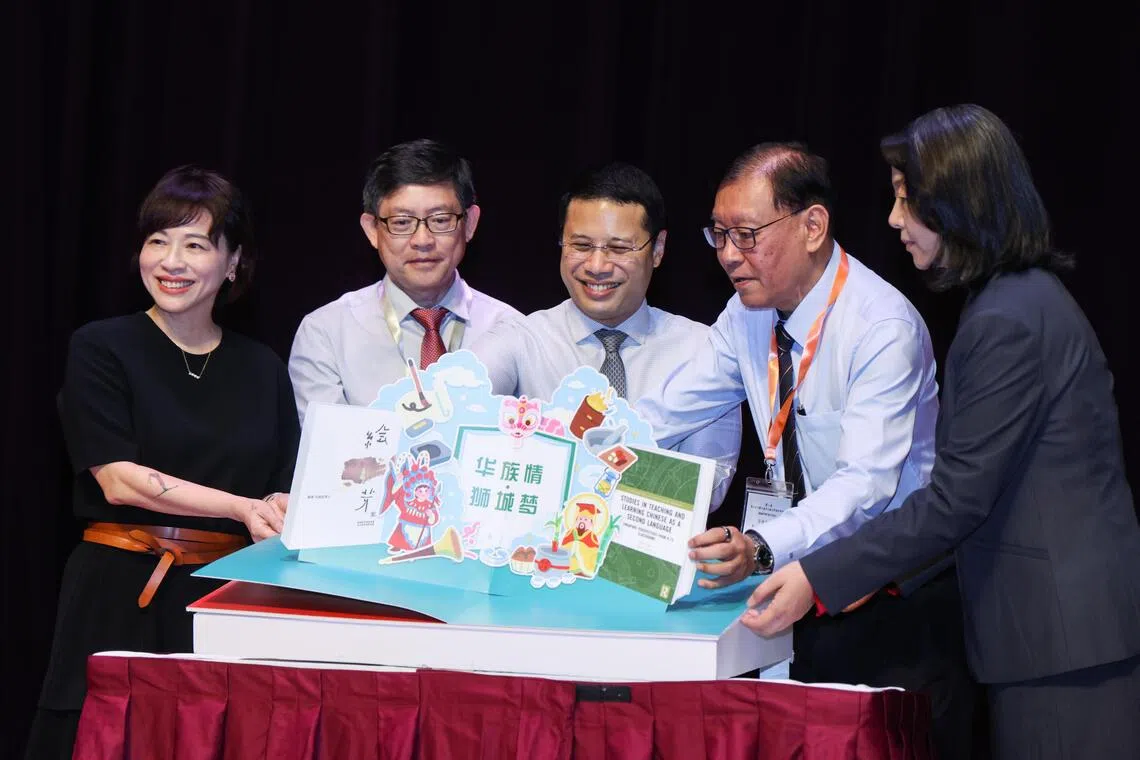
The book was launched on Sept 8 at the Singapore Centre for Chinese Language’s eighth international conference on teaching and learning Chinese.
PHOTO: LIANHE ZAOBAO
Published Sep 08, 2026, 05:50 PM
Updated Sep 08, 2026, 05:50 PM
Research shows English-speaking pupils often confuse visually or semantically similar Chinese characters, affecting their language learning.
A new publication offers teaching strategies to address common errors, helping educators improve Chinese lessons and prevent misconceptions.
The Ministry of Education supports mother tongue learning with new programmes and emphasises bilingualism’s role in identity and global opportunities.
SINGAPORE – Primary school pupils who grow up speaking English as their first language may struggle to differentiate between the Chinese characters for “bitter” and “sour” or between “half” and “sheep”. This is because they are either related in meaning or similar in pronunciation.
These were some of the findings on common mistakes pupils make that Singapore Centre for Chinese Language (SCCL) lecturer Gong Cheng, who assessed 672 Primary 1 pupils from 2023 to 2024, discovered . Her research identified five error types made by the pupils.
Some of the errors stem from visual or semantic similarities, such as mistaking the Chinese character for “it” with “also” or “sweep” for “wipe”.
Pupils may also recognise familiar components within a character but fail to understand it as a whole , such as when confusing “mum” and “horse”. They also process c ommonly paired words as fixed units instead of analysing each character individually, causing them to mistake one character of a common phrase with another.
The last error type involves pupils forming broad categories of meaning without making precise distinctions. This results in “uncle” being confused for “father”.
Her findings were presented in a publication launched on Sept 8 by the SCCL to mark its 18th anniversary. The centre held its eighth international conference on teaching and learning Chinese as a second language .
The conference was attended by more than 600 participants, including scholars, educators and classroom practitioners from Singapore, China, Japan, Vietnam, Taiwan and Hong Kong.
The publication, titled Studies In Teaching And Learning Chinese As A Second Language: Singapore Perspectives From K-12 Classrooms , is a collection of papers on SCCL’s research into Chinese-language teaching and aims to help educators develop teaching strategies.
Chinese language use has generally declined among families, according to the General Household Survey 2025.
Among Chinese residents, the share who spoke English most frequently at home was 57.1 per cent in 2025, compared with 47.6 per cent in 2020 . Thirty-six per cent of Chinese residents said they spoke Mandarin most frequently at home in 2025, down from 40.2 per cent in 2020.
Dr Gong Cheng was the principal investigator for a paper which looked into the common mistakes Primary 1 pupils made in Chinese tests. PHOTO: LIANHE ZAOBAO
Dr Gong Cheng was the principal investigator for a paper which looked into the common mistakes Primary 1 pupils made in Chinese tests.
Gong’s research comes alongside efforts by the Ministry of Education (MOE) to boost the teaching of mother tongue languages. These include extending mother tongue lessons at selected MOE kindergartens and launching the Fly With Books reading programme in primary schools.
Anderson Serangoon Junior College will also launch the Chinese Language Elective Programme in 2027.
Gong said her research could help educators plan lessons to address each error type, and pre-empt misconceptions.
For example, teachers could place visually similar characters side by side and point out their differences to pupils. They could also ask pupils to write the key strokes for each character, helping them see how the characters differ.
To address mistakes arising from semantic similarities, teachers could ask students to act out each word to understand they mean different things, said Gong.
“(A pupil who speaks Chinese as a second language) relies on holistic recognition, taking in the general shape of a word without grasping key details. A native speaker, by contrast, would likely perceive and reproduce the character accurately,” said Gong.
“They are essentially guessing the meaning of words; there is a certain logic to it, yet it’s incorrect. This is why they often perform better on tests where they can choose the correct answer,” she added, referring to the different error types.
Minister for Education Desmond Lee said bilingualism is the cornerstone of Singapore’s education system. PHOTO: LIANHE ZAOBAO
Minister for Education Desmond Lee said bilingualism is the cornerstone of Singapore’s education system.
Speaking at the conference, Minister for Education Desmond Lee said: “Bilingual learning helps foster a sense of identity among students as Singaporeans and deepens their understanding of our multicultural society.”
He added that being bilingual can also help students seize international opportunities, enabling them to stand on firmer ground in today’s increasingly competitive society.
Teachers should also effectively leverage digital technology to design more effective and engaging learning experiences, said Lee.
SCCL executive director Foo Suan Fong said educators must keep learning and adapting, amid AI-driven changes in education.
The SCCL supports the professional development of Chinese-language teachers here by conducting research on teaching and learning, and promoting the Chinese language and culture.
Gong said: “ Our children... are trying, but they haven’t grasped the most crucial element.
“If we learn from their mistakes and help them, they can learn more easily and our teachers will have a better direction for their teaching.”
Education and schools
Ministry of Education
该书于9月8日在新加坡中文中心举办的第八届国际汉语教学研讨会上发布。
图片来源:联合早报
发布于2026年9月8日下午5:50
更新于2026年9月8日下午5:50
研究表明,以英语为母语的学生经常混淆视觉上或语义上相似的汉字,从而影响他们的语言学习。
一本新出版物提供了应对常见错误的教学策略,帮助教育工作者改进中文课程并防止误解。
教育部通过新项目支持母语学习,并强调双语在身份认同和全球机遇中的作用。
新加坡——以英语为母语的小学生可能难以区分“苦”和“酸”或“一半”和“羊”这两个汉字。这是因为它们在意义上相关,或者发音相似。
新加坡华文中心(SCCL)讲师龚成对2023年至2024年间672名小学一年级学生进行了评估,并发现了学生常犯的一些错误。她的研究确定了学生常犯的五种错误类型。
有些错误源于视觉或语义上的相似性,例如将汉字“它”误认为“也”,或者将“扫”误认为“擦”。
学生可能能够识别汉字中的熟悉组成部分,但却无法理解其整体含义,例如将“妈妈”和“马”混淆。他们还会将常用词组视为固定的整体来处理,而不是单独分析每个汉字,导致他们将常用短语中的一个汉字与另一个汉字混淆。
最后一种错误类型是学生形成宽泛的含义类别,而没有进行精确区分。这会导致“叔叔”和“父亲”混淆。
她的研究成果发表在SCCL于9月8日发布的一份出版物中,该出版物是为了纪念SCCL成立18周年而推出的。该中心还举办了第八届汉语作为第二语言教学与学习国际会议。
超过 600 名参与者参加了此次会议,其中包括来自新加坡、中国、日本、越南、台湾和香港的学者、教育工作者和课堂实践者。
该出版物名为《汉语作为第二语言的教学与学习研究:新加坡中小学课堂的视角》,收录了新加坡汉语中心(SCCL)关于汉语教学研究的论文,旨在帮助教育工作者制定教学策略。
根据《2025年家庭普查》显示,汉语在家庭中的使用率普遍下降。
到2025年,中国居民中在家最常说英语的比例将达到57.1%,而2020年这一比例为47.6%。到2025年,36%的中国居民表示他们在家最常说普通话,这一比例低于2020年的40.2%。
龚成博士是研究小学一年级学生在华文测试中常见错误的论文的主要负责人。图片来源:联合早报
龚成博士是研究一年级小学生在中文测试中常见错误的论文的主要研究者。
龚的研究与教育部加强母语教学的举措相呼应。这些举措包括在部分教育部下属幼儿园推广母语课程,以及在小学推出“与书同行”阅读计划。
安德森实龙岗初级学院也将于 2027 年推出中文选修课程。
龚女士表示,她的研究可以帮助教育工作者制定课程计划,以解决每种类型的错误,并预先预防误解。
例如,教师可以将外形相似的汉字并排摆放,向学生指出它们的区别。教师还可以让学生写出每个汉字的笔画,帮助他们理解汉字之间的差异。
龚老师说,为了解决语义相似造成的错误,老师可以要求学生用肢体语言来表达每个词的意思,从而理解它们的含义不同。
龚说:“(以中文为第二语言的学生)依靠的是整体识别,他们只能抓住字的大致形状,而无法掌握关键细节。相比之下,以中文为母语的人则更有可能准确地感知和书写汉字。”
“他们本质上是在猜测词义;这其中似乎存在某种逻辑,但却是错误的。这就是为什么他们在可以选择正确答案的测试中往往表现更好,”她补充道,并指出了不同类型的错误。
教育部长李智陞表示,双语教育是新加坡教育体系的基石。(图片来源:联合早报)
教育部长李智陞表示,双语教育是新加坡教育体系的基石。
教育部长李智陞在会议上表示:“双语学习有助于培养学生的新加坡人身份认同感,并加深他们对我们多元文化社会的理解。”
他还补充说,掌握双语还可以帮助学生抓住国际机遇,使他们在当今竞争日益激烈的社会中站稳脚跟。
李表示,教师还应有效利用数字技术来设计更有效、更具吸引力的学习体验。
SCCL执行董事Foo Suan Fong表示,在人工智能驱动的教育变革中,教育工作者必须不断学习和适应。
SCCL 通过开展教学研究和学习研究,以及推广汉语和中国文化,支持本地汉语教师的专业发展。
龚说:“我们的孩子……正在努力,但他们还没有掌握最关键的要素。”
“如果我们能从他们的错误中吸取教训并帮助他们,他们就能更容易地学习,我们的老师也能更好地指导教学。”
教育和学校
教育部