China’s new maritime combat drone poised for global success: analysts分析人士称,中国新型海上作战无人机有望在全球范围内取得成功。
Beijing is positioning itself as a drone provider for certain countries, while the country's next-gen fighter jet faces more uncertain export prospects.
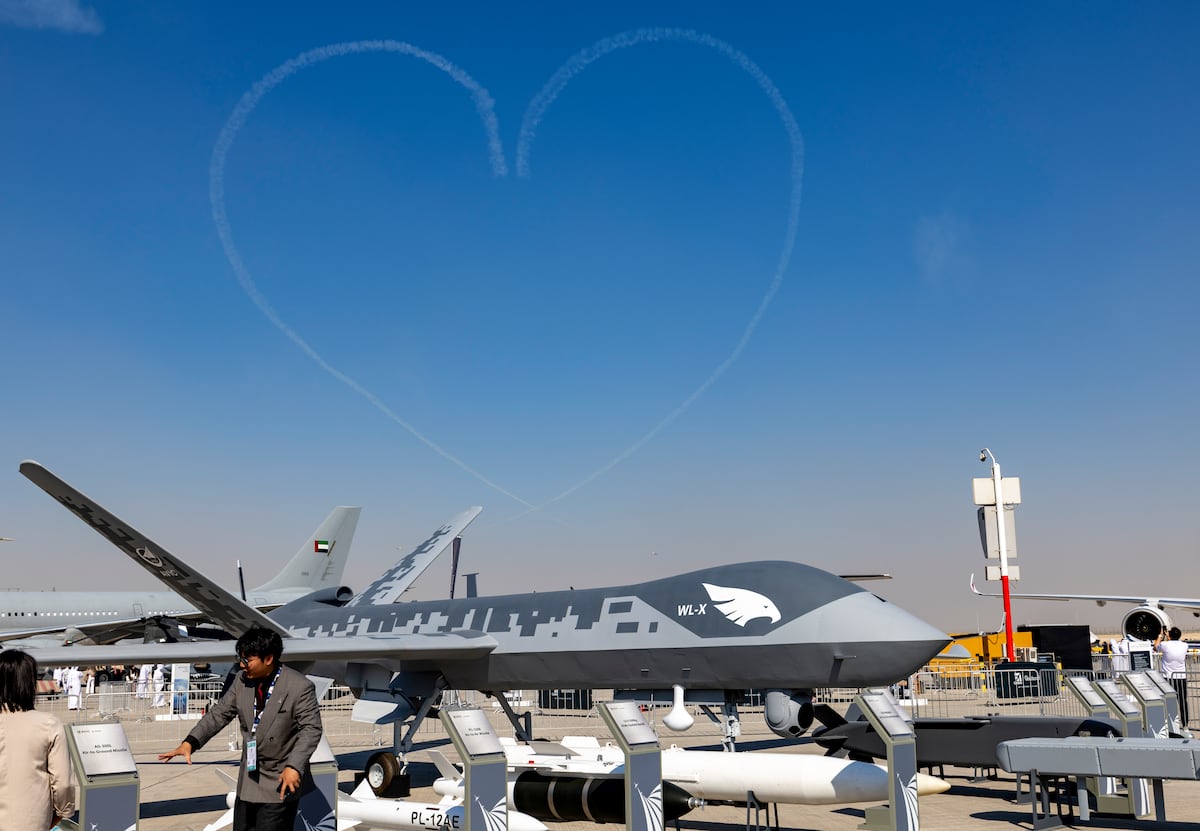
SINGAPORE — Beyond China’s ostentatious display of its J-35A fighter jet at the Singapore Airshow was a lower-profile piece of equipment, the new Wing-Loong X combat drone, which experts say is far more likely to find international success.
Beijing banked on Asia’s largest aerospace event, organized here from Feb. 3-7, to flex its aviation muscle, in a bid to attract more customers.
At the enormous booth of the country’s top aerospace manufacturer, Aviation Industry Corporation of China, or AVIC, placed in the center of the exhibition hall, a mock-up of the WL-X combat drone was displayed on the side. It was the first time the latest member of the Wing Loong family of drones, designed for maritime surveillance and strike missions, was shown in the Southeast Asia region.
Whereas Chinese military equipment may have been previously overlooked, experts say that the context has changed, as its systems are being taken more seriously, especially in the drone category.
“Chinese products are not only being noticed in the West, but their aircraft and combat drones are also being recognized as competitors – the capability gap between these systems and their U.S. competitors is narrowing while maintaining significantly lower costs,” Andreas Rupprecht, a military aviation researcher specializing in China, said.
A model of China's J-35A fifth-generation fighter jet sits on the show floor at the Singapore Airshow in February 2026. (Elisabeth Gosselin-Malo/staff)
Considering Beijing’s robust export footprint in uncrewed systems, the WL-X could could find similar success among customers interested in bolstering their maritime capabilities.
“The Wing Loong family and CH-drone series have been sold to dozens of states; it is plausible to expect the new drone on the buying list of countries that cannot access or afford Western systems due to cost, export controls, or political constraints,” Federico Borsari, resident fellow at the Center for European Policy Analysis, said.
At a 2024 exhibition in China, AVIC displayed a prototype of the drone armed with different maritime weapon systems, including underwing sonobuoy dispenser pods and electric-propulsion torpedoes. At the Singapore Airshow, while information was displayed regarding the physical capabilities and 24-meter wingspan of the WL-X, the manufacturer offered no information on payload options.
Among the list of operators of the Chinese-made Wing Loong drone models are Saudi Arabia, the UAE, Egypt, Pakistan, Morocco, Algeria, Indonesia, and Nigeria. In 2024, the Royal Saudi Air Force reportedly reached a new milestone with its Wing Loong II fleet, logging 5,000 flight hours.
According to Borsari, some of these countries could be potential recurring customers of the new variant, interested in integrating it to support their navies.
The success of the WL-X will largely be contingent on its price tag, which is traditionally an area where China faces weaker competition from more expensive Western-made platforms.
While China has been profitable in the combat drone sector, it has not seen the same success in the smaller market for fifth-generation fighter jets, even if the large-scale model of the J-35A here garnered attention from visitors here.
A company representative declined to answer whether foreign buyers had expressed interest in the Chinese-built aircraft.
According to Timothy Heath, senior international defense researcher at RAND, the Asian country will have a hard time marketing it in an already saturated market.
“The industry is small for Beijing since many of the wealthiest countries that can afford fifth-generation airplanes are either allies with the U.S. or long-standing clients of Russia. … Only a few, such as Pakistan, have enduring security ties with China,” Heath said.
He suggested that the country’s best attempt is likely to result from “poaching” clients from Moscow, especially as its military industry has lagged due to the war in Ukraine.
A 2025 report to Congress of the U.S.-China Economic and Security Review Commission noted that Beijing reportedly offered to sell 40 J-35As to Pakistan in June 2025, but that these deliveries have not yet been completed.
Elisabeth Gosselin-Malo was a Europe correspondent for Defense News. She covers a wide range of topics related to military procurement and international security, and specializes in reporting on the aviation sector. She is based in Milan, Italy.
新加坡——在新加坡航展上,中国除了高调展示其歼-35A战斗机之外,还有一种低调的装备——新型翼龙X战斗无人机。专家表示,这种无人机更有可能在国际上取得成功。
北京希望借助2月3日至7日在此举办的亚洲最大航空航天盛会,展示其航空实力,以吸引更多客户。
在位于展厅中央的中国航空工业集团公司(AVIC)巨大的展位上,陈列着一架WL-X战斗无人机的模型。这是翼龙系列无人机的最新成员首次在东南亚地区亮相,该系列无人机专为海上监视和打击任务而设计。
专家表示,虽然中国军事装备以前可能被忽视,但情况已经发生了变化,因为人们越来越重视中国的军事系统,尤其是在无人机领域。
“中国产品不仅在西方受到关注,而且其飞机和作战无人机也被视为竞争对手——这些系统与美国竞争对手之间的能力差距正在缩小,同时成本却显著降低,”专门研究中国的军事航空研究员安德烈亚斯·鲁普雷希特说。
2026年2月,中国第五代战斗机歼-35A的模型在新加坡航展的展台上展出。(Elisabeth Gosselin-Malo/工作人员摄)
考虑到北京在无人系统领域强大的出口实力,WL-X 可能会在有兴趣增强其海上能力的客户中获得类似的成功。
“翼龙系列和CH无人机系列已经卖给了数十个国家;可以预见,由于成本、出口管制或政治限制,一些国家无法获得或负担得起西方的系统,那么新型无人机很可能就会出现在这些国家的采购名单上,”欧洲政策分析中心常驻研究员费德里科·博尔萨里说。
在2024年中国举办的航展上,中航工业展示了一款配备多种海上武器系统的无人机原型,包括翼下声呐浮标投放吊舱和电推进鱼雷。在新加坡航展上,虽然展示了WL-X的物理性能和24米翼展等信息,但制造商并未提供有效载荷选项方面的任何信息。
中国制造的翼龙无人机运营商包括沙特阿拉伯、阿联酋、埃及、巴基斯坦、摩洛哥、阿尔及利亚、印度尼西亚和尼日利亚。据报道,2024年,沙特皇家空军的翼龙II无人机机队飞行时间累计达到5000小时,创下新的里程碑。
博尔萨里表示,其中一些国家可能是该新型号的潜在回头客,有兴趣将其整合到海军中以提供支持。
WL-X 的成功很大程度上取决于其价格,而价格一直是中国在竞争中面临的来自西方制造的更昂贵平台的较弱领域。
虽然中国在战斗无人机领域获得了丰厚的利润,但在规模较小的第五代战斗机市场却没有取得同样的成功,即使这里展出的歼-35A大型模型吸引了参观者的目光。
公司代表拒绝回答是否有外国买家对中国制造的飞机表示出兴趣。
兰德公司高级国际防务研究员蒂莫西·希思表示,这个亚洲国家在一个已经饱和的市场中很难推销这种产品。
希思表示:“对北京而言,这个行业规模很小,因为许多能够负担得起第五代战机的最富裕国家要么是美国的盟友,要么是俄罗斯的长期客户……只有少数国家,例如巴基斯坦,与中国保持着长期的安全关系。”
他认为,该国最好的尝试可能是从莫斯科“挖走”客户,尤其是在乌克兰战争导致其军工产业发展滞后的情况下。
2025 年,美中经济与安全审查委员会向国会提交了一份报告,指出北京方面据称于 2025 年 6 月向巴基斯坦提出出售 40 架歼-35A 战斗机,但这些交付尚未完成。
伊丽莎白·戈斯林-马洛曾任《防务新闻》欧洲通讯员。她的报道涵盖军事采购和国际安全等广泛领域,尤其擅长航空领域的报道。她常驻意大利米兰。