The Cheyenne Attack Helicopter Had A Crazy Rotating Gunner’s Seat Right Out Of Star Wars夏延攻击直升机的旋转炮手座椅造型奇特,简直就像是从《星球大战》里直接搬出来的一样。
Lockheed's AH-56 Cheyenne was ahead of its time in many ways. While its swiveling gunner's seat was not one of them, it certainly was cool.
新闻视频
By Brett Tingley and Tyler Rogoway
Updated Apr 2, 2021 4:06 PM EDT
The Lockheed AH-56 Cheyenne was the world’s most advanced attack helicopter in its heyday, sporting revolutionary features that were far ahead of their time . Unfortunately, the Cheyenne program never fully succeeded due to technical issues, program management shortfalls, changing procurement priorities, high cost, and a crash in 1969 that left a test pilot dead. Despite never entering service, the Cheyenne left a profound impact on the concept of close air support and attack helicopter design, and today holds a special place in military aviation history. Looking back, one of its wildest features was a gunner’s seat that literally swiveled 360 degrees along with its weapons. Over half a century after appearing on the AH-56, that gunner’s station looks like something straight out of a Star Wars space battle sequence.
The need for a U.S. Army attack helicopter presented itself quickly when the United States entered the Vietnam War, although the Army’s search for a close air support and/or attack helicopter dates back to at least 1957 . When the U.S. Army deployed the 57th Medical Detachment to Vietnam in March 1962, it sent along Bell UH-1 Iroquois, better known as “Hueys.” Large numbers of additional Hueys followed as more divisions were deployed to Vietnam. Many of these Hueys in Vietnam were subsequently armed, including with improvised weapon systems crafted by troops in the field. By the late 1960s, the U.S. Army was testing a wide variety of weapons on the Huey, including various automatic weapons , anti-tank guided missiles , and rocket launchers.
AH-56 Cheyenne firing rockets., U.S. Army
After seeing the clear need for a well-armed multi-mission attack helicopter for its involvement in the worsening Vietnam War, the U.S. Army established the Advanced Aerial Fire Support System (AAFSS) in 1964 to develop and procure a new attack helicopter. In 1965, the service declared Lockheed as the winner of the AAFSS program contract, and 10 prototypes of their proposed attack helicopter were ordered. The Army designated the helicopter the AH-56A and nicknamed it the Cheyenne.
The Cheyenne sported aerodynamic features not seen on other helicopters of its time. A nearly 4,000-horsepower turbine engine and a pusher propeller on the tail boom allowed the helicopter to hit a 224-mile-per-hour cruise speed and dash at speeds up to 240 miles per hour. The Cheyenne had 26.7-foot fixed wings to supply lift, which, combined with the pusher propeller, took much of the aerodynamic load off of its rigid main rotor. Supplying thrust with the pusher propeller meant that, unlike standard helicopters, the Cheyenne could quickly accelerate and decelerate without pitching its nose up or down. Conversely, the Cheyenne could also pitch its nose up or down while hovering without moving forward or backward.
Bob Mitchell, the curator of the U.S. Army Aviation Museum, says that this combination of aerodynamic features gave the Cheyenne a key advantage over other attack helicopters at the time. “One of the key factors in gunship operations – certainly when conducting diving fire – is that your speed builds exponentially, so you only have a couple of seconds to acquire, engage then start your recovery,” Mitchell said in an interview for an official Army story on the AH-56 in 2018. “On the Cheyenne, the pilot could enter his dive, then reverse thrust on the pusher to slow the aircraft down considerably, allowing him to fixate on the target, fire and then start his recovery. For that reason alone it was a beautiful gunship.”
The Cheyenne’s unique ability to distribute fire during its attack runs didn’t stop there.
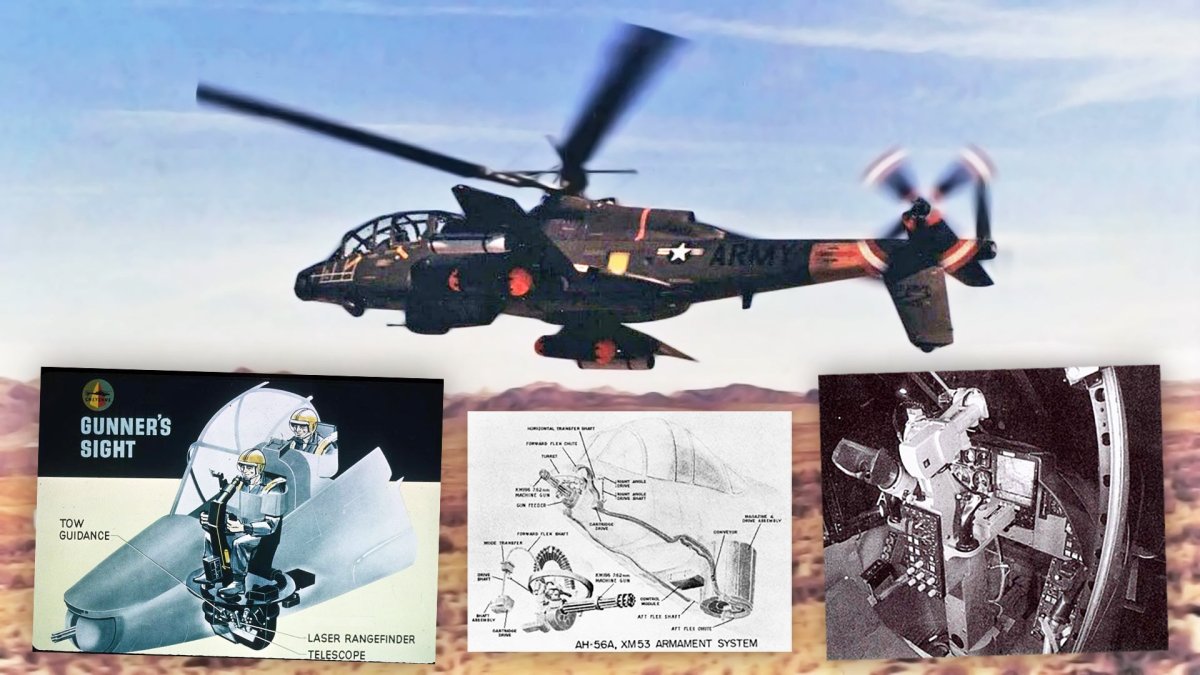
The Cheyenne had a two-seat tandem cockpit with the pilot in the rear and an advanced fire control suite for the gunner in the front seat. One of the craziest features of the Cheyenne was this gunner’s seat and control station.
Reminiscent of the gun turrets on World War II bombers, and like the swiveling gunner seats in the Millennium Falcon from Star Wars , the Cheyenne’s gunner’s seat, sighting system, and firing controls rotated a full 360 degrees to allow the gunner to face the direction in which he was firing, even completely to the rear.
Lockheed Aircraft Corporation
A periscope sight allowed the gunner to aim the 30mm XM140 cannon in the belly turret with 360-degree direct fire capability. This drastically expanded what a potential attack run could look like for a helicopter of the era and increased the tactical flexibility of the helicopter overall.
The pilot wore a then-cutting-edge helmet-mounted display (HMD) that would also allow them to independently aim the helicopter’s nose-mounted turret. This forward turret could accommodate either a 7.62mm Minigun or a 40mm M129 grenade launcher .
The gunner’s cockpit in the Cheyenne with its swiveling chair and control station., Public Domain
In addition to the turrets, the Cheyenne featured six hardpoints on its stub wings on which it could carry pods loaded with 2.75-inch rockets, wire-guided BGM-71 TOW antitank missiles, or external fuel tanks, among other stores. The Cheyenne’s fire control system featured doppler radar and a laser range finder, both well ahead of their time.
Many elements of the Cheyenne’s avionics systems were revolutionary, as well. The AH-56 sported an automatic flight control system and multiple radar systems, all connected to a then-state-of-the-art digital “Computer Central Complex” (CCC), allowing it to safely operate at low altitudes. Central to this was the Cheyenne’s AN/APQ-118 terrain-following radar system , manufactured by Norden, which could be used in both manual terrain-following (MTF) and automatic terrain-following (ATF) modes.
Journal of the American Helicopter Society
According to a 1971 study of the Cheyenne’s radar system published in the Journal of the American Helicopter Society, the computing suite in the AH-56 combined what were then cutting-edge avionics, including a forward-looking radar (terrain-following radar, or TFR), an automatic flight control system (AFCS), a vertical situation display (VSD), and a plan position display (PPD), enabling “safe, low altitude penetration of territories under IFR and night conditions.” Other sensor capabilities, including infrared and electronic support measures, as well as datalink systems, could help the unique helicopter act in an advanced scout and forward fire support director role.
The Cheyenne entered flight testing in 1967, including an initial test at Van Nuys Airport in which the Cheyenne wowed onlookers with its ability to “bow” to the crowd, that is, lowering its nose while in a stationary hover. Testing continued until March 1969, when the third Cheyenne prototype experienced unexpected vibration of its main rotor during a flight test. The vibrations caused the rotor to strike the canopy and tail boom of the aircraft, killing pilot David A. Beil instantly. In the aftermath of the crash, the Army immediately issued Lockheed a Cure Notice, a statement made by the government that a contractor has failed to meet its requirements. Two months later, the service’s Cheyenne production contract with Lockheed was terminated.
The Cheyenne below its maker’s title., Public Domain
The Cheyenne program then languished in bureaucratic purgatory for several years until the Army officially canceled it in 1972. Not that long after, the Army launched the Advanced Attack Helicopter (AAH) program, which would eventually lead to the AH-64 Apache.
Official reasons for the AH-56’s cancellation were numerous, as we previously stated. However, according to the “ Abridged History of Army Attack Helicopter Program ” prepared by the Office of the Assistant Vice Chief of Staff of the Army (OAVCSA), there were numerous other problems related to the management of the program and not the helicopter itself, including the OAVCSA’s claim that Lockheed did not have “adequate helicopter experience.” Lockheed never pursued the development of another helicopter, although today’s Lockheed Martin Corporation develops helicopters through its Sikorsky subsidiary.
Another reason for the program’s demise was that the Cheyenne was designed at somewhat of a transitional period between analog and digital avionics. By the time the Army canceled the AH-56 program, digital avionics, which were lighter, faster, more reliable, more precise, and had better night and all-weather capabilities, were beginning to be developed. The cost of transitioning the AH-56 over to these new systems was also cited as a factor in its cancellation. The far simpler Bell Cobra, which was developed adjacent to Cheyenne as a low-risk alternative, was seen as a far cheaper and readily available option, in part due to it sharing an engine, transmission, and rotor system with variants of the Bell UH-1 Iroquois already in service.
Out of the 10 AH-56 prototypes that Lockheed built, four aircraft survive to this day: two are on display at the Army Aviation Museum at Fort Rucker in Alabama, one is at Fort Polk in Louisiana, and another at Kentucky’s Fort Campbell.
Two surviving Cheyennes at the Army Aviation Museum., US Army
Many of the features found on the Cheyenne would later show up on other aircraft. For instance, by the time the Boeing AH-64 Apache entered service in 1986, helmet-mounted targeting displays were standard, although with far more capabilities than Cheyenne’s system had. The Apache also integrated the digital sensor and cockpit technologies that the AH-56 was just too early to incorporate.
As for swiveling gunner’s seats and sighting systems, just making the sensors themselves swivel, as well as the gun turret, and projecting the video feed in front of the pilot’s eye and on cockpit screens was a far more attractive option that was largely made possible by technological progress during the 1970s.
While the Cheyenne never officially entered service, it nevertheless had a profound impact on the design of future attack helicopters and helped unlock the possibilities of an advanced close air support aircraft concept. In his 2018 interview, U.S. Army Aviation Museum curator Bob Mitchell said that without the Cheyenne, there would be no A-10.
“I like to refer to the Cheyenne as the father of the A-10 program, because after that, the next aircraft the Air Force would design would be the A-10 Thunderbolt for close air support,” he explained . “Now, because of the Cheyenne, we finally got a dedicated aircraft for close air support.”
In addition, the Cheyenne’s high-speed, compound helicopter configuration has been reborn, at least to a certain degree, in the form of the Sikorsky S-97 Raider , a variant of which could very well become the Army’s next scout helicopter. Other variants of Sikorsky’s X-2 technology , namely the SB-1 Defiant , which is in the running to satisfy a huge component of the Army’s Future Vertical Lift program, also have some general similarities to AH-56. Even Boeing recently was looking to pitch a major refresh of their Apache by adding a pusher propeller and stub wings, which would have given it a very similar configuration to Cheyenne’s.
Maybe Cheyenne’s biggest problem was that it was too ambitious, and it definitely pioneered its share of wacky technological dead-ends, like the gunner’s rotating seat, but it also got an amazing amount right and should be remembered in that light.
Contact the author: Brett@TheDrive.com
Comments couldn’t be loaded. Please refresh the page.
作者:Brett Tingley 和 Tyler Rogoway
更新于美国东部时间2021年4月2日下午4:06
洛克希德AH-56“夏延”攻击直升机在其鼎盛时期是世界上最先进的攻击直升机,拥有诸多革命性的设计,远远领先于时代。然而,由于技术问题、项目管理缺陷、采购优先事项的变更、高昂的成本以及1969年导致试飞员丧生的坠机事故,“夏延”项目最终未能完全成功。尽管从未投入使用,但“夏延”对近距离空中支援和攻击直升机的设计理念产生了深远的影响,如今在军事航空史上占有特殊的地位。回顾历史,它最令人惊叹的设计之一是炮手座椅,该座椅可以与武器一起360度旋转。时隔半个多世纪,AH-56上的这个炮手座椅看起来仍然像是直接从《星球大战》的太空大战场景中走出来的一样。
美国陆军对攻击直升机的需求在美国卷入越南战争后迅速凸显,尽管早在1957年,陆军就开始寻求近距离空中支援和/或攻击直升机。1962年3月,美军向越南部署第57医疗分遣队时,随行的正是贝尔UH-1“易洛魁”(Iroquois)直升机,俗称“休伊”(Huey)。随着更多师级部队部署到越南,大量休伊直升机也随之投入使用。许多驻越的休伊直升机后来都配备了武器,包括由前线部队自行研制的简易武器系统。到了20世纪60年代末,美军开始在休伊直升机上测试各种武器,包括各种自动武器、反坦克导弹和火箭发射器。
AH-56“夏延”武装直升机发射火箭弹,美国陆军
由于越战局势日益恶化,美国陆军意识到需要一种装备精良的多用途攻击直升机,因此于1964年成立了先进空中火力支援系统(AAFSS)项目,旨在研发和采购新型攻击直升机。1965年,陆军宣布洛克希德公司中标AAFSS项目,并订购了10架其设计的攻击直升机原型机。陆军将该直升机命名为AH-56A,并昵称为“夏延”(Cheyenne)。
夏延直升机拥有当时其他直升机所不具备的空气动力学特性。一台近4000马力的涡轮发动机和尾梁上的推进式螺旋桨使它能够达到224英里/小时的巡航速度,并能以高达240英里/小时的速度冲刺。夏延直升机采用26.7英尺长的固定翼来提供升力,这与推进式螺旋桨相结合,大大减轻了刚性主旋翼的空气动力负荷。由于推进式螺旋桨提供的推力,与标准直升机不同,夏延直升机可以在不抬头或低头的情况下快速加速和减速。反之,夏延直升机也可以在悬停时抬头或低头而不前后移动。
美国陆军航空博物馆馆长鲍勃·米切尔表示,夏延武装直升机凭借其空气动力学特性,在当时的同类攻击直升机中脱颖而出,拥有关键优势。“武装直升机作战的关键因素之一——尤其是在进行俯冲射击时——在于速度呈指数级增长,因此飞行员只有几秒钟的时间来锁定目标、开火并开始改出,”米切尔在2018年接受美国陆军官方关于AH-56的采访时说道。“而夏延武装直升机的飞行员可以先进入俯冲状态,然后通过推进器反推来大幅降低飞机速度,从而锁定目标、开火并开始改出。仅凭这一点,它就是一款优秀的武装直升机。”
夏延战机在攻击过程中独特的火力分配能力还不止于此。
夏延战斗机采用双座串列式座舱,飞行员位于后座,前座炮手则配备了先进的火控系统。夏延战斗机最令人匪夷所思的设计之一就是这套炮手座椅和控制台。
夏延号的炮塔让人联想起二战轰炸机的炮塔,也像《星球大战》中千年隼号的旋转炮手座椅一样,炮手座椅、瞄准系统和射击控制装置可以旋转整整 360 度,使炮手能够面向射击方向,甚至完全面向后方。
洛克希德飞机公司
潜望镜瞄准器使炮手能够360度直接射击,瞄准机腹炮塔内的30毫米XM140机炮。这极大地扩展了当时直升机潜在攻击范围,并提高了直升机的整体战术灵活性。
飞行员佩戴了当时最先进的头盔显示器(HMD),该显示器还可以让他们独立瞄准直升机机头安装的炮塔。这个前炮塔可以安装一挺7.62毫米迷你机枪或一门40毫米M129榴弹发射器。
夏延战斗机炮手的座舱,配有旋转座椅和控制台。(公共领域)
除了炮塔之外,“夏延”战斗机在其短翼上还设有六个外挂点,可挂载装有2.75英寸火箭弹、BGM-71 TOW线导反坦克导弹或外部油箱等的吊舱。“夏延”的火控系统配备了多普勒雷达和激光测距仪,这两项技术在当时都远超时代。
夏延直升机的许多航空电子系统也具有革命性意义。AH-56配备了自动飞行控制系统和多套雷达系统,所有这些系统都连接到当时最先进的数字“计算机中央复合体”(CCC),使其能够在低空安全飞行。其中最核心的是夏延直升机的AN/APQ-118地形跟踪雷达系统,该系统由诺登公司制造,可用于手动地形跟踪(MTF)和自动地形跟踪(ATF)模式。
美国直升机协会期刊
根据1971年发表在《美国直升机协会杂志》上的一篇关于夏延直升机雷达系统的研究报告,AH-56的计算机套件整合了当时最先进的航空电子设备,包括前视雷达(地形跟踪雷达,简称TFR)、自动飞行控制系统(AFCS)、垂直态势显示器(VSD)和平面位置显示器(PPD),使其能够在“仪表飞行规则(IFR)和夜间条件下安全低空渗透”目标区域。其他传感器功能,包括红外和电子支援措施以及数据链系统,可以帮助这款独特的直升机执行高级侦察和前沿火力支援指挥任务。
夏延直升机于1967年进入飞行测试阶段,其中包括在范奈斯机场进行的一次初步测试。在这次测试中,夏延直升机展现了其“向人群鞠躬”的能力,即在悬停静止时降低机头,令在场观众惊叹不已。测试一直持续到1969年3月,当时第三架夏延原型机在飞行测试中主旋翼出现意外振动。振动导致旋翼撞击座舱盖和尾梁,飞行员大卫·A·贝尔当场身亡。事故发生后,陆军立即向洛克希德公司发出整改通知,表明承包商未能满足其要求。两个月后,陆军终止了与洛克希德公司签订的夏延直升机生产合同。
夏延人(Cheyenne)位于其制造商名称下方。公共领域
随后,夏延计划在官僚主义的泥潭中沉寂了数年,直到 1972 年陆军正式取消了该计划。不久之后,陆军启动了先进攻击直升机 (AAH) 计划,该计划最终催生了 AH-64 阿帕奇直升机。
正如我们之前所述,AH-56项目取消的官方理由有很多。然而,根据陆军副参谋长助理办公室(OAVCSA)编写的《陆军攻击直升机项目简史》,除了直升机本身的问题外,该项目还存在许多其他与项目管理相关的问题,例如OAVCSA声称洛克希德公司缺乏“足够的直升机经验”。洛克希德公司此后从未继续研发其他直升机,尽管如今的洛克希德·马丁公司通过其子公司西科斯基公司继续研发直升机。
该项目终止的另一个原因是,夏延直升机的设计正处于模拟航电向数字航电过渡的时期。在陆军取消AH-56项目时,更轻便、更快速、更可靠、更精确,且具备更佳夜间和全天候作战能力的数字航电系统正开始研发。将AH-56升级到这些新系统的成本也被认为是导致其被取消的原因之一。与夏延直升机同期开发的贝尔眼镜蛇直升机结构更为简单,风险也更低,被视为一种更经济且易于获得的替代方案,部分原因是它与已服役的贝尔UH-1易洛魁直升机的衍生型号共享发动机、变速箱和旋翼系统。
洛克希德公司制造的 10 架 AH-56 原型机中,有 4 架至今仍保存完好:2 架在阿拉巴马州鲁克堡的陆军航空博物馆展出,1 架在路易斯安那州波尔克堡,另 1 架在肯塔基州坎贝尔堡。
美国陆军航空博物馆现存两架夏延战斗机。
夏延直升机上的许多功能后来都出现在其他飞机上。例如,到1986年波音AH-64阿帕奇直升机服役时,头盔瞄准显示器已经成为标配,而且其功能远比夏延直升机的系统强大。阿帕奇还集成了AH-56当时尚未采用的数字传感器和座舱技术。
至于旋转炮手座椅和瞄准系统,只需让传感器本身以及炮塔旋转,并将视频画面投射到飞行员眼前和座舱屏幕上,这便是一个更具吸引力的选择,而这在很大程度上得益于 20 世纪 70 年代的技术进步。
尽管“夏延”直升机从未正式服役,但它对未来攻击直升机的设计产生了深远的影响,并帮助开启了先进近距离空中支援飞机概念的可能性。美国陆军航空博物馆馆长鲍勃·米切尔在2018年的一次采访中表示,如果没有“夏延”,就不会有A-10攻击机。
“我喜欢把‘夏延’称为A-10项目的鼻祖,因为在那之后,空军设计的下一款飞机就是用于近距离空中支援的A-10‘雷电’攻击机,”他解释说。“现在,多亏了‘夏延’,我们终于拥有了一款专门用于近距离空中支援的飞机。”
此外,夏延直升机的高速复合式直升机构型在某种程度上以西科斯基S-97“突袭者”的形式重现,其衍生型号很可能成为陆军下一代侦察直升机。西科斯基X-2技术的其他衍生型号,例如正在竞标陆军未来垂直起降计划重要组成部分的SB-1“挑战者”,也与AH-56有一些相似之处。甚至波音公司最近也曾计划对其“阿帕奇”直升机进行重大升级,增加推进式螺旋桨和短翼,使其构型与夏延直升机非常相似。
或许夏延最大的问题是它野心太大,而且它确实开创了不少古怪的技术死胡同,比如炮手的旋转座椅,但它也做对了很多事情,应该从这个角度记住它。
联系作者:Brett@TheDrive.com
评论加载失败,请刷新页面。