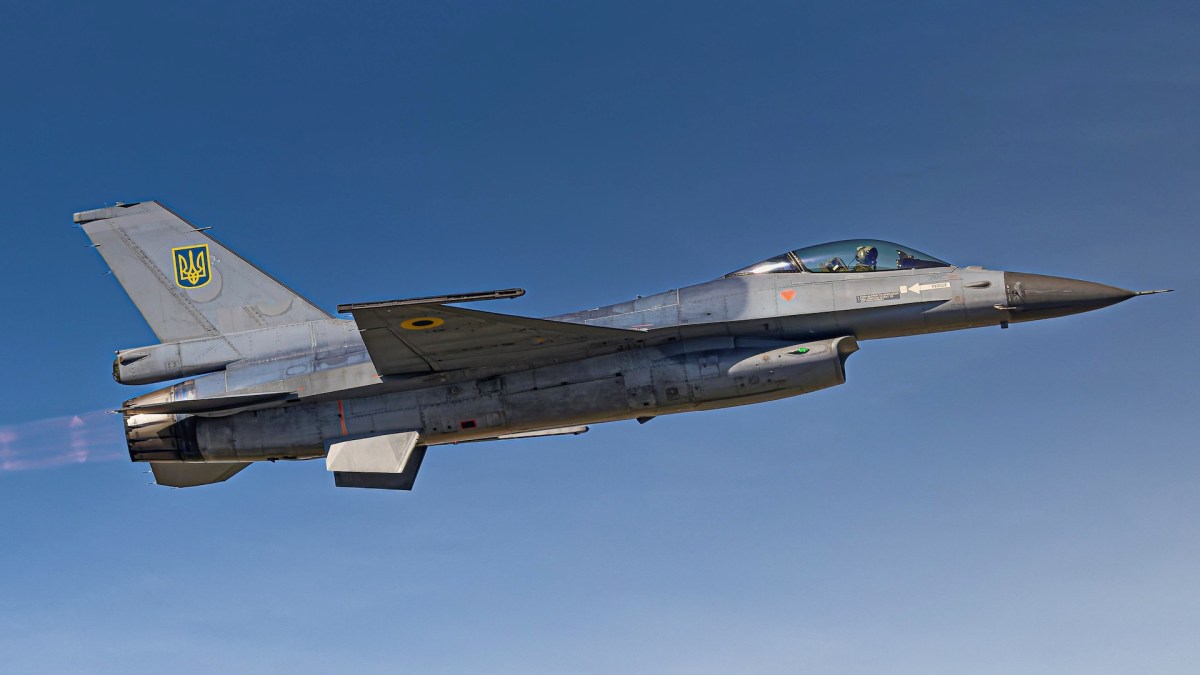
Ukraine’s F-16 Fleet Is In A Readiness Crisis乌克兰的F-16机队正处于战备危机之中
As the war rages on, more than half of the aging fighters are reportedly grounded, while Western air-to-air missile stocks are also running low. As the war rages on, more than half of the aging fighters are reportedly grounded, while Western air-to-air missile stocks are also running low.
Published Sep 30, 2026 1:10 PM EDT
Ukraine’s F-16 fleet is facing growing pressure from the demands of the air war , with a shortage of air-to-air missiles now compounded by what appears to be a serious bottleneck in the critical maintenance system supporting the aging aircraft.
The Wall Street Journal reported Wednesday that more than half of Ukraine’s F-16s are currently in what a Western source described as “maintenance limbo.” The same source told the newspaper that, at the current rate of operations and maintenance, Ukraine could exhaust the remainder of its available aircraft by the end of the year.
An F-16 over the Kyiv region on August 18, 2026. The jet carries four Sidewinder missiles, a Sniper targeting pod, and an AN/ALQ-131 electronic countermeasures pod. Photo by Roman PILIPEY / AFP ROMAN PILIPEY
The Ukrainian Air Force declined to provide the WSJ with figures on the status of the fleet. Open-source analysis suggests that Ukraine may have received around 40-50 F-16s so far. However, a proportion of these are held back for training elsewhere in Europe , while there have been five confirmed losses . Approximately 110 F-16s have now been promised by a coalition comprising Belgium, Denmark, the Netherlands, Norway.
This is a growing issue, especially because right now F-16s are playing an important role in intercepts of jet powered Geran-4/5. https://t.co/ZtMFBSLAy1 — Michael Kofman (@KofmanMichael) September 30, 2026
This is a growing issue, especially because right now F-16s are playing an important role in intercepts of jet powered Geran-4/5. https://t.co/ZtMFBSLAy1
The report follows TWZ ’s recent reporting on a separate constraint affecting the F-16 force: Ukraine is struggling to maintain adequate stocks of air-to-air missiles for its fighters. AIM-9 Sidewinders and AIM-120 Advanced Medium-Range Air-to-Air Missiles (AMRAAM) have been heavily used against Russian cruise missiles and drones, and Ukrainian F-16 pilots have reportedly had to ration their missile shots. Aircraft have increasingly had to rely on their internal 20mm cannon when suitable missiles are not available. This is a far from ideal substitute, as you can read about here , but Kyiv is reportedly now negotiating for tens of thousands of additional rounds of 20mm ammunition.
The moment a Russian jet-powered "Shahed" drone is shot down by an F-16 fighter jet using its M61 Vulcan cannon. pic.twitter.com/gU72HJTXUa — WarTranslated (@wartranslated) September 23, 2026
The moment a Russian jet-powered "Shahed" drone is shot down by an F-16 fighter jet using its M61 Vulcan cannon. pic.twitter.com/gU72HJTXUa
Ukrainian F-16s have been apparently been carrying laser-guided 70mm Advanced Precision Kill Weapon System II (APKWS II) rockets, which should provide an extremely valuable, lower-cost option for engaging long-range drones and subsonic cruise missiles. The exact status of this weapon in Ukrainian hands is unclear, but there is so far limited evidence of extensive use by its F-16s, at least in the public domain.
All these problems are closely related because the same high operational tempo that is consuming Ukraine’s missile stocks is also putting additional hours on the already well-worn F-16 airframes.
The aircraft have become a critical important component of Ukraine’s air-defense effort, particularly as Russia has expanded its use of increasingly sophisticated one-way attack drones, as we wrote about only yesterday. WSJ reports that Russia has launched around 2,000 jet-powered drones against Ukraine this month, compared with approximately 350 in June. The newer, jet-powered drones can reportedly reach speeds of up to 375 miles per hour, making them more difficult for Ukraine’s interceptor drones to engage and increasing the importance of conventional fighters. At the same time, the stocks of effectors for ground-based air defense systems are being reduced, in some cases to a critical level , increasing the reliance on crewed fighters to take up the slack.
A Ukrainian drone attempts to intercept a Russian Geran-4 jet-powered drone. GUR
F-16s are well-suited to the counter-drone and counter-cruise missile mission, but using them extensively against large numbers of relatively inexpensive targets presents a difficult sustainment problem. In fact, the lower speed and altitude differential between the F-16 and a jet-powered drone, compared to a propeller-driven one, makes the higher-performance weapon an easier target for the crewed fighter in most scenarios.
However, every sortie adds flight hours to the aircraft, while each missile engagement draws from an inventory that Ukraine and its Western partners have to replenish. As the aircraft accumulate hours, they reach scheduled inspection and maintenance intervals, increasing demand on a maintenance network that is already supporting a fleet operating under wartime conditions.
The United States has established a substantial support arrangement for that purpose. In January, the Pentagon awarded Belgian company Sabena Aerospace Engineering a contract with a ceiling of approximately $235.5 million for intermediate- and depot-level maintenance of Ukrainian F-16 aircraft and engines, together with associated material-management support. The contract runs through January 2029, with approximately $69.7 million initially obligated.
Ukrainian Air Force F-16AM Fighting Falcon departing Belgium after receiving depot-level maintenance earlier this year. pic.twitter.com/Hy35iUZd8P — OSINTtechnical (@Osinttechnical) August 28, 2026
Ukrainian Air Force F-16AM Fighting Falcon departing Belgium after receiving depot-level maintenance earlier this year. pic.twitter.com/Hy35iUZd8P
The contract provides an indication of the scale of the infrastructure required to keep the Ukrainian F-16 fleet operational. It also highlights why the reported turnaround times in Belgium are significant. A typical phase-inspection that would normally take approximately two to six weeks in the United States is reportedly taking as long as 40 weeks in Belgium.
A 40-week turnaround does not necessarily mean that an aircraft spends 40 weeks continuously undergoing a phase inspection. The overall period an aircraft is unavailable can also include waiting for parts, additional repairs, scheduling, and other work. It is unclear exactly how many Ukrainian F-16s are currently affected by these various factors.
U.S. Air Force engine shop airmen remove the engine of an F-16 during a phase maintenance inspection in the United States. U.S. Air National Guard photo by Master Sgt. Christopher Stewart/Released Master Sgt. Christopher Stewart
At the same time, the reported turnaround times do point to a substantial capacity problem. Ukraine operates a relatively small F-16 fleet, so aircraft that remain unavailable for extended periods have a disproportionate effect on the number of fighters that can actually be generated for combat missions. Its mission spectrum also includes air-to-ground sorties , putting more demand on the hard-pressed F-16 fleet.
F-16 fighters are the best way to counter new Russian jet-powered drones. Ukrainian F-16 aces have shot down about 2,500 drones of all types and about 650 cruise missiles. Jet drones are exactly the kind of target F-16s shoot down very well, and it usually costs $25,000 or… pic.twitter.com/ajxYN9K0yK — Slava 🇺🇦 (@Heroiam_Slava) September 30, 2026
F-16 fighters are the best way to counter new Russian jet-powered drones. Ukrainian F-16 aces have shot down about 2,500 drones of all types and about 650 cruise missiles. Jet drones are exactly the kind of target F-16s shoot down very well, and it usually costs $25,000 or… pic.twitter.com/ajxYN9K0yK
The F-16s have finite airframe lives, require increasingly substantial inspections as they accumulate hours, and depend on a supply chain for engines, components and other parts. The missiles used to destroy the targets are another finite resource. It should also be recalled that the jets supplied to Ukraine are among the oldest still in operational service. Although upgraded to F-16AM/BM standard, the airframes have accumulated a lot of hours and fatigue.
There is an additional complication with the air-to-air missile inventory, too. AMRAAM is not used only by Ukrainian F-16s, but also employed by its NASAMS ground-based air-defense systems. Sidewinders, too, have both air-launched and surface-launched applications . The same broader Western supply chain therefore has to support both fighter operations and some of Ukraine’s surface-to-air missile systems. Stocks of both AMRAAM and Sidewinder have been eroded by Ukraine, as well as by combat actions in the Middle East .
Southern Ukraine, a Ukrainian NASAMS surface to air missile system intercepts a Russian drone with an (SL)AIM-120B AMRAAM. pic.twitter.com/LTeDDHaECp — OSINTtechnical (@Osinttechnical) May 22, 2025
Southern Ukraine, a Ukrainian NASAMS surface to air missile system intercepts a Russian drone with an (SL)AIM-120B AMRAAM. pic.twitter.com/LTeDDHaECp
At the same time, Ukraine is continuing to receive additional F-16s. Belgium has said it will transfer three more aircraft to Ukraine before the end of this year. More aircraft will increase the potential size of the force, but they will also add to the requirement for spare parts, engines, technicians and depot capacity.
“There is an important agreement with Belgium on the transfer of three F-16 fighter jets by the end of this year,” Ukrainian President Volodymyr Zelensky wrote on X. “We will work to receive these aircraft through an accelerated procedure.”
There is an important agreement with Belgium on the transfer of three F-16 fighter jets by the end of this year. We will work to receive these aircraft through an accelerated procedure. We have already received urgent deliveries of F-16 ammunition from Belgium and other… — Volodymyr Zelenskyy / Володимир Зеленський (@ZelenskyyUa) September 29, 2026
There is an important agreement with Belgium on the transfer of three F-16 fighter jets by the end of this year. We will work to receive these aircraft through an accelerated procedure. We have already received urgent deliveries of F-16 ammunition from Belgium and other…
Zelensky said Ukraine had already received “urgent deliveries” of F-16 weapons from Belgium and Spain, among other countries.
The alternatives to the F-16 are also limited in the near term. Ukraine continues to operate the Soviet-era MiG-29 Fulcrum and a small number of Su-27 Flankers , but these aircraft are themselves aging and are also required for strike missions . In their favor, the Soviet types were designed around a different concept of operations, making them easier to maintain in the field, and Ukraine has its own support infrastructure to sustain them.
The French Mirage 2000-5F force provides another Western option, but deliveries have been relatively limited, and additional aircraft are arriving incrementally rather than in numbers that can quickly compensate for a major reduction in F-16 availability. The longer-term fighter replacement plan is more ambitious. Sweden has agreed to provide 16 Gripen C/D fighters , with the first aircraft expected in early 2027, while a separate agreement covers the purchase of 16 new Gripen E fighters whose deliveries are not scheduled to begin until early 2029.
🇫🇷🇺🇦 French-delivered Dassault Mirage 2000-5F fighter jet in service of the Ukrainian Air Force during flight somewhere over Ukraine. pic.twitter.com/eBCjtx2Gjc — Status-6 (@Archer83Able) May 17, 2026
🇫🇷🇺🇦 French-delivered Dassault Mirage 2000-5F fighter jet in service of the Ukrainian Air Force during flight somewhere over Ukraine. pic.twitter.com/eBCjtx2Gjc
That leaves the F-16 as the principal Western fighter capability available to Ukraine for the immediate future, increasing the significance of any prolonged disruption to its maintenance pipeline or its supply of air-to-air weapons. Ukraine needs enough aircraft to maintain a meaningful combat presence, enough missiles to arm them for the missions they are being asked to fly, and enough maintenance capacity to keep those aircraft available as their flight hours accumulate.
All this is becoming more important as Russia’s aerial campaign evolves. If the increase in faster jet-powered drones continues, Ukraine may have to devote still more fighter sorties to countering them at the very same time that a large portion of its existing F-16 fleet is reportedly unavailable and its stocks of air-to-air missiles are under serious pressure.
Contact the autjor: thomas@thewarzone.com
Comments couldn’t be loaded. Please refresh the page.
发布于美国东部时间2026年9月30日下午1:10
乌克兰的 F-16 机队正面临着空战需求带来的越来越大的压力,空对空导弹的短缺如今又因维护老旧飞机的关键系统似乎出现严重瓶颈而雪上加霜。
《华尔街日报》周三报道称,乌克兰超过一半的F-16战机目前处于西方消息人士所说的“维护停滞”状态。同一消息人士告诉该报,按照目前的作战和维护速度,乌克兰到年底可能会耗尽其剩余的可用战机。
2026年8月18日,一架F-16战斗机飞越基辅地区。该机携带四枚“响尾蛇”导弹、一个“狙击手”瞄准吊舱和一个AN/ALQ-131电子对抗吊舱。照片由Roman PILIPEY/法新社提供。
乌克兰空军拒绝向《华尔街日报》提供有关其F-16机队现状的数据。公开来源的分析表明,乌克兰迄今可能已接收了约40至50架F-16战机。然而,其中一部分被留在欧洲其他地区进行训练,同时已确认损失了5架。由比利时、丹麦、荷兰和挪威组成的联盟已承诺向乌克兰提供约110架F-16战机。
这是一个日益严重的问题,尤其因为目前F-16战机在拦截喷气式Geran-4/5导弹方面发挥着重要作用。https://t.co/ZtMFBSLAy1 — Michael Kofman (@KofmanMichael) 2026年9月30日
这是一个日益严重的问题,尤其因为目前F-16战机在拦截喷气式Geran-4/5导弹方面发挥着重要作用。https://t.co/ZtMFBSLAy1
这份报告紧随TWZ近期关于F-16部队面临的另一项限制的报道之后:乌克兰正努力维持其战斗机所需的充足空空导弹库存。AIM-9“响尾蛇”和AIM-120先进中程空空导弹(AMRAAM)已被大量用于拦截俄罗斯巡航导弹和无人机,据报道,乌克兰F-16飞行员不得不节约使用导弹。当没有合适的导弹可用时,飞机越来越多地依赖其内置的20毫米机炮。正如您可以在此处阅读到的那样,这远非理想的替代方案,但据报道,基辅目前正在就数万发额外的20毫米机炮弹药进行谈判。
一架俄罗斯喷气式“沙赫德”无人机被F-16战斗机用其M61火神炮击落的瞬间。 pic.twitter.com/gU72HJTXUa — WarTranslated (@wartranslated) September 23, 2026
俄罗斯喷气式“沙赫德”无人机被F-16战斗机用M61火神炮击落的瞬间。 pic.twitter.com/gU72HJTXUa
乌克兰的F-16战机显然已经携带了70毫米激光制导的先进精确杀伤武器系统II(APKWS II)火箭弹,这应该能为拦截远程无人机和亚音速巡航导弹提供一种极其宝贵且成本更低的选项。目前尚不清楚乌克兰是否拥有这种武器,但至少在公开领域,迄今为止几乎没有证据表明乌克兰的F-16战机广泛使用了这种武器。
所有这些问题都密切相关,因为消耗乌克兰导弹库存的高强度作战节奏,也使得已经磨损严重的 F-16 战机机身承受了额外的飞行时间。
这些飞机已成为乌克兰防空体系中至关重要的组成部分,尤其是在俄罗斯不断扩大使用日益精密的单向攻击无人机的情况下,正如我们昨天报道的那样。《华尔街日报》报道称,本月俄罗斯已向乌克兰发射了约2000架喷气式无人机,而6月份的发射数量约为350架。据报道,这些新型喷气式无人机的速度可达每小时375英里,这使得乌克兰的拦截无人机更难拦截,也凸显了常规战斗机的重要性。与此同时,地面防空系统的作战效能正在减少,在某些情况下甚至已降至临界水平,这使得乌克兰更加依赖有人驾驶战斗机来弥补防空能力的不足。
一架乌克兰无人机试图拦截一架俄罗斯“格朗-4”喷气式无人机。
F-16战斗机非常适合执行反无人机和反巡航导弹任务,但若要将其广泛用于攻击大量相对廉价的目标,则会带来严重的后勤保障问题。事实上,与螺旋桨驱动的无人机相比,F-16与喷气式无人机之间的速度和高度差距较小,这使得在大多数情况下,性能更优异的无人机更容易成为有人驾驶战斗机的目标。
然而,每次出动都会增加飞机的飞行时间,而每次导弹交战都会消耗乌克兰及其西方伙伴必须补充的库存。随着飞机飞行时间的累积,它们会达到预定的检查和维护周期,这增加了本已在战时条件下运行的机队的维护网络的压力。
为此,美国已建立了一项实质性的支持机制。今年1月,五角大楼授予比利时萨贝纳航空航天工程公司一份价值约2.355亿美元的合同,用于乌克兰F-16战斗机及其发动机的中级和大修,以及相关的物资管理支持。该合同有效期至2029年1月,首期已支付约6970万美元。
今年早些时候,一架乌克兰空军的F-16AM“战隼”战斗机在比利时接受大修后离开。 pic.twitter.com/Hy35iUZd8P — OSINTtechnical (@Osinttechnical) August 28, 2026
今年早些时候,一架乌克兰空军的F-16AM“战隼”战斗机在比利时接受大修后离开。 pic.twitter.com/Hy35iUZd8P
这份合同表明了维持乌克兰F-16机队正常运转所需的基础设施规模之大。它也突显了比利时报告的周转时间为何如此之长。据报道,在美国通常需要两到六周的典型阶段性检查,在比利时却需要长达40周的时间。
40周的周转时间并不一定意味着飞机需要连续40周进行阶段性检查。飞机无法使用的总时间还可能包括等待零部件、额外维修、安排日程以及其他工作。目前尚不清楚究竟有多少架乌克兰F-16战机受到这些因素的影响。
美国空军发动机维修车间的空军人员正在美国进行阶段性维护检查,期间他们正在拆卸一架F-16战斗机的发动机。美国空军国民警卫队照片,由一级军士长克里斯托弗·斯图尔特拍摄/发布。
与此同时,报道中的周转时间确实表明存在严重的运力问题。乌克兰的F-16机队规模相对较小,因此飞机长时间无法使用会对实际可用于作战任务的战斗机数量造成不成比例的影响。此外,乌克兰的任务范围还包括对地攻击,这进一步加剧了本已捉襟见肘的F-16机队的负担。
F-16战斗机是应对俄罗斯新型喷气式无人机的最佳选择。乌克兰F-16王牌飞行员已经击落了约2500架各类无人机和约650枚巡航导弹。喷气式无人机正是F-16战斗机擅长击落的目标,而且通常只需花费25000美元或…… pic.twitter.com/ajxYN9K0yK — Slava 🇺🇦 (@Heroiam_Slava) September 30, 2026
F-16战斗机是应对俄罗斯新型喷气式无人机的最佳选择。乌克兰F-16王牌飞行员已经击落了约2500架各类无人机和约650枚巡航导弹。喷气式无人机正是F-16战斗机擅长击落的目标,而且通常只需花费25000美元或…… pic.twitter.com/ajxYN9K0yK
F-16战机的机身寿命有限,随着飞行时间的增加,需要进行越来越频繁的检查,并且依赖于发动机、零部件和其他部件的供应链。用于摧毁目标的导弹也是一种有限的资源。此外,还应指出,交付给乌克兰的战机是目前仍在服役的最老旧的战机之一。尽管已升级到F-16AM/BM标准,但这些战机的机身已经积累了大量的飞行时间和疲劳。
空空导弹库存也存在另一个复杂问题。先进中程空空导弹(AMRAAM)不仅供乌克兰F-16战斗机使用,也用于其NASAMS地面防空系统。响尾蛇导弹同样兼具空射和地射能力。因此,同一条西方供应链必须同时支持战斗机作战和乌克兰的部分地空导弹系统。乌克兰自身以及中东地区的战斗行动都消耗了AMRAAM和响尾蛇导弹的库存。
乌克兰南部,乌克兰NASAMS地对空导弹系统使用(SL)AIM-120B AMRAAM导弹拦截了一架俄罗斯无人机。 pic.twitter.com/LTeDDHaECp — OSINTtechnical (@Osinttechnical) 2025年5月22日
乌克兰南部,乌克兰NASAMS地对空导弹系统使用(SL)AIM-120B AMRAAM导弹拦截了一架俄罗斯无人机。 pic.twitter.com/LTeDDHaECp
与此同时,乌克兰仍在继续接收更多的F-16战斗机。比利时表示,将在今年年底前再向乌克兰交付三架飞机。更多飞机将扩大乌克兰F-16战斗机的规模,但同时也会增加对备件、发动机、技术人员和维修能力的需求。
乌克兰总统泽连斯基在X上写道:“我们与比利时就今年年底前交付三架F-16战斗机达成了一项重要协议。我们将努力通过加快程序接收这些飞机。”
我们与比利时达成了一项重要协议,将于今年年底前交付三架F-16战斗机。我们将努力通过加快程序接收这些飞机。我们已经从比利时和其他国家紧急接收了F-16的弹药……——弗拉基米尔·泽连斯基 / Володимир Зеленський (@ZelenskyyUa) 2026年9月29日
我们与比利时达成了一项重要协议,将于今年年底前向其交付三架F-16战斗机。我们将努力通过加快程序接收这些飞机。我们已经从比利时和其他国家紧急接收了F-16的弹药……
泽连斯基表示,乌克兰已经从比利时和西班牙等国“紧急接收”了F-16武器。
短期内,F-16的替代方案也十分有限。乌克兰目前仍在使用苏联时代的米格-29“支点”战斗机和少量苏-27“侧卫”战斗机,但这些飞机本身也已老旧,而且也需要执行打击任务。不过,苏联时代的这些机型是基于不同的作战理念设计的,因此更容易在野战条件下维护,而且乌克兰也拥有自己的后勤保障体系来维护它们。
法国的幻影2000-5F战斗机部队是西方的另一种选择,但交付量相对有限,而且后续飞机的交付是逐步进行的,无法迅速弥补F-16战斗机可用性的大幅下降。长期的战斗机替换计划则更为雄心勃勃。瑞典已同意提供16架鹰狮C/D战斗机,预计首架飞机将于2027年初交付;另一项协议涵盖了16架新型鹰狮E战斗机的采购,这些飞机的交付计划要到2029年初才会开始。
🇫🇷🇺🇦 一架法国交付的达索幻影2000-5F战斗机,隶属于乌克兰空军,正在乌克兰上空飞行。 pic.twitter.com/eBCjtx2Gjc — Status-6 (@Archer83Able) 2026年5月17日
🇫🇷🇺🇦 一架法国交付的达索幻影2000-5F战斗机,隶属于乌克兰空军,正在乌克兰境内某处飞行。 pic.twitter.com/eBCjtx2Gjc
这意味着在可预见的未来,F-16 将成为乌克兰可获得的主要西方战斗机,因此,任何对其维护体系或空空武器供应的长期中断都将造成重大影响。乌克兰需要足够的飞机来维持有效的作战能力,足够的导弹来装备这些飞机以执行其被要求执行的任务,以及足够的维护能力来确保这些飞机在飞行小时数不断增加的情况下仍能保持可用状态。
随着俄罗斯空中作战行动的演变,这一切变得愈发重要。如果速度更快的喷气式无人机数量持续增加,乌克兰可能不得不投入更多战斗机出动来应对这些无人机,而与此同时,据报道,乌克兰现有的大部分F-16战斗机机队都无法使用,其空空导弹库存也面临巨大压力。
联系作者:thomas@thewarzone.com
评论加载失败,请刷新页面。