Rafale jets, submarines push France’s defense exports to $19B in 2024阵风战斗机和潜艇将推动法国2024年国防出口额达到190亿美元。
French defense leaders expect a record year for 2025, with arms sales a key source of income to fund costly aircraft and nuclear programs at home.
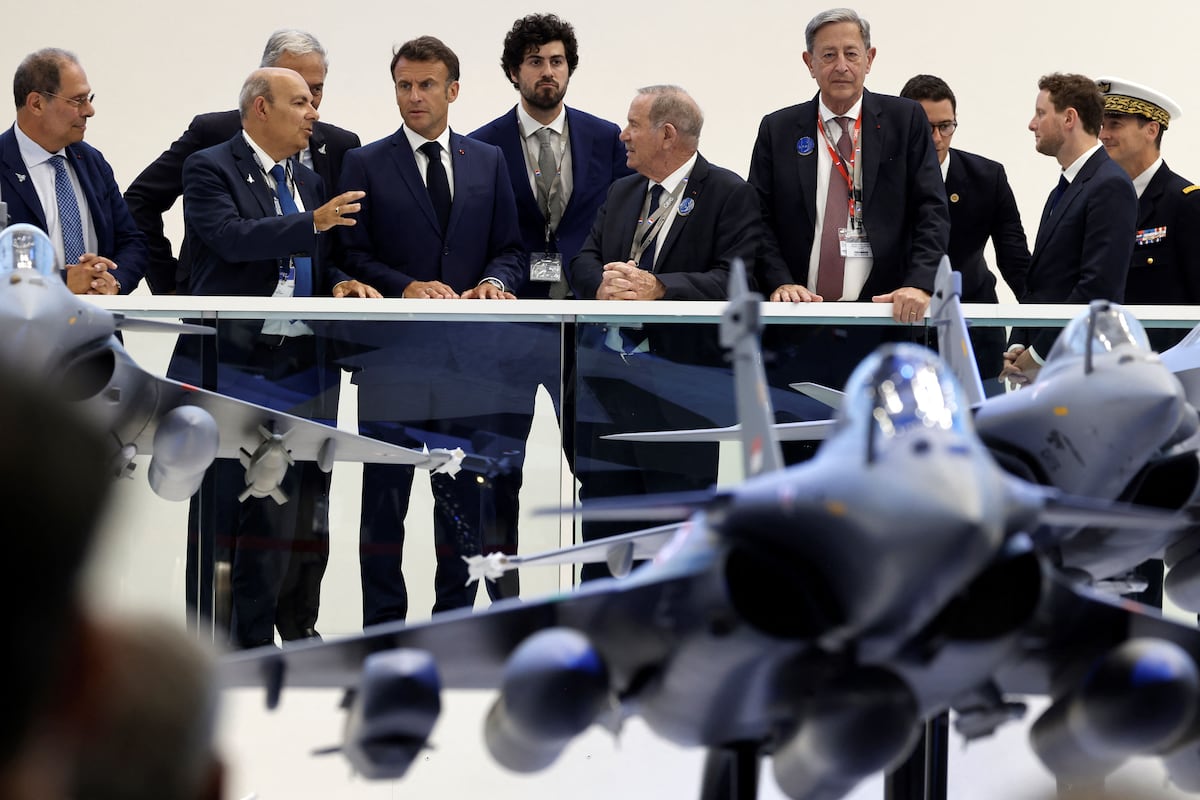
PARIS — French defense export orders had their second-best year ever in 2024, rising to more than €18 billion (US$18.6 billion) on demand for Rafale fighter jets and submarines, Armed Forces Minister Sébastien Lecornu told troops in his traditional New Year’s address in Paris on Tuesday.
Lecornu called for 2025 to be a new record year, driven by exports of surface vessels , submarines , radars, artillery, helicopters and yet more Rafale jets. Export efforts will also focus on the latest version of the French-Italian SAMP/T air-defense system, which the minister said is fundamental to defending against future ballistic-missile threats, particularly from Iran and Russia.
France counts on exports to help pay for what it calls strategic autonomy, allowing the country to maintain capabilities such as building an entire fighter jet or nuclear-powered submarine, with an economy a fraction that of the United States or China. France was the second-largest arms shipper in the 2019-2023 period after the United States, accounting for 11% of global arms exports, according to data from the Stockholm International Peace Research Institute.
“Exporting our weapons is vital to developing our defense industrial and technological base,” Lecornu said. “It is just as vital for our trade balance, and for creating jobs throughout France. But it is also a prerequisite for our sovereignty.”
Last year’s orders included nearly €10 billion for Dassault Aviation’s Rafale jet and Naval Group submarines, according to Lecornu. France’s overall defense export orders more than doubled from €8.2 billion in 2023 , after a record €27 billion in 2022.
Separately, Dassault Aviation reported export orders for 30 Rafale fighters in 2024 from 18 a year earlier. Export deliveries rose to seven aircraft from two, on total deliveries of 21 Rafale jets in 2024 and 13 a year earlier.
Lecornu warned the government’s failure to pass a 2025 budget last year in a divided parliament threatens France’s ability to fund the military sufficiently. He called on lawmakers to assume their legislative responsibility, saying the armed forces should “at the very least” receive the budget set out in the 2024-2030 military spending law “to ensure France’s real military effectiveness.”
The annual defense budget increase of €3 billion over the planning period should seen as a floor, “certainly not a ceiling,” the minister said. With security threats mounting, “we must not weaken.”
Arms production is rising in countries at war and authoritarian regimes, but also the large democratic powers, some of which are allies and export competitors alike, according to the minister. France is “only at the beginning” of reaching the level of a true war economy, despite this being essential to the survival of the country’s sovereign defense industry, Lecornu said.
“The war economy we are implementing should also make our defense industry more competitive on the export market, particularly in terms of lead times and prices, when there is a brutal competition being played out as the world rearms itself.” Lecornu has previously said that slow delivery times have caused French firms to lose orders to foreign rivals.
European Union plans to support the defense industry are useful but shouldn’t result in European taxpayers’ money being spent on producing American equipment under license, the minister argued. The latter might provide “the illusion of European autonomy” but would put the continent at the mercy of a potential strategic U-turn by its U.S. ally, according to Lecornu.
EU countries must remain sovereign in defining operational and capability requirements, Lecornu said. The European Commission’s role should be to speed up and simplify the development of European defense industries, “not to take the place of member states by creating additional complexities or constraints.”
The minister called on manufacturers to take more risks in weapons innovation, rather than count on the government to pay for new projects. “Where there is a market, there is by definition an economic model to be found, and the taxpayer alone cannot be systematically called upon in any form of precondition.”
French priorities in 2025 will include deployment of artificial intelligence throughout the defense department, starting in operational intelligence and cyber. The goal is to make AI available for all operational uses, including in anti-drone warfare, operational decision making, fire control for terrestrial robots and piloting aids for fighter jets, Lecornu said.
“The year 2025 should allow us to move up a gear and make France one of the world’s leading countries in the field of military artificial intelligence.”
France is also betting on quantum technologies, which will have a major impact on how war is waged, according to Lecornu. The armed forces will deploy quantum inertial units in submarines and Rafale jets, and quantic atomic clocks in its satellites.
Space will also be key in 2025, with the first commercial flight of the Ariane 6 launcher lifting the military surveillance satellite CSO-3 into orbit. France plans to organize a military space summit in the first half to bring together the French space industry and prioritize the military’s needs.
Drones will be another area of focus, with France seeking to ensure that “every Army unit, every Navy surface vessel or every aircraft of the Air and Space Force” has its accompanying drones and corresponding anti-drone system. Industry must move quickly and, if necessary, turn to existing, cheap, off-the-shelf systems rather than going through years of development and certification, Lecornu said. “The situation is urgent, and here too, only results will count.”
France isn’t where it needs to be in terms of anti-drone electronic warfare, and Lecornu said he expects a leap forward in this area in 2025. “Where drones are present, they must be mirrored by electronic warfare capabilities, either for jamming or detection. All our platforms and forward bases will be targets tomorrow, and must have their own electronic warfare capabilities.”
Rudy Ruitenberg is a Europe correspondent for Defense News. He started his career at Bloomberg News and has experience reporting on technology, commodity markets and politics.
巴黎——法国武装部队部长塞巴斯蒂安·勒科尔努周二在巴黎向部队发表传统的新年致辞时表示,由于对阵风战斗机和潜艇的需求,2024年法国国防出口订单创下历史第二好年份,超过180亿欧元(186亿美元)。
莱科尔努呼吁2025年成为新的出口纪录年,其主要动力来自水面舰艇、潜艇、雷达、火炮、直升机以及更多阵风战斗机的出口。出口重点还将放在最新版本的法意联合研制的SAMP/T防空系统上,莱科尔努部长表示,该系统对于防御未来弹道导弹威胁,特别是来自伊朗和俄罗斯的威胁,至关重要。
法国依靠出口来维持其所谓的战略自主,使其能够在经济规模远小于美国或中国的情况下,维持诸如自主研发战斗机或核动力潜艇等能力。根据斯德哥尔摩国际和平研究所的数据,在2019年至2023年期间,法国是仅次于美国的第二大武器出口国,占全球武器出口的11%。
勒科尔努表示:“出口武器对于发展我们的国防工业和技术基础至关重要。它对我们的贸易平衡以及在法国各地创造就业机会同样至关重要。但这也是我们维护主权的先决条件。”
据勒科尔努称,去年的订单包括近100亿欧元的达索航空公司的“阵风”战斗机和法国海军集团的潜艇。法国国防出口总订单额在2022年创下270亿欧元的纪录后,预计2023年将达到82亿欧元,增长超过一倍。
此外,达索航空报告称,2024年“阵风”战斗机的出口订单从上年的18架增加到30架。出口交付量从2架增加到7架,2024年“阵风”战斗机的总交付量为21架,而上年为13架。
勒科尔努警告说,由于议会两党分歧严重,政府去年未能通过2025年预算,这威胁到法国为军队提供充足资金的能力。他呼吁议员们承担起立法责任,并表示武装部队“至少”应该获得2024-2030年军事开支法案中规定的预算,“以确保法国真正的军事效能”。
这位部长表示,规划期内每年增加30亿欧元的国防预算应该被视为底线,“绝非上限”。随着安全威胁日益加剧,“我们绝不能放松警惕”。
据这位部长称,不仅在交战国和专制政权中,武器生产也在增长,一些大型民主国家也在增长,其中一些既是盟友又是出口竞争对手。勒科尔努表示,尽管这对于法国主权国防工业的生存至关重要,但法国距离真正建立起战时经济体系“才刚刚起步”。
“我们正在推行的战时经济政策也应该提升我们国防工业在出口市场的竞争力,尤其是在交货时间和价格方面,因为随着世界重新武装,竞争将异常激烈。” 勒科尔努此前曾表示,交货缓慢导致法国企业将订单拱手让给外国竞争对手。
这位部长认为,欧盟支持国防工业的计划固然有益,但不应导致欧洲纳税人的钱被用来购买美国授权生产的装备。莱科尔努表示,后者或许能营造出“欧洲自主的假象”,但实际上会让欧洲大陆受制于其盟友美国潜在的战略转向。
莱科尔努表示,欧盟各国必须保持自主权,自行决定作战和能力需求。欧盟委员会的作用应该是加快和简化欧洲国防工业的发展,“而不是通过制造额外的复杂性或限制来取代成员国”。
这位部长呼吁制造商在武器创新方面承担更多风险,而不是指望政府为新项目买单。“有市场的地方,就必然存在经济模式,任何形式的前提条件都不能仅仅依靠纳税人。”
法国国防部2025年的优先事项包括在整个国防部门部署人工智能,首先从作战情报和网络安全入手。勒科尔努表示,目标是使人工智能能够应用于所有作战领域,包括反无人机作战、作战决策、地面机器人火力控制以及战斗机驾驶辅助系统。
“到2025年,我们应该能够加快步伐,使法国成为世界军事人工智能领域的领先国家之一。”
据勒科尔努称,法国也在押注量子技术,这将对战争方式产生重大影响。法国军队将在潜艇和阵风战斗机上部署量子惯性单元,并在卫星上部署量子原子钟。
太空领域在2025年仍将至关重要,届时阿丽亚娜6号运载火箭将进行首次商业飞行,把军用侦察卫星CSO-3送入轨道。法国计划在上半年举办一次军事航天峰会,汇聚法国航天工业界的力量,并优先考虑军方的需求。
无人机将是另一个重点领域,法国力求确保“陆军的每个单位、海军的每一艘水面舰艇以及空军和太空军的每一架飞机”都配备相应的无人机和反无人机系统。勒科尔努表示,业界必须迅速行动,必要时应采用现有的、价格低廉的现成系统,而不是耗费数年时间进行研发和认证。“情况十分紧迫,而且在这方面,只有结果才算数。”
法国在反无人机电子战方面还远未达到应有的水平,勒科尔努表示,他预计2025年该领域将取得飞跃式发展。“凡是有无人机的地方,就必须配备相应的电子战能力,无论是干扰还是探测。我们所有的平台和前沿基地明天都可能成为攻击目标,因此必须具备自身的电子战能力。”
鲁迪·鲁伊滕贝格是《防务新闻》的欧洲记者。他的职业生涯始于彭博新闻社,拥有报道科技、大宗商品市场和政治方面的经验。