Fewer marriages, fussier couples: The wedding business in Singapore is getting tougher结婚数量减少,新人要求更高:新加坡的婚庆行业竞争日益激烈。
Singapore’s bridal studio industry is evolving as specialist boutiques grow amid shrinking weddings, rising costs, and strong overseas competition. Read more at straitstimes.com.
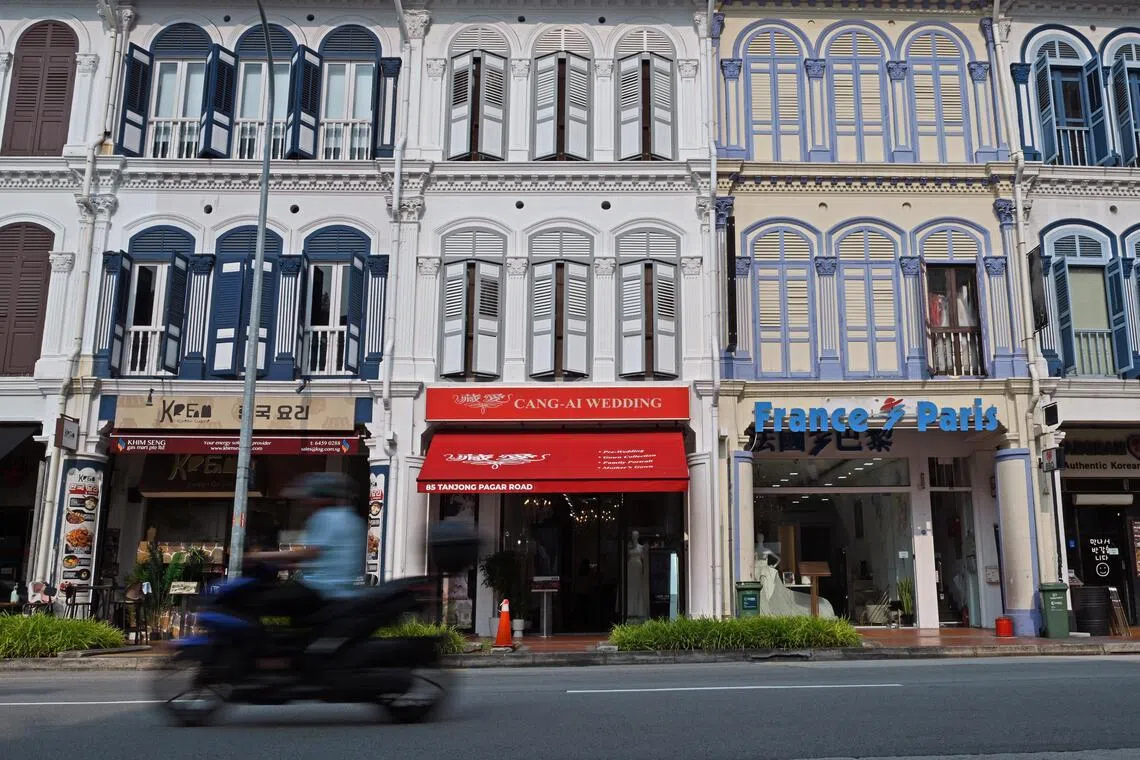
Former bridal salon enclave Tanjong Pagar is now left with a few studios and many more Korean eateries.
ST PHOTO: DESMOND FOO
Published Sep 03, 2026, 01:05 PM
Updated Sep 03, 2026, 04:50 PM
Bridal studios in Singapore have split into one-stop shops and specialised boutiques. The former are losing ground as couples grow more selective.
The wedding industry faces challenges due to fewer marriages, smaller celebrations, cautious spending, and competition from cheaper overseas services.
Lower rents in Ubi have made the area a new enclave for bridal studios, dethroning old hotspots in Tanjong Pagar and Shenton Way.
SINGAPORE – The busy thoroughfare at Tanjong Pagar Road has always been known as a bridal studio hub.
But an update is in order. At the shophouse-lined main street, purveyors of ivory gowns and romantic photo shoots are few, stragglers in a sea of Korean eateries.
It was not always like this. Derrick Goh, manager of holdout boutique Z Wedding, remembers that there were more than 20 studios in the area when he first took up his post in the late 2000s.
Now, he counts just four. Since the Covid-19 pandemic years , more than 10 of his former neighbours have disappeared, either shutting down or migrating to cheaper pastures, he says.
The exodus plays into fears of an industry in ill health. By now, the beats of the narrative are familiar: Studios go broke, flake on customers and leave a trail of unfulfilled orders and panicked brides in their wake.
This year has been especially grim. In August, the shock closure of major player Korea Artiz Studio triggered more than 60 complaints to the Consumers Association of Singapore for $271,000 in pre-payment losses.
Still, even that bumper crop is only about a third of the 195 complaints filed in the first eight months of 2026.
By contrast, the association received two complaints in 2025 and 103 in 2024, most of which came from the folding of another big fish, Love Nest, and its related entities .
The high-profile horror stories point to an ailing industry, yet tell only half the tale of an evolving sector that has split into two camps.
Death of convenience
Bridal studios here say the failed businesses are mostly one-stop shops – full-service operations that provide everything from gown rentals and pre-wedding photo shoots to hair, make-up and wedding-day photography in a single package.
It is this old-school model that is dying out as savvier consumers seek specialist outfits that run just one aspect of the show.
Kin Bridal, a gowns-only brand that launched with a shop in Ubi two years ago, is even growing. It has never been in the red, says 30-year-old founder Lynn Tan.
She adds: “We started because of passion and interest. Of course, when we were looking at financial modelling, it was also something that made sense and so far, there is proof of concept.”
Kin Bridal’s studio in Ubi. PHOTO: KIN BRIDAL
Kin Bridal’s studio in Ubi.
Scott Ng, co-founder of popular gown specialist Bridefully Yours, says: “In the last 10 years, a lot of providers started moving towards the specialist route. Instead of doing it all, they do one thing. The appeal of the one-stop shop is convenience, but we see that couples now prefer to pick and choose the best providers in each area.
“They want the best of everything now.”
Concentrating on gowns means Bridefully Yours can “go deep into the craft”, which makes for better products, says Ng’s wife and business partner, Eve Law. Though the millennial pair own a wedding group that covers other aspects of nuptials, they market services for pre-wedding shoots, photography and gowns as individual brands.
It is a way of distancing their brands from the old-fashioned, and increasingly untenable, under-one-roof model.
Bridefully Yours, a popular gown specialist in Singapore. PHOTO: BRIDEFULLY YOURS
Bridefully Yours, a popular gown specialist in Singapore.
PHOTO: BRIDEFULLY YOURS
The shift is palpable at the new bridal enclave in Ubi.
Whereas Tanjong Pagar was associated with full-scale studios, Ubi houses a mix of bridal businesses, including young specialist boutiques that shy away from aggressive marketing of packages.
The turn is in line with a more educated market.
Millennial and Gen Z couples tying the knot browse an endless catalogue of vendors on social media before they ever make an appointment and their approach is curatorial, says Law.
“They might get only one dress from us and others from competitors. Weddings are becoming an expression of their taste,” she adds.
Bridefully Yours’ gown rack. PHOTO: BRIDEFULLY YOURS
Bridefully Yours’ gown rack.
Like most of the younger salons, the seven-year-old brand gets up to 90 per cent of its customers from social media.
With searches for bridal services increasingly beginning online, one-stop shops that rely on wedding fairs for exposure are on the back foot.
Z Wedding traditionally depends on expos for 80 per cent of its clientele, says Goh. As fewer couples resort to fairs, the full-suite salon, which is more than 30 years old, has expanded into pet and non-wedding photography in recent years to shore up its business. Non-wedding jobs now account for one-fifth of its takings.
Specialist salons may be ahead of the full-service pack, but even they concede that the wedding business is getting tougher.
The key issue, they say, is structural: fewer marriages. There were some 25,000 marriages in 2025, a figure that all studio owners seem to have memorised. The unhappy number is the lowest in nearly a decade, excluding the pandemic-racked 2020, and marks a decline in marriages for the third year running since the post-pandemic spike in 2022.
The dip alone is not fatal to business, but it is a gloomy backdrop to the factors straining margins: shrinking wedding sizes, cautious spending and stiff overseas competition.
Newly-wed Tay Rui Lin held her bash in January at an open-air bar in the Dempsey enclave with just 130 guests. “We wanted it to be more of a casual party thing with our friends and family,” says the 31-year-old legal counsel. “We also wanted to save money for our honeymoon.”
She required only one dress for the event. It was made by a family friend on short notice, but if that had fallen through, she had a backup saved on Chinese e-commerce site Taobao – no studio necessary.
The old dogma of a hotel ballroom do with 50 to 100 tables has given way to an average of 20 to 30 tables, sometimes in “exotic venues”, says Bridefully Yours’ Ng.
“Weddings have become more couple-centric. Twenty years ago, it was very family-oriented, about ‘face’ , and all the relatives had to be there. The younger generation are keeping it simpler ,” he adds.
Accordingly, studios across the board are seeing drops in the average number of gowns rented by brides who are forgoing elaborate programmes that call for multiple dresses.
Says Kin Bridal’s Tan: “There’s not much we can do to change the minds of consumers. What we can do is be sensitive to upcoming trends. We know they are downsizing weddings and going simple, so that is reflected in the style of our gowns. We have a good range of simple gowns for them.”
Kin Bridal held a runway bridal show in August. PHOTO: KIN BRIDAL
Kin Bridal held a runway bridal show in August.
Annabel Law, founder of bundle package firm Wedding Venue SG, says prudent Gen Z wedding spending is behind the trend. The idea is not to throttle finances with a $100,000 blowout at the start of marriage.
“They have to pay for their house and renovation, and that is going up as well,” says Law.
The parsimony has amped up the threat of overseas competitors.
Popular pre-wedding shoots in China and Vietnam have eaten into sales of package deals, says a sales attendant at a Tanjong Pagar one-stop shop who spoke on condition of anonymity. She estimates a 40 per cent drop in customers since 2024.
A strong Singapore dollar and cheaper creative services abroad mean that doing an overseas shoot with local studios can cost less than a Singapore shoot – or the same, with more thrown in. And couples get a holiday to boot.
Gown rental specialists are rattled by brides who buy their dresses online or abroad.
Kin Bridal prices most of its rentals at below $1,000 a dress, “so people are not driven to fly to Vietnam or China”, says Tan.
Cheryl Ng, founder of gown rental boutique WeddingCrafters, was so worried about brides buying gowns online or overseas that in 2025, she launched an online store selling dresses for below $700 – though it has so far attracted mostly American buyers.
In the first eight months of 2026, she has also seen a quintuple jump in alteration requests for gowns purchased elsewhere.
WeddingCrafters specialises in locally designed wedding gowns. PHOTO: ANDROIDSINBOOTS
WeddingCrafters specialises in locally designed wedding gowns.
PHOTO: ANDROIDSINBOOTS
She says: “It’s a bit of a concern that even the many studios here are still not enough to cater to (these brides). That, plus a shrinking market, is a bit scary, especially if you look at the next five to 10 years as people just get more comfortable doing everything online.
“They do the whole try-on process here and then make the purchase online.”
Even high-end studios, which serve a more open-handed crowd, have discovered their luxury gowns are not so price-inelastic.
Bride-to-be Jane Tan is hardly operating on a shoestring. The 27-year-old is expecting 450 guests, customising an evening dress and renting a designer gown. However, she will get the gown from Kuala Lumpur instead of a Singapore studio.
There will be no boutique care, tailoring or rental of accessories, and there is a risk of chaotic transportation of the gown. But the bargain was a no-brainer, she says, as the same dress costs over 30 per cent more in Singapore.
Popular multi-label designer gown outfit Truly Enamoured is an outlier in that its growth has been positive, though modest, despite the drop-off in marriages. The studio carries gowns by brand-name designers such as Vera Wang and Viktor&Rolf.
Truly Enamoured was one of the first local studios to rent designer gowns. PHOTO: TRULY ENAMOURED
Truly Enamoured was one of the first local studios to rent designer gowns.
PHOTO: TRULY ENAMOURED
Yet, its premium catalogue, ranging from $2,000 to $10,000 a dress, wrests with pressure from Vietnamese dressmakers, says commercial director Zeng Jing Yi.
It is combating fiercer competition by doubling down on the customer experience. Post-pandemic, it created a team just to reply to text messages from brides within five minutes, and went from providing one stylist for each bride to deploying a full team of experts – one to choose the dress, another to tailor, and technical stylists who work with the seamstress.
All this has driven up costs, says Zeng. But prices have not budged since before the pandemic. “Our competitors haven’t raised prices, so we can’t either,” she says.
The pursuit of lower costs has made light industrial area Ubi an attractive proposition for some.
Tucked behind nondescript doors in dozens of buildings is a scattered network of bridal salons. Most were set up in the last three to four years.
The rent at an industrial unit in Ubi is about half the price of an average commercial unit, says Giorgia Couture founder Vienna Mei. She moved to Ubi from financial district development Marina One in 2024, driven by poor business in 2023. It is a smarter business strategy, she says – less money for more space.
Lili Lim, founder of studio Love To Love, cites the area’s winsome location near young couples in Sengkang and Tampines as her reason for settling down in Ubi.
Rates go even lower in industrial estates in the west, but Ubi offers enough relief to make a difference, she says, adding: “We don’t have to hard-sell to keep up with costs. This lets us focus on good service instead of trying to hit a high sales target. We don’t need to be so pushy, so we have an advantage, in this sense.”
Ubi’s relative remoteness is also no drawback in an age where traffic comes from social media and word-of-mouth recommendations, says Lim.
Most studios are by-appointment-only places so there is no need for a central location to entice walk-ins.
Kin Bridal’s Tan says proximity to other studios is also a boon as couples who tend to pack multiple fittings into a day find it easy to swing by her place.
Favourable rent has helped her price more competitively. “We spend less on rental, so we don’t need to transfer that to consumers,” she says.
The flourishing hub has frustrated others in the sector who maintain commercial units – one more thorn in the side of an industry vulnerable to price battles.
But for all their travails, studios do not want out.
Says Bridefully Yours’ Law: “People are still spending on weddings. It’s still a significant milestone, but the things they are spending on are shifting.
“It’s not a sunset industry.”
Weddings and engagements
曾经的婚纱店聚集地丹戎巴葛如今只剩下几家工作室和许多韩国餐馆。
圣路易斯照片:德斯蒙德·福
发布于 2026 年 9 月 3 日下午 1:05
更新于2026年9月3日下午4:50
新加坡的婚纱工作室已经分化为一站式服务中心和专业精品店。随着新人们越来越挑剔,前者正逐渐失去市场份额。
由于结婚人数减少、婚礼规模缩小、消费谨慎以及来自海外更便宜服务的竞争,婚庆行业面临着诸多挑战。
乌美较低的租金使该地区成为婚纱工作室的新聚集地,取代了丹戎巴葛和珊顿道等旧热点地区。
新加坡——丹戎巴葛路这条繁忙的街道一直以来都是婚纱工作室的聚集地。
但有必要更新一下信息。在这条两旁林立着店屋的主街上,提供象牙色礼服和浪漫摄影服务的店铺寥寥无几,它们就像是韩式餐馆海洋中的零星散落者。
情况并非一直如此。Z Wedding婚纱精品店的经理Derrick Goh回忆说,在他2000年代末刚上任时,这一带曾有20多家婚纱工作室。
现在,他只剩下四家了。他说,自新冠疫情爆发以来,他以前的十多家邻居已经消失了,要么关门歇业,要么搬到了更便宜的地方。
这场人员外流加剧了人们对这个行业健康状况不佳的担忧。如今,故事的套路已经耳熟能详:工作室破产、爽约,留下一堆未完成的订单和惊慌失措的新娘。
今年尤其糟糕。8月份,韩国知名家居品牌Korea Artiz Studio突然倒闭,引发新加坡消费者协会收到60多起投诉,涉及预付款损失高达27.1万新元。
即便如此,这笔丰收也仅占 2026 年前八个月提交的 195 起投诉的三分之一左右。
相比之下,该协会在 2025 年收到两起投诉,在 2024 年收到 103 起投诉,其中大部分来自另一家大公司 Love Nest 及其关联实体的倒闭。
这些备受瞩目的恐怖故事表明该行业正处于困境,但这仅仅讲述了一个不断发展、分裂成两个阵营的行业的一半故事。
便利之死
这里的婚纱工作室表示,倒闭的企业大多是一站式商店——提供全方位服务,从婚纱租赁和婚前摄影到发型、化妆和婚礼当天摄影,所有服务都包含在一个套餐中。
这种老式模式正在消亡,因为更精明的消费者会寻找只负责时装秀某个特定环节的专业公司。
Kin Bridal是一个只卖婚纱的品牌,两年前在乌美开设了第一家门店,如今发展势头良好。30岁的创始人Lynn Tan表示,公司从未出现过亏损。
她补充道:“我们最初是出于热情和兴趣。当然,当我们研究财务模型时,也觉得这样做很有意义,而且到目前为止,概念已经得到了验证。”
Kin Bridal位于Ubi的婚纱工作室。照片:KIN BRIDAL
Kin Bridal位于Ubi的工作室。
知名婚纱专卖店 Bridefully Yours 的联合创始人 Scott Ng 表示:“过去十年,许多供应商开始转向专业化路线。他们不再包揽一切,而是专注于某一方面。一站式服务的吸引力在于便利,但我们发现,现在的新人们更倾向于在每个领域挑选最好的供应商。”
“他们现在想要最好的。”
专注于婚纱意味着 Bridefully Yours 可以“深入钻研工艺”,从而打造更优质的产品,吴女士的妻子兼商业伙伴 Eve Law 表示。这对千禧一代的夫妇虽然拥有一家涵盖婚礼其他环节的婚礼集团,但他们将婚前拍摄、摄影和婚纱服务以独立品牌的形式进行销售。
这是使他们的品牌与老式的、越来越站不住脚的单一屋檐下模式保持距离的一种方式。
Bridefully Yours,新加坡一家颇受欢迎的婚纱专卖店。图片:Bridefully Yours
Bridefully Yours,新加坡一家颇受欢迎的婚纱专卖店。
照片:BRIDEFULLY YOURS
在乌比的新兴新娘聚集区,这种转变显而易见。
丹戎巴葛 (Tanjong Pagar) 以大型婚纱店而闻名,而乌美 (Ubi) 则聚集了各种婚纱店,包括一些年轻的专业精品店,这些精品店并不热衷于推销套餐。
这种转变符合市场受教育程度提高的趋势。
Law 表示,千禧一代和 Z 世代的准新人们在预约之前,会在社交媒体上浏览无数的供应商目录,他们的做法是精心挑选的。
“她们可能只会从我们这里买一件婚纱,其他的则会从竞争对手那里买。婚礼正逐渐成为她们品味的体现,”她补充道。
Bridefully Yours 的婚纱架。图片:BRIDEFULLY YOURS
Bridefully Yours 的婚纱架。
与大多数新兴美发沙龙一样,这个成立七年的品牌高达 90% 的顾客都来自社交媒体。
随着人们越来越多地从网上搜索婚庆服务,依赖婚博会来获得曝光的一站式婚庆服务机构正处于劣势。
据吴女士介绍,Z Wedding 过去80%的客户都来自婚庆展会。随着参加展会的新人越来越少,这家拥有30多年历史的综合性婚庆摄影工作室近年来拓展了宠物摄影和非婚庆摄影业务,以维持运营。目前,非婚庆摄影业务已占其总收入的五分之一。
专业美发沙龙可能比提供全方位服务的沙龙领先一步,但即使是他们也承认,婚礼行业正变得越来越艰难。
他们认为,关键问题在于结构性因素:结婚数量减少。2025年大约有25000对新人结婚,这个数字似乎所有制片厂老板都耳熟能详。这个令人沮丧的数字是近十年来的最低值(不包括受疫情重创的2020年),也是自2022年疫情后结婚高峰以来,结婚数量连续第三年下降。
单凭此次下滑本身并不会致命,但它却给利润率受到挤压的诸多因素蒙上了一层阴霾:婚礼规模缩小、消费谨慎以及激烈的海外竞争。
新婚不久的郑瑞琳 (Tay Rui Lin) 于一月份在登布西山 (Dempsey) 的一家露天酒吧举办了婚宴,仅邀请了 130 位宾客。“我们想和亲朋好友一起举办一个轻松的派对,”这位 31 岁的法律顾问说道,“我们也想为蜜月旅行省钱。”
她参加活动只需要一件礼服。这件礼服是由一位朋友临时制作的,但如果朋友没能帮上忙,她还在中国电商平台淘宝上保存了一件备用——根本不需要去工作室。
Bridefully Yours 的 Ng 表示,过去酒店宴会厅举办 50 到 100 张桌子的旧教条已经让位于平均 20 到 30 张桌子,有时甚至在“异国情调的场所”举办。
“婚礼现在更注重新人本身。二十年前,婚礼非常注重家庭,讲究‘面子’,所有亲戚都必须到场。年轻一代则更倾向于简单朴素的婚礼,”他补充道。
因此,各大婚纱店普遍发现,新娘们放弃需要多件礼服的繁复婚礼流程,导致她们租借礼服的平均数量下降。
Kin Bridal的Tan表示:“我们很难改变消费者的想法。但我们能做的就是关注未来的趋势。我们知道他们正在缩小婚礼规模,追求简约,所以我们的婚纱款式也体现了这一点。我们为他们准备了一系列款式简洁的婚纱。”
Kin Bridal于8月举办了一场婚纱时装秀。图片:KIN BRIDAL
Kin Bridal 于 8 月举办了一场婚纱时装秀。
婚礼场地套餐公司Wedding Venue SG的创始人Annabel Law表示,Z世代谨慎的婚礼消费是这一趋势背后的原因。他们的理念并非在婚姻伊始就挥霍10万美元,从而耗尽积蓄。
“他们得支付房款和装修费用,而这些费用也在上涨,”劳说道。
这种节俭风气加剧了海外竞争对手的威胁。
一位不愿透露姓名的丹戎巴葛一站式商店的销售人员表示,中国和越南流行的婚纱照拍摄已经蚕食了套餐产品的销量。她估计,自2024年以来,顾客数量将下降40%。
新加坡元走强,加上海外创意服务价格更低,意味着在海外与当地工作室合作拍摄可能比在新加坡拍摄更便宜——甚至可能价格相同,但还能获得更多增值服务。而且,情侣们还能顺便享受一次假期。
婚纱租赁专家们对那些在网上或国外购买婚纱的新娘感到不安。
Tan表示,Kin Bridal的大部分租赁礼服价格都低于每件1000美元,“这样人们就不会被迫飞往越南或中国”。
婚纱租赁精品店 WeddingCrafters 的创始人 Cheryl Ng 非常担心新娘们会在网上或海外购买婚纱,因此在 2025 年,她推出了一家在线商店,出售价格低于 700 美元的礼服——尽管到目前为止,它主要吸引了美国买家。
2026 年前八个月,她还发现,从其他地方购买的礼服的修改要求增加了五倍。
WeddingCrafters 专营本地设计的婚纱。图片:ANDROIDSINBOOTS
WeddingCrafters 专门经营本地设计的婚纱。
照片:ANDROIDSINBOOTS
她说:“令人担忧的是,即使这里有很多工作室,仍然无法满足(这些新娘)的需求。再加上市场萎缩,这有点可怕,尤其是考虑到未来五到十年,人们会越来越习惯于在网上完成所有事情。”
“他们会在这里完成所有试穿流程,然后再在线购买。”
即使是服务于出手阔绰的顾客的高端工作室也发现,他们的奢华礼服的价格弹性并不小。
准新娘简·谭(Jane Tan)的婚礼预算可不低。这位27岁的新娘预计将有450位宾客,她不仅要定制一件晚礼服,还要租借一件设计师礼服。不过,她租借的礼服并非来自新加坡的婚纱工作室,而是来自吉隆坡。
不会提供精品店式的护理、裁剪或配饰租赁服务,而且礼服运输过程中也可能出现混乱。但她表示,这笔交易绝对划算,因为同样的礼服在新加坡要贵30%以上。
颇受欢迎的多品牌设计师婚纱店 Truly Enamoured 是个例外,尽管结婚人数有所下降,但其业务却实现了增长,尽管增速较为温和。该工作室销售 Vera Wang 和 Viktor&Rolf 等知名设计师的婚纱。
Truly Enamoured是当地最早提供设计师礼服租赁服务的工作室之一。图片:TRULY ENAMOURED
Truly Enamoured 是当地最早出租设计师礼服的工作室之一。
照片:真心着迷
然而,其高端产品目录(每件连衣裙售价从 2,000 美元到 10,000 美元不等)面临着来自越南服装制造商的压力,商务总监曾静怡表示。
为了应对日益激烈的竞争,该公司加倍投入提升客户体验。疫情后,该公司专门组建了一个团队,确保在五分钟内回复新娘的短信;此外,该公司还从为每位新娘配备一名造型师,发展到部署一支完整的专家团队——一名负责挑选婚纱,一名负责裁剪,还有技术造型师与裁缝合作。
曾女士表示,所有这些都推高了成本。但自疫情爆发前以来,价格一直没有变动。“我们的竞争对手没有提价,所以我们也不能提价,”她说。
为了降低成本,乌美轻工业区对一些人来说极具吸引力。
在数十栋毫不起眼的建筑里,隐藏着一个分散的婚纱店网络。其中大部分都是在过去三四年内开设的。
Giorgia Couture创始人Vienna Mei表示,Ubi工业园区的租金大约只有普通商业单元租金的一半。由于2023年业绩不佳,她于2024年从金融区Marina One搬迁至Ubi。她认为这是一个更明智的商业策略——用更少的钱获得更大的空间。
工作室 Love To Love 的创始人 Lili Lim 表示,她选择在乌美定居的原因是,该地区靠近盛港和淡滨尼的年轻情侣,地理位置十分迷人。
她表示,西部工业园区的税率甚至更低,但Ubi提供的优惠足以产生显著影响,并补充道:“我们不必为了控制成本而强行推销。这让我们能够专注于提供优质服务,而不是试图完成高销售目标。我们不需要那么咄咄逼人,所以从这个意义上讲,我们具有优势。”
林表示,在如今客流量主要来自社交媒体和口碑推荐的时代,Ubi 相对偏远的位置也并非劣势。
大多数工作室都只接受预约,因此无需选址中心来吸引顾客。
Kin Bridal 的 Tan 表示,靠近其他工作室也是一大优势,因为那些一天内要进行多次试装的准新人们很容易顺道来她的工作室。
优惠的租金使她能够以更具竞争力的价格销售产品。“我们在租金上的支出较少,所以不需要将这部分成本转嫁给消费者,”她说道。
这个蓬勃发展的中心让业内其他拥有商业部门的企业感到沮丧——对于一个容易受到价格战影响的行业来说,这无疑是雪上加霜。
尽管面临种种困难,电影制片厂并不想退出市场。
Bridefully Yours 的法则指出:“人们仍然在婚礼上花钱。婚礼仍然是一个重要的里程碑,但他们花钱的地方正在发生变化。”
“这不是一个夕阳产业。”
婚礼和订婚