The Navy’s New Stealth Destroyer Has Watered Down Capabilities, Questionable Future海军新型隐形驱逐舰性能缩水,前景堪忧
The awesome-looking DDG-1000 Zumwalt class has been the victim of fluctuating Navy priorities and near-sighted cost-cutting—and even the tiny, three-ship fleet might be doomed.
新闻视频
Updated Jul 2, 2020 3:15 PM EDT
Next month the first DDG-1000 Zumwalt class stealth destroyer will be commissioned into US Navy service. The program has been through three name changes since it began two decades ago and the design’s planned production run has been slashed dramatically from nearly three dozen hulls to a measly three. The truth is that the assault on the Zumwalts started long before production was cut. The ship you see today, even in all its exotic glory, is the sad result of a long series of illogical cost-cutting initiatives and spastic fiscal re-prioritizations by the Navy. These misguided measures left the final Zumwalt class design a truncated and far less capable mutation of how it was originally envisioned, and degradation to the class’ capabilities continue to this day.
The story of how the Zumwalt class came to be is long, complicated and meandering, but the ship’s core concept was spurned in the 1990s under the Surface Combatant For The 21st Century (SC21) initiative . Both a cruiser and a destroyer were to evolve from a similar SC21 design. The cruiser could replace the Navy’s aging Ticonderoga class cruisers and the slightly smaller SC21 destroyer would eventually augment, then replace the young rleigh Burke class . By 2002 the SC21 cruiser had been cut, and a new cruiser program dubbed the CG-X was started alongside the DD-X, which would eventually become the Zumwalt class.
The ship to be commissioned USS Zumwalt on a shakedown cruise., USN
Different by design:
The DDG-1000 is about one-third larger in displacement than the latest Flight IIA Arleigh Burke destroyers, clocking in at around 14,500 tons, and it’s is innovative in a number of ways. Its low observable (stealthy design, which includes multiple spectrum signature reduction, including electromagnetic emissions, radar, acoustic and infrared, is unprecedented on such a large scale.
The ship’s power plant is absolutely cutting-edge, as is its electric distribution system. Dubbed the Integrated Power System, the system uses the ship’s gas turbines and generators to produce massive amounts of electricity that can be distributed in a “smart” manner throughout the ship. Gone are the mechanical linkages between the ship’s turbines and its shafts, instead the screws are turned by electric motors.
Although this “hybrid” propulsion concept is not new, the totality of the system and the amount of power the DDG-1000 can produce is. In total a Zumwalt class ship can generate a ridiculous 78 megawatts of electricity, which is enough to power nearly 10,000 average american homes. Even while cruising at 20 knots the ship has a whopping 58 megawatts of reserve power. The Zumwalt’s Integrated Power System keeps that power in reserve for new technologies to be fitted in the future, like lasers and especially electricity-chugging electromagnetic railguns .
An EM Railgun is not just a land or surface attack weapon. Its super-high velocity and flat-shooting projectiles should be capable of blasting aircraft out of the sky at long-range, and it may even have the ability to engage fast-approaching ballistic missiles.
The Zumwalts will also mark the return of naval gunfire support to the Pentagon’s active weapons portfolio, a capability that has been lost since the retirement of the Iowa class battleships in the early 1990s. Although the ships will not pack anywhere near the heavy-hitting punch of the Iowa’s 16 inch guns, they will be able to sling 155mm rounds much further and much more accurately.
A slew of versatile munitions can be fired from DDG-1000’s Automatic Gun Systems (AGS), including GPS guided and rocket-assisted rounds, giving the Zumwalt’s high-volume and extremely accurate precision fire-support capability over a range of 75 miles (100 miles according to some sources).
Defense News Daily writes:
“The Zumwalt Class’ 2 Advanced Gun Systems (AGS) are each expected to fire up to 10 rounds per minute, using an automated magazine. The 304 round magazine has to organize and process ammunition and propellant changes from up to 38 pallets. Each pallet weighs about 6,000-pounds, holding 8 propelling charges, and 8 of the 230-pound, GPS-guided 155mm Long Range Land Attack Projectile (LRLAP) shells. The gun can take and fire up to 10 rounds per minute, which BAE explains as “140 to 160 projectiles in the air at once [with] multiple round simultaneous impact effects against single or multiple targets.” On the other hand, actually doing that would quickly exhaust this ship’s 2 magazines.”
Impressive to say the least.
The AGS allows the Zumwalt to support ground forces, including special operations teams which can be deployed on small boats through the ship’s stealthy rear ramp, without the need for close air support assets. The DDG-1000 will have those as well. The ship can support MH-60R Seahawk helicopters that can sling AGM-114 Hellfire missiles and laser-guided rockets, as well as by MQ-8B and MQ-8C Firescout unmanned helicopters carrying a similarly deadly payload and providing reconnaissance and network relay functions over long distances. Emerging capabilities like the tail-sitting TERN will only increase the Zumwalt’s punch and aerial data-collection capabilities.
Zumwalt also has 80 Mark 57 vertical launch cells that line her gunnels, each capable of carrying up to four Evolved Sea Sparrow missiles, a single RGM-109 Tomahawk cruise missile or an ASROC rocket-assisted torpedo . In the future, stealthy and far more capable missiles, like LRASM , could be fitted.
In addition, the Zumwalt class has some very high-end sonar gear, including hull-mounted high-frequency and mid-frequency sonar systems that are optimized to detect submarines and mines in the challenging littoral (near-shore) environment.
The Zumwalt will go to sea with a crew of about 150 people – less than half that of the smaller Arleigh Burke class. It is supposed to accomplish this feat primarily through automation, and a completely new, open-architecture “electronic keel” has been designed into the ship. Dubbed the Total Shipboard Computing Environment, this network and computing system, will take advantage in leaps in automation while its massive coffin-like hardened servers fuse the ship’s sensor information, weapons capabilities, communications, navigation, engineering and even the ship’s predicted radar, acoustic and emissions signature at any given time into an integrated command and control interface. This information will be piped around the ship on common computing stations, so with the proper access, someone could control the ship’s navigation from engineering, or its weapons from the bridge. It is all very Star Trek: The Next Generation .
The nerve-center of the ship is also new. Gone is the classic low-ceilinged and vault-like Combat Information Center (CIC) of AEGIS equipped destroyers and cruisers. In its place is the SMC, the Ship’s Mission Center, which looks more like a starship command center than something found on a surface combatant.
Taken together, you get a ship that is intended to be able to fight far forward of any other major surface combatant in the Navy’s inventory. At least, that’s the idea. That capability could have wide implications for when fighting in an anti-access, area-denial scenario . In effect, Zumwalt is supposed to be able to bring its weapons, sensors and even special operations personnel to bear earlier in a conflict than its predecessors, all while ingesting information that it can feed back to less survivable weapons systems operating hundreds of miles further away from the enemy.
This all sounds well and good, but the Zumwalt also has its fair share of controversies, and not just those related to its $4B plus price tag, or its whopping $10 billion in development costs. The stability of its unique tumblehome hull form , the size of the crew in relation to the size of the ship, their ability to handle battle damage in combat, and the durability of the ship’s composite superstructure are among other serious “nuts and bolts” issues raising questions about the DDG-1000. We will have to wait and see whether these concerns prove credible.
Old Mistakes Die Hard- The Zumwalt class lacks a close-in air defense weapon system:
The DDG-1000 does not have a close-in weapon system (CIWS) , used as a last line of defense against incoming anti-ship missiles. Today the US Navy uses variations of the RIM-116 Rolling Airframe Missile , now in its second block form, and updated versions of the venerable Mk15 Phalanx gun system for this role. So why would the Navy omit such a critical system on such a valuable ship that will be fighting in the most inhospitable of combat environments?
One possibility is that the cost to integrate such a system into the ship’s stealthy slab-sided design was deemed too great by decision-makers in the Pentagon. The second possibility, one I find even more troubling, is that a dedicated CIWS was not included in the final Zumwalt configuration because the ship’s proposed “stealthiness” gave it greater survivability than its unstealthy counterparts, allowing for the omission of a CIWS as an acceptable risk. Wouldn’t such a statement do wonders when selling the program on Capitol Hill? Either way, the decision was incredibly near-sighted and potentially deadly.
The reality is that the Zumwalts , like all low-observable (stealthy) weapon systems, are NOT invisible. They are simply detectable at shorter ranges by certain sensors when compared with their more conventional predecessors. Low observability, especially for a ship, is a fantastic capability largely proven by Lockheed’s Sea Shadow technology demonstrator in the 1980s and 1990s. But for a capable and well-networked foe, there are ways to detect and prosecute a missile attack on a ship at standoff distances that do not necessarily include radars–or at least the ones whose operating bands the Zumwalt class is designed to evade. For instance, long-range over-the-horizon radar systems that use low frequencies have the ability to detect stealth ships and aircraft under some conditions, and their fidelity is only increasing as more capable computer processing power becomes available. So unless these arrays are destroyed before Zumwalt moves into their detection range, assuming there is political will to do so, then detection and possible low-fidelity targeting of the stealthy ship is possible even over great distances.
Technology aside, an enemy may just get lucky, or use non-traditional forms of searching and tracking even the stealthiest of ships. Even with the Zumwalt’s low-observable features, engagement by anti-ship missiles– some of which travel at very high-speed and can be launched in large salvos–is possible. Additionally, if the ship were struck in another fashion, by a torpedo, mine, aircraft dropped munition or anti-ship ballistic missile, it is doubtful that its radar signature would stay highly masked and the Zumwalt’s visual and infrared signature would certainly blossom exponentially from the damage.
In those circumstances, damage control with the Zumwalt’s small crew would be bad enough. Not having a CIWS capable of rapid engagements, one that would work automatically as sea-skimming missiles homed in on a now unmasked and crippled ship, is a very empty-headed call.
In war the unexpected or unlikely is bound to happen, and vulnerabilities in any technology–no matter how advanced–can be exploited by the enemy without warning. It’s better to be safe than sorry when it comes to a critical last line of defense against increasingly prevalent air-breathing anti-ship missiles. Especially since these munitions are increasingly networked and able to search an area for targets of opportunity, and engage those targets all on their own, even without the use of any kind of radar.
Anti-ship missiles are also increasingly “dual-mode” capable when it comes to their terminal homing abilities. This means that they have both radar and imaging infrared sensors to detect their target and prosecute their final attack. Even though the DDG-1000’s infrared signature is supposedly reduced, it’s not eliminated. The Zumwalt’s hot gun barrels and vertical launch system cells won’t help keep the DDG-1000 undetectable to infrared sensors during combat.
Some may say that cutting edge “soft kill” defensive capabilities have enough merit to omit a CIWS. These include utilizing the ship’s powerful AESA radar to shoot pencil thin beams of energy that fry a missile’s sensitive sensor components, lasers that dazzle electro-optical or infrared sensors, flares and smoke screens that misdirect missile seekers or obscure the ship’s infrared signature, and high-end electronic warfare systems that can confuse or blind the radars of incoming missiles. While countermeasure technologies are advancing more rapidly than ever, It’s doubtful that they are good enough to rely on them solely, especially when 150 sailor’s lives are at risk aboard America’s most expensive and supposedly capable surface combatant.
The enemy can adapt their weapons with hardened missile components and dual mode seekers, or even tri-mode seekers (adding electromagnetic homing capabilities) for terminal guidance. This is just the never ending saga of measure and countermeasure. And in a conflict with a peer-state, the enemy would be unlikely to fire a single missile. Instead, the Zumwalt should be prepared for multiple missiles of multiple types, flying diverse flight profiles and from multiple vectors, in an attempt to overwhelm a ship’s defenses. And since DDG-1000 will often be working alone, far ahead of the fleet, closer to shores where its weapons and sensors are optimized to perform, an overwhelming and multi-layered attack that comes at short notice with little time to react is very real possibility.
You would think that fixed versions of the Rolling Airframe Missile launcher that sit flush behind sliding doors on each side of DDG-1000s deckhouse could have been feasible, but as of now nothing like this has been described as existing on the design. One day Rolling Airframe Missiles may be adapted to be fired from the ship’s Mk57 vertical launch system, but this would put the missile at an energy disadvantage after launch and only four missiles per cell have been rumored to have been proposed. Seeing that the ship only has 80 VLS cells in total, that’s a lot of precious real estate to take up for just a handful of missiles. Still, there is no indication that this capability is being seriously looked at for DDG-1000. Even the mounting of a Oerlikon Millennium Naval Revolver Gun in its stealthy housing would be an off-the-shelf CIWS solution for the Zumwalt class, and one that would make far more sense while being much less expensive than integrating a whole new missile concept with the ship.
As designed, the DDG-1000s were intended to pack a pair of 57mm Mk110 cannons which have limited aerial CIWS capabilities. Generally, this gun is capable, especially with P3 programmable ammo loaded in it, but it does not offer the reliability, maneuverability and rapid engagement capability of the RIM-116 RAM or even the independent operation and volume of fire of the 20mm Vulcan cannon equipped Phalanx.
The Mk110 gun system in its stealthy enclosure. Two of these would have been mounted above the rear corners of DDG-1000’s hangar. , Poxnar/wikicommons
Even the diminutive Littoral Combat Ship , w h i c h packs the same 57mm gun system, is equipped with a CIWS in the form of the Mk 15 Phalanx or SeaRAM–a self-contained version of the Rolling Airframe Missile system that merges a RAM magazine with the Phalanx’s mount and radar system. It seems more than just a little odd that an LCS will have better close-in protection against incoming air-breathing threats than the world’s most advanced and expensive surface combatant in a last line of defense scenario. Especially considering the DDG-1000 is meant to penetrate further into high-threat environments than any other surface vessel, while the LCS can’t even fight in medium threat environments without an AEGIS equipped destroyer or cruiser protecting it nearby.
But the omissions didn’t stop there. Even the limited CIWS capability offered by the Mk110 57mm cannons were eliminated from the Zumwalt class baseline design in 2014. This late revision was justified by the Navy as a move that would save money and weight. Now the ships will get two cheaper and much smaller Mk46 30mm Bushmaster cannons
w i t h m i n i m a l a i r d e f e n s e c a p a b i l i t y that are largely curtailed to use defending the ship against swarming small boat attacks at very close ranges (about two miles or less) and have no real air defense capability. Even the 30mm’s effectiveness against swarming small boats is being questioned when compared with the much longer-ranged 57mm guns that were intended for the ship.
The Zumwalt will also carry RIM-162 Evolved Sea Sparrow Missiles (ESSMs ), four of which can be packed into a single vertical launch system tube. These maneuverable missile have close-in engagement capabilities, but the Navy has already come to terms with the fact that they cannot replace a CIWS. Flight IIA Arleigh Burke class destroyers were originally to be equipped without a CIWS, and many initially sailed without one installed, relying totally on VLS launched ESSMs for close-in to medium-range protection. This proved to be short sighted, and the ships have since been retrofitted with a proper CIWS system.
And the Navy’s commitment to dedicated CIWS systems has since accelerated. The Navy destroyers that are forward deployed to Spain, ones that often sail into the super anti-ship missile engagement zone that is the Black Sea , are getting SeaRAM systems installed in addition to the Phalanx CIWS they already carry.
Moral of the story? American destroyers are getting up-gunned with more CIWS capability, not the other way around.
The Zumwalt’s area air defense and ballistic missile defense capabilities were thrown overboard long ago:
It is logical to think that the Navy’s new stealth super destroyer would be well stocked with a variety of the latest surface-to-air missile technologies, creating a “layered air defense” ranging hundreds of miles from the ship. Every American Navy cruiser and destroyer built in the last 30 years has had this feature set at the heart of their multi-mission capabilities. Yet once again, when it comes to the stripped down Zumwalts, this is not the case.
These destroyers ended up being focused on the land bombardment and littoral dominance missions, not on air defense–even though these mission requires robust air defense capabilities to be successful. Area air defense and anti-ballistic missile patrol duty will instead be provided by the upcoming Flight III Arleigh Burke class ships and existing Aegis equipped surface combatants. In fact, while the DDG-1000 has most of the physical hardware needed for wide-area air defense missions, and even anti-ballistic missile defense, it runs non-Aegis software that does not have the capability to fire and use the SM-2/3/6 “Standard” series of missiles . Making things worse, half its intended radar system, one that would have made it the most capable air defense asset ever sent to sea, was gutted as a cost saving measure.
As a result, the DDG-1000 will only be stocked with Evolved Sea Sparrow Missiles (ESSMs) for self defense against aerial threats, vastly restricting the range and breadth of the ship’s counter-air potential. The RIM-162 ESSM has the ability to fly out to around 30 miles, which pales in comparison to the long-range and heavy hitting Standard missile series carried by the Navy’s existing AEGIS cruisers and destroyers.
Additionally, the large S-band SPY-4 radar array, originally designed to be 22 feet high and to work in concert with the smaller X-band SPY-3 radar array as part of the integrated Air and Missile Defense Radar (AMDR) system, was removed from DDG-1000. The reasoning behind this was to save on cost, but it also promoted the upcoming Flight III Arleigh Burke ships into the area air defense and anti-ballistic missile defense role exclusively.
This system would have allowed the Zumwalts to utilize SPY-4 for volume search, long-range tracking, ballistic missile discrimination and some missile communications and SPY-3 for horizon search, high-fidelity tracking, target illumination and missile communications simultaneously in an unprecedented, fused, “dual band” manner. Instead, the smaller SPY-3 radar was installed without its counterpart SPY-4, and the SPY-3 system was given software to perform both roles, although with severely degraded overall capabilities.
So between the undeveloped software, inability to fire Standard Missiles, and the omission of the originally intended radar suite, a ship that could have set a new standard in surface-based air warfare capability was drastically degraded to save a few bucks and to cement the Arleigh Burke Flight III’s future.
The strangest thing about this decision is that the full Dual Band AMDR system, with both arrays, will be installed on the USS Gerald R. Ford supercarrier, so it is not like the system is no longer in development. Considering super carriers operate while cocooned inside a thickly layered air defense net, provided by an armada of Arleigh Burke and Ticonderoga class guided missile picket ships, all with magazines bristling with Standard missiles as well as ESSMs, and these floating air bases also pack around their own air force as well, this does not make a good case for the adequacy of the Zumwalt’s truncated anti-air sensor suite.
The Ford’s dual band radar apertures are clearly visible on the ship’s island super structure., Huntington Ingalls
In reality, DDG-1000’s anti-air capability is defensive in nature, with only a limited capability for highly localized air defense within a couple dozen miles of the ship. This is a travesty, a missed opportunity that makes no sense, fiscally or tactically. A string of SM-2/3/6 and SPY-4 radar equipped DDG-1000s could create an “invisible sanitized corridor” stretching over many hundreds of miles, deep into denied territory. In this corridor ships and aircraft could transit in relative safety, deeply piercing the enemy’s anti-access/area denial bubble.
In addition, having missiles such as the SM-6 onboard DDG-1000 could offer stealthy fighter and bomber aircraft like the F-35, F-22 and the upcoming B-21 an extended magazine once their own limited weapons stocks run dry. Cooperative Engagement Capability and similar concepts could see stealthy allied aircraft targeting enemy aircraft deep in their own airspace and cueing DDG-1000-based missiles onto those targets. In fact, remote pairing between the F-35 and the SM-6 was just tested successfully . The SM-6, with its secondary surface and ground attack capabilities, could even allow stealthy aircraft to remotely target boats and ground targets far from shore for these missiles to strike after they were ordered to be launched from a DDG-1000. This hunter-killer concept would dramatically increase the tactical options for low observable aircraft already at risk over enemy territory, and it’s a capability only the Zumwalts could provide.
Artist rendering of a F-35 providing targeting information for a remotely fired SM-6., Lockheed Martin
Although the idea of using the DDG-1000 as an “arsenal ship” is promising, and although the DDG-1000 is perfectly suited for providing this capability to stealthy combat aircraft as both will operate closer to threats than their conventional, non-stealthy counterparts, there is one problem. Filling the Zumwalt’s limited VLS “real estate” (80 VLS cells vs 96 on the Arleigh Burke class and 122 on the Ticonderoga class) with missiles that the ship cannot provide targeting and guidance for organically is unlikely to happen. If the ship had its full radar and software suite available, it would be able to employ these missiles on its own. Making them available for remote targeting by another player on the battlefield would be no big deal. Stocking them just for this purpose is highly unlikely.
In the not so distant future, ballistic missile defense will not just be about protecting a region from a rogue attack, it will also be about protecting the anti-ballistic missile ship, and its floating companions, themselves. In a world where anti-ship ballistic missiles are becoming a reality, ballistic missile defense (BMD) capabilities will become more of a defensive necessity for flotillas than a “regional defense mission” of its own. The full SPY-3/SPY-4 radar suite, with SM-2/3/6 capabilities would have allowed the Zumwalt class to simultaneously watch for incoming ballistic missiles as well as air breathing threats (aircraft, cruise missiles etc), and engage those threats over long distances if need be.
Today, Aegis ballistic missile defense equipped cruisers and destroyers largely are unable to execute both the air defense and anti-ballistic missile defense function at the same time, although the Flight III Arleigh Burke class, which will feature a full and updated version of the AMDR radar known as the SPY-6, will be able to. But seeing as DDG-1000 will often operate independently from larger flotillas, it will have to go about its business without an anti-ballistic missile “umbrella” overhead, even while operating deep into denied territory.
Bad decisions neutered the Zumwalt class, but a study with questionable conclusions doomed it:
The DDG-1000’s area air defense and anti-ballistic missile capabilities were abandoned slowly over time. Originally the DG(X), which became the Zumwalt class, was supposed to have a larger air defense focused sister class, the CG(X). The designs were very similar between the two types but the cruiser was to be larger with a greater focus on air defense, but the CG(X) was cancelled in 2010, leaving just the Zumwalt class to fend for itself.
Artist rendition of the DDG-1000., US Navy
Yet even the Zumwalt class was truncated in size from its original concept under the DG(X) initiative. Magazine size in particular was slashed from between 116 and 128 VLS cells down to just 80. What’s most troubling about this move is that the Mk57 VLS cells on the Zumwalt class are larger than the Mk41 cells found on today’s AEGIS cruisers and destroyers. This means that larger and even longer-range surface-to-air weaponry and ballistic missile interceptors could have filled many of these cells, giving the ship a unique long-range air defense capability to match the abilities of its SPY-3 and SPY-4 radar systems. As mentioned earlier, this radar suite didn’t pan out either.
The cancellation of the CG(X), and the limiting of the Zumwalt class’ production numbers to just three ships while curtailing their baseline capabilities was spurred by a 2009 radar/hull study initiated by the Navy. The study pushed for an outgrowth of the already fairly over-built Arleigh Burke class destroyer to accommodate a larger radar suite, a more advanced combat system, and much more electrical power generation, among other upgrades. The study concluded that the Navy should ditch the Zumwalt’s potentially revolutionary design and unique capabilities and stick with a 30 year design that would offer lower risk and would be more cost effective, stating that each new Flight III Arleigh Burke class would cost less than $2B each.
Rendering of what a AMDR equipped Flight III Arleigh Burke class may look like., …
This report for which the Navy hung its future surface combatant capability upon, has since proven to have been less than accurate or truthful. In 2012 the GAO concluded that:
“The Navy relied on its 2009 Radar/Hull Study as the basis to select DDG 51 over DDG 1000 to carry the Air and Missile Defense Radar (AMDR) as its preferred future surface combatant—a decision that may result in a procurement of up to 43 destroyers and cost up to $80 billion over the next several decades. The Radar/Hull Study may not provide a sufficient analytical basis for a decision of this magnitude. Specifically, the Radar/Hull Study:
focuses on the capability of the radars it evaluated, but does not fully evaluate the capabilities of different shipboard combat systems and ship options under consideration,
does not include a thorough trade-off analysis that would compare the relative costs and benefits of different solutions under consideration or provide robust insight into all cost alternatives, and
assumes a significantly reduced threat environment from other Navy analyses, which allowed radar performance to seem more effective than it may actually be against more sophisticated threats.
The Navy’s planned production schedules of the restart DDG 51 ships are comparable with past performance and officials told us that hull and mechanical systems changes are modest, but these ships will cost more than previous DDG 51s. A major upgrade to the ship’s combat system software also brings several challenges that could affect the restart ships, due in part to a key component of this upgrade that has already faced delays. Further delays could postpone delivery to the shipyard for the first restart ship, and could also jeopardize the Navy’s plan to install and test the upgrade on an older DDG 51 prior to installation on the restart ships. This first installation would serve to mitigate risk, and if it does not occur on time the Navy will be identifying, analyzing, and resolving any combat system problems on the first restart ship. Further, the Navy does not plan to fully test new capabilities until after certifying the upgrade as combat-ready, and has not planned for realistic operational testing necessary to fully demonstrate its integrated cruise and ballistic missile defense performance.
The Navy faces significant technical risks with its new Flight III DDG 51 ships, and the current level of oversight may not be sufficient given these risks. The Navy is pursuing a reasonable risk mitigation approach to AMDR development, but it will be technically challenging. According to Navy analysis, selecting the DDG 51 hullform to carry AMDR requires significant redesign and reduces the ability of these ships to accommodate future systems. This decision also limits the radar size to one that will be at best marginally effective and incapable of meeting the Navy’s desired capabilities. The Navy may have underestimated the cost of Flight III, and its plan to include the lead ship in a multiyear procurement contract given the limited knowledge about the configuration and the design of the ship creates potential cost risk. Finally, the current level of oversight may not be commensurate with a program of this size, cost, and risk and could result in less information being available to decision makers.”
Zumwalt class compared to Arleigh Burke Flight IIA. , USN
Since the GAO published its counter to the Navy’s 2009 radar-hull study, the cost of Flight III Arleigh Burke class has remained a key uncertainty, and much of the risk that the Navy was trying to avoid by going with an existing design over DDG-1000 will become less relevant as the Zumwalt class rapidly matures. Not only that, but under the current plan, the Arleigh Burke class is supposed to remain relevant through 2072 , at which time the basic design will be more than 80 years old. Considering how quickly potential peer-state competitors’ military capabilities are advancing around the world, this seems like an absurd proposition.
These new Flight III Arleigh Burke class destroyers, of which at least 22 are slated to be built (likely many more), will have very limited room for growth and may not be able to accommodate disruptive technologies like railguns in the future. So what the Navy gets with this restart and revamping of an old class is a fully maxed-out design on day one–a ship that will struggle to adapt to new threats and that is not nearly as survivable as the much larger, more adaptable and stealthy DDG-1000.
The worst part of this blunder it is that these two designs should not have to be pitted against each other. They are much more effective working cooperatively as part of a larger high-low capability mix of naval strategy. Producing a smaller number of Zumwalt class destroyers while also producing new Arleigh Burke class destroyers seems like a fairly equitable trade off, especially since the DDG-1000’s development costs are already sunk, even if such a plan results in a slight overall active hull number decrease.
If the Navy had procured a proper frigate instead of the Littoral Combat Ship, one that is armed with Evolved Sea Sparrow Missile and can defend itself in medium threat environments, a plan to procure both the Zumwalt class and more Arleigh Burke class destroyers would be much more acceptable. Although it may mean slightly fewer hulls in the water overall, a new frigate could pick up many of the lower-end roles currently performed by Arleigh Burke class destroyers. This would free the Navy’s cruisers and destroyers to concentrate on higher-end tasking.
Ongoing design sacrifices:
Although the DDG-1000s will be tougher to detect by enemy sensors than their less stealthy progenitors (about 50 times less visible on radar according to the Navy, although this figure is clearly anecdotal), they will also be operating much closer to enemy sensors. As a result, these ships will have to pay close attention to the electromagnetic spectrum around them and will have to use their incredible processing power to best predict the edges of the enemy’s detection capabilities. Many variables go into this, including the configuration the ship is in at any given time, the environment around it, what type of emissions it is putting out, what type of electronic countermeasures are being used, and even at which aspect of the ship is being presented to each known enemy sensor.
Passive sensors are far more problematic, and it is nearly impossible for Zumwalt to know where they are and if they are tracking her. These include electromagnetic sensors that can detect radar and communications emissions, and in some cases triangulate them to a geographical position. DDG-1000 surely has the ability to actively mask its radar and communications transmissions using low-probability of intercept tactics, but these tactics are not perfect. This is especially true considering how slow the ship moves compared to, say, a stealthy aircraft; exposure time is just far greater. These passive sensors can also include infrared scanning and electro-optical devices, and maybe most importantly, acoustic sensors. The Zumwalt is known to have a chilled exhaust and a very quiet audible signature, some have even posited it is akin to an Ohio class nuclear ballistic missile submarine, though such a claim is doubtful.
While details about the specific nature of Zumwalt’s various signatures are classified, it’s clear that when it comes to radar visibility, the ship has devolved considerably over the years. What was once a very stealthy design has been the victim of a never ending list of compromises. In recent years these compromises have become almost comically absurd, and now it seems that the Navy is willing to bolt anything onto the the class in order to save money.
First off, USS Lyndon B Johnson (DDG-1002), the final ship in the tiny class, will not feature the stealthy composite deckhouse that is such a key feature on the baseline DDG-1000 design. Instead it will be made out of steel . This not only has the potential to drastically increase the ship’s radar signature , it will also greatly increase weight exactly where you don’t want it on a ship (high up) that already faces questions about its stability. The Navy says that, even with these design changes, the ship’s weight distribution and radar signature is “acceptable.” Exactly what that means is unclear.
DDG-1000s massive composite deckhouse is lowered onto its hull., USN
Enjoy the Zumwalt’s clean lines now because they are about to change significantly. In a race to save money, the Navy has decided not to embed a bunch of sensors and communications infrastructure into the ship’s slab-sided deckhouse. Instead they will be bolted on as if they were an afterthought, making a $4B+ stealth ship, well, less stealthy to say the least.
The Navy told USNI News last march the following:
“The current DDG-1000 topside configuration is a performance and weight improvement and cost-avoidance initiative. This configuration adds a mast to the forward part of the deckhouse and relocates several communications systems including Ultra High Frequency (UHF), Very High Frequency (VHF), data link and the wind sensor from the deckhouse to the mast. This configuration will be present on all three ships and provides improved performance redundancy, cost avoidance and weight reduction, while still meeting Key Performance Parameters (KPP) requirements for Radar Cross Section (RCS).”
The Zumwalt’s new configuration. Gone are its stealthy lines and added are many small sensors and comm systems bolted onto her deckhouse and she even has sensor mast now. , USN
The bottom line is that DDG-1000 is still stealthy, but not nearly as stealthy as it could be, or as it was envisioned to be. Just because a 600 foot warship has the radar signature of a fishing trawler, it doesn’t mean that it can’t be seen or attacked. Taiwan did just that by accident just months ago.
It’s disheartening that the Navy has bet so much on the Zumwalt’s low observable design, and paid huge dollars developing it, but then has not done everything it can do maintain and or improve upon it. In fact, they have done the exact opposite.
A mismatched mash-up of capabilities:
The various omissions in the Zumwalt’s capability have resulted in a ship that is focused on chucking cruise missiles and sending GPS guided cannon shells dozens of miles inland. But if the Navy wants a stealth Tomahawk chucker, guess what? They already have four of them with far more vertical launch cells than the DDG-1000 has. These are the converted Ohio class nuclear-powered guided missile submarines (SSGNs). In the coming years, Virginia class nuclear fast attack submarines with extended payload modules will take up this role as the four converted Ohio class SSGNs are retired.
Minus its 155mm guns, has the stripped-down, anti-air mission-less Zumwalt become a far more vulnerable above-water guided missile submarine? A stealthy anti-submarine, special operations, and land attack arsenal ship? If so, why not build more submarines instead? They would be far more survivable and can stay on station much longer than the Zumwalt .
Ohio class SSGN with its special operations capabilities and 154 TLAMs. The boat also retains its outstanding anti-submarine capability as well. , …
Even with the Zumwalt’s more limited set of missions, the ships are supposed to do something a submarine cannot, they have the ability to deliver special operations forces via helicopter deep into enemy territory and support them directly with long-range gunfire… Theoretically at least.
Yet, even this mission set is problematic. While the destroyer may be stealthy, the manned helicopters it carries (MH-60R/S) certainly aren’t. This mismatch in capabilities limits the vessel’s ability to differentiate itself from what a submarine could offer in anything but a low-threat environment without major external third-party support (jamming, SEAD, escort etc). Pairing the DDG-1000 with a stealthy helicopter would allow it to operate much more independently, especially in the “over the beach” special operations support role. Independence of operation may not be a choice, considering the ship’s capabilities are unlike any other in the fleet and it is designed to go where other surface combatants cannot.
We do know that stealthy Black Hawk variants exist. Procuring a number of these aircraft for use with the Zumwalt class would at least offer a differentiation between what the ship can provide, compared with submarines, when it comes to special operations support missions.
The idea of the Navy fielding such a unique capability is unlikely as the service’s two special warfare helicopter squadrons have already been cut down to just one to save money, and they can’t even get their aging HH-60Hs replaced with new Seahawks. There is a chance that this mission could be provided by the Army’s 160th Special Operations Air Regiment who are known to already operate these rare aircraft. Their pilots are often deck qualified as well, but there has been no mention of a serious plan to match these two stealthy assets up together even on a case-by-case basis. Doing so would at least lend more credibility as to the utility of certain aspects of the Zumwalt’s final, albeit far less than optimal configuration.
One also has to ask themselves the value of just three stripped down and shrunken DDG-1000s when it is pretty clear that proper investment will not be made into technologies uniquely suited for the tiny class. Instead the Navy will likely procure weapons tailored to the much more plentiful Flight III Arleigh Burke class and its progenitor cousins.
The Tomahawk cruise missile for instance, even in its most advanced form , is dated and less than ideal to be used against a capable foe with a high-grade integrated air defense system and strong shoreline, airborne and shipborne defenses. A new stealthy cruise missile would be much more appropriate for the Navy’s new stealth destroyer. Lockheed’s aforementioned LRASM and a land attack version of that missile, would be a good candidate for this capability, although it would not take full advantage of the ship’s larger VLS cells. A very high-speed prompt strike missile would also be very useful for a ship that can operate closer to enemy shores, and such a system would likely take advantage of the DDG-1000’s high adaptable VLS system which can manage as much as 45% more rocket flow compared to the Mark41 VLS. But once again, with only three ships in the fleet, the Zumwalt’s will likely be relegated to using the Arleigh Burke’s hand-me-downs.
DDG-1000 under construction. You can see one of her 155mm AGS barrel sticking up., USN
In other words, because the Navy pulled anchor on the Zumwalt class so early, it’s doubtful that the proper investment will be made to their ongoing evolution. This situation is not only relevant in the way of updated radars and subsystems, but also in terms of game-changing and “synergistic” peripheral technologies tailored to the Zumwalts unique attributes.
With all this in mind, as the years go by will the Navy really continue to use the Zumwalt class as a front-line weapon system, or more as a testbed for new technologies? Will a fleet of just three ships, which feature a slew of unique systems all in need of continued support, be deemed too expensive to operate as they age and require maintenance and upgrades to remain relevant? This question is especially valid considering that the DDG-1000 lacks the ability to execute the area air defense mission by decree, making it more of “niche capability.” Considering that all three ships will be based on America’s west coast, will having maybe a single DDG-1000 deployed in the Pacific at any given time really offer enough capability to justify their running and sustainment costs for decades to come? Time will tell, but the Pentagon has a nasty history of losing interest in these types of programs when funding gets tight and the overall size of a force, whether it be in aircraft or ships, is threatened.
A more logical solution to this whole destroyer procurement controversy would have been to build a single full-up DDG-1000 as a technology demonstrator. Once the Navy has actually evaluated the real ship and what it can do, then it could have made its decision on how to procure it and/or the Flight III Arleigh Burke class. Instead key decisions were made to curtail and eventually cut the Zumwalt class program based on questionable studies even though the actual ship would still be constructed and available for testing just a handful of years later.
Once again, the Pentagon is making long-term, high-impact procurement decisions without even testing the options it has already paid to develop before making those critical choices. It is another form of the concurrency that has done massive damage to America’s weapons inventories in recent decades.
The F-22 of the high seas:
In the end the Navy is betting a lot on the idea that this huge ship, one that moves in two dimensions at moped speeds, will never be detected and thus engaged by a large aerial threat. The ship has just one limited-range air defense missile to defend itself and the omission of any sort of traditional CIWS capability is a repeat of a lesson the Navy has already learned. In all, this lack of area air defense capability is a mismatch when considering the ship’s “tip of the spear” mission. The application of stealth technology is very helpful when it comes to survivability but it does not make something invisible or invincible, especially not a ship this large, or one that has had its radar signature increasingly compromised in the name of relatively modest cost savings.
These issues combined with the massive reduction in production numbers leave comparisons between the Zumwalt class and the F-22 Raptor all but intuitive. Both had their production cut incredibly short under the purview of Secretary of Defense Robert Gates and the Obama Administration even before the weapon system could really prove its value. Both had decades long development cycles that cost many billions of dollars, and both are now being called too expensive although their unit price was predicted to drop drastically if they were procured in reasonable quantities. Both also had their demise justified by prioritizing supposedly lower-risk, lower-cost, jack-of-all-trades alternatives that are now proving more troublesome and costly than originally envisioned. And both had key capabilities withheld under the false guise of “savings.”
The F-22 Raptor, of which just 187 operational examples were ever built, has much in common with the Zumwalt class., USAF
Not giving the Zumwalts the proper hardware and software to execute area air defense and eventually the ballistic missile defense mission is just like how the USAF fielded the F-22 without a helmet mounted display or the latest AIM-9X sidewinder missile: Spend tens of billions of dollars, then draw the budgetary line arbitrarily around relatively low-cost but key survivability and defensive design features. Shameful. Now the question is, will the Navy lament the decision to deep-six the Zumwalt class prematurely just as the USAF does for shuttering F-22 production after just 187 operational examples were built.
The saddest part of this story is that the ship had the potential to be an absolute disrupter in the surface warfare realm. One that could help enable so many others, in the air, on the sea and on the ground, to do their job against the most advanced peer-state competitors. Instead, the Pentagon’s chronic attention deficit disorder, near-sighted cost cutting measures and shipbuilding politics resulted in a ship that although still impressive on some levels, when you go just below its awesome sci-fi exterior, questions about squandered potential and contemplations on what could have been become unavoidable.
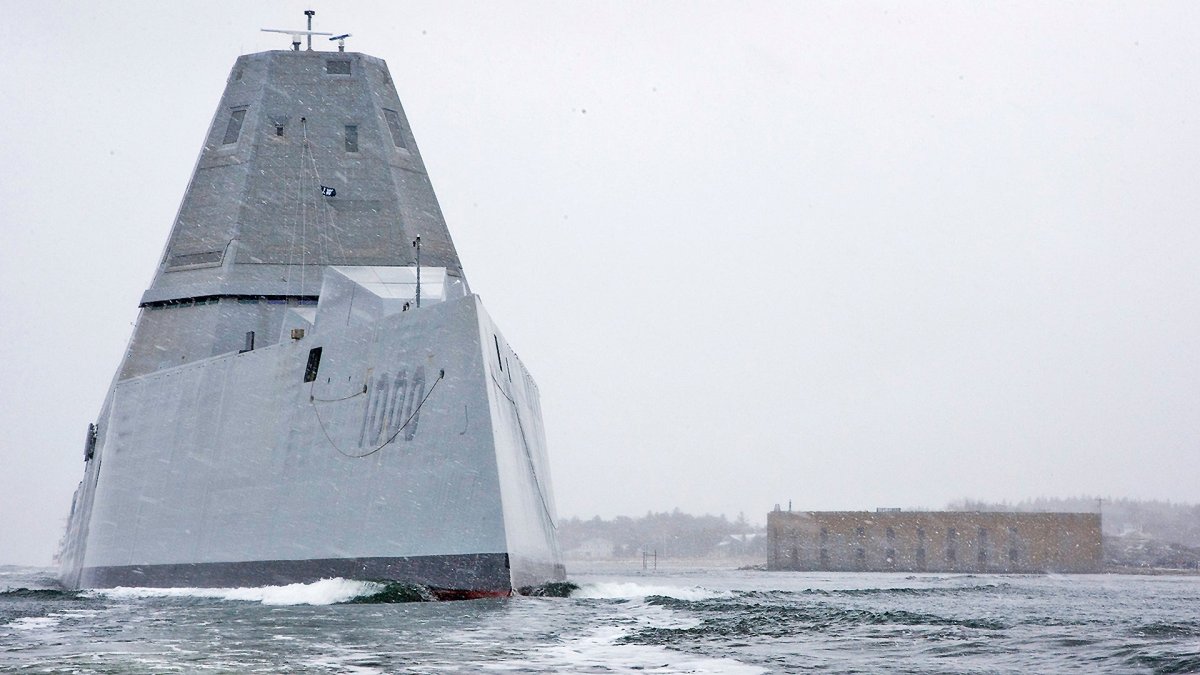
The Zumwalt is one visually imposing ship., USN
Portions of this piece were adapted from prior work by the author.
Contact the author: Tyler@thedrive.com
Comments couldn’t be loaded. Please refresh the page.
更新于美国东部时间2020年7月2日下午3:15
下个月,首艘DDG-1000“朱姆沃尔特”级隐形驱逐舰将正式加入美国海军服役。该项目自二十年前启动以来,已经历了三次更名,原计划的建造数量也从近30艘大幅削减至区区3艘。事实上,“朱姆沃尔特”级的衰落早在减产之前就已开始。如今你所看到的这艘舰艇,即便拥有如此惊艳的外观,也是海军一系列不合逻辑的成本削减措施和混乱的财政优先事项调整的悲哀结果。这些错误的举措导致最终的“朱姆沃尔特”级设计沦为最初设想的缩水版,性能也远逊于最初设想,而该级舰艇的性能退化至今仍在持续。
朱姆沃尔特级驱逐舰的诞生历程漫长、复杂且曲折,但其核心概念源于上世纪90年代的“21世纪水面作战舰艇”(SC21)计划。该计划旨在基于相似的SC21设计方案,研发巡洋舰和驱逐舰。巡洋舰可以取代海军老旧的提康德罗加级巡洋舰,而尺寸稍小的SC21驱逐舰则将逐步增强并最终取代年轻的伯克级驱逐舰。然而,到了2002年,SC21巡洋舰项目被取消,取而代之的是名为CG-X的新巡洋舰项目和DD-X驱逐舰项目,后者最终发展成为朱姆沃尔特级驱逐舰。
即将服役的“朱姆沃尔特”号航空母舰正在进行试航。
设计上有所不同:
DDG-1000 的排水量比最新的 Flight IIA 型阿利·伯克级驱逐舰大约大三分之一,约为 14,500 吨,并且在许多方面都具有创新性。其低可探测性(隐身)设计,包括多种频谱特征降低,例如电磁辐射、雷达、声学和红外特征降低,在如此大规模上是前所未有的。
这艘船的动力装置和配电系统都堪称尖端科技。这套名为“集成电力系统”的系统利用船上的燃气轮机和发电机产生大量电力,并以“智能”的方式分配到整艘船上。船上涡轮机与其轴之间的传统机械连接已被移除,取而代之的是由电动机驱动螺旋桨旋转。
虽然这种“混合动力”推进概念并不新鲜,但DDG-1000驱逐舰的整个系统及其发电量却是前所未有的。一艘朱姆沃尔特级驱逐舰的总发电量高达78兆瓦,足以满足近1万户美国普通家庭的用电需求。即使以20节的巡航速度航行,该舰仍保留着高达58兆瓦的备用电力。朱姆沃尔特级驱逐舰的综合动力系统将这些电力储备起来,以备未来加装激光武器,尤其是耗电量巨大的电磁轨道炮等新技术之需。
电磁轨道炮不仅仅是一种陆地或水面攻击武器。其超高初速和直线弹道的炮弹应该能够远距离击落飞机,甚至可能具备拦截高速来袭弹道导弹的能力。
“朱姆沃尔特”级巡洋舰的服役也标志着五角大楼现役武器体系中重新纳入了舰炮火力支援能力,这项能力自上世纪90年代初“衣阿华”级战列舰退役以来便已丧失。尽管这些舰艇的火力远不及“衣阿华”级16英寸主炮,但它们发射155毫米炮弹的射程更远,精度也更高。
DDG-1000 的自动火炮系统 (AGS) 可以发射多种用途的弹药,包括 GPS 制导炮弹和火箭增程炮弹,使朱姆沃尔特级驱逐舰在 75 英里(根据一些资料,可达 100 英里)的范围内具备高容量和极其精确的火力支援能力。
《国防新闻日报》报道:
“朱姆沃尔特级两栖攻击舰的先进舰炮系统(AGS)预计每门射速可达每分钟10发,采用自动化弹匣。这个容量为304发的弹匣需要整理和处理多达38个托盘的弹药和推进剂更换。每个托盘重约6000磅,装有8个推进剂和8枚230磅重的GPS制导155毫米远程陆攻炮弹(LRLAP)。该舰火炮的射速可达每分钟10发,BAE系统公司解释说,这意味着“同时向空中发射140至160发炮弹,多发炮弹同时撞击单个或多个目标,产生多重打击效果”。然而,实际操作起来,这艘舰艇的两个弹匣很快就会耗尽。
毫不夸张地说,令人印象深刻。
“朱姆沃尔特”号驱逐舰的自动地面支援系统(AGS)使其能够支援地面部队,包括可通过舰尾隐蔽舷梯搭乘小型快艇部署的特种作战小队,而无需近距离空中支援。DDG-1000型驱逐舰也将配备近距离空中支援。该舰可搭载MH-60R“海鹰”直升机,该直升机可挂载AGM-114“地狱火”导弹和激光制导火箭;此外,还可搭载MQ-8B和MQ-8C“火力侦察兵”无人直升机,这些直升机携带类似的致命载荷,并可在远距离执行侦察和网络中继任务。诸如尾部搭载的TERN无人机等新兴能力将进一步提升“朱姆沃尔特”号的作战能力和空中数据采集能力。
“朱姆沃尔特”号航母舷侧还设有80个Mark 57型垂直发射单元,每个单元最多可携带四枚改进型海麻雀导弹、一枚RGM-109战斧巡航导弹或一枚ASROC火箭助推鱼雷。未来,该舰还可以装备隐身性能更强、威力更大的导弹,例如远程反舰导弹(LRASM)。
此外,“朱姆沃尔特”级还配备了一些非常高端的声呐设备,包括船体安装的高频和中频声呐系统,这些系统经过优化,可在具有挑战性的近岸环境中探测潜艇和水雷。
“朱姆沃尔特”级巡洋舰将搭载约150名船员出海——不到较小的“阿利·伯克”级巡洋舰船员的一半。它主要依靠自动化实现这一壮举,为此,舰上设计了一个全新的开放式架构“电子龙骨”。这套名为“舰载全计算环境”的网络和计算系统,将充分利用自动化技术的飞跃式发展,其巨大的、如同棺材般的加固服务器,将舰船的传感器信息、武器能力、通信、导航、工程,甚至包括舰船在任何给定时间的预测雷达、声学和辐射特征,融合到一个集成的指挥控制界面中。这些信息将通过舰上的公共计算工作站进行传输,因此,只要拥有相应的权限,任何人都可以从工程部控制舰船的导航,或者从舰桥控制武器。这一切都让人想起《星际迷航:下一代》。
舰艇的指挥中心也焕然一新。以往装备宙斯盾系统的驱逐舰和巡洋舰上那种低矮、如同金库般的作战信息中心(CIC)已不复存在。取而代之的是舰艇任务中心(SMC),它看起来更像是星舰的指挥中心,而非水面作战舰艇上的设施。
综合来看,这艘舰艇的设计目标是能够在海军现役任何其他主力水面作战舰艇的作战前沿部署作战。至少,这是设计理念。这种能力在反介入/区域拒止作战场景中可能具有广泛的意义。实际上,朱姆沃尔特级驱逐舰应该能够比其前辈更早地将武器、传感器甚至特种作战人员投入战斗,同时还能收集信息并将其反馈给数百英里之外、生存能力较弱的武器系统。
这一切听起来都很美好,但朱姆沃尔特级驱逐舰也存在不少争议,不仅仅是其超过40亿美元的造价,或是高达100亿美元的研发成本。其独特的内倾式船体稳定性、舰员人数与舰体尺寸的匹配度、舰员在战斗中应对损伤的能力,以及舰艇复合材料上层建筑的耐久性等,都是关于DDG-1000驱逐舰的诸多“实际操作”问题。这些担忧是否属实,我们拭目以待。
旧错难改——朱姆沃尔特级驱逐舰缺少近程防空武器系统:
DDG-1000型驱逐舰没有近程防御武器系统(CIWS),这种系统是抵御来袭反舰导弹的最后一道防线。如今,美国海军使用RIM-116“滚体导弹”(目前已发展到第二阶段)的各种改进型以及久经考验的Mk15“密集阵”舰炮系统的升级版来执行这项任务。那么,为什么海军会在这样一艘将在极其恶劣的作战环境中作战的重要舰艇上省略如此关键的系统呢?
一种可能性是,五角大楼的决策者认为将这种系统集成到舰艇的隐形平板式设计中成本过高。第二种可能性,也是我更担心的,是最终的“朱姆沃尔特”级护卫舰配置中没有配备专用近程防御武器系统(CIWS),是因为该舰的“隐形”性能使其比其他非隐形舰艇具有更高的生存能力,因此可以接受不配备CIWS的风险。这样的说辞在国会山推销该项目时岂不是大有裨益?无论如何,这个决定都极其短视,而且可能造成致命后果。
事实上,朱姆沃尔特级驱逐舰与所有低可探测性(隐形)武器系统一样,并非完全隐形。它们只是与更传统的同类武器相比,在较短的距离上更容易被某些传感器探测到。低可探测性,尤其对于舰艇而言,是一项极其强大的能力,洛克希德·马丁公司在20世纪80年代和90年代的“海影”技术验证机就充分证明了这一点。但是,对于一个能力强大且网络布局完善的对手来说,即使不使用雷达——至少不使用朱姆沃尔特级驱逐舰旨在规避的那些雷达频段——也有办法在远距离探测并反击针对舰艇的导弹攻击。例如,使用低频的远程超视距雷达系统在某些情况下能够探测到隐形舰艇和飞机,而且随着计算机处理能力的提升,其探测精度还在不断提高。因此,除非这些阵列在朱姆沃尔特号进入其探测范围之前被摧毁(假设有政治意愿这样做),否则即使在很远的距离上,也有可能探测到这艘隐形舰艇并对其进行低精度瞄准。
抛开技术不谈,敌人或许会侥幸得手,或者使用非常规的搜索和追踪手段,即使是最隐蔽的舰艇也不例外。即便“朱姆沃尔特”级驱逐舰具备低可探测性特征,也并非完全不可能遭到反舰导弹的攻击——其中一些导弹速度极快,而且可以齐射。此外,如果该舰遭到其他攻击,例如鱼雷、水雷、飞机投掷的弹药或反舰弹道导弹,其雷达反射截面积恐怕难以保持高度隐蔽,而且“朱姆沃尔特”级驱逐舰的可见光和红外特征肯定会因受损而呈指数级增强。
在这种情况下,仅靠朱姆沃尔特级巡洋舰上少量船员进行损管就已经够糟糕了。如果舰上没有能够快速交战的近程防御武器系统(CIWS),那种可以自动发射掠海导弹攻击一艘已经暴露身份且受损的舰艇的近程防御武器系统,那就太愚蠢了。
战争中,意外或小事总是难以避免,任何技术——无论多么先进——的漏洞都可能被敌人毫无预警地利用。面对日益猖獗的吸气式反舰导弹,在关键的最后一道防线面前,防患于未然远胜于亡羊补牢。尤其值得注意的是,这些导弹的联网程度越来越高,它们能够自主搜索目标区域并进行攻击,甚至无需任何雷达辅助。
反舰导弹的末端制导能力也日益增强,具备“双模”特性。这意味着它们同时拥有雷达和成像红外传感器来探测目标并执行最终攻击。尽管DDG-1000的红外特征据称有所降低,但并未完全消除。朱姆沃尔特级驱逐舰的高温炮管和垂直发射系统并不能帮助DDG-1000在战斗中躲避红外传感器的探测。
有人可能会说,尖端的“软杀伤”防御能力足以弥补近程防御武器系统(CIWS)的不足。这些能力包括利用舰载强大的有源相控阵雷达发射细如铅笔的能量束,烧毁导弹的敏感传感器组件;使用激光干扰光电或红外传感器;发射干扰弹和烟幕,误导导弹导引头或掩盖舰艇的红外特征;以及使用高端电子战系统干扰或致盲来袭导弹的雷达。虽然反制技术正以前所未有的速度发展,但仅凭这些技术是否足以应对威胁仍值得怀疑,尤其是在美国最昂贵、号称性能最强的水面作战舰艇上,150名水兵的生命都面临危险的情况下。
敌方可以对其武器进行改装,例如加固导弹部件,配备双模导引头,甚至三模导引头(增加电磁寻的能力)以实现末端制导。这无休止地体现了敌我对抗的博弈。在与势均力敌的国家发生冲突时,敌方不太可能只发射一枚导弹。相反,“朱姆沃尔特”号驱逐舰应该做好准备,应对多种类型、多种飞行轨迹、多种发射方向的导弹,以期突破舰艇的防御系统。由于DDG-1000经常单独行动,远在舰队前方,靠近海岸,其武器和传感器在这些区域都经过优化,因此,敌方很可能发动突如其来的、多层次的猛烈攻击,让舰艇几乎没有反应时间。
你可能会认为,在DDG-1000驱逐舰的甲板室两侧滑动门后安装固定式的“滚动体导弹”发射器是可行的,但目前为止,设计方案中并未提及此类方案。未来或许可以将“滚动体导弹”改装为从该舰的Mk57垂直发射系统发射,但这会使导弹在发射后处于能量劣势,而且据传每个发射单元仅可容纳四枚导弹。考虑到该舰总共只有80个垂直发射单元,仅仅为了几枚导弹就占用如此宝贵的空间,实在不划算。然而,目前没有任何迹象表明DDG-1000正在认真考虑采用这种能力。即使是安装一门厄利孔“千禧年”海军型近程防御武器系统(Oerlikon Millennium Naval Revolver)的隐蔽式炮塔,对于朱姆沃尔特级驱逐舰来说也是一种现成的近程防御武器系统解决方案,而且比为该舰集成一套全新的导弹系统要合理得多,成本也低得多。
DDG-1000型驱逐舰的设计初衷是装备两门57毫米Mk110型舰炮,但其空中近防能力有限。这门炮总体而言性能尚可,尤其是在装填P3可编程弹药的情况下,但其可靠性、机动性和快速交战能力不及RIM-116 RAM近防系统,甚至在独立操作性和火力方面也逊于配备20毫米“火神”舰炮的“密集阵”近防系统。
Mk110舰炮系统采用隐蔽式外壳。其中两套系统原本会安装在DDG-1000驱逐舰机库后角上方。(图片来源:Poxnar/wikicommons)
即使是装备相同57毫米舰炮系统的小型濒海战斗舰(LCS),也配备了Mk 15“密集阵”近程防御系统(CIWS)或“海拉姆”(SeaRAM)近程防御系统——后者是“滚体导弹”(RAM)系统的独立版本,将RAM导弹弹药库与“密集阵”导弹的发射架和雷达系统集成在一起。在最后一道防线作战场景中,LCS在抵御来袭空中威胁方面竟然比世界上最先进、最昂贵的水面作战舰艇拥有更好的近距离防御能力,这着实令人费解。尤其考虑到DDG-1000驱逐舰的设计目标是比其他任何水面舰艇更深入地渗透到高威胁环境中,而LCS在没有配备宙斯盾系统的驱逐舰或巡洋舰护航的情况下,甚至无法在中等威胁环境中作战。
但删减之处远不止于此。就连Mk110 57毫米舰炮所提供的有限的近防系统能力也在2014年从朱姆沃尔特级驱逐舰的基本设计中被取消。海军解释说,这一后期修改是为了节省成本和减轻重量。现在,这些舰艇将配备两门更便宜、尺寸更小的Mk46 30毫米“大毒蛇”舰炮。
该舰防空能力极弱,主要用于在极近距离(约两英里或更近)抵御小型快艇的密集攻击,几乎没有真正的防空能力。即使是30毫米炮,与原本计划安装在该舰上的射程更远的57毫米炮相比,其对付密集小型快艇的效能也备受质疑。
“朱姆沃尔特”级驱逐舰还将携带RIM-162改进型海麻雀导弹(ESSM),一个垂直发射系统发射管可容纳四枚。这些机动性强的导弹具备近距离交战能力,但海军已经意识到它们无法取代近程防御武器系统(CIWS)。最初,阿利·伯克级驱逐舰的Flight IIA型并未配备CIWS,许多舰艇最初也确实未安装,完全依靠垂直发射系统发射的ESSM导弹进行近中程防御。事实证明,这种做法目光短浅,这些舰艇后来都进行了改装,加装了合适的CIWS系统。
此后,海军对专用近防武器系统的投入进一步加快。部署在西班牙的海军驱逐舰,经常驶入黑海这个反舰导弹高发区,除了原有的密集阵近防武器系统外,还在加装了海拉姆近防武器系统。
这个故事告诉我们什么?是美国的驱逐舰正在升级近程防御武器系统,而不是反过来。
“朱姆沃尔特”级巡洋舰的区域防空和弹道导弹防御能力早已被弃用:
人们很容易认为,海军新型隐形超级驱逐舰会配备各种最新的地对空导弹技术,从而构建覆盖数百英里范围的“多层防空系统”。过去30年建造的每一艘美国海军巡洋舰和驱逐舰都将这种系统作为其多任务能力的核心。然而,对于精简版的朱姆沃尔特级驱逐舰来说,情况却并非如此。
这些驱逐舰最终被分配到对陆轰炸和近岸优势作战任务,而非防空任务——尽管这些任务的成功需要强大的防空能力。区域防空和反弹道导弹巡逻任务将由即将服役的Flight III级阿利·伯克级驱逐舰和现有的配备宙斯盾系统的水面作战舰艇承担。事实上,尽管DDG-1000驱逐舰拥有执行广域防空任务乃至反弹道导弹防御所需的大部分硬件,但它运行的却是非宙斯盾系统的软件,无法发射和使用SM-2/3/6“标准”系列导弹。更糟糕的是,为了节省成本,其原计划安装的雷达系统(原本可以使其成为有史以来最强大的海上防空装备)的一半被拆除了。
因此,DDG-1000型驱逐舰将仅配备改进型海麻雀导弹(ESSM)用于自卫,以应对空中威胁,这极大地限制了该舰的防空能力范围和打击范围。RIM-162型ESSM的射程约为30英里,与海军现有宙斯盾巡洋舰和驱逐舰所配备的远程、高威力标准系列导弹相比,相形见绌。
此外,原设计高度为22英尺、与较小的X波段SPY-3雷达阵列协同工作的大型S波段SPY-4雷达阵列(作为综合防空反导雷达(AMDR)系统的一部分)已从DDG-1000驱逐舰上拆除。此举旨在节省成本,同时也使即将服役的Flight III型阿利·伯克级驱逐舰能够专门承担区域防空和反弹道导弹防御任务。
这套系统原本可以让朱姆沃尔特级轰炸机以前所未有的融合“双频”方式,同时利用SPY-4雷达进行体积搜索、远程跟踪、弹道导弹识别和部分导弹通信,并利用SPY-3雷达进行地平线搜索、高精度跟踪、目标照射和导弹通信。然而,最终安装的却是较小的SPY-3雷达,而没有配备SPY-4雷达。SPY-3系统虽然被赋予了能够同时执行两种任务的软件,但整体性能却大幅下降。
因此,由于软件尚未开发、无法发射标准导弹以及缺少最初计划的雷达套件,一艘原本可以树立水面防空作战能力新标准的舰艇,为了节省一些钱并巩固阿利·伯克Flight III的未来,其性能被大幅降低。
这项决定最令人费解之处在于,完整的双频AMDR系统(包括两个阵列)将安装在“杰拉尔德·R·福特”号超级航母上,所以该系统并非停止研发。考虑到超级航母在由阿利·伯克级和提康德罗加级导弹巡逻舰组成的密集防空网内作战,这些舰艇的弹药库中都装满了标准导弹和ESSM导弹,而且这些海上空军基地本身也配备了空军力量,这无疑凸显了“朱姆沃尔特”级航母上那套简陋的防空传感器系统的不足。
福特号的双波段雷达孔清晰可见于舰岛上层建筑上。——亨廷顿·英格尔斯
实际上,DDG-1000的防空能力本质上是防御性的,其防空能力仅限于舰艇周围几十英里的局部范围。这实在令人惋惜,错失良机,无论从财政还是战术角度来看都毫无意义。如果DDG-1000配备一系列SM-2/3/6导弹和SPY-4雷达,就能在敌方控制区内纵深数百英里,形成一条“隐形安全走廊”。舰艇和飞机可以在这条走廊内相对安全地通行,从而深入敌方的反介入/区域拒止防区。
此外,DDG-1000驱逐舰搭载SM-6等导弹,可以为F-35、F-22以及即将服役的B-21等隐形战斗机和轰炸机提供额外的弹药储备,以应对自身有限的武器库存耗尽的情况。协同作战能力及类似概念可以让隐形盟军飞机瞄准己方领空深处的敌机,并引导DDG-1000上搭载的导弹攻击这些目标。事实上,F-35与SM-6的远程配对测试刚刚成功完成。SM-6具备辅助的对地攻击能力,甚至可以让隐形飞机远程瞄准远离海岸的舰船和地面目标,并在接到DDG-1000发射导弹的指令后进行打击。这种猎杀概念将极大地增加那些在敌方领空处于危险之中的低可探测性飞机的战术选择,而这种能力只有朱姆沃尔特级驱逐舰才能提供。
艺术家绘制的F-35战斗机为遥控发射的SM-6导弹提供目标信息的效果图。(洛克希德·马丁公司)
尽管将DDG-1000用作“武器库舰”的想法很有前景,而且DDG-1000也非常适合为隐形战斗机提供这种能力(因为两者都比传统的非隐形战机更接近威胁),但仍然存在一个问题。朱姆沃尔特级驱逐舰有限的垂直发射系统(80个发射单元,而阿利·伯克级为96个,提康德罗加级为122个)不太可能装满舰上自身无法提供目标指示和制导的导弹。如果该舰拥有完整的雷达和软件系统,它就能独立使用这些导弹。让战场上的其他单位远程瞄准这些导弹也并非难事。但仅仅为了这个目的而储备这些导弹则几乎不可能。
在不久的将来,弹道导弹防御不仅关乎保护区域免受非法攻击,更关乎保护反弹道导弹舰及其舰艇自身的安全。在反舰弹道导弹日益成为现实的今天,弹道导弹防御(BMD)能力对于舰队而言,与其说是一项独立的“区域防御任务”,不如说是一种必要的防御手段。完整的SPY-3/SPY-4雷达系统,具备SM-2/3/6导弹拦截能力,本可使朱姆沃尔特级驱逐舰同时监视来袭的弹道导弹和空中威胁(飞机、巡航导弹等),并在必要时进行远距离拦截。
如今,装备宙斯盾弹道导弹防御系统的巡洋舰和驱逐舰大多无法同时执行防空和反弹道导弹防御任务,尽管配备升级版反弹道导弹雷达(SPY-6)的阿利·伯克级驱逐舰(Flight III)将具备这种能力。但鉴于DDG-1000驱逐舰经常独立于大型舰队作战,即使在敌方控制区深处执行任务,它也必须在没有反弹道导弹“保护伞”的情况下开展行动。
糟糕的决策削弱了朱姆沃尔特级驱逐舰的性能,但一项结论存疑的研究最终导致了它的消亡:
DDG-1000 的区域防空和反弹道导弹能力随着时间的推移逐渐被放弃。最初,DG(X) 型(后来的朱姆沃尔特级)计划配备一艘更大的、更注重防空能力的姊妹舰 CG(X)。两型舰艇的设计非常相似,但巡洋舰的舰体更大,更侧重于防空,然而 CG(X) 项目于 2010 年被取消,只剩下朱姆沃尔特级独自作战。
美国海军DDG-1000驱逐舰的艺术渲染图。
然而,即使是朱姆沃尔特级驱逐舰,在DG(X)计划下,其规模也比最初设想有所缩减。特别是弹药库的容量,从116到128个垂直发射单元大幅削减至仅80个。最令人担忧的是,朱姆沃尔特级上的Mk57垂直发射单元比现役宙斯盾巡洋舰和驱逐舰上的Mk41单元更大。这意味着,更大、射程更远的舰空武器和弹道导弹拦截器本可以占据许多发射单元,使该舰拥有独特的远程防空能力,足以与其SPY-3和SPY-4雷达系统相媲美。正如前文所述,这套雷达系统最终也未能投入使用。
CG(X)项目的取消以及朱姆沃尔特级驱逐舰建造数量限制在三艘并缩减其基本性能,源于海军于2009年发起的一项雷达/舰体研究。该研究力主对已略显超前的阿利·伯克级驱逐舰进行升级改造,以容纳更大的雷达系统、更先进的作战系统以及更强大的电力系统等。研究结论认为,海军应放弃朱姆沃尔特级驱逐舰潜在的革命性设计和独特性能,转而采用一种风险更低、成本效益更高的30年期设计方案,并指出每艘新型Flight III型阿利·伯克级驱逐舰的造价将低于20亿美元。
配备AMDR系统的Flight III型阿利·伯克轰炸机的效果图,……
这份曾被海军寄予厚望、用于构建未来水面作战能力的报告,事后证明并不准确或真实。2012年,美国政府问责局(GAO)得出结论:
“海军依据其2009年的雷达/船体研究报告,选择DDG 51而非DDG 1000作为其未来水面作战舰艇的首选舰艇,以搭载防空反导雷达(AMDR)。这一决定可能导致未来几十年内采购多达43艘驱逐舰,耗资高达800亿美元。然而,该雷达/船体研究报告可能不足以提供如此重大决策所需的充分分析依据。具体而言,该雷达/船体研究报告:
报告重点评估了所评估雷达的性能,但并未全面评估正在考虑的不同舰载作战系统和舰艇方案的性能。
并未包含全面的权衡分析,无法比较不同解决方案的相对成本和收益,也无法提供对所有成本方案的深入分析。
与其他海军分析相比,这种假设大大降低了威胁环境,使得雷达性能看起来比实际面对更复杂的威胁时可能更有效。
海军重启DDG 51型驱逐舰的生产计划与以往的进度相当,官员告诉我们,舰体和机械系统的改动不大,但这些舰艇的造价将高于之前的DDG 51型驱逐舰。舰艇作战系统软件的重大升级也带来了一些挑战,可能会影响重启舰艇的进度,部分原因是该升级的关键部件已经出现延误。进一步的延误可能会推迟首艘重启舰艇的交付,并可能危及海军在重启舰艇上安装升级系统之前,先在一艘较旧的DDG 51型驱逐舰上进行安装和测试的计划。首次安装旨在降低风险,如果未能按时完成,海军将在首艘重启舰艇上识别、分析和解决任何作战系统问题。此外,海军计划在确认升级系统具备作战能力之前不进行全面测试,也没有计划进行必要的实际作战测试,以充分展示其综合巡航导弹和弹道导弹防御性能。
海军新型Flight III型DDG 51驱逐舰面临着重大的技术风险,鉴于这些风险,目前的监管力度可能不足。海军正在采取合理的风险缓解措施来开发AMDR雷达,但这在技术上将极具挑战性。根据海军的分析,选择DDG 51舰体搭载AMDR雷达需要进行重大重新设计,并降低了这些舰艇未来兼容其他系统的能力。这一决定还将雷达尺寸限制在勉强有效且无法满足海军所需性能的范围内。海军可能低估了Flight III型的成本,并且考虑到对首舰的配置和设计了解有限,其计划将首舰纳入多年采购合同的做法可能会带来潜在的成本风险。最后,目前的监管力度可能与如此规模、成本和风险的项目不相称,并可能导致决策者掌握的信息不足。
朱姆沃尔特级轰炸机与阿利·伯克级轰炸机IIA飞行队的比较。(美国海军)
自美国政府问责局 (GAO) 发布其对海军 2009 年雷达船体研究的反驳报告以来,阿利·伯克级驱逐舰第三阶段 (Flight III) 的成本一直是关键的不确定因素。海军当初选择现有设计而非 DDG-1000 驱逐舰试图规避的许多风险,随着朱姆沃尔特级驱逐舰的快速成熟而变得不再那么重要。不仅如此,根据目前的计划,阿利·伯克级驱逐舰的服役期将持续到 2072 年,届时其基本设计将超过 80 年。考虑到潜在竞争对手的军事能力在全球范围内飞速发展,这似乎是一个荒谬的提议。
这些新型的阿利·伯克级驱逐舰(Flight III)至少计划建造22艘(很可能更多),其发展空间非常有限,未来可能无法容纳诸如电磁轨道炮之类的颠覆性技术。因此,海军通过重启和改造这一老旧舰级,得到的却是从一开始就完全达到设计极限的舰艇——这种舰艇难以适应新的威胁,而且其生存能力远不及更大、适应性更强、隐蔽性更好的DDG-1000型驱逐舰。
这次失误最糟糕的地方在于,这两种设计本不应该相互竞争。它们作为海军战略中高低能力组合的一部分协同作战,效率会更高。减少朱姆沃尔特级驱逐舰的产量,同时建造新的阿利·伯克级驱逐舰,似乎是一个相当合理的权衡方案,尤其是在DDG-1000的研发成本已经投入的情况下,即使这样的方案会导致现役舰艇总数略有减少。
如果海军当初采购的是一艘真正的护卫舰,而不是濒海战斗舰,一艘配备改进型海麻雀导弹、能够在中等威胁环境下自卫的护卫舰,那么同时采购朱姆沃尔特级驱逐舰和更多阿利·伯克级驱逐舰的计划就更容易被接受了。虽然这可能意味着海军舰艇总数会略有减少,但一艘新的护卫舰可以承担目前由阿利·伯克级驱逐舰执行的许多低端任务。这将使海军的巡洋舰和驱逐舰能够专注于执行更高端的任务。
持续的设计牺牲:
尽管DDG-1000型驱逐舰比其隐身性能较差的前辈舰艇更难被敌方传感器探测到(据海军称,其雷达可见度降低约50倍,但这显然只是推测),但它们的作战位置也更靠近敌方传感器。因此,这些舰艇必须密切关注周围的电磁频谱,并利用其强大的处理能力来尽可能准确地预测敌方探测能力的极限。这其中涉及诸多因素,包括舰艇在任何特定时刻的配置、周围环境、其发出的辐射类型、所使用的电子对抗措施类型,甚至包括舰艇在已知敌方传感器面前呈现的方位。
被动传感器带来的问题要大得多,朱姆沃尔特号几乎不可能知道它们的位置以及是否正在跟踪自己。这些传感器包括电磁传感器,它们可以探测雷达和通信信号,在某些情况下还能通过三角定位确定地理位置。DDG-1000 DDG-1000 当然有能力使用低截获概率战术主动掩盖其雷达和通信信号,但这些战术并非完美无缺。考虑到朱姆沃尔特号的航速远低于隐形飞机等飞行器,暴露时间自然更长,这一点尤为重要。这些被动传感器还包括红外扫描和光电装置,或许最重要的是声学传感器。朱姆沃尔特号的排气经过冷却处理,声学特征非常低,有人甚至认为它类似于俄亥俄级核动力弹道导弹潜艇,但这种说法值得怀疑。
虽然朱姆沃尔特级巡洋舰各种特征的具体细节属于机密,但显而易见的是,就雷达隐蔽性而言,该舰的性能近年来已大幅下降。曾经非常隐蔽的设计如今却沦为一系列无休止妥协的牺牲品。近年来,这些妥协几乎荒谬至极,如今看来,海军为了节省开支,似乎愿意在朱姆沃尔特级巡洋舰上加装任何东西。
首先,作为小型驱逐舰系列的最后一艘,“林登·B·约翰逊”号(DDG-1002)将不会采用DDG-1000基础设计中至关重要的隐形复合材料甲板室,而是采用钢材建造。这不仅可能大幅增加舰艇的雷达反射截面积,还会显著增加舰艇的重量,而舰艇的上部(舰体顶部)恰恰是最不希望增加重量的地方,尤其对于一艘本就存在稳定性问题的舰艇而言。海军方面表示,即使进行了这些设计改动,舰艇的重量分布和雷达反射截面积仍然“可以接受”。但具体含义尚不明确。
美国海军DDG-1000驱逐舰巨大的复合材料甲板室被吊装到舰体上。
现在就好好欣赏“朱姆沃尔特”级驱逐舰简洁流畅的线条吧,因为它们即将发生重大改变。为了节省开支,海军决定不在舰体平坦的甲板室中预装大量传感器和通信基础设施。相反,这些设备将像事后添加的一样用螺栓固定上去,这使得这艘造价超过40亿美元的隐形战舰,至少可以说,隐蔽性大打折扣。
美国海军去年三月向美国海军学会新闻网透露了以下信息:
“目前DDG-1000上层建筑的配置方案旨在提升性能、减轻重量并降低成本。该方案在甲板室前部增加了一根桅杆,并将包括超高频(UHF)、甚高频(VHF)、数据链和风速传感器在内的多个通信系统从甲板室移至桅杆上。所有三艘舰艇都将采用此配置方案,该方案在满足雷达反射截面(RCS)关键性能参数(KPP)要求的同时,提高了性能冗余度,降低了成本并减轻了重量。”
“朱姆沃尔特”级驱逐舰的新配置。它原有的隐蔽线条已不复存在,取而代之的是许多安装在甲板室上的小型传感器和通信系统,甚至还配备了传感器桅杆。——美国海军
归根结底,DDG-1000 仍然具备隐身能力,但远未达到其应有的隐身效果,也未达到预期目标。一艘 600 英尺长的军舰即使雷达反射截面积与渔船相当,也不意味着它不会被发现或攻击。台湾几个月前就意外地犯了这样的错误。
令人沮丧的是,海军对朱姆沃尔特级驱逐舰的低可探测性设计寄予厚望,并投入巨资进行研发,但之后却没有尽一切努力对其进行维护和改进。事实上,他们的做法恰恰相反。
能力不匹配的大杂烩:
朱姆沃尔特级驱逐舰的诸多能力缺陷导致其主要功能是发射巡航导弹和向内陆数十英里处发射GPS制导炮弹。但如果海军需要一艘能够隐形发射战斧巡航导弹的舰艇,你猜怎么着?他们已经有四艘了,而且它们的垂直发射单元数量远超朱姆沃尔特级驱逐舰。这些就是由俄亥俄级核动力导弹潜艇(SSGN)改装而来。未来几年,随着这四艘改装后的俄亥俄级SSGN退役,配备扩展有效载荷模块的弗吉尼亚级核动力攻击潜艇将接替这一任务。
去掉155毫米舰炮后,这艘精简了装备、不再执行防空任务的“朱姆沃尔特”号潜艇是否变成了一艘更容易被攻击的水上导弹潜艇?它是否变成了一艘隐蔽的反潜、特种作战和对陆攻击武器库舰?如果是这样,为什么不建造更多潜艇呢?潜艇的生存能力要强得多,而且可以比“朱姆沃尔特”号在海上停留更长时间。
俄亥俄级SSGN具备特种作战能力,配备154枚TLAM导弹。该艇也保留了其卓越的反潜能力。
即使朱姆沃尔特级巡洋舰的任务范围较为有限,但它也应该能够做到潜艇无法做到的事情:通过直升机将特种作战部队深入敌后,并用远程火力直接支援他们……至少理论上是这样。
然而,即使是这样的任务组合也存在问题。驱逐舰本身可能具备隐身能力,但其搭载的有人直升机(MH-60R/S)却并非如此。这种能力上的不匹配限制了该舰在低威胁环境之外,缺乏强大的外部第三方支援(例如干扰、防空压制、护航等)的情况下,其作战能力难以与潜艇相媲美。如果将DDG-1000与隐身直升机搭配使用,将使其能够更加独立地执行任务,尤其是在“滩头登陆”特种作战支援方面。考虑到该舰的能力在舰队中独一无二,且其设计目标是前往其他水面作战舰艇无法到达的区域,因此独立作战或许并非可选项。
我们确实知道存在隐形版的黑鹰直升机。如果能为朱姆沃尔特级驱逐舰采购一定数量的这种飞机,至少能让该舰在特种作战支援任务方面,与潜艇形成区别。
海军部署这种独特能力的可能性不大,因为为了节省开支,海军的两个特种作战直升机中队已经缩减到一个,而且他们甚至无法用新型海鹰直升机替换老旧的HH-60H。这项任务或许可以由陆军第160特种作战航空团来完成,该团已知已经装备了这些罕见的飞机。他们的飞行员通常也具备舰载机资格,但目前还没有任何关于将这两种隐形装备进行协同作战的切实计划,即使是逐个案例进行协同作战。如果能够协同作战,至少可以增强朱姆沃尔特级巡洋舰最终配置(尽管远非最佳配置)某些方面的实用性。
人们不禁要问,仅仅三艘精简缩小版的DDG-1000驱逐舰究竟价值几何?很明显,海军不会对专为这种小型舰艇设计的技术进行足够的投资。相反,海军很可能会采购专为数量更多的Flight III型阿利·伯克级驱逐舰及其前身舰型量身定制的武器装备。
例如,即使是最先进的“战斧”巡航导弹,也已经过时,对于拥有高水平综合防空系统以及强大的岸防、空防和舰防能力的敌方来说,并非理想之选。新型隐形巡航导弹更适合海军的新型隐形驱逐舰。洛克希德公司前文提到的远程反舰导弹(LRASM)及其陆攻版本都是不错的选择,尽管它们无法充分利用该舰更大的垂直发射单元。对于能够在敌方海岸附近作战的舰艇来说,高速快速打击导弹也十分有用,而这种系统很可能能够充分利用DDG-1000型驱逐舰高适应性垂直发射系统,该系统的导弹发射能力比Mark41垂直发射系统高出45%。但同样,由于舰队中只有三艘“朱姆沃尔特”级驱逐舰,它们很可能只能使用“阿利·伯克”级驱逐舰的旧装备。
DDG-1000 驱逐舰正在建造中。可以看到其中一门 155 毫米 AGS 炮管露在外面。(美国海军)
换句话说,由于海军过早地停止了朱姆沃尔特级驱逐舰的研发,其后续升级能否获得足够的投资令人怀疑。这种情况不仅体现在雷达和子系统的升级方面,也体现在针对朱姆沃尔特级驱逐舰独特性能量身定制的、具有变革意义的“协同”周边技术方面。
考虑到所有这些因素,随着时间的推移,海军真的会继续将朱姆沃尔特级驱逐舰作为一线武器系统,还是更多地将其作为新技术试验平台?这支仅有三艘舰艇的舰队,配备了大量需要持续维护的独特系统,随着舰艇老化,维护和升级成本也会增加,最终是否会被认为运营成本过高?考虑到DDG-1000型驱逐舰缺乏执行区域防空任务的能力,使其更像是一种“小众能力”,这个问题尤其值得关注。考虑到这三艘舰艇都将部署在美国西海岸,在太平洋地区同时部署一艘DDG-1000型驱逐舰,真的能够提供足够的作战能力来证明其未来几十年的运行和维护成本是合理的吗?时间会给出答案,但五角大楼在资金紧张、部队规模(无论是飞机还是舰艇)受到威胁时,往往会对这类项目失去兴趣,这在历史上屡见不鲜。
解决这场驱逐舰采购争议的更合理方案本应是建造一艘完整的DDG-1000型驱逐舰作为技术验证舰。待海军实际评估了这艘舰艇及其性能后,再决定如何采购该舰以及/或者阿利·伯克级驱逐舰的Flight III型。然而,关键决策却基于一些存疑的研究,最终导致朱姆沃尔特级驱逐舰项目被缩减甚至终止,尽管该舰的建造工作仍在进行中,几年后即可投入测试。
五角大楼再次在没有对已投入资金研发的方案进行测试的情况下,就做出影响深远的长期采购决策。这种做法与近几十年来严重损害美国武器库存的并行采购模式如出一辙。
公海上的F-22:
最终,海军押注于这样一种想法:这艘体型庞大、速度却如同摩托车般缓慢的舰艇,永远不会被大型空中威胁发现并攻击。该舰仅配备一枚射程有限的防空导弹用于自卫,而完全没有配备任何传统的近程防御武器系统(CIWS),这无疑是海军重蹈覆辙。总而言之,考虑到该舰作为“矛尖”的任务,这种区域防空能力的缺失显得格格不入。隐身技术的应用固然有助于提高舰艇的生存能力,但它并不能使舰艇完全隐形或无敌,尤其对于如此庞大的舰艇而言更是如此,更何况它为了节省成本而不断降低雷达反射截面积。
这些问题,再加上产量的大幅削减,使得朱姆沃尔特级驱逐舰和F-22猛禽战斗机之间的比较几乎毫无意义。在国防部长罗伯特·盖茨和奥巴马政府的授意下,这两款战机的生产都被大幅缩短,甚至在武器系统真正证明其价值之前就被砍掉了。它们的研发周期长达数十年,耗资数十亿美元,如今却都被认为过于昂贵,尽管当初预测,如果以合理的数量采购,它们的单价将会大幅下降。此外,它们的夭折也被冠以优先考虑所谓风险更低、成本更低、功能更全面的替代方案的理由,而这些替代方案现在却被证明比最初设想的更加麻烦和昂贵。而且,它们的关键能力都被以“节省成本”为幌子而隐瞒了。
F-22猛禽战斗机总共只生产了187架,它与朱姆沃尔特级轰炸机有很多共同之处。(美国空军)
不给朱姆沃尔特级驱逐舰配备执行区域防空乃至最终弹道导弹防御任务所需的硬件和软件,就好比美国空军当初让F-22战斗机在没有头盔显示器和最新型AIM-9X响尾蛇导弹的情况下服役一样:花费数百亿美元,然后随意地在一些成本相对较低但至关重要的生存能力和防御设计特性上划定预算界限。真是可耻。现在的问题是,海军是否会像美国空军当年在仅生产了187架作战型F-22后就停止生产一样,后悔过早地将朱姆沃尔特级驱逐舰彻底淘汰?
这个故事最令人惋惜的地方在于,这艘舰艇原本有潜力成为水面作战领域的颠覆者。它本可以帮助空中、海上和陆地上的众多其他力量更好地对抗最先进的同级对手。然而,五角大楼长期存在的注意力缺陷、目光短浅的成本削减措施以及造船业的政治博弈,最终造就了一艘虽然在某些方面依然令人印象深刻,但当你深入了解其令人惊叹的科幻外表之下,就会不由自主地质疑它浪费了多少潜力,并开始思考它本可以取得怎样的成就。
“朱姆沃尔特”级驱逐舰是一艘视觉效果非常震撼的军舰。(美国海军)
本文部分内容改编自作者之前的作品。
联系作者:Tyler@thedrive.com
评论加载失败,请刷新页面。