The war in Ukraine should serve to bolster Europe’s air power ambitions乌克兰战争应该有助于增强欧洲的空中力量雄心。
Russia’s invasion of Ukraine is a stark reminder that Europe’s NATO members need to spend more wisely — and not simply spend more — in bolstering their collective defense against unwarranted aggression.
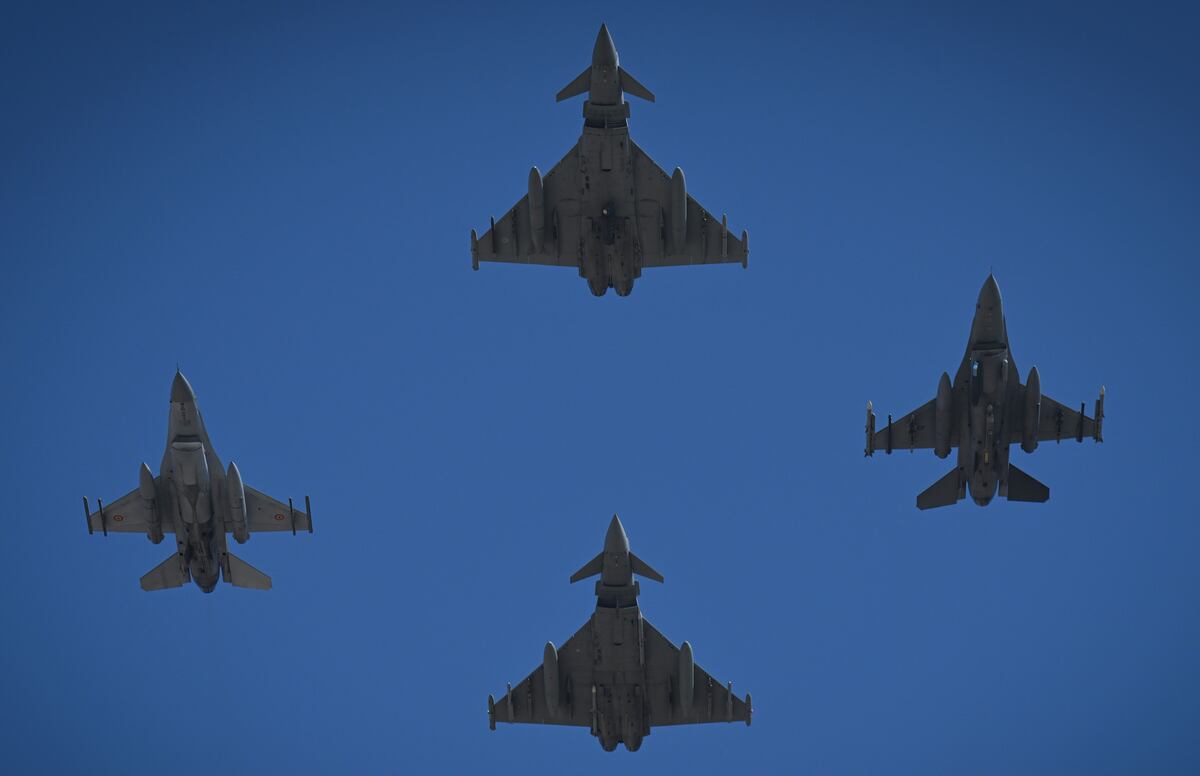
Russia’s invasion of Ukraine is a stark reminder that Europe’s NATO members need to spend more wisely — and not simply spend more — in bolstering their collective defense against unwarranted aggression. Kyiv’s success so far in blunting Moscow’s armed forces provides a pointer as to where at least some of the additional investment and focus should go, not least of all in air and counter-air systems as well as what are sometimes termed combat enablers.
The needs are both near- and medium-to-long term. In the near-term, continuing to improve air and missile defense would bolster the conventional deterrence of NATO European members, providing the capacity to better address the threat of short-range ballistic and longer-range cruise missiles.
Both types of systems have been widely used by Russian forces in attacks on Ukraine, if often with patchy success. Still, the existing threat and Russia’s military doctrine are clear. And so better defense against ballistic and cruise missiles would benefit NATO operationally and further bolster the credibility of its conventional deterrence. Critical national infrastructure, otherwise, could become a critical vulnerability.
The importance of being able to degrade an opponent’s ground-based air defense is also underscored by the war in Ukraine. Russian attempts to unpick Ukraine’s surface-to-air missile systems and radar net appear piecemeal, making Russian air operations riskier and limiting its freedom of action.
The suppression or destruction of enemy air defenses is now a growing priority for NATO air forces in any consideration of a confrontation with a peer rival, rather than using, for the most part, air power to support ground forces, as seen in recent counterinsurgency operations.
In the longer term, the importance of command and control has been reinforced by Russia’s war, alongside access to accurate and timely data sourced from air and space assets. If Finland and Sweden become NATO members, the alliance will likely experience an improvement in the quantity and quality of data in regard to Russian dispositions and military activity. But continued investment will be needed from European states to meet capability requirements, especially given the U.S. also has its eye on potential Pacific-based contingencies.
Europe remains dependent on the U.S. to a large degree for this sort of information gathering and coordination. And the same could be said for enablers like air mobility and air tanking assets.
Moreover, the continent will need to recapitalize its fleets of combat aircraft. These future capabilities would likely remain in the local inventory for most of this century.
Europe has already embarked on the development of a next generation of multirole combat aircraft, and it has managed to avoid a repeat of the 1980s, which saw the emergence of three competing projects: the French Rafale; the (West) German, Italian, Spanish and British European Fighter Aircraft (now the Eurofighter Typhoon); and the Swedish JAS 39 Gripen.
There is no European unanimity however, with France, Germany and Spain pursuing the Future Combat Air System , or FCAS, while the U.K., Italy and Sweden are involved in what is dubbed Tempest .
France is the lead on FCAS, with the U.K. taking a similar, if arguably more accommodating position on Tempest. London has also looked beyond its traditional European partner base, with Japan increasingly involved with elements of the Tempest project.
While two rival projects — rather than a single pan-European combat aircraft — can be argued as inefficient, at least they are underway. There continues to be a possibility the two could somehow merge , though the industrial divide between the groups remains wide. There is also a question of how Franco-German politico-industrial relations play out.
Regarding FCAS, it is not without tension. Germany’s selection of the Lockheed Martin-made F-35 to replace the Tornado in its commitment to the NATO nuclear role is unlikely to have been popular in Paris, even though the acquisition is not a genuine threat to German participation in the FCAS program.
Douglas Barrie is a senior fellow for military aerospace at the International Institute for Strategic Studies.
俄罗斯入侵乌克兰鲜明地提醒我们,欧洲北约成员国需要更明智地使用资金,而不仅仅是增加投入,来加强其集体防御,抵御无端侵略。基辅迄今为止在削弱莫斯科武装力量方面取得的成功,至少为未来应将部分额外投资和重点放在哪些方面指明了方向,尤其是在空中和反空袭系统以及有时被称为作战赋能系统的领域。
这些需求既包括近期需求,也包括中长期需求。在近期,继续改进防空和导弹防御将增强北约欧洲成员国的常规威慑能力,使其能够更好地应对短程弹道导弹和远程巡航导弹的威胁。
俄罗斯军队在对乌克兰的袭击中广泛使用了这两种类型的导弹系统,尽管成效参差不齐。然而,现存的威胁和俄罗斯的军事理论是显而易见的。因此,加强对弹道导弹和巡航导弹的防御将有利于北约的作战行动,并进一步增强其常规威慑的可信度。否则,关键的国家基础设施可能会成为重大的薄弱环节。
乌克兰战争也凸显了削弱对手地面防空能力的重要性。俄罗斯试图瓦解乌克兰地对空导弹系统和雷达网的努力显得零散,这使得俄罗斯的空中行动风险更大,行动自由也受到限制。
在考虑与势均力敌的对手发生冲突时,北约空军现在越来越重视压制或摧毁敌方防空系统,而不是像最近的反叛乱行动中那样,主要使用空中力量支援地面部队。
从长远来看,俄罗斯的战争凸显了指挥控制的重要性,同时,获取来自空天资产的准确及时的数据也至关重要。如果芬兰和瑞典加入北约,北约在俄罗斯部署和军事活动方面的数据数量和质量可能会得到提升。但欧洲各国仍需持续投资以满足能力需求,尤其考虑到美国也密切关注着太平洋地区可能发生的突发事件。
欧洲在信息收集和协调方面仍然很大程度上依赖美国。空中机动和空中加油等辅助能力方面也是如此。
此外,非洲大陆还需要对其作战飞机机队进行更新换代。这些未来的作战能力很可能在本世纪的大部分时间里都保留在当地的装备序列中。
欧洲已经开始研发下一代多用途战斗机,并且成功避免了 20 世纪 80 年代的情况重演。当时出现了三个相互竞争的项目:法国的“阵风”战斗机;(西)德国、意大利、西班牙和英国的欧洲战斗机(现为欧洲台风战斗机);以及瑞典的 JAS 39“鹰狮”战斗机。
然而,欧洲并没有达成一致意见,法国、德国和西班牙正在推进未来作战空中系统(FCAS),而英国、意大利和瑞典则参与了被称为“暴风雨”(Tempest)的项目。
法国在FCAS项目中处于主导地位,英国在Tempest项目中则采取类似立场,尽管可能更为灵活。伦敦方面也已将目光投向传统欧洲合作伙伴之外,日本越来越多地参与到Tempest项目的各个环节中。
虽然两个相互竞争的项目——而不是单一的泛欧战斗机项目——效率可能不高,但至少它们都在进行中。这两个项目未来仍有可能合并,尽管双方的产业差距依然很大。此外,法德之间的政产关系将如何发展也是一个值得关注的问题。
关于未来空中作战系统(FCAS)项目,并非没有争议。德国选择洛克希德·马丁公司制造的F-35战斗机来取代“旋风”战斗机,以履行其在北约核力量中的角色,这一举措在巴黎不太可能受到欢迎,尽管此举并不会对德国参与FCAS项目构成真正的威胁。
道格拉斯·巴里是国际战略研究所军事航空航天高级研究员。