No, The F-117 Never Had Air-To-Air Capability, But One Did Get A Radar不,F-117从未具备空对空作战能力,但其中一架确实加装了雷达。
The "Black Jet" never got the ability to shoot down other aircraft, but not due to a lack of creativity on behalf of the Skunk Works team.
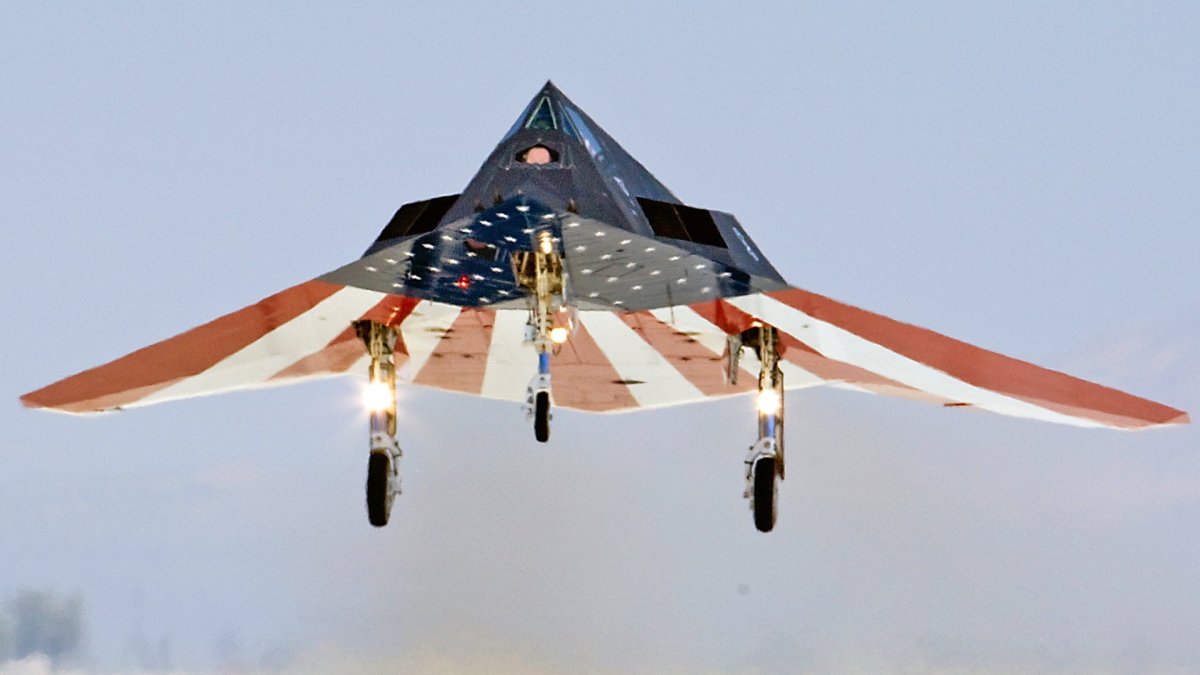
Published Jun 19, 2020 7:41 PM EDT
After years of studying the history of the F-117 Nighthawk program and having written many articles about some of its most obscure elements , one topic that has continued to surface in various forms has to do with the stealth attack jet being used in the air-to-air role. Discussion of this surfaced briefly on the Fighter Pilot Podcast recently, which you can and should check out here . Comments from a veteran Nighthawk pilot resulted in speculation that this capability may have indeed existed in an operational sense. The hard truth is it absolutely did not, but Skunk Works and the Air Force did toy around with the idea of enabling the F-117 in the air-to-air arena and giving the jet a radar on multiple occasions during its first decade of existence.
It is true that during the early 1980s, as the F-117 was marching towards an operational state, Lockheed’s Skunk Works and the Air Force kicked around the idea of using the F-117 as a clear air interceptor of sorts aimed at swatting down high-value Soviet assets. Years before that, prior to the true limitations and strengths of the final design becoming known, a more robust air-to-air capability was discussed. But these were just conceptual ideas. Some limited testing, much of which was a byproduct of trialing the stealth jet’s radar signature against U.S. airborne early warning and control aircraft and fighters, was done. That being said, we can now get back to the notion that the air-to-air mission was actually within the F-117’s operational repertoire.
Here is the relevant excerpt from the Fight Pilot Podcast podcast, as transcribed by The Aviationist :
“Yes its primary role was attack but having said that, it could actually carry every munition in the inventory at the time of its insertion, with the exception of the Sparrow missile which was radar-guided so we could carry air-to-air missiles we could carry the full gamut of air-to-ground munitions and everything. So the F-117 designation has long been rumored and then postulated and many beers have gone down about why it was as such but I think it was basically they just said – hey we don’t want to have anything really too extraordinary out there at all – but yes in all reality it is an attack jet but it did have a limited air-to-air capability.” … “Our secondary role was to shoot down the Soviet AWACS. So yeah, we were invisible to their radar and we didn’t want them controlling their airspace so, either on the way in or on the way out you could add a Soviet AWACS paint it to the side of your aircraft”
“Yes its primary role was attack but having said that, it could actually carry every munition in the inventory at the time of its insertion, with the exception of the Sparrow missile which was radar-guided so we could carry air-to-air missiles we could carry the full gamut of air-to-ground munitions and everything. So the F-117 designation has long been rumored and then postulated and many beers have gone down about why it was as such but I think it was basically they just said – hey we don’t want to have anything really too extraordinary out there at all – but yes in all reality it is an attack jet but it did have a limited air-to-air capability.”
“Our secondary role was to shoot down the Soviet AWACS. So yeah, we were invisible to their radar and we didn’t want them controlling their airspace so, either on the way in or on the way out you could add a Soviet AWACS paint it to the side of your aircraft”
The F-117’s cockpit was state of the art at the time of its introduction, but it didn’t have a radar. , Paul Weatherman/Lockheed Martin/Code One
When I heard this, I was a bit flabbergasted. I knew that this wasn’t really the case, at least how it may have sounded. The free-flowing nature of the podcast really didn’t delve into it too deeply, so it was entirely possible it just came out a bit different than intended. So, our friends at the Fighter Pilot Podcast put us in touch with Robert “Robson” Donaldson, their guest for the episode and a veteran F-117 pilot who flew the jet during an amazing time in its operational history, between 1989 and 1992. We previously talked to him about the F-117’s nuclear strike role , which also came up briefly in the podcast. Donaldson was happy to clarify his statements on the topic and to discuss the matter in a bit more detail.
According to the retired F-117 driver and commercial airline pilot, no, the Nighthawk never actually had air-to-air combat as an operational mission. It wasn’t trained for by F-117 crews and the aircraft were not really configured for it in any meaningful way. The concepts that had been passed around early in the jet’s existence included being able to sneak up on unsuspecting Soviet airborne early warning and control aircraft and take them out before they could ever alert prowling fighters as to the attacker’s whereabouts. This would have been done, at least notionally, by an F-117 toting a heat-seeking AIM-9L Sidewinder missile, as the jet had no radar of any kind in order to employ radar-guided missiles.
The Soviet Beriev A-50 Mainstay airborne early warning and control aircraft was coming online just as the F-117 became operational. , Public Domain
This sounds pretty cool, but in reality, it wasn’t plausible. The F-117 would have no way to look for an airborne target beyond what could be seen outside the cockpit windows, which were notoriously obscured. Its pilot was shut off from the outside world when the aircraft was in a stealth configuration, too. In other words, data-links and radio calls were really not an option, and relying on them alone at the time was far from ideal, especially for such a dangerous mission.
If the F-117 was able to somehow find its target and could navigate within around four miles or so of it to be in a position to launch its AIM-9L, the missile would have to be extended into the slipstream with the F-117’s bay door open in order to even attempt to obtain a lock. Once again, that is only if the jet and the missile’s seeker were pointed directly at the target in the first place. The hard fact here is that opening the bay doors and extending the AIM-9 into the slipstream while trying to lock up the target would give away the F-117’s presence and its position. Considering it was a subsonic attack aircraft, running away at high speed wouldn’t have been a good option after a shot was taken, nor would it have been the stealthiest aspect of the aircraft to present to your enemies after they already knew you were present.
In other words, this was totally implausible operationally speaking and it never became a reality for good reason.
A Navy Hornet firing an AIM-9L/M Sidewinder from its wingtip rail. Lock-on after launch (LOAL), which is ideal for stealth aircraft with weapons bays, has only become a reality recently for the Sidewinder family of missiles. , USN
What if the F-117 had its own air-to-air radar? It sounds intriguing, but making it happen, especially in the 1980s, was far harder than it sounds. Just using a traditional fighter’s fire control radar, assuming you could even mount it somehow and still have it be effective without compromising the jet’s radar signature, would give away the aircraft’s position via its radio frequency emissions. This would have negated the whole stealth technology thing and the F-117 was never designed to accommodate such a large piece of kit in its nose in the first place.
Robert Donaldson told The War Zone that Ben Rich himself, head of the Skunk Works during the F-117’s ascendency, a man that is largely credited with giving birth to stealth technology as we know it today, told him about one concept his team was looking into while meeting with the aviation legend at the original Lockheed Skunk Works headquarters in Burbank. Rich described the concept as a radar that would fit into the existing nose of the F-117 and was housed behind a sliding door when not in use.
F-117 with its FLIR visible. The turret sat behind a radar reflective screen. , USAF
The idea was that the Nighthawk pilot would be able to activate the radar to take a ‘snapshot’ of the airspace in front of them, with the door snapping open and closed similar to a shutter on a camera so as to only disrupt the jet’s stealthy signature for a very short amount of time. This was similar to the aborted flip-down Radar Locating System (RLS) that never made it onto the production F-117. You can read all about the RLS and its weird backstory in this past piece of ours . In retrospect, the RLS system might have been effective when it came to locating and attacking enemy airborne early warning aircraft and they used a similar pop open and closed concept of operations, but that’s beside the point.
By taking one quick radar sweep of the area, enemy sensors would have been challenged to home in on the radar’s emissions and identify the F-117’s general position. With the radar picture in hand, the pilot could target an aircraft in the distance and make a run on it, only taking quick radar snapshots as they closed in, providing just enough information to get the Nighthawk lined up for a quick Sidewinder shot.
It’s an interesting idea, but as far as we know, it was just that, an idea. Still, Rich clearly was interested in it considering he shared it with the newly minted F-117 pilot. It certainly would have solved a lot of problems without heavily eroding the F-117’s inherent advantages. This was also an era where low-probability of intercept (LPI) radar technology was still fairly new, having first been tested in relation to a stealth aircraft on Northrop’s Tacit Blue demonstrator , and Lockheed was working on its own advanced LPI capabilities for the Advanced Tactical Fighter (ATF) program that would eventually give birth to the F-22 Raptor.
F-22 and F-117. , USAF
In fact, the active electronically scanned array (AESA) radar technology that was set to be a fixture in the ATF program would have likely been necessary for Rich’s radar-enabled F-117 concept, as there would be no place to put a mechanically scanned array behind a flat faceted door as it was described. The place for such a radar would have likely been where the forward-looking infrared turret exists in the F-117’s nose. This would have provided a way to largely retain the F-117’s outer mold line while still giving the jet a limited air-to-air radar capability. It wouldn’t have been able to scan an azimuth as wide as a traditional fighter radome would have allowed, but a small AESA could have provided a usable cone-like scan volume very quickly so as to give the pilot some situational awareness as to what lay in front of the jet. LPI radar modes would have helped keep the F-117 safe from the enemy’s passive radio frequency detection capabilities.
Donaldson’s account is highly intriguing. It really does point to a concept of taking the advances made for the looming ATF program in terms of radar tech and injecting them into the already existing F-117, and thus giving it new capabilities and missions. But why do you need a relatively anemic performing F-117 with limited radar capabilities when you could have an F-22? Well, the latter aircraft wouldn’t be operational for many years, so using even early forms of its sensor tech with the operational F-117 may have proven to be attractive for Rich and his Skunks.
Ben Rich and the F-117., Lockheed Martin
The thing is, Rich’s concept as relayed to Robertson would have been at least a second try to realize a radar-toting F-117 if it had ever been put into practice. Shortly after the F-117 was operational, a program aimed to turn the stealth jet into an all-weather attack aircraft via the addition of a radar. Multiple sources have described this offshoot of the program to me over the years, including a senior officer that was intimately familiar with the F-117 program during the period in question.
An F-117 is said to have been modified to house a radar set that was a cousin of the AN/APQ-164 passive electronically scanned array (PESA) radar that would eventually find itself in the B-1B bomber. The B-1B had a reduced radar signature and its radar required LPI modes, so that capability aspect may have already been baked into the radar set at the time of the F-117 tests, or at least it was deep in development.
The radar’s ability to take detailed synthetic aperture radar (SAR) maps of what was ahead allowed for relatively precise targeting in all weather. It could also detect moving targets on the ground and its downward-angled face provided a reduced radar signature for the aircraft that was carrying it. Since it was possible to electronically steer its beam, it would have been probably the best candidate available to fit within the odd shaping limitations of even a modified F-117 nose. A mechanically scanned dish would have created a variable radar signature that could potentially compromise the stealthy jet.
The AN/APQ-164 PESA on the B-1B., Public Domain via Defense-Update.com
One of the developmental F-117s, tail #794 according to Have Blue and the F-117A : Evolution of the “Stealth Fighter,” received the radar in 1984 at the Skunk Works’ Burbank plant and began flight testing out of Groom Lake after the modifications were complete. The installation was unique, with a specially built selective frequency ‘evanescent’ radome covering the PESA antenna that allowed for the radar to work while also maintaining a high degree of low-observability. This radome technology was absolutely cutting-edge at the time and eventually found itself utilized on the F-22 Raptor.
It isn’t clear exactly how the tests went, but as I understand it the entire concept would have been very costly to achieve in a scaled manner. Also, the F-117 was an extremely precise strike asset via its infrared targeting and navigation system and laser-guided bombs. While the F-117 may have been able to find its target in bad weather with the radar, it would not have been able to deliver its two bombs with anywhere near the accuracy as what laser guidance provided by just using the radar alone.
It turns out that it would be exactly two decades after the radar tests that the F-117 finally got all-weather strike capability via the GPS-guided Joint Direct Attack Munition (JDAM)—no radar needed.
F-117 during JDAM trials in the early 2000s. , USAF
As for what the F-117 looked like with such a radar installed, that remains a mystery. We have inquired with Lockheed and the Air Force in an attempt to get a photo of the unique configuration, but have come up empty-handed, which isn’t all the surprising considering elements of the F-117 program remain remarkably murky. It’s also possible that this radar-equipped F-117 was tested against aerial targets if the radar had an air-to-air a mode at the time, but we don’t know that for sure.
In some ways, the whole idea of an F-117 with an air-to-air mission was too ahead of its time. Today, low observable aircraft can stay connected to critical networks without sacrificing stealth and radars have become more compact and powerful, with AESA arrays being commonplace today. LPI modes on those radars have become ever more wily and harder to detect, as well.
So, even without a radar, in this current age in which combat aircraft and the missiles they fire themselves are networked, an upgraded F-117 could rely entirely on off-board targeting information when attacking an enemy aircraft from beyond visual range. Even its own electronic surveillance suite would be sensitive enough to geolocate an enemy aircraft via its own emissions and to prosecute an attack based on that information. But this is now, not three decades ago. At that time, this simply wasn’t possible.
In the end, it’s safe to say that the F-117 never had an air-to-air role, but it certainly wasn’t due to a lack of imagination on the part of the Skunk Works. Still, not a single air-to-air missile was ever fired by an F-117, not even in basic testing.
Contact the author: Tyler@thedrive.com
Comments couldn’t be loaded. Please refresh the page.
发布于美国东部时间2020年6月19日晚上7:41
多年来,我一直在研究F-117“夜鹰”项目的历史,并撰写了许多关于其一些鲜为人知的细节的文章。其中一个反复出现的话题是关于这款隐形攻击机是否曾被用于空对空作战。最近,在“战斗机飞行员播客”(Fighter Pilot Podcast)节目中,也曾简要讨论过这个问题,您可以点击此处收听。一位资深“夜鹰”飞行员的评论引发了人们的猜测,认为这种能力或许确实在实际作战中存在过。然而,残酷的现实是,它从未真正具备过这种能力。不过,在F-117服役的最初十年里,臭鼬工厂(Skunk Works)和美国空军确实多次考虑过让F-117具备空对空作战能力,并为它配备雷达。
的确,在20世纪80年代初,当F-117逐渐接近服役状态时,洛克希德·马丁公司的臭鼬工厂和美国空军曾探讨过将F-117用作某种形式的晴空拦截机,旨在击落苏联的高价值目标。在此之前数年,在最终设计的真正局限性和优势尚未完全明朗之前,人们就曾讨论过更强大的空对空作战能力。但这些都只是概念性的想法。当时进行了一些有限的测试,其中大部分是测试这款隐形战机雷达信号与美国空中预警和控制飞机及战斗机对抗的副产品。即便如此,我们现在可以回到F-117的作战能力范围之内这一观点。
以下是The Aviationist网站转录的Fight Pilot Podcast播客的相关摘录:
“没错,它的主要任务是攻击,但即便如此,它实际上可以携带当时库存中的所有弹药,除了雷达制导的麻雀导弹。所以我们可以携带空空导弹,可以携带全系列的空地弹药等等。F-117这个名字的由来早已是众说纷纭,人们也对此争论不休,但我认为基本上就是因为他们说——嘿,我们不想让任何太特别的东西出现在战场上——但实际上它是一架攻击机,只是空对空作战能力有限。”……“我们的次要任务是击落苏联的预警机。所以,是的,我们对他们的雷达来说是隐形的,我们不想让他们控制我们的领空,所以,无论是在进场还是撤离的时候,你都可以在飞机侧面涂上苏联预警机的标志。”
“没错,它的主要任务是攻击,但即便如此,它实际上可以携带当时库存中的所有弹药,除了雷达制导的麻雀导弹。所以我们可以携带空空导弹,可以携带全系列的空地弹药等等。F-117这个名字的由来早已是众说纷纭,人们也对此进行了各种猜测,甚至为此争论不休。但我认为,基本上就是因为他们觉得——嘿,我们不想让任何过于特殊的战机出现在市场上——但实际上,它确实是一架攻击机,只是具备有限的空对空作战能力。”
“我们的次要任务是击落苏联预警机。所以,是的,我们对他们的雷达来说是隐形的,我们不想让他们控制他们的领空,所以,无论是在进出领空的时候,你都可以在飞机侧面涂上苏联预警机的标志。”
F-117的座舱在当时堪称一流,但它没有配备雷达。(图片来源:Paul Weatherman/洛克希德·马丁/Code One)
听到这话,我有点懵。我知道事实并非如此,至少听起来可能不像。播客的风格比较随意,并没有深入探讨这个问题,所以最终表达出来可能和预期略有出入。于是,我们在“战斗机飞行员播客”(Fighter Pilot Podcast)的朋友们联系到了罗伯特·“罗布森”·唐纳森,他是本期节目的嘉宾,也是一位经验丰富的F-117飞行员,曾在1989年至1992年F-117服役期间驾驶过这款战机,那段时期正是F-117服役史上的辉煌时期。我们之前曾和他讨论过F-117的核打击任务,这个话题在播客中也曾被简要提及。唐纳森很乐意澄清他之前关于这个话题的说法,并就此展开更详细的讨论。
据一位退役的F-117飞行员兼民航飞行员称,夜鹰战机从未真正执行过空战作战任务。F-117机组人员没有接受过空战训练,而且该型战机也从未进行过任何有意义的空战配置。该战机早期曾流传过一些概念,例如能够悄悄接近毫无防备的苏联空中预警和控制飞机,并在其向巡逻的战斗机发出警报之前将其击落。理论上,这种战术是由一架携带红外制导AIM-9L“响尾蛇”导弹的F-117完成的,因为该战机本身没有任何雷达,无法使用雷达制导导弹。
苏联别里耶夫A-50“主力”空中预警和控制飞机与F-117战斗机同时投入使用。(公共领域)
这听起来很酷,但实际上却行不通。F-117 战机无法探测到驾驶舱窗外以外的空中目标,而其驾驶舱窗的遮蔽效果众所周知地差。此外,当飞机处于隐身状态时,飞行员与外界完全隔绝。换句话说,数据链和无线电通话根本无法使用,在当时的情况下,仅仅依靠这些手段远非理想之选,尤其是在执行如此危险的任务时。
如果F-117能够找到目标,并能导航到距离目标约四英里(约6.4公里)的位置发射AIM-9L导弹,那么为了尝试锁定目标,F-117必须打开弹舱门,将导弹伸出到气流中。当然,前提是战机和导弹的导引头一开始就直接指向目标。然而,残酷的现实是,在试图锁定目标的同时打开弹舱门并将AIM-9伸出到气流中,会暴露F-117的行踪和位置。考虑到它是一架亚音速攻击机,在开火后高速逃离并非明智之举,而且在敌人已经知晓你的位置之后,这种做法也绝非隐蔽之举。
换句话说,从操作层面来说,这完全不切实际,而且出于充分的理由,它从未成为现实。
一架海军“大黄蜂”战斗机从翼尖挂架发射了一枚AIM-9L/M“响尾蛇”导弹。发射后锁定(LOAL)技术对于配备武器舱的隐形飞机来说非常理想,但直到最近才成为“响尾蛇”系列导弹的现实。
如果F-117拥有自己的空对空雷达会怎样?这听起来很有意思,但要实现这一点,尤其是在20世纪80年代,远比想象中困难得多。即使你设法将其安装在传统战斗机的火控雷达上,并且保证其有效且不影响飞机的雷达反射截面,也会通过无线电频率辐射暴露飞机的位置。这将彻底破坏隐身技术,而且F-117的设计之初就没考虑过在机头安装如此庞大的设备。
罗伯特·唐纳森告诉《战区》杂志,在F-117战斗机鼎盛时期担任“臭鼬工厂”负责人的本·里奇,曾向他介绍过里奇团队正在研究的一个概念。里奇被广泛认为是现代隐形技术的奠基人之一。当时,唐纳森正在位于伯班克的洛克希德·马丁公司“臭鼬工厂”总部与这位航空传奇人物会面。里奇将这个概念描述为一种可以安装在F-117现有机头的雷达,不用时可以收纳在滑动门后。
F-117战斗机,其前视红外成像系统清晰可见。炮塔位于雷达反射屏后方。(美国空军)
其设想是,夜鹰战机的飞行员可以激活雷达,对前方空域进行“快照”拍摄,舱门会像相机快门一样快速打开和关闭,从而仅在极短时间内干扰战机的隐身信号。这与最终未能应用于量产型F-117战机的翻折式雷达定位系统(RLS)类似。您可以在我们之前的这篇文章中了解RLS及其奇特的背景故事。回顾来看,RLS系统在定位和攻击敌方空中预警机方面或许有效,而且它们也采用了类似的快速开合操作方式,但这与我们讨论的重点无关。
通过对该区域进行一次快速雷达扫描,敌方传感器将难以追踪雷达信号并确定F-117的大致位置。有了雷达图像,飞行员就可以锁定远处的敌机并发起攻击,在接近目标的过程中只需快速进行雷达扫描,即可获得足够的信息,使“夜鹰”战斗机能够迅速瞄准并发射“响尾蛇”导弹。
这确实是个有趣的想法,但据我们所知,它仅仅只是个想法而已。不过,考虑到里奇把这个想法告诉了那位新晋的F-117飞行员,他显然对此很感兴趣。这无疑能解决很多问题,而且不会严重削弱F-117的固有优势。当时,低截获概率(LPI)雷达技术还相当新颖,它最初是在诺斯罗普公司的“静默蓝”(Tacit Blue)隐形飞机验证机上进行测试的,而洛克希德公司也在为最终催生F-22猛禽战斗机的先进战术战斗机(ATF)项目研发先进的LPI能力。
F-22 和 F-117,美国空军
事实上,ATF项目中计划采用的有源电子扫描阵列(AESA)雷达技术对于里奇的雷达化F-117概念来说可能必不可少,因为正如他所描述的,在扁平多面舱门后方根本找不到安装机械扫描阵列雷达的空间。这种雷达的安装位置很可能位于F-117机头前视红外炮塔所在的位置。这样既能基本保持F-117的外形轮廓,又能赋予其有限的空对空雷达能力。虽然它的扫描范围无法达到传统战斗机雷达罩所能达到的方位角,但小型AESA雷达可以快速提供可用的锥形扫描范围,使飞行员能够感知前方敌方的态势。低截获概率(LPI)雷达模式则有助于F-117免受敌方被动射频探测能力的干扰。
唐纳森的描述非常引人入胜。它确实指出了一种理念,即利用即将启动的ATF项目在雷达技术方面取得的进展,将其融入现有的F-117战机,从而赋予其新的能力和任务。但是,既然可以选择F-22,为什么还要选择性能相对薄弱、雷达能力有限的F-117呢?原因在于,F-22还需要很多年才能投入使用,因此,即使是早期版本的F-22传感器技术,对于里奇和他的“臭鼬”团队来说,与现役的F-117结合使用,或许也颇具吸引力。
本·里奇和F-117战斗机,洛克希德·马丁公司
问题在于,里奇向罗伯逊传达的构想,即便最终得以实施,也至少是第二次尝试为F-117加装雷达。F-117投入使用后不久,一项旨在通过加装雷达将这款隐形战机改造为全天候攻击机的项目便应运而生。多年来,多位消息人士向我描述了该项目的这一衍生计划,其中包括一位在当时对F-117项目非常熟悉的资深军官。
据称,一架F-117战斗机曾被改装,以安装一套与AN/APQ-164被动电子扫描阵列(PESA)雷达类似的雷达装置,后者最终也被用于B-1B轰炸机。B-1B轰炸机的雷达反射截面积较小,其雷达需要低截获概率(LPI)模式,因此,在F-117进行测试时,该雷达装置可能已经具备了这种能力,或者至少已经进入了深入研发阶段。
该雷达能够绘制前方详细的合成孔径雷达(SAR)图像,使其在各种天气条件下都能进行相对精确的目标定位。它还能探测地面上的移动目标,其向下倾斜的天线面可以降低搭载飞机的雷达反射截面积。由于其波束可以电子控制,因此它可能是最适合改装后的F-117机头(即使是形状特殊的机头)的雷达选择。而机械扫描天线则会产生可变的雷达反射截面积,这可能会暴露这架隐形战机的行踪。
B-1B轰炸机上的AN/APQ-164 PESA,图片来自Defense-Update.com,公共领域。
根据《Have Blue》和《F-117A:隐形战斗机的演变》一书的记载,编号为794的F-117研发型飞机于1984年在臭鼬工厂的伯班克工厂加装了雷达,改装完成后便在格鲁姆湖机场开始了飞行测试。这套雷达装置非常独特,其PESA天线被一个特制的选择性频率“瞬逝”雷达罩覆盖,既保证了雷达的正常工作,又使其保持了高度的隐蔽性。这种雷达罩技术在当时绝对是尖端科技,最终也被应用到了F-22猛禽战斗机上。
目前尚不清楚测试的具体情况,但据我了解,要大规模实施这一概念,成本将非常高昂。此外,F-117凭借其红外瞄准导航系统和激光制导炸弹,已成为一种极其精确的打击力量。虽然F-117或许能够在恶劣天气下利用雷达找到目标,但它投放两枚炸弹的精度远不及仅依靠雷达进行激光制导所能达到的水平。
事实证明,在雷达测试整整二十年后,F-117 终于通过 GPS 制导的联合直接攻击弹药 (JDAM) 获得了全天候打击能力——无需雷达。
2000年代初期,美国空军的F-117战斗机正在进行联合直接攻击弹药(JDAM)试验。
至于安装这种雷达的F-117是什么样子,至今仍是个谜。我们曾向洛克希德公司和空军询问,试图获得这种独特配置的照片,但一无所获。考虑到F-117项目的一些细节仍然扑朔迷离,这并不令人意外。此外,如果当时的雷达具备空对空模式,那么这架配备雷达的F-117也可能进行过对空目标的测试,但我们无法确定。
从某种程度上来说,F-117执行空对空任务的设想过于超前。如今,低可探测性飞机可以在不牺牲隐身性能的前提下与关键网络连接,雷达也变得更加紧凑强大,AESA阵列雷达如今已十分普及。此外,这些雷达的低可探测性模式也变得越来越狡猾,更难被探测到。
因此,即使没有雷达,在如今战斗机及其发射的导弹都联网的时代,升级后的F-117在超视距攻击敌机时,也能完全依赖外部目标信息。它自身的电子监视系统也足够灵敏,能够通过敌机的辐射信号对其进行定位,并据此发起攻击。但这已是过去,而非三十年前。在当时,这根本不可能。
最终可以肯定地说,F-117从未承担过空对空作战任务,但这绝非臭鼬工厂缺乏想象力所致。尽管如此,F-117也从未发射过任何空对空导弹,即使在基础测试中也没有。
联系作者:Tyler@thedrive.com
评论加载失败,请刷新页面。