How France’s Army chief is avoiding getting sucked into a ‘Ukrainian tunnel’法国陆军总司令如何避免陷入“乌克兰隧道”
Also high on Gen. Pierre Schill's mind is seeing the Scorpion program fully implemented and figuring out the “eternal dialectics between sword and shield” that characterize tank warfare.
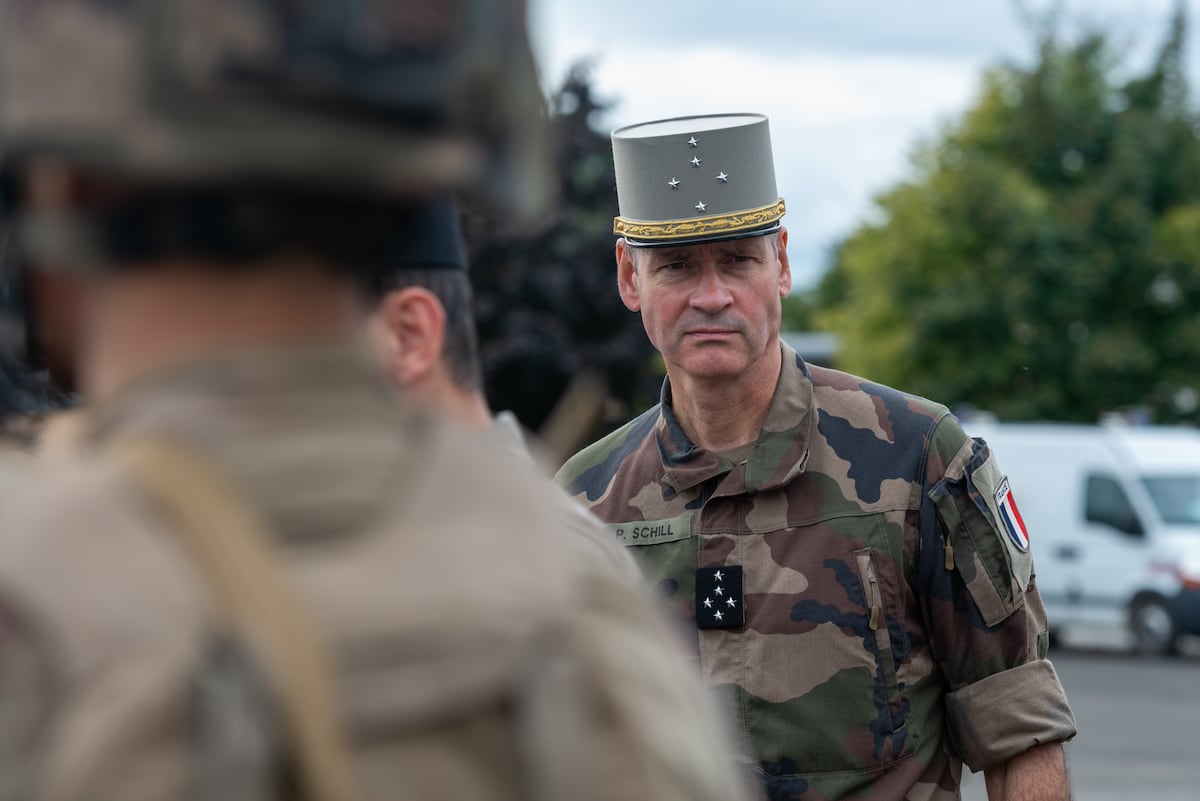
STUTTGART, Germany — The French Army is in the midst of a broad equipment overhaul as it replenishes its ammunition arsenals, procures upgraded armored vehicles and teams up with its German counterparts to develop a new battle tank. While many of these efforts have been in the works for years, Russia’s invasion of Ukraine sharply demonstrated what European armies should expect in modern land warfare, and how to prepare for it.
Chief of the French Army Gen. Pierre Schill shared his perspective on the service’s path forward in an interview with Defense News ahead of the biennial Eurosatory industry conference in Paris. High on Schill’s mind is seeing the Scorpion program fully implemented , figuring out the “eternal dialectics between sword and shield” that characterize tank warfare , and avoiding getting sucked into what he called a “Ukrainian tunnel.”
This interview was edited for length and clarity.
How do you view the French Army evolving over the course of the military’s 2019-2025 strategic planning and budgeting period, known as the French Military Planning law?
Relying on the “Au contact!” model launched by former Army chief Gen. Jean-Pierre Bosser, which thoroughly reorganized the Army by providing it with high versatility, the “Operational Superiority” plan has a clear ambition: to harden the Army. In the framework of the 2019-2025 military budget law and beyond, by the year 2030, the goal is to form an army able to participate in all conflicts, up to a major engagement.
Four objectives have been defined to achieve it: troops up to the challenge of future clashes; capabilities enabling us to out-class our adversaries; training focused on the major engagement; and an operational way of functioning. Over the last decades, the Army has acquired valuable operational experience in Afghanistan, in the Central African Republic and in the Sahel, which proved to be pivotal for the efficiency of our operations.
French soldiers are seen outside of a Griffon armored vehicle near Gao, Mali, in October 2021. (Courtesy of the French Armed Forces Ministry)
Hardening the Army does not mean questioning this experience of peacekeeping operations and counterinsurgency conflicts. Like a pianist, we need to work our second hand to make the most of the “keyboard of action,” as former Army Gen. André Beaufre called it. The Army must be able to produce effects and to provide strategic solutions for the various engagement scenarios, ranging from the direct confrontation of wills to indirect approaches, and to compromise with the major and minor modes of conflict.
Defense is a critical topic for society: What price are we ready to pay, and how do we want to defend our country? The 2019-2025 FMP focuses on repair and stepping up to materialize the ambition. The modernization initiated with the Scorpion modernization program is probably the most significant since the end of World War II. It will renew our armored vehicles that have been in service for 40 years and will multiply their efficiency by placing them into a network.
Tomorrow, units will share the information in near-real time to define the best possible tactical combination to protect themselves and destroy the enemy. The ambition of collaborative combat consists of understanding, deciding and acting more quickly than the adversary.
Much more than a mere reequipping of the Land Force, Scorpion represents an evolution in the way of operating on the battlefield with the development of collaborative combat. Connectivity will enable a really dynamic allocation of sensors and shooters, and it will provide new tactical perspectives, owing in particular to the ability to fire beyond the line of sight.
Hardening also means anticipating and thinking about our future needs. That is the purpose of the Titan project, which will describe and define the composition and organization of our future battlefield capabilities — the upgraded Leclerc tank, new armored personnel carriers, Tiger MkIII attack helicopters, the Caesar self-propelled howitzer, and the Multiple Launch Rocket System, or LRU — by 2040, and will extend collaborative combat to the joint and allied levels.
How are the missions changing, and which military theaters will be the most important for future potential conflict?
In 1991, when I was a young lieutenant, recently appointed to a regiment, the Berlin Wall had just collapsed. The threat of a Cold War was fading away as we were ready to fight the invader on our own ground without previous notice. The events that occurred since then show that in 30 years, everything can happen. War is back on our continent. How can the conflict in Ukraine evolve? How can we build peace once the weapons have become quiet?
In the south, the situation in the Sahel will remain a security concern for a long time. And we must be careful not to be absorbed in a Ukrainian tunnel, but to keep a strategic hindsight.
Today, like yesterday, the Army must permanently adapt to the reality of the threats. War is too complex and evolutionary to be frozen in a formula. In the fog of war and against strategic uncertainties, it is imperative that we accurately understand the intent of our competitors. Who is our adversary? What are his interests? What are his objectives? Since strategic surprise remains possible, we have to consider all options.
The Army is ready to permanently operate in three strategic areas: first, in the domestic and overseas territories to ensure the protection and the defense of the nation’s sovereignty and resilience by fulfilling a wide variety of missions. Then we have to be a major actor of strategic solidarity in Europe by meeting the requirements of the alliances and agreements. We are very likely at the dawn of a new age for the security of the continent. The third area is that of prevention and influence at the outskirts of Europe and beyond, to contribute to controlling and resolving the hot spots of crises.
How will new vehicles, such as the upgraded Leclerc tanks and the future Main Ground Combat System that will succeed them, be a force multiplier for troops?
Current events demonstrate that tank capacity remains indispensable to our toughest engagements. They determine the ability for meeting engagements and getting the initiative back. In the eternal dialectics between sword and shield, the Leclerc main battle tank will be equipped with new aggression and protection capacities to be engaged on tomorrow’s battlefield.
French soldiers of the 8e RMAT (8th Quartermaster Regiment) work on a Leclerc tank, on June 9, 2015 at Mourmelon military camp, northeastern France. AFP PHOTO / MARTIN BUREAU (Photo credit should read MARTIN BUREAU/AFP/Getty Images)
Its successor, the Main Ground Combat System, will not be a mere tank but actually a system of systems constituting a new approach to the close-combat architecture and an efficient network in an operational cloud. It could thus comprise several platforms with different firing systems — large-caliber guns, missiles, etc. — some of them unmanned and escorted by remote-controlled air sensors.
MGCS will pave the way for new military capabilities in terms of effects, robotization and armor. Moreover, the configuration as a system of systems will allow for the integration of new technologies, which will be developed during the 21st century.
Which emerging and disruptive technologies — such as artificial intelligence, quantum computing, space systems and cloud computing — will have the greatest impact on the French Army in the next few years?
Thirteen areas have been identified as having an impact on the technological progress of the air-land combat system: sensor networks; information exchange; cybernetics; resilience of connected systems; mastering of mass data and calculation power; automated systems as complements to human systems; performance of platforms; improvement of the dismounted combatant; energy; aid to decision-making and training; effects of weapons and ammunition; evolution of materials (especially those designed for protection); and artificial intelligence.
Some of these promising technologies are developed for their intrinsic potential technological breakthroughs. The objective is to drive them to maturity in a logic of planned innovation, like quantum computing. Simultaneously, we seek to integrate the already mature technologies, like artificial intelligence, into the Scorpion-generation weapon systems, into intelligence with the processing of multi-sensor data or into provisional maintenance.
The COVID-19 pandemic has sharply demonstrated gaps in the global defense supply chain across many sectors. Where has your service seen the biggest issues in getting equipment fielded on time, and how have you tried to resolve those supply chain issues?
The impact of the COVID-19 crisis on the delivery of our equipment was variable. The activities related to industrial production, trials and expertise were disturbed, in particular during the first lockdown in 2020 followed by a progressive resumption of the activity. The activities that were more compatible with the social distancing measures or teleworking, like research consultancy, have been less disturbed.
However, the crisis has not delayed the achievement of major milestones defined in 2020, such as the deliveries of armored personnel carriers protected against improvised explosive devices. Owing to the involvement of all actors of both the public and private sectors, solutions have been implemented to prevent the interruption of activities or to guarantee their resumption as early as possible. Delays caused by the COVID-19 pandemic in 2020 were resolved at the end of 2021.
What are the lessons learned for ground warfare in Europe when it comes to new equipment and technology investments, as well as the importance of partnerships with NATO, the European Union, and other allies and partners?
The conflict in Ukraine reminds us of some fundamental principles and fully illustrates the overall complexity of the ground environment. Modern warfare and technological evolutions have not made the confrontation on the ground of secondary importance. The engagement on the ground and near the ground aims at having the ascendancy over the enemy, at dominating him both physically and morally, up to destroying him if necessary. The moral forces are of paramount importance and, beyond that, the nation’s resilience.
Tomorrow, like yesterday, that confrontation will continue to take place in the state of uncertainty that is specific to the ground environment. Attacking or destroying can be done from afar; building and conquering is done on the ground. The ground environment remains the fundamental area of strategic rivalries: wealth conquest, territorial gain, influence, and control of populations and the centers of power.
There are in Europe approximately 20 models of tanks and aircraft, and more than 150 types of armament — not to mention the diversity of signals assets. That does not make the chains of command of interoperability easy. Interoperability of capabilities is a first relevant lever to enhance the effectiveness of the operations conducted with our European Union partners.
For instance in 2018, a strategic partnership on the motorized capability, or CAMO, of the Belgian Land Component was signed. This agreement includes two dimensions: the acquisition of Scorpion capabilities — 382 Griffons, nine Caesar self-propelled howitzers, and 60 Jaguars equipped with both CONTACT communication systems and the Scorpion Combat Information System — as well as a transformation of the Belgian Land Component similar to that conducted by the French Army to shape combined arms battle groups around Scorpion.
The CAMO program, and the widening of the Scorpion community to other European partners, contributes to reinforcing interoperability with our allies and therefore to the defense of Europe. I am deeply convinced of that.
To fight together, we need to train together and be able to command together. This field of operational interoperability is the field of excellence of NATO. The Army has daily contacts with its NATO allies through the troops deployed to Estonia and Romania. Each major training milestone already includes an allied dimension, such as in the exercises Brilliant Jump and Cold Response, which were recently carried out in Norway. The Army works on the nature of its exercises to prepare for high intensity and show its strategic solidarity to its European partners. The major exercise in open terrain, Orion 2023, will therefore be as much a training as a demonstration of interoperability and a proof of our collective force.
Vivienne Machi is a reporter based in Stuttgart, Germany, contributing to Defense News' European coverage. She previously reported for National Defense Magazine, Defense Daily, Via Satellite, Foreign Policy and the Dayton Daily News. She was named the Defence Media Awards' best young defense journalist in 2020.
德国斯图加特——法国陆军正在进行大规模的装备更新换代,包括补充弹药库、采购升级版装甲车辆,并与德国同行合作研发新型主战坦克。虽然其中许多工作已筹备多年,但俄罗斯入侵乌克兰的行动却鲜明地展现了欧洲军队在现代陆地战争中将面临的挑战以及如何做好准备。
法国陆军总司令皮埃尔·席尔将军在巴黎举行的两年一度的欧洲防务工业大会(Eurosatory)前夕接受《防务新闻》采访,分享了他对陆军未来发展方向的看法。席尔将军最关注的是“蝎子”坦克歼击车项目的全面实施,弄清坦克战中“刀剑与盾牌之间永恒的辩证关系”,以及避免陷入他所谓的“乌克兰隧道”。
为了篇幅和清晰度,本次采访内容经过编辑。
您如何看待法国军队在 2019-2025 年军事战略规划和预算周期(即法国军事规划法)内的发展演变?
“作战优势”计划以陆军前总司令让-皮埃尔·博塞尔将军提出的“接触!”模式为基础,该模式通过赋予陆军高度多用途性,对其进行了彻底的重组,其目标明确:强化陆军。在2019-2025年军费预算框架内及之后,到2030年,目标是打造一支能够参与所有冲突,直至大规模战役的军队。
为实现这一目标,我们制定了四项具体措施:打造一支能够应对未来冲突挑战的部队;提升我们超越对手的能力;开展以重大战役为重点的训练;以及建立一套高效的作战方式。过去几十年,陆军在阿富汗、中非共和国和萨赫勒地区积累了宝贵的作战经验,这些经验对于提高我们的作战效率至关重要。
2021年10月,在马里加奥附近,法国士兵站在一辆“狮鹫”装甲车外。(图片由法国武装部队部提供)
强化陆军并不意味着质疑维和行动和反叛乱冲突的经验。正如前陆军上将安德烈·博弗雷所言,我们需要像钢琴家一样,运用另一只手,才能最大限度地发挥“行动键盘”的作用。陆军必须能够产生实际效果,并为各种作战场景提供战略解决方案,这些场景涵盖了从直接的意志对抗到间接的策略,以及与各种主要和次要冲突模式达成妥协。
国防是社会关注的焦点:我们愿意付出怎样的代价?我们又将如何保卫国家?2019-2025年国防现代化计划(FMP)的重点在于修复和升级,以实现既定目标。以“蝎子”装甲车现代化计划为开端的现代化进程,可能是二战结束以来规模最大的一次。该计划将更新服役40年的装甲车辆,并通过将其纳入网络,显著提升其作战效能。
明天,各部队将近乎实时地共享信息,以确定最佳战术组合,从而保护自身并消灭敌人。协同作战的目标在于比对手更快地理解、决策和行动。
“蝎子”系统远非陆军的简单装备升级,它代表着战场作战方式的革新,体现了协同作战的发展。互联互通将实现传感器和射手的真正动态部署,并提供全新的战术视角,尤其得益于其超视距射击能力。
强化自身能力也意味着预见并思考我们未来的需求。这正是“泰坦”项目的目的所在。该项目旨在描述和定义我们未来战场能力的组成和组织——到2040年,包括升级后的勒克莱尔坦克、新型装甲运兵车、虎式MkIII攻击直升机、凯撒自行榴弹炮以及多管火箭炮系统(LRU),并将协同作战扩展到联合和盟军层面。
军事任务正在发生哪些变化?未来潜在冲突中,哪些战区将最为重要?
1991年,我刚晋升为少尉,隶属一个团,柏林墙刚刚倒塌。冷战的威胁似乎正在消退,我们随时准备在毫无预警的情况下,在自己的土地上与入侵者作战。然而,此后发生的种种事件表明,短短三十年,一切皆有可能。战争再次席卷了我们的大陆。乌克兰冲突将如何演变?当战火平息之后,我们又该如何重建和平?
在南部,萨赫勒地区的局势将长期构成安全隐患。我们必须谨慎,避免陷入乌克兰的泥潭,而要保持战略远见。
今天,如同昨天一样,军队必须不断适应威胁的现实。战争过于复杂多变,无法被一成不变的模式所束缚。在战争迷雾和战略不确定性面前,我们必须准确了解对手的意图。我们的对手是谁?他们的利益是什么?他们的目标是什么?由于战略突袭仍然可能,我们必须考虑所有选项。
陆军已做好在三大战略领域长期作战的准备:首先,在国内和海外领土,通过执行各种任务,确保国家主权和韧性得到保护和捍卫。其次,我们必须履行联盟和协议的要求,成为欧洲战略团结的重要力量。我们很可能正处于欧洲大陆安全新时代的开端。第三个领域是在欧洲周边地区乃至更远的地方开展预防和影响工作,为控制和解决危机热点地区做出贡献。
升级后的勒克莱尔坦克以及未来将取代它们的主战地面作战系统等新型车辆,将如何成为部队的战斗力倍增器?
当前的战事表明,坦克作战能力在最严峻的战斗中仍然不可或缺。它决定着我们应对战斗和夺回主动权的能力。在刀剑与盾牌永恒的博弈中,勒克莱尔主战坦克将配备全新的进攻和防护能力,以应对未来的战场挑战。
2015年6月9日,在法国东北部穆尔梅隆军营,法国第8后勤团(8e RMAT)的士兵正在检修一辆勒克莱尔坦克。法新社/马丁·比罗摄(图片版权应注明:马丁·比罗/法新社/盖蒂图片社)
它的继任者——主战地面作战系统——并非简单的坦克,而是一个系统集合体,它构成了一种全新的近战架构,并在作战云中构建了一个高效的网络。因此,它可能包含多个配备不同火力系统的平台——大口径火炮、导弹等等——其中一些平台将采用无人驾驶,并由远程控制的空中传感器护航。
MGCS将在作战效能、机器人化和装甲方面为新型军事能力铺平道路。此外,作为系统之系统,其配置将允许集成21世纪将要开发的新技术。
未来几年,人工智能、量子计算、空间系统和云计算等新兴颠覆性技术将对法国军队产生最大的影响吗?
已确定有 13 个领域对空地作战系统的技术进步产生影响:传感器网络;信息交换;控制论;互联系统的韧性;海量数据和计算能力的掌握;作为人类系统补充的自动化系统;平台性能;步兵作战能力的提升;能源;决策和训练辅助;武器和弹药的效果;材料的发展(特别是防护材料的发展);以及人工智能。
这些前景广阔的技术中,有些是基于其内在的潜在技术突破而开发的。我们的目标是按照计划创新的逻辑,推动这些技术走向成熟,例如量子计算。与此同时,我们也致力于将人工智能等已成熟的技术整合到“蝎子”导弹系统、多传感器数据处理智能系统或临时维护系统中。
新冠疫情凸显了全球国防供应链在诸多领域的不足。贵单位在装备按时交付方面遇到的最大问题是什么?你们又是如何尝试解决这些供应链问题的?
新冠疫情对我们设备交付的影响程度不一。与工业生产、试验和专业技术相关的活动受到干扰,尤其是在2020年第一次封锁期间,以及随后逐步恢复生产活动的过程中。而那些更适合保持社交距离或远程办公的活动,例如研究咨询,受到的影响较小。
然而,这场危机并未延误2020年制定的重要里程碑的实现,例如交付能够抵御简易爆炸装置的装甲运兵车。由于公共和私营部门所有参与者的共同努力,已实施了多项解决方案,以防止活动中断或确保活动尽快恢复。2020年由新冠疫情造成的延误已于2021年底得到解决。
在新型装备和技术投资方面,欧洲地面战争有哪些经验教训?与北约、欧盟和其他盟友及伙伴建立伙伴关系的重要性又是什么?
乌克兰冲突提醒我们一些基本原则,并充分展现了地面环境的复杂性。现代战争和技术发展并未使地面对抗的重要性降低。地面及近地面作战的目标是取得对敌优势,在物质和精神上压制敌人,必要时甚至要将其摧毁。精神力量至关重要,而民族韧性也同样重要。
明天,如同昨天,这场对抗仍将在地面环境特有的不确定性中继续上演。攻击或摧毁可以远程进行;建设和征服则必须在地面上完成。地面环境仍然是战略竞争的根本领域:财富掠夺、领土扩张、影响力以及对民众和权力中心的控制。
欧洲大约有20种型号的坦克和飞机,以及超过150种武器装备——更不用说种类繁多的信号设备了。这使得协同作战的指挥链难以协调。能力的协同作战能力是提升与欧盟伙伴开展行动效率的首要关键因素。
例如,2018年,比利时陆军签署了一项关于其机动能力(CAMO)的战略伙伴关系协议。该协议包含两个方面:一是采购“蝎子”系统装备——382辆“狮鹫”自行火炮、9门“凯撒”自行榴弹炮和60辆“美洲虎”装甲车,这些装备均配备了“接触式通信系统”(CONTACT)和“蝎子”作战信息系统;二是参照法国陆军的做法,对比利时陆军进行转型,围绕“蝎子”系统构建诸兵种合成战斗群。
CAMO计划以及“蝎子”系统与其他欧洲伙伴的合作,有助于加强与盟友的互操作性,从而保卫欧洲。对此我深信不疑。
要并肩作战,我们需要共同训练,并具备共同指挥的能力。作战互操作性正是北约的优势所在。陆军通过部署在爱沙尼亚和罗马尼亚的部队,与北约盟国保持着日常联系。每一次重要的训练里程碑都包含盟军参与的元素,例如最近在挪威举行的“卓越跳跃”和“寒冷反应”演习。陆军致力于改进演习的性质,以应对高强度训练,并向其欧洲伙伴展现战略团结。因此,即将举行的“猎户座2023”大型开阔地形演习,既是一次训练,也是一次互操作性展示,更是对我们集体力量的证明。
薇薇安·马奇是驻德国斯图加特的一名记者,主要负责《防务新闻》的欧洲报道。她此前曾为《国家防务杂志》、《防务日报》、《卫星通讯》、《外交政策》和《代顿每日新闻》撰稿。2020年,她荣获防务媒体奖最佳青年防务记者称号。