Russia’s Strategic Bomber Trio Poses With Nearly All Its Weapons俄罗斯战略轰炸机三部曲与几乎所有武器合影
The Russian Air Force's Long-Range Aviation assets are photographed with their ordnance laid out around them.
Updated Nov 27, 2020 6:05 PM EST
A fearsome-looking array of weapons artfully arranged in front of the aircraft expected to carry them is a familiar trope of military aviation and has frequently been used for both military “shows of strength” and marketing purposes. Until now, however, there have been precious few opportunities to see Russia’s strategic bombers displayed alongside their potential payloads. That has changed with the accompanying set of photos recently released by the Russian Ministry of Defense.
The three photos, part of a larger package of imagery that was published online by the defense ministry on November 6, 2020, show similarly staged head-on views of the three combat types that currently equip the Russian Aerospace Forces’ Long-Range Aviation arm: the Tu-160 Blackjack , Tu-95MS Bear-H, and Tu-22M3 Backfire-C . Each of the three bomber/missile-carrier aircraft — all of which were developed by the Tupolev design bureau — are presented with a selection of the weapons that they can carry, including rarely seen stealthy cruise missiles. There are some notable omissions, too.
The supersonic, swing-wing Tu-160 sits on the runway behind two rows of subsonic air-launched cruise missiles. Nearest to the jet is a line of 12 Kh-55SM subsonic cruise missiles, codenamed AS-15 Kent by NATO. These are “legacy” nuclear-armed weapons, the original design of which dates back to the late 1970s and which has more recently served as the basis for cruise missiles developed in China and Iran .
Here, the turbofan-powered missile’s control surfaces are folded away. The Kh-55SM can be fitted with two conformal fuel tanks to extend its range to around 1,864 miles and these are seen attached. Some of the Russian Aerospace Forces’ Kh-55SM weapons have reportedly been converted to the non-nuclear Kh-555 or AS-22 Kluge, but those shown all appear to be nuclear-armed Kh-55SMs since they lack the forward stabilizing fins added to the conventional version.
Tu-160 Blackjack., Russian Ministry of Defense
Nearest to the camera in the Tu-160 photo are another dozen examples of the more modern Kh-101/102 stealthy, subsonic cruise missile, similarly mounted on ground-handling trollies. This new-generation weapon was developed in non-nuclear Kh-101 (NATO AS-23A Kodiak) and nuclear Kh-102 (AS-23B) forms from the outset. Just like the Kh-55SM, the missiles are powered by turbofan engines. The maximum range of the Kh-101 missile is reportedly between 1,864 and 2,485 miles and the Kh-102 is said to be able to fly further. These weapons apparently entered series production in 2010-11 and the Kh-101 was subsequently used in combat during Russia’s campaign in Syria , launched by both Tu-160 and Tu-95MS bombers.
The Tu-160 can only carry its weapons internally, in tandem bomb bays. Each contains a rotary launcher that can carry six missiles, for a total of either 12 Kh-55 series missiles or 12 Kh-101/102s.
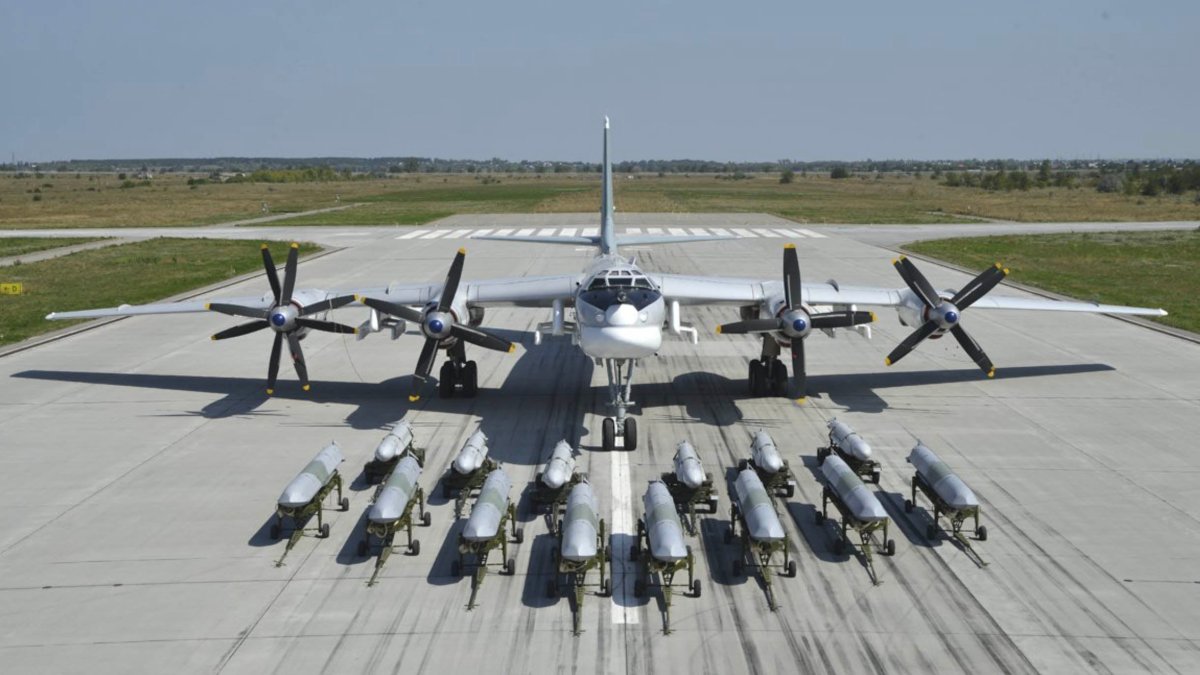
Like the Tu-160, the turboprop-powered Tu-95MS is currently restricted to the carriage of missiles only, although it too has now gained a conventional cruise missile capability to provide a much greater level of flexibility in the post-Cold War era. In this view, we can see the same types of weapons as arranged with the Tu-160, although the numbers are different: six Kh-55SMs and eight Kh-101/102s.
Tu-95MS Bear-H., Russian Ministry of Defense
This Bear-H seen in the picture is an example that has been equipped with four twin hardpoints under the wings to permit the carriage of up to eight Kh-101/102 weapons, which are otherwise too large to fit in the existing bomb bay.
The Tu-95MS also features the same rotary launcher found on the Tu-160, but since it has only one bomb bay, its internal payload is reduced to six Kh-55 series missiles. Around half the fleet are Tu-95MS16 aircraft that can carry 10 more Kh-55 missiles under the wings.
Finally, the intermediate-range Tu-22M3 — another supersonic, swing-wing design — is presented with exclusively freefall armament options, including a pair of enormous FAB-3000 general-purpose bombs, each weighing 6,614 pounds, followed by weapons of increasingly smaller mass, including streamlined weapons and two different types of flat-fronted 1,102-pound general-purpose bombs. Additional bombs are mounted on the Backfire’s external carriers, underneath the fixed section of the wings. All these bombs date from the Cold War period and reflect the fact that the vast majority of ordnance used in combat by the Russian Aerospace Forces is still unguided, with a resulting reduction in accuracy.
Tu-22M3 Backfire-C., Russian Ministry of Defense
Surprisingly, the Tu-22M3’s missile armament is not shown. The Backfire can carry a maximum of three, but more usually one or two examples, of the huge Kh-22 missile, known to NATO as the AS-4 Kitchen, which entered production back in the late 1960s. This delta-wing weapon, powered by a liquid-fuel rocket engine, can be used against both high-value fixed ground targets and warships. Accelerating to near hypersonic speeds over Mach 4 for the final run-in to the target, it remains a problem for air defense systems despite its age. It can carry a nuclear or conventional warhead and has a maximum range of 317 miles. It is now being replaced by the outwardly similar Kh-32, with its range extended to around 559 miles.
While the Backfire has never launched Kh-22 or Kh-32 missiles in combat, they have dropped freefall bombs, most recently over Syria. This may be the reason for the absence of missile armament in this instance. It’s also possible that the Kh-22 is now being displaced by the more modern Kh-32, which may only be optimized for anti-shipping strikes. If that’s the case, the Tu-22M3 load-out may reflect the type’s current weapons options for use against ground targets.
During operations over Syria, Tu-22M3s were noted dropping “sticks” of 10 or 12 551-pound bombs, or six 1,102-pound bombs and, on at least one occasion, a single 6,614-pound bomb was delivered.
Despite their age, the Russian Aerospace Forces’ three strategic bombers provide a useful capability and one that’s more flexible than the intercontinental ballistic missiles (ICBMs) and ballistic missile submarines (SSBNs) that make up the other two arms of the traditional nuclear “triad.” The fact that the bombers can be forward deployed and, increasingly, can employ different conventional weapons, enhances their utility.
The Tu-22M3, in particular, may appear a relic of the Cold War, representing a class of bomber that has disappeared from Western inventories, although it’s notable that, unlike the Tu-160 and Tu-95MS, the Backfire is not covered by the New START treaty, which places restrictions on the maximum size of the overall bomber fleet. On the other hand, the potential demise of the treaty could see the Tu-22M3’s inflight refueling capability reinstated, to provide it with a true strategic range.
Currently, modernization programs are underway for each of the Russian Aerospace Forces’ three strategically tasked types and a program has been launched to resume production of the Tu-160 and its unique NK-25 engines . These upgrades, plus new-build Blackjacks, should ensure that the Long-Range Aviation arm remains useful at least until the arrival of the promised new-generation PAK DA , although the current timeline for this seems doubtful.
Coupled with high-profile foreign visits and an increasing tempo of long-range “patrol” flights by the Russian Aerospace Forces, it’s perhaps little surprise that the Russian Ministry of Defense is taking this opportunity to display at least some of the payloads of its bombers.
Contact the author: thomas@thedrive.com
Comments couldn’t be loaded. Please refresh the page.
更新于美国东部时间2020年11月27日下午6:05
在即将搭载它们的飞机前方,精心布置着一系列威猛的武器,这是军事航空领域常见的景象,经常被用于军事“实力展示”和市场宣传。然而,此前人们很少有机会看到俄罗斯的战略轰炸机与其潜在载荷一同展示。但随着俄罗斯国防部最近发布的一组照片,这种情况发生了改变。
这三张照片是俄罗斯国防部于2020年11月6日在网上发布的一组图片的一部分,展示了俄罗斯空天军远程航空兵目前装备的三种作战机型:图-160“海盗旗”、图-95MS“熊-H”和图-22M3“逆火-C”。这三款轰炸/导弹载机均由图波列夫设计局研制,照片中展示了它们可携带的部分武器,包括罕见的隐形巡航导弹。当然,照片中也有一些明显的遗漏。
超音速可变后掠翼图-160飞机停在跑道上,其后方是两排亚音速空射巡航导弹。距离飞机最近的是一排12枚Kh-55SM亚音速巡航导弹,北约代号为AS-15“肯特”。这些是“传统”核武器,其最初设计可追溯到20世纪70年代末,近年来,中国和伊朗也以此为基础研发了巡航导弹。
图中所示为涡扇动力导弹的控制面已折叠收起。Kh-55SM导弹可加装两个保形副油箱,使其射程增至约1864英里(约3000公里),图中可见副油箱已安装到位。据报道,俄罗斯空天军的部分Kh-55SM导弹已改装为非核版本的Kh-555或AS-22“克鲁格”(Kluge),但图中所示的均为核动力Kh-55SM导弹,因为它们缺少常规版本所配备的前稳定翼。
图-160“黑杰克”战斗机,俄罗斯国防部
在图-160照片中,离镜头最近的是另外十几枚更先进的Kh-101/102隐形亚音速巡航导弹,它们同样安装在地面操作小车上。这种新一代武器从一开始就开发了非核版本的Kh-101(北约代号AS-23A“科迪亚克”)和核版本的Kh-102(AS-23B)。与Kh-55SM一样,这些导弹也采用涡扇发动机。据报道,Kh-101导弹的最大射程在1864至2485英里之间,而Kh-102的射程据说更远。这些武器显然在2010-2011年投入批量生产,Kh-101随后在俄罗斯入侵叙利亚的军事行动中投入实战,由图-160和图-95MS轰炸机发射。
图-160只能将武器内置于机身,装在串联式弹舱内。每个弹舱都配备一个旋转式发射器,可携带六枚导弹,总共可携带12枚Kh-55系列导弹或12枚Kh-101/102导弹。
与图-160一样,涡轮螺旋桨动力的图-95MS目前也仅限于携带导弹,但它现在也具备了携带常规巡航导弹的能力,从而在后冷战时代提供了更大的灵活性。从图中我们可以看到,它搭载的武器类型与图-160相同,只是数量不同:六枚Kh-55SM和八枚Kh-101/102。
图-95MS“熊-H”,俄罗斯国防部
图片中的这架 Bear-H 就是一个例子,它在机翼下配备了四个双联挂点,可以携带多达八枚 Kh-101/102 武器,否则这些武器体积太大,无法装入现有的炸弹舱。
图-95MS也配备了与图-160相同的旋转式导弹发射器,但由于只有一个弹舱,其内部有效载荷减少到只能携带6枚Kh-55系列导弹。该机队约有一半是图-95MS16型飞机,这种飞机可以在机翼下额外携带10枚Kh-55导弹。
最后,中程型图-22M3——另一款超音速变后掠翼飞机——仅配备自由落体式武器,包括两枚巨大的FAB-3000通用炸弹,每枚重达6614磅,随后是质量逐渐减小的武器,包括流线型武器和两种不同类型的扁平弹头1102磅通用炸弹。此外,还有一些炸弹挂载在“逆火”战斗机机翼固定部分下方的外部挂架上。所有这些炸弹都源于冷战时期,反映出俄罗斯空天军在战斗中使用的绝大多数弹药仍然是非制导武器,导致精度较低。
图-22M3“逆火-C”,俄罗斯国防部
令人惊讶的是,图-22M3的导弹武器装备并未展示。“逆火”轰炸机最多可携带三枚,但通常只携带一到两枚巨型Kh-22导弹(北约代号AS-4“厨房”),该导弹于20世纪60年代末投入生产。这种三角翼导弹采用液体燃料火箭发动机,可用于打击高价值的固定地面目标和军舰。它在最后冲锋阶段加速至接近高超音速(超过4马赫),尽管服役已久,但对防空系统而言仍然是一个棘手的难题。Kh-22导弹可携带核弹头或常规弹头,最大射程为317英里(约500公里)。目前,Kh-22导弹正被外形相似的Kh-32导弹取代,后者的射程可达约559英里(约890公里)。
虽然“逆火”轰炸机从未在实战中发射过Kh-22或Kh-32导弹,但它投掷过自由落体炸弹,最近一次是在叙利亚上空。这或许可以解释此次行动中该机为何没有携带导弹。此外,Kh-22导弹可能已被更先进的Kh-32导弹取代,而Kh-32导弹或许仅针对反舰打击进行了优化。如果情况属实,图-22M3的武器配置可能反映了该机型目前用于对地攻击的武器选项。
在叙利亚上空作战期间,人们注意到 Tu-22M3 投掷了 10 或 12 枚 551 磅炸弹,或 6 枚 1,102 磅炸弹,而且至少有一次,投掷了一枚 6,614 磅炸弹。
尽管服役时间较久,俄罗斯空天军的三架战略轰炸机仍然具备强大的作战能力,而且比构成传统核“三位一体”的另外两大武器——洲际弹道导弹(ICBM)和弹道导弹潜艇(SSBN)——更加灵活。这些轰炸机能够前沿部署,并且越来越多地能够使用不同的常规武器,这进一步提升了它们的效用。
图-22M3轰炸机尤其显得像是冷战时代的遗物,代表着西方国家已从其装备序列中消失的一类轰炸机。值得注意的是,与图-160和图-95MS不同,“逆火”轰炸机并不受《新削减战略武器条约》(New START)的约束,该条约对轰炸机机队的总规模有所限制。另一方面,如果该条约最终失效,图-22M3的空中加油能力或许能够恢复,从而使其具备真正的战略航程。
目前,俄罗斯空天军三种战略机型的现代化升级计划正在进行中,同时,图-160及其特有的NK-25发动机的复产计划也已启动。这些升级,加上新生产的“海盗旗”远程攻击机,应该能够确保远程航空兵至少在承诺的新一代PAK DA导弹交付之前保持作战能力,尽管目前来看,PAK DA的交付时间表令人怀疑。
鉴于俄罗斯空天军高调出访和远程“巡逻”飞行频率不断增加,俄罗斯国防部借此机会展示其轰炸机的部分有效载荷也就不足为奇了。
联系作者:thomas@thedrive.com
评论加载失败,请刷新页面。