Excalibur Was A Vulcan Gatling Gun Wielding Air Defense Vehicle Straight Out of G.I. Joe“王者之剑”是一辆装备火神加特林机枪的防空车辆,就像是从《特种部队》里走出来的一样。
The US Army never adopted the eight-wheeled design, but the service is now looking at wheeled anti-aircraft vehicles once again.
新闻视频
By Joseph Trevithick
Updated Feb 6, 2019 3:30 AM EST
Late in the Cold War, the Standard Manufacturing Company pitched a new type of short-range air defense vehicle, called Excalibur, to the U.S. Army. Looking like something out of a G.I. Joe playset or a 1980s action movie , this Vulcan cannon-armed vehicle was just one of many designs the company suggested could revolutionize the service’s mechanized units.
It’s not clear exactly when Standard Manufacturing, situated in Dallas, Texas – and apparently unrelated to the Connecticut-based gunmaker of the same name – built the first prototype design, but one was available for tests by 1985. The firm had applied for a patent for the vehicle’s unique 8×8 trailing-arm suspension in 1984, which the U.S. Patent and Trademark Office granted two years later .
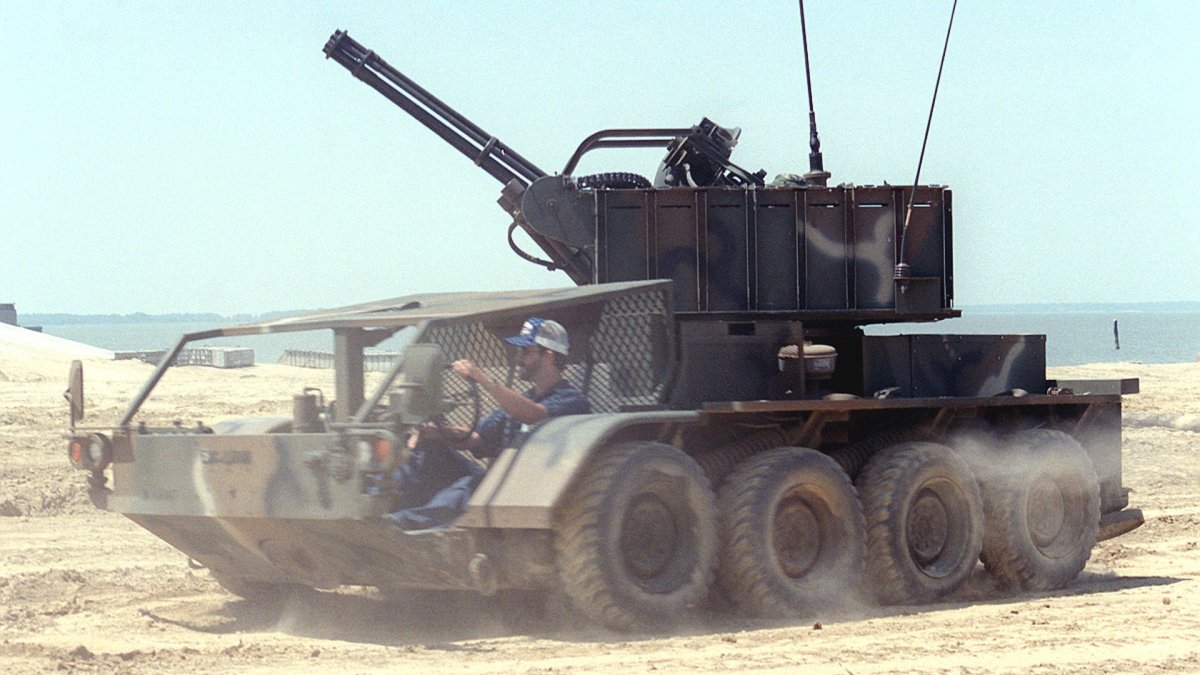
According to Fred Crismon’s Modern U.S. Military Vehicles , Excalibur, also known as the Vulcan Wheeled Carrier, combined this suspension with a 135-horsepower Detroit Diesel V8 engine, which reportedly gave it a top speed on improved roads of 45 miles per hour. On top of the chassis, there was a lightweight, open-framed crew-cab in front and a turret in the rear with a radar-assisted 20mm M168 six-barrel cannon, a variant of the M61A1 Vulcan cannon found on fighter jets and other aircraft . The entire vehicle weighed approximately 16,000 pounds.
More importantly, Standard Manufacturing claimed that the suspension system, in which every one of the eight wheels could articulate up and down independently, would give it the same mobility on uneven ground as a tracked vehicle. At the same time, Excalibur would have significantly higher speeds on rough terrain and improved roads, but with fewer maintenance requirements, reducing the operating costs compared to traditional tracked designs.
The Excalibur Vulcan Wheeled Carrier vehicle during a US Army exercise in 1985., US Army
At the time, the Army’s had tracked and towed Vulcan Air Defense Systems , or VADS, in service using the same manned turret. Excalibur would have been lighter than the M113 armored personnel carrier that served as the basis for the tracked system.
The tracked VADS, also known as the M163, was significantly heavier than the standard M113, as well, necessitating a reinforced suspension and additional floatation gear to maintain its amphibious capabilities. On roads, that vehicle could hit a top speed of 40 miles per hour, but at the cost of increased wear and tear on its tracks and the road surface.
The M167 towed version was limited in its mobility by whatever vehicle was pulling it along. In 1985, the system’s prime mover was the first iteration of the new ubiquitous Humvee , which had better mobility off-road than its predecessors, but still could not match the capabilities of a tracked vehicle, especially when pulling a heavy trailer.
Even so, it’s not clear what the exact impetus was for the Texas-based company to develop this vehicle, since the Army had two versions of the VADS in service already, primarily to provide short-range defense for ground units against low-flying aircraft and helicopters. But it did come at a time when the Army had become increasingly concerned that its ground units and their vehicles might be too heavy and bulky to rapidly deploy in response to far-reaching conflicts.
The rapid collapse of the Shah’s regime in Iran and the speed at which the Soviet Union invaded Afghanistan , both of which occurred in 1979, pushed the service to craft what it first dubbed a High Technology Test Bed and then renamed as the High Technology Light Division. Excalibur would have been well at home in this organization, which for a time had an entire battalion of militarized dune buggies .
Chenowth Fast Attack Vehicles from 2nd Battalion, 1st Infantry during a training exercise in South Korea in the 1980s., US Army
The same organization subsequently experimented with various light tank and assault gun concepts, Humvees carrying Hellfire missiles , and other state-of-the-art, but highly mobile systems. Likely with this type of organization in mind, Standard Manufacturing’s patent outlines an entire family of vehicles based on its 8×8 suspension, including cargo trucks, armored personnel carriers, scout vehicles, mobile artillery rocket launchers, and platforms for communications nodes and electronic warfare systems.
The drawing of the last vehicle actually looks very much like a truck carrying the Franco-German-designed Roland surface-to-air missile , which the Army had planned to acquire in the 1980s. We don’t know exactly what happened to Standard Manufacturing’s concept. None of the vehicles based on its proprietary chassis, which also included a variety of civilian trucks and construction equipment, ever entered series production.
Drawings depicting various vehicles that could use the Standard Manufacturing suspension system as shown in its patent. Figure 35 looks very similar to US Army’s truck-mounted Roland launcher., USPTO
The complexity of the independent suspension system may have made the vehicles too costly or unreliable for military use, especially during rapid deployment operations where there might not be the immediate benefit of established repair facilities or robust logistics chains. It would also undoubtedly have needed additional armor protection for the crew cab and other military equipment. This, in turn, might have increased its overall weight and reduced the potential mobility and speed benefits.
Especially after the Cold War ended in 1991, and the U.S. defense budget began to contract, Excalibur may just have been too expensive when compared to the existing mix of traditional tracked and wheeled vehicles. By the end of the 1980s, the Army had already shelved the entire High Technology Light Division concept and returned most of the test units to more conventional force structures.
A Standard Manufacturing Company cargo truck using its 8×8 independent suspension system during a US Army exercise in 1985., US Army
The basic underlying concepts didn’t go away, though. In the 1980s, the U.S. Marine Corps had purchased a fleet of 8×8 wheeled armored vehicles based on the Swiss-designed MOWAG Piranha , known as the LAV-25 family , for a variety of roles. This fleet included a small number of LAV-Air Defense variants, or LAV-ADs, which featured a turret with a Vulcan cannon and eight Stinger short-range surface-to-air missiles. Early prototypes iterations also included a 70mm rocket pod for attack ground targets, a concept that carried over to a similar, proposed Canadian design known as the Multi-Mission Effects Vehicle (MMEV).
In the early 2000s, the Army finally followed suit with the Stryker series , derived from the MOWAG Piranha III . By that point, however, the service had largely dismissed the need for short-range air defense in the future and did not buy an air defense type. This decision that has since proven to be immensely short-sighted, which you can read more about in detail in this past War Zone feature .
Some foreign VADS operators have put the turrets on various other wheeled vehicles, as well. The Saudi Arabian National Guard acquired a version of the Cadillac Gage V-150 4×4 armored vehicle straight from the manufacturer with the Vulcan weapon system .
More recently, Jordan’s state-owned King Abdullah II Design and Development Bureau (KADDB) defense company modified a number of the country’s 6×6 Cougar Mine Resistant Ambush Protected (MRAP) vehicles to carry the VADS turret. This combination is more about providing massive firepower against ground targets, though, which was always a secondary role for the tracked and towed Vulcan systems.
KADDB-modified Cougar MRAPs of the Jordanian Army with the Vulcan turret near the Al Roqban refugee camp in 2017., Jordan Pix/Getty Images
The turrets themselves appear to be relatively durable and the basic components of the gun system remain in production. Variants of the Vulcan cannon remain in service as air-to-air weapons and as part of the Phalanx close-in defense system on ships.
The Army even adopted a trailer-mounted version of the Phalanx as a means of protecting forward outposts against small rockets and mortar bombs. Just in November 2017, reports emerged that South Korea was upgrading its towed variants with new thermal optics as an interim defense against North Korean threats such as low- and slow-flying An-2 biplanes and small unmanned aircraft .
Especially when it comes to the increasing proliferation of small drones among state among state and non-state actors , the VADS system, or weapons like it , are increasingly relevant again. Combined with a short-range surface-to-air missile system, such as Stinger , the old turrets might be a good interim short-range air defense option in many cases, regardless of what platform carrying them.
As it stands now, the Army is looking to field a Stryker-based air-defense vehicle in the near term to address its aforementioned and increasingly glaring short-range air defense gap, both with regards to the threat of low-flying manned aircraft and small drones. Though the service appears to be focusing largely on missile-based systems, OrbitalATK has demonstrated a vehicle carrying both an electronic warfare jammer to target small drones and an XM914 single-barrel 30mm cannon.
OrbitalATK’s prototype Stryker with its Anti-Unmanned Aerial Vehicle Defense System, or AUDS, and an XM914 30mm cannon., OrbitalATK
The Army wants prototypes of the air defense Stryker ready for testing by 2019 , but has yet to settle on a particular design. If everything proceeds on schedule, the first batch of vehicles could join units in Europe the following year.
At that time, more than three decades after Standard Manufacturing designed its Excalibur prototype, the Army may finally have an 8×8 air defense system.
Another Stryker air defense configuration from Boeing and General Dynamics Land Systems., Boeing/GDLS
Contact the author: jtrevithickpr@gmail.com
Comments couldn’t be loaded. Please refresh the page.
作者:约瑟夫·特雷维西克
更新于美国东部时间2019年2月6日凌晨3:30。
冷战后期,标准制造公司向美国陆军推销了一种名为“神剑”(Excalibur)的新型短程防空车辆。这款装备火神炮的车辆外形酷似特种部队玩具或20世纪80年代动作电影中的道具,而这只是该公司提出的众多设计方案之一,这些方案有望彻底改变美国陆军的机械化部队。
位于德克萨斯州达拉斯的 Standard Manufacturing 公司(显然与康涅狄格州同名的枪支制造商无关)究竟何时制造出第一辆原型车尚不清楚,但到 1985 年,一辆原型车已经可以进行测试。该公司于 1984 年为该车辆独特的 8×8 拖臂悬架申请了专利,美国专利商标局在两年后授予了该专利。
根据弗雷德·克里斯蒙的《现代美国军用车辆》一书,Excalibur(又名Vulcan轮式运输车)将这种悬挂系统与一台135马力的底特律柴油V8发动机相结合,据称其在路况良好的道路上的最高时速可达45英里/小时。底盘上方,前部是一个轻型开放式驾驶室,后部是一个炮塔,炮塔上装有一门雷达辅助的20毫米M168六管机炮,这是战斗机和其他飞机上使用的M61A1“火神”机炮的改进型。整车重量约为16000磅。
更重要的是,标准制造公司声称,其悬挂系统(八个车轮均可独立上下运动)使其在崎岖路面上拥有与履带车辆相同的机动性。同时,Excalibur 在崎岖地形和路况良好的道路上速度显著提升,且维护需求更低,与传统履带式车辆相比,运营成本也更低。
1985年美国陆军演习期间的“神剑火神”轮式运输车。
当时,陆军已经装备了履带式牵引的“火神”防空系统(VADS),该系统使用相同的有人炮塔。“神剑”装甲车比履带式系统所基于的M113装甲运兵车更轻。
履带式VADS(也称M163)比标准的M113重得多,因此需要加固悬挂系统和额外的浮力装置来保持其两栖能力。在公路上,该车最高时速可达40英里/小时,但代价是履带和路面磨损加剧。
M167牵引式系统的机动性受限于牵引车辆。1985年,该系统的牵引车辆是当时广泛使用的悍马军车的第一代产品,其越野机动性优于前代车型,但仍然无法与履带式车辆的性能相媲美,尤其是在牵引重型拖车时。
即便如此,这家总部位于德克萨斯州的公司研发这款车辆的确切动机尚不明确,因为陆军当时已经装备了两种型号的VADS,主要用于为地面部队提供近程防御,抵御低空飞行的飞机和直升机。但当时正值陆军日益担忧其地面部队及其车辆可能过于笨重,难以在应对远距离冲突时快速部署之际。
1979年,伊朗国王政权的迅速垮台和苏联入侵阿富汗的迅猛发展,促使美国陆军组建了最初名为“高科技试验场”的机构,后更名为“高科技轻型部队”。“亚瑟王”号(Excalibur)如果加入这个机构,一定会如鱼得水,因为该机构一度拥有一整个营的军用沙滩车。
20世纪80年代,美国陆军第1步兵团第2营的切诺斯快速攻击车在韩国进行训练演习。
同一组织随后试验了各种轻型坦克和突击炮概念、搭载“地狱火”导弹的悍马军车以及其他先进且高度机动的系统。标准制造公司的专利很可能是考虑到这类组织的需求,概述了一系列基于其8×8悬挂系统的车辆,包括货车、装甲运兵车、侦察车、移动式火箭炮发射车以及通信节点和电子战系统平台。
最后那辆车的设计图看起来很像一辆运载法德联合研制的“罗兰”地对空导弹的卡车,而美国陆军曾在20世纪80年代计划采购这种导弹。我们并不清楚标准制造公司的这个概念最终发生了什么。基于该公司专有底盘研发的车辆,包括各种民用卡车和工程机械,最终都未能投入批量生产。
图示为可使用Standard Manufacturing公司专利中所示悬挂系统的各种车辆。图35与美国陆军的卡车式罗兰发射器非常相似。(美国专利商标局)
独立悬挂系统的复杂性可能导致车辆成本过高或可靠性不足,不适合军事用途,尤其是在快速部署行动中,因为此时可能无法立即获得完善的维修设施或可靠的后勤保障。此外,驾驶室和其他军事装备无疑需要额外的装甲防护。而这反过来又可能增加车辆的整体重量,降低其潜在的机动性和速度优势。
尤其是在1991年冷战结束后,美国国防预算开始缩减,“神剑”装甲车与当时现有的传统履带式和轮式车辆相比,造价可能过于昂贵。到了20世纪80年代末,陆军已经搁置了整个高科技轻型师的概念,并将大部分试验部队重新编入更常规的部队编制。
1985年,一辆标准制造公司(Standard Manufacturing Company)的货车在美军的一次演习中使用了其8×8独立悬挂系统。(美军)
然而,其基本理念并未消失。上世纪80年代,美国海军陆战队采购了一批基于瑞士MOWAG Piranha设计的8×8轮式装甲车,即LAV-25系列,用于执行各种任务。这批车辆中包含少量LAV防空型(LAV-AD),配备一个装有火神炮和八枚毒刺短程地对空导弹的炮塔。早期原型车还配备了一个用于攻击地面目标的70毫米火箭发射器,这一概念也被加拿大提出的类似设计方案——多任务效应车辆(MMEV)所借鉴。
21世纪初,陆军最终也推出了“斯特瑞克”系列装甲车,该系列源自MOWAG“食人鱼III”型防空导弹系统。然而,当时陆军已基本放弃了未来对近程防空的需求,因此没有采购任何防空型装甲车。事实证明,这一决定极其短视,您可以在之前的“战区”专题报道中了解更多详情。
一些外国VADS运营商也将炮塔安装在其他各种轮式车辆上。沙特阿拉伯国民警卫队直接从制造商处采购了一辆配备火神武器系统的凯迪拉克Gage V-150 4×4装甲车。
最近,约旦国有的阿卜杜拉二世国王设计与发展局(KADDB)国防公司对该国部分6×6“美洲狮”防地雷反伏击车(MRAP)进行了改装,使其能够搭载VADS炮塔。不过,这种组合的主要目的是提供强大的地面火力,而这原本并非履带式和牵引式“火神”系统的辅助功能。
2017年,约旦陆军的KADDB改装版“美洲狮”防地雷反伏击车(Cougar MRAP)在阿尔罗克班难民营附近,配备“火神”炮塔。(图片来源:Jordan Pix/Getty Images)
炮塔本身似乎相对耐用,火炮系统的基本部件也仍在生产。火神炮的各种改进型至今仍作为空对空武器以及舰载密集阵近程防御系统的一部分服役。
陆军甚至采用了拖车式“密集阵”防御系统,作为保护前沿哨所免受小型火箭弹和迫击炮弹袭击的手段。就在2017年11月,有报道称韩国正在为其拖曳式“密集阵”系统升级新型热成像仪,作为应对朝鲜威胁(例如低空慢速飞行的安-2双翼飞机和小型无人机)的临时防御措施。
尤其是在国家和非国家行为体之间小型无人机日益增多的情况下,VADS系统或类似武器的重要性再次凸显。与诸如“毒刺”之类的短程地对空导弹系统结合使用,无论搭载于何种平台,这些老式炮塔在许多情况下都可能成为一种有效的临时短程防空方案。
目前,美国陆军正计划在近期部署一款基于“斯特瑞克”装甲车的防空车辆,以弥补其日益凸显的短程防空缺口,应对低空有人驾驶飞机和小型无人机的威胁。尽管陆军似乎主要关注导弹系统,但OrbitalATK公司已展示了一款搭载电子战干扰器(用于干扰小型无人机)和XM914单管30毫米机炮的车辆。
OrbitalATK公司的“斯特瑞克”原型车配备了反无人机防御系统(AUDS)和一门XM914型30毫米机炮。
美国陆军希望在2019年前完成“斯特瑞克”防空装甲车原型车的测试,但尚未最终确定具体设计方案。如果一切按计划进行,首批车辆有望于次年交付欧洲部队。
届时,在 Standard Manufacturing 设计出 Excalibur 原型机三十多年后,美国陆军可能终于拥有了一套 8×8 防空系统。
波音公司和通用动力陆地系统公司联合推出的另一种“斯特瑞克”防空配置方案。
联系作者:jtrevithickpr@gmail.com
评论加载失败,请刷新页面。