Confessions Of A Navy F-14 Fleet Pilot Turned F-5 Aggressor一位海军F-14舰队飞行员转投F-5假想敌战队的自白
Francesco "Paco" Chierici talks fighting in Tomcats and Tigers, losing comrades, and flying 737s during the week and fighters on the weekend.
新闻视频
By Francesco "Paco" Chierici and Tyler Rogoway
Updated Sep 28, 2021 6:26 PM EDT
In the first part of our two-part series on the high-flying adventures and in-cockpit experiences of Francesco “Paco” Chierici, he talked in-depth about flying Grumman A-6 Intruders during the twilight of the type’s service. In the second part, we get into Paco’s experiences, trials, and tribulations going from a ‘mud-mover’ to a dogfighter in the legendary F-14 Tomcat. Eventually, Paco would go from a Tomcat pilot to an F-5 adversary reserve pilot tasked with teaching fleet pilots how not to die in the highly unforgiving realm of air-to-air combat. But beyond the flying, we discuss so much more, from the U.S. military’s pilot shortage to dealing with the loss of comrades to becoming a documentary filmmaker and eventually an author.
Paco’s Lions Of The Sky was recently released and he details below how the fictional story was ripped directly from the people, places, and experiences he had as a career Naval Aviator.
So strap into the cockpit, arm your ejection seat, and light the burners as we blast off on a voyage into Paco’s colorful and action-packed past.
From mud-moving to dogfighting
I had experienced Basic Fighter Maneuvers (BFM, aka dogfighting) in the training command and fancied myself a natural. As an Intruder pilot, I would try to convince as many other pilots to fly a little BFM at the end of our bombing missions as often as possible.
There is nothing quite as hideous as two Intruders trying to dogfight.
My delusion was reinforced in the Tomcat RAG (Replacement Air Group training squadron), whereas a seasoned fleet pilot I was more comfortable being aggressive than my nugget classmates, but I knew nothing about how to really fight the jet. That fact was put on display numerous times when I finally got to my first F-14 fleet squadron, VF-213 Blacklions, and had numerous flights dedicated to air-to-air maneuvering. I got my butt handed to me by some of the best Tomcat pilots on the West Coast—Slammer Richardson, Stash Fristachi, Killer Killian, Whiskey Bond, and my roommate, Waylon Jennings.
On one particularly humiliating flight from the Lincoln , a Hornet flown by Mousse savaged me on three successive engagements. But losing is the best teacher. I had come into the community with a love of aerial combat and I learned that the best dogfighters were made, not born.
I read the Topgun manual, listened in the debriefs, and eventually crafted myself into a respectable BFMer. No Pappy Boyington , but serviceable.
Of course, as good as I thought I was at the end of my Tomcat days, I was to soon find out how to really fight a plane once I became a Bandit.
Life is a series of humiliations.
The guy—or gal—in the back
The synergy between pilot and crew member was crucial to the successful employment of both the A-6 and the F-14. A good crew working well together was a thing of beauty.
Both platforms were relics of a previous age—bleeding edge when they were introduced, but hanging on at the ends of their eras when I flew them. What allowed them to compete with more modern aircraft was the proper execution of a crew concept. Of course, when the crews weren’t in sync, it was a frustrating and enormous shit show.
To help maximize the crew’s performance, both communities endeavored to pair compatible crews and have them fly together as much as possible. During the course of normal turn-around ops this was difficult to accomplish. People had different schedules and priorities which made for a catch-as-catch-can environment. But during work-ups, or combat operations, there was a much higher effort put into flying with your designated crew-member.
Working with a RIO in the Tomcat while fighting in the visual arena was totally binary. Either the pilot and the RIO bonded synergistically, fusing into a lethal team that enhanced situational awareness and weapons deployment, or they were a complete disaster.
When the pilot and the RIO weren’t well suited for the specific dynamics of the visual arena, the result was a massive net-negative. If a RIO didn’t speak enough or spoke too much, the pilot wouldn’t get enough information to properly fight the plane while assessing the threat of the adversary aircraft. When it worked, it was amazing . When it didn’t, it was frustrating and at times, embarrassing. But it was nice to always have a RIO to blame!
The Tomcat’s biggest arrow
As most Tomcat aficionados are aware, the plane was built to employ the AIM-54 Phoenix missile. Originally designed for fleet defense against large and fast Soviet bombers, the Phoenix was massive in every way, and far ahead of its time.
It weighed 1,000 pounds, was thirteen feet long, had a rocket motor burn time of over a minute, flew at Mach 5 and 80,000 feet, and delivered its 135-pound warhead to a target more than 100 miles away using its onboard radar in the end-game.
A lethal sledgehammer of a missile.
To effectively target this brute, an enormously powerful radar was required. To carry the giant radar dish and as many as six Phoenixes, Grumman designed a monster—the F-14 Tomcat—once it was clear that the F-111B failed in the role. Because the radar was so powerful and its dish so large, the AWG-9 was able to far exceed the detection, sorting, and targeting ranges of any other fighter in the world for decades.
The AWG-9’s capabilities were a generational advance over its contemporaries, the F-4 and even the F-15. Through brilliant engineering and raw power, it was able to achieve results that we now take for granted in the most modern fighters—the once upon a time groundbreaking ability to simultaneously scan, target, and fire multiple missiles.
One of my fondest memories of flying the Tomcat was the many missile shoots I was able to take part in. I shot AIM-9 Sidewinders at drones and a total of five Phoenix missiles over four separate events.
The Sidewinder came off the rails screaming like a bottle rocket, finding its way to the target in an angry corkscrew. The Phoenix was so heavy it had to be dropped from the plane like a bomb before the motor could fire. At trigger squeeze you felt the Phoenix release from the jet with a distinct thump. About a second later, which is an eternity, the motor would light off and the AIM-54 would howl past the Tomcat from below, leaving a huge plume as it rocketed into the stratosphere.
It would receive data from the Tomcat’s radar until it pitched over from 80,000 feet and closed on the target, then the RIO would cut it loose and the Phoenix’s on-board radar would consummate the deadly rendezvous.
At close range the missile would aim directly at the target, flying a horizontal path, smoking all the way to fireball. It was a sight to behold, from the shooter’s vantage point.
Despite being enormous and labor intensive to load, the Phoenix evolved with the times quite well. In most metrics, it could outperform the AIM-120 AMRAAM. The range, motor burn-time, warhead and on-board radar were no contest. The software and firmware were updated periodically allowing the missile to compete in the modern world. But like the Tomcat, it was a beast that was outperforming its design specifications a little past its shelf life.
Making the big cat dogfight
Though the Tomcat was technically a fighter plane, it wasn’t really designed for the visual BFM arena. It had a number of elements working against it when it came to dogfighting.
First was its size, it was fondly referred to as the ‘Big Fighter,’ and it was huge . One of the basic tenants of aerial combat is, ‘lose sight, lose the fight.’ Against a Tomcat that was almost impossible.
The A-model was also underpowered for maneuvering fights with an approximately 0.67:1 thrust to weight ratio. Furthermore, we had a 6.5 G limit, though there was no black box that would tell on you, so we often went well beyond 7 G. While it had massive elevators that would develop an incredible instantaneous pitch rate, the lack of ailerons and the sheer width of the plane made the roll rate sluggish.
Finally, the ergonomics of the cockpit were designed in the late ‘60s. There was no HOTAS (Hands On Throttles and Stick). The BVR intercept was run by the RIO in the back manipulating the radar and working with the pilot. Once the merge was imminent, inside 10 nautical miles, the pilot took over. But he would still have to call for the RIO to engage the dogfight mode of the radar.
Despite these massive deficiencies, the Tomcat, in the hands of a skilled pilot flying with a good RIO, could be quite lethal in the visual arena. Especially if it had the General Electric motors.
In a two-circle fight, where degrees of turn per second are a premium, the Tomcat was quite adept. But if you got the A-model slow, into the ‘black hole’ around 250 knots, you were stuck in a region the plane did not excel in. The TF-30 engines just didn’t have enough grunt to allow the plane to fly extremely slowly, nor to power back up to proper maneuvering speed.
The GE engines, on the other hand, enabled a skilled pilot to work the slow speed environment successfully. A very good pilot could even pirouette the plane using the GE engines by bringing one out of afterburner. The Tomcat would swap ends gracefully and reverse course instantly.
The auto function of the wing sweep could work against a pilot in the BFM arena as well. The angle of the sweep was a function of a variety of factors, including speed, angle of attack, and altitude.
F-15s liked to drag the Tomcat high and use their superior thrust to gain an advantage. An off-the-books tactic we used to counter this was to manually extend the wings to the fullest, then incrementally lower the flaps beyond the normal maneuver setting. It was hugely successful, but the danger was that the flap torque tubes were not designed for this and could become stuck.
Life is all about tradeoffs, and not losing to an F-15 is certainly worth the ire of the maintenance Master Chief.
I flew BFM against a variety of dissimilar aircraft as a Tomcat pilot. During a memorable week off the coast of Pakistan we flew a number of BFM and BVR sorties against the Pakistani Air Force. I still have some spectacular HUD footage from engagements against MiG-21s (J-7s).
I remember being amazed at the lack of proficiency and proper weapons employment from their F-16 pilots. When we were in the Persian Gulf, we had a week where we fought the Emirati Mirage 2000-5 pilots. They were actually quite aggressive pilots who displayed a keen awareness of the tactics to employ against the weaknesses of the F-14A. They would jam to the merge, then pull 9Gs, flying so high we almost lost sight. If we did, they would tag us with a heater (infrared short-range guided missile). But if you could survive the first merge to employ follow-on BFM, they became easy prey.
Probably the single best BFM platform I ever flew against was the F-16N. Stripped down and slicked up, it was a dogfighting monster, virtually unbeatable.
Editor’s note: Read all about the Navy’s infamous F-16N and what it was like to fly it in this past special feature of ours.
I once had a friend in a Topgun Viper park himself a couple thousand feet on my nose when I was flying a slick F-5. I counted down “3, 2, 1 Fight’s on!” and tried my damnedest to stay offensive. Inside of 270 degrees of turn, the Viper came nose on and was gunning me.
It was eye-watering performance.
In the summer of 1990, I had been stashed at NAS Miramar just after completing flight school. I was assigned to VFC-13, the adversary squadron, while I waited for a training slot for the A-6 at NAS Whidbey Island in Washington State. Miramar was at the peak of the post- Top Gun sugar rush. The O’Club on a Wednesday night was like what I imagine Studio 54 was like in the ‘70s. There was an hour-long line to get on base and go to the Club. It was so profitable for the base that they built a separate entrance through the perimeter fence directly into the back entrance of the Club.
Thursday mornings were hell.
NAS Whidbey Island was a markedly different cultural scene. No one drove the hour and a half from Seattle to party at the Whidbey O’Club on a Friday night. But that actually made for a very tight community. We shared the base and the Friday night happy hours with the Prowler community as well. While Whidbey didn’t have wall to wall revelers and live music, most of the aviators on base could be found at the club drinking together.
My favorite pastime was playing a dice game called Klondike. On a big night just before a few squadrons were leaving on cruise, the pot could quickly balloon to a few thousand dollars.
There was nothing like leaving for six months to make gambling with huge piles of cash seem like a good idea.
I was a new guy in three different fleet squadrons and one reserve squadron. Each of these had a distinct culture which greeted the FNG (Fucking New Guy) slightly differently. My first was an Intruder squadron which I joined the day of their victorious fly-in returning from the Iraq War I in ’91. I was joining a group which had been to war together and done great deeds under tremendous stress. They hadn’t had a new pilot in a very long time and I was replacing one whom they had lost, along with his B/N during combat ops.
It wasn’t a very warm reception.
They were justifiably proud of their accomplishments and not super accepting of a bright, bushy-tailed new dude, who undoubtedly wasn’t as good as he thought he was.
It took a good six months to break into the brotherhood.
The next few squadrons I joined had a much more accepting culture. When I joined VF-213, my Tomcat squadron, it was as a fleet experienced aviator with many hundreds of hours, a few hundred carrier traps, and I was a fully qualified LSO (Landing Signal Officer). They were a very easy group to join and I felt accepted immediately.
It helped that I had a fair amount to offer, I jumped right back to LSO duties, and the Lions were eager to learn how to employ the F-14 as a ‘Bombcat.’ But despite my eagerness to be a fighter pilot, I was a complete neophyte in the world of air-to-air combat, and it was obvious. The Lions took great care training me and the other new crews and we always felt valued and encouraged, so much as these emotions are possible in a cutthroat fighter squadron.
VF-213 almost changed their name from the Blacklions shortly after I arrived. To some, she was a cursed squadron and the black cat logo was as good a scapegoat as anything else.
The Lions had lost a number of planes due to a variety of causes in the years prior to my arrival. Tomcats hit the ramp of the ship during landing, stalled in the overhead break, exploded in mid-air for no apparent reason. There seemed to be no common thread unifying the mishaps, so straws were grasped at, including changing the famed Blacklion logo. Thankfully that wasn’t a remedy that was pursued.
When I got to 213, the mishaps continued. In fact, during my two years in Air Wing Eleven, the entire Wing lost nine jets and had six fatalities. Four of the lost planes were Tomcats and three of the deaths were in them.
It was a jumpy time.
As one of my friends, HOB Higgins, said, we felt like cats in a room full of rocking chairs. Shortly after I joined 213 we lost Kara Hultgreen while she was attempting to land on the Lincoln . I had known Kara briefly in the Training Command.
Kara Hultgreen., YouTube Screencap
We both had Alfa Romeo convertibles and we laughed about the spotty reliability and repair costs of the Italian sports cars. She was the perfect ‘fighter-chic,’ quick with a smile, fun to be around, sharp-witted, and not afraid to stand her ground. She folded herself into the fabric of the Blacklions seamlessly and was warmly regarded as part of the ‘pride.’
The treatment she received after her death has always stayed with me as one of the greatest injustices witnessed during my naval career. Our XO replicated the mishap 100 times in the simulator and crashed 97 of them.
At the time of her death, she was a pack-player behind the boat, meaning that she was solidly in the middle of the squadron’s landing grades. Yet, as one of the first woman to fly Tomcats in the fleet, and the first to die doing so, she was held as an example of the supposed error of women in combat.
It hurt to see her sacrifice used in such a vicious manner, especially since her death had nothing to do with her gender. Kara was an inspiration for the female character of my novel, Lions of the Sky . I began with the question, “What would Kara’s journey had looked like had she lived?”
My character, Keely Silvers, is the embodiment of Kara’s fighter spirit—tough, funny, a natural pilot, and ultimately, someone to be reckoned with.
The hardest tactic to master
Death and disaster are a dark reality of military aviation. Despite all of the emphasis on safety and training rules, the environment is unforgiving and the penalty for error is swift and deadly.
I flew for 20-years and lost more than 20 friends and comrades. The list of reasons for the mishaps was dizzying: mid-air collisions, maintenance errors, G induced loss of consciousness (G-LOC), impacting the earth, and a few more.
After every mishap, we had to both grieve and disassociate ourselves. It was a battle of opposing emotional efforts. On the one hand, we would hold a memorial ceremony, complete with missing man flyby. They were all gut-wrenching affairs which forced you to confront your mortality and hold loved-ones close. Then, often hours later, it was time to get right back on the horse, back into the very same environment, the same missions, the same planes that had just taken your buddy’s life. To do that required a conscious act of delusion. Forcing fear, trepidation, uncertainty into a box and shelving them in a storage bunker deep in the back of your mind.
The pilots I knew who perished spanned the spectrum of skill level, from the best I ever saw, to some who were not very good. The Grim Reaper didn’t distinguish. We convinced ourselves that we weren’t next, that the bullet wouldn’t be in the next chamber during our aerial game of Russian Roulette.
My last two years on active duty our air wing lost nine airplanes and six people. It seemed like every two months there was an ELT sounding off alerting us to yet another mishap. I didn’t realize how much strain it put on me until I left.
After a couple of months away I slept much better and felt much lighter in spirit. But flying pointy nosed jets, pulling Gs, and burning jet fuel are as addicting as it gets. Within a few more months I was back in the air, getting my fix with the reserves, and loving every minute because I knew I wasn’t next.
Missing Man formationo of the Big John., USN
My second cruise over the ‘sandbox,’ as Iraq was referred to, was enhanced by flying a different airframe in a different community. It wasn’t quite the same stuff, different day. I had a lot to learn about my new plane and a much different mission to master.
We had three basic missions flying the F-14 over Iraq during Southern Watch: reconnaissance, strike, and air superiority.
I enjoyed the variety of missions. The reconnaissance missions required flying with a TARPS (Tactical Airborne Reconnaissance Pod System), which we fondly referred to as ‘The Turd.” The pod weighed roughly two-thousand pounds and was hung towards the rear of the Tomcat. It affected the center of gravity and thus the handling characteristics of the plane. More importantly, it reduced the amount of fuel available to land aboard the ship.
I always enjoyed the added responsibility of the pressure to get good pictures and the fact that I only had one look at the boat before I was fuel critical.
One of the three cameras on the TARPS pod aimed at a forty-five-degree angle. We would frequently skirt the Iraqi border while flying along the Tigris River to obtain imagery of Iranian naval bases. Once, while flying a profile I had flown dozens of times prior, safely—if barely—in Iraqi airspace, an Iranian controller came up on the emergency frequency and warned me to leave. He followed by saying that if I did not leave, I was in danger of intercept by the Iranian air force.
Before the RIO could answer I jumped on the radio and made sure he knew we would welcome any Iranian jet that wanted to come up and play. It would have been the coolest thing in the world to do a 1v1 against an Iranian F-14.
Sadly, it was an empty threat. We did a quick lap, eagerly looking for a jet to tangle with, but no one showed up.
The strike missions we flew were similar to the missions I had flown in the Intruder. Occasionally we would plan missions against specific targets scattered across Iraq, then fly practice strikes against them as we patrolled southern Iraq below the no-fly zone. Other times we would fly to a predetermined box and check in with a ground controller for tasking. During my cruise, we never received any, we just orbited at the ready.
One of the more interesting missions we flew was to escort for the U-2s that flew parallel to the 33rd parallel that defined the southern border of the no-fly zone. Iraqi jets were permitted to operate between the 32nd and 33rd parallels in a narrow band of air space. The rules of engagement prevented us from engaging with the Iraqis so long as they stayed in their box, but if a MiG penetrated south of the 33rd, then it was fair game—the rules allowed us to chase it down.
The Iraqis often played a game of chicken, flying their MiG-25s south at high speed then turning them away at the last moment, avoiding triggering the line of death. The AWACS would alert us of the threat and we would commit toward the target, arming up the missiles in case shit got real. While it never happened to me, it was always cause to spike the adrenaline system and ultimately a whole lot more fun than burning another hole in the sky.
When we took on the tasking to escort the U-2s however, the threat became much more real. The U-2 flies at extremely high altitude, though well within missile range of the AA-6 air-to-air missiles the super-fast MiG-25 Foxbats carried.
We took the threat to the vulnerable U-2s very seriously and took it upon ourselves to devise a plan that would allow us to protect the pilots from an Iraqi jet that wanted to take a shot. The challenge was that the U-2 flew far higher and much slower than the Tomcats. One of our RIOs, Smash Kormash, devised a zig-zag flight path where we could fly below the U-2s while maintaining our slowest tactical speed.
While they flew their missions oblivious to us, we were flying a long, jinking pattern below, keeping our knots up in the event a Foxbat showed any interest.
Paco refueling from a KC-10 in his F-14., USN
Rim Of The Pacific (RIMPAC) ’96 was my last at sea period with the Tomcat, VF-213, and Air Wing Eleven. It was a bittersweet three-month mini-deployment for me. I felt at the top of my game, yet I was just a few months from leaving active duty for whatever lay beyond.
As an Air Wing, the involvement of the dozen or so foreign ships was largely transparent to our operations. The only time we noticed anything unusual was on the occasion when our practice intercepts were controlled by someone with an Australian, or Spanish, or Japanese accent. There were no foreign navy air assets that we wrangled with, so the international aspect of the exercise was no factor for the aviators.
All of that changed on the night of June 3rd. The USS Independence was operating in RIMPAC along with the USS Kitty Hawk , which Air Wing Eleven had transitioned to. One of the A-6s from VA-115, attached to Air Wing Five, was towing a target on an extremely long cable. The target was to be fired upon by a Japanese destroyer, the JDS Yuugiri , with her Mk15 Phalanx 20mm CIWS.
As the Intruder flew past, the Yuugiri armed her gun far too soon. The CIWS performed as advertised, immediately shooting the A-6 out of the sky. Fortunately, both crew members ejected safely, though they never quite lived down being the first US plane shot down by the Japanese since World War II.
Phalanx firing at a target during live-fire training., USN
Grumman reliability through raw dedication
I was lucky in that I caught both the A-6 and the F-14 during good cycles of their maintenance and reliability. Ironically, I believe it was due to the fact that they were both near the ends of their service lives.
As I mentioned earlier, shortly after I checked into VA-155 as an A-6 Intruder pilot, we began receiving brand new jets with as little as ten hours on the airframes. The old jets they were replacing had been depressing to fly. Wing crack issues kept us to below 4 Gs, which sucked badly.
Having a brief taste of a jet that was barely hanging on gave us an appreciation for the new Intruders we received. We flew the hell out of them, though, knowing the squadron was to be decommissioned when we returned from cruise.
I had much the same experience when I was in VF-213. The squadron had experienced so many bizarre mishaps over its recent past that we got the best of everything. The best A models (a dubious claim), the best maintainers, an amazing maintenance Master Chief (Hulbert), and priority for parts. The maintainers were determined not to be a factor in any future mishaps and the jets were groomed to perfection.
On my last cruise I was the Avionics and Armament Division Officer, responsible for the majority of the maintainers. It was a great opportunity to observe them as they worked the jets and I could not have been more impressed. Unbelievable intelligent and hardworking young men and women working twelve-hour shifts in the blazing heat and stifling humidity of the Persian Gulf. Not once during that deployment did I miss a sortie, which is unheard of. There was a launch where I came close, however.
I had a Central Air Data Computer (CADC) issue that we discovered just after engine start. The CADC was vital to making the complex wing sweep mechanism work in the Tomcat. It was a hundred-pound box just behind the cockpit under a panel with dozens of fasteners. It wasn’t a difficult fix to swap it out, but it took time and effort.
When the mechanic informed me of the problem, I knew I was going to miss the launch. We only had ten minutes. But he said, “Don’t worry, sir. I’ll get you going. Hang tight.”
I watched as he pulled the massive box and scrambled down my ladder, hustling across the flight deck in 130-degree midday heat. I knew he had to lug that box down three flights of ladders to his shop, grab a new one and lug it back up.
With minutes to spare before the Air Boss canceled me, I saw him labor back across the deck, up my ladder, and onto the back of the jet. The box was inserted and checked, the panel was refastened, and we were ready to go with barely a moment to spare.
I was deeply moved by that commitment, then, and now. It was an impressive display of dedication and professionalism and I have never forgotten it.
I had the great privilege to deploy on the Forrestal
USS Ranger (CV-61), the nuclear-powered Nimitz class U SS Lincoln (CVN-72), and the first-in-class USS Kitty Hawk (CV-63), getting over 100 traps aboard each. They all hold a special place in my memory and were distinctive in surprising ways.
I am glad I served aboard the Ranger first, as she was the smallest and oldest. Despite her age, and the fact that I was on her for her very last cruise, she was a very well-maintained ship. I remember distinctly that Ranger and Air Wing Two were a fantastic pairing. You could set your watch by the sound of the first catapult shot of a scheduled launch. It was the kind of precision the ship’s company took great pride in and it was reflected in every aspect.
The dirty-shirt wardroom, where the aviators ate, was arranged differently than other carriers. It was a subtle, but significant variation in that the tables were only 4-tops, like in most restaurants. Other carriers had massive picnic-style tables that could seat 20 or more.
Squadrons would have tablecloths made with their logos, staking out territory. This tended to divide the wardroom, where aviators felt compelled to eat at their squadron table even if they were alone. On Ranger you generally ate with whomever you were in line with, regardless of squadron. The result was a much tighter Air Wing where all the aviators knew each other, reducing parochialism and enhancing camaraderie.
USS Ranger with her ‘Grumman Air Wing’ deployed in the 1990s., USN
The best part about cruising on Ranger’s last cruise was being able to modify the living quarters with impunity. We knew the ship was to be decommissioned right when we returned. That gave us a sense of liberty when it came to some major modifications which weren’t possible on a ship that would be carefully scrutinized during a turnaround period.
One threesome of Lieutenant Commanders took possession of a 6-man bunk room. They saved half of the bunks, desks, and wardrobes, then cleaned out the other half, chucking it all overboard one night. It left a huge empty space, which was an unknown luxury on a warship.
Despite the fact that a carrier is an enormous 1,100-foot long ship, it is illusory when it comes to space inside. 5,000 people are crammed into that tiny real estate and there is no room at all for comfort or lounging—except for in this one room on Ranger .
The guys filled that empty space with carpeting, a poker table, couches and lounge chairs, an awesome poker lamp, and they finished it up by covering the drab gray walls with fake wood tack paper. It was an incredible space to congregate, drink some illicit beverages, and play poker deep into the night.
The downside of the Ranger was that she was a conventionally powered ship. That meant that she didn’t have unlimited fresh water for ‘Hollywood’ (long) showers or air conditioning.
USS Abraham Lincoln approaching its new home port of Everett, Washington in 1996. , USN
The Lincoln , my second home away from home, is the only ship I served on still in service. As a nuke, she was able to pump frigid air into all the spaces even in the miserable heat of the Persian Gulf. You may laugh, but that was a major enhancement to the quality of life. She was also able to make unlimited fresh water. Despite that, she had the same spring-loaded hand-held shower nozzles as all the conventional boats. We easily bypassed that restriction with a three-inch C-clamp, which we would affix to the shower head to hold down that damn button. With that minor mod, we were able to enjoy an almost normal shower after coming back from a six-hour mission over Iraq—a luxury we thought we absolutely deserved.
The Kitty Hawk was the ship I spent the least amount of time aboard, just half a work-up and a RIMPAC. I don’t remember too much about her other that she was definitely my least favorite. She wasn’t as clean or well run as Ranger and she wasn’t shiny and new as Lincoln . We took to calling her ‘Shitty Kitty,’ probably because we were a little bitter about the crap air conditioning again.
It doesn’t take much to make an aviator bitch.
USS Kitty Hawk steaming to Hawaii in the 1990s., USN
Once I left active duty, I joined the airlines as a commercial pilot. It was a good decision for family reasons, but after a few months, I found myself missing the smell of jet exhaust and the sensation of pulling Gs.
I was extremely lucky in that a good friend of mine from 213 had joined VFC-13 at NAS Fallon as an active duty pilot. He called me and told me they were forming a selection board to screen for new reserve pilots.
I couldn’t put my package together fast enough.
I was selected and began flying a few months later and I couldn’t have been happier. Flying pointy nosed, afterburning fighters was still in my blood and I was thrilled to get some more hits at the JP-5 crack pipe.
The Adversary syllabus at the Saints (VFC-13) was extremely rigorous. As I mentioned earlier, when I left the F-14 I felt I was a pretty good fighter pilot. Once I began the syllabus with the Saints, I quickly learned I was still a neophyte.
These guys were amazing pilots who were also able to recall each instance of each engagement. It was mind-blowing. Despite having only 15 hops, the syllabus took anywhere from nine months to a year to complete. The standard was perfection and the norm was multiple re-flys. I was so happy to finally complete the training and join the squadron as a basic adversary pilot.
Despite the fact I was flying pointy nosed jets and wearing a flight suit, it was obvious we weren’t an active duty squadron. About a third of the pilots were still on active duty, assigned to the Saints for administration and continuity. A few more were full-time reservists, called Selective Reservists. The rest of us were airline pilots who came in seven to ten days a month.
The core of the unit stayed together for the whole ten years I was there, which made for a very tightly knit group. But we spent most of the time scattered across the country living with our families and working our real jobs. In a fleet squadron, it was the opposite, you spent the vast majority of your time with your squadron mates and at work, they were your de facto family. Your spouse and kids got what was left over on the occasion you were at home.
I left active duty for family reasons and I’m glad I did. But the closeness of a fleet squadron is something I’ll remember fondly as long as I live.
Paco inspecting an F-5 before a flight out of NAS Fallon., Courtesy of Paco
From Tomcats to Tigers
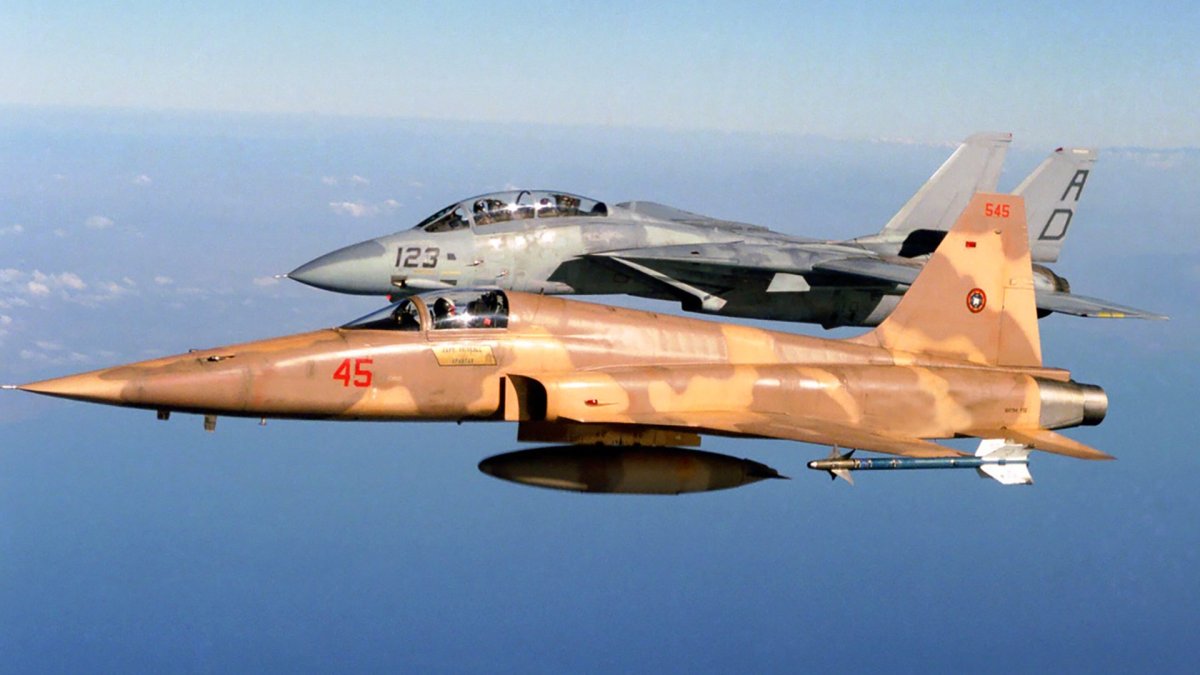
There were some major aspects of moving to the F-5 from the mighty Tomcat. The most obvious were size and a single-seat cockpit. The Tomcat usually took to the sky at around 65,000 pounds. It was 63 feet long and 64 feet wide. The F-5 weighed around 15,000 pounds in the max configuration we flew her in, with a single centerline drop tank—less than the Tomcat’s fuel load alone. The Tiger was 47 feet long and 26 wide—a lawn dart compared to the Big Fighter.
The Tomcat pilot famously had a RIO for the pilot to blame for all his errors, while in the F-5 you had to rely on a bad wingman to suck up the critique. The cockpit in the Tomcat was huge, lots of room for limbs and noggin. Strapping into the F-5 was akin to putting on your last piece of flight gear.
It became a part of you.
It was so tight in that cockpit that I couldn’t straighten out my legs or sit completely straight. If I had been forced to eject, I’m sure I would have suffered some negative consequences.
The Tomcat was so fun to fly, it was like a muscle car, a ’65 Shelby Cobra. Lots of power, even in the A model, a sense of weight behind the controls, it buffeted under G, bucking and straining through the turns. The F-5 was like a go-kart. Underpowered but light in the controls and nimble as all hell. It could do two aileron rolls per second.
F-5N of VFC-13 landing at NAS Fallon., USN
The Tomcat was a fleet bird, built to carry missiles and bombs into combat. She had so much drag that when you were supersonic and came out of burner it felt as though you were slamming on the brakes. The Tiger was clean, just an AIM-9 and a telemetry pod on the wingtips, and occasionally a centerline fuel tank. She slipped through the ‘number’ (Mach 1) easily.
They were both jets from the same era, but the Tomcat was a warfighter, bristling with equipment meant to find and destroy the enemy and survive the encounter. Radar, RWR gear, chaff and flares, IFF, TCS, and much more. The aviators had to be proficient with all of the equipment, using as many as possible on each mission. The F-5 was a pair of engines and wings. It was so simple and it was perfect for reservists.
All we had to do after a few weeks away was come back for one warm-up flight and we were ready to rock. The F-5Ns the squadron received from the Swiss starting in 2005 were a bit more complex, sporting anti-skid brakes, basic pulse radar, RWR gear, and an INS (inertial navigation system). But it was an incremental upgrade, still basic when compared to the fleet birds.
It was a pleasure to jump into the F-5 and go fight, whether it was the professional adversary mission we provided to the fleet, or the in-house 1v1s we loved more than anything. But it could never match the adrenaline rush of flying the Big Fighter from the boat. Each and every launch was like suiting up for the ‘Big Game.’
The Tomcat absolutely dwarfs the svelte F-5. , US Navy via National Archives
Air-to-air fighting doesn’t require crazy maneuvering. It isn’t about who can do the wildest stunt to gain an advantage or who has a secret trick up his sleeve only pulled out when needed to get that last-ditch advantage. Real dogfighting isn’t like in the movie Top Gun— hitting the brakes and he’ll fly right by. The best fighter pilots are masters of their plane. It is an extension of their bodies and minds. They are able to fly it to the absolute edge of performance, whether that is a rating high G two-circle fight, or a one-circle fight where nose position is key—as well as myriad permutations and variations in between, such as rolling and flat scissors.
It is as much an intellectual challenge as a physical one, where creativity meshes with integrally with skill. The best pilots I saw were able to think three merges ahead and set up their opponent for the weapon of their choice. It was a thrill to experience, even from the wrong end of the kill shot.
That said, there were some fighter pilots who were just a whole level above the rest in their stick and rudder skills. One of the best at a specific ‘move’ was a friend and squadron mate in VFC-13.
Memo could swap ends in an F-5 more perfectly than I believed possible. Somehow, when he was defensive in the vertical, he was able to pirouette the Tiger in a manner that reversed his course and still afforded him airspeed to continue maneuvering. I witnessed it many times while nipping at his heels over the Nevada skies. Sure, I was just moments away from a guns kill, then he would snap the jet impossible fast and pass me close aboard going the opposite direction.
He tried in vain to teach it to me. I could come close. I could swap direction and end up slow, or I could mush through a turn and keep some knots on the jet, but I could never get the right combination of both.
It still pisses me off.
Editor’s note: You can read more about what it is like putting the F-5 to work as an adversary in this past special feature of ours.
A colorful formation of VFC-13 F-5s. , Tyler Rogoway/Author
The F-5 has lived many lives and is on the verge of yet another. It began in the ‘60s as a basic fighter/bomber we could sell to allies who couldn’t afford top of the line fighters. It excelled at that mission. It has been continuously updated to meet the requirements of the evolving battlespace.
Aerodynamically, the F-5 will always be what we call a category 3 fighter, where the F-35 and F-22 are now category 5 fighters. Compared to modern jets, it is underpowered, slow, and bleeds airspeed badly in a sustained turn, not to mention it has no stealth other than its tiny size. But with just a few modifications, the F-5 is being turned into a threat plane with a legitimate sting. The newest upgrades include an AESA radar, good RWR gear, chaff and flares, a jamming pod, and a helmet mounted cueing system for a high off-boresight IR (infrared-guided) missiles.
A Tiger so outfitted can provide Super Hornets and F-35s a legitimate threat, especially in the training environment.
One of the aspects of the Tiger as an adversary platform that has served it well across the decades is that if you are a Blue fighter and you lose to an F-5, there is a definite error you made. A decisive training moment that can be isolated and debriefed and remembered, so that the same mistake will not be made in combat.
TacAir just won a Navy contract to support the adversary mission at NAS Fallon alongside VFC-13. Their F-5s will be the most advanced F-5 aggressors ever put in the air. Read all about these aircraft in this previous feature of ours. , TacAir
It’s your captain speaking…
Stepping into the cockpit of a 737 after flying F-14s and F-5s is like stepping into a different skin. The person and the mindset you have as a fighter pilot and the manner in which you fly the plane are diametrically opposed to the style of piloting required to be a good airline pilot.
A good flight in a fighter involved lots of sweating and action, high Gs, close passes against another plane with a thousand knots of closure and aggressive, in-close maneuvering. A good flight in an airliner in one where the passengers feel as if they are enjoying a nice cocktail in their living room and just happen to be whizzing across the continent at 500 knots. Maybe a movie and a nap—certainly nothing exciting.
And that’s ok. That’s the way it should be. That is why I fly Yak-50s on the weekend while some of my friends are on the golf course. I still get to go up and pull Gs and dogfight against other fiends, but now it’s in propeller planes and we have to pay for our own gas!
Socially, in the cockpit, the worst kind of airline pilot to fly with is the former military jet jock who tries to hang on to the glory of his former life. We get fantastic training from our company on how they want us to fly the airliners, there’s no need to bring up war stories from your fighter days.
All the pilots in an airliner cockpit here in the U.S. are exceptionally qualified to fly commercial planes, whether we came up flying canceled checks in a Cessna 172 in the middle of the night or were blasted from an aircraft carrier in the Persian Gulf.
Where have all the pilot’s gone?
It has always amazed me how poorly the Navy treated its aviators. Even during the best of times, we had to battle the establishment to maintain our distinct identity and esprit de corps. The relentless tide of bullshit that the administrators threw at us demanded a constant self-evaluation—do I really love flying these jets so much that I’m going to put up with this crap?
The stark reality is that a carrier costs $12 billion. Add a few billion more for the requisite ships and now you’ve got a Carrier Strike Group, the basic war-fighting unit of the modern Navy. Add a few billion more and you can arm that strike group with purpose, the seventy-odd planes and helicopters required to outfit the Air Wing that embarks on the carrier.
The many billions in ships and aircraft exist for one purpose, to project power against the enemy from nearly any place in the world. The 11 (counting the impending arrival of the Ford ) carriers and their associated Strike Groups are the most lethal offensive weapon the world has ever seen. Yet they exist almost entirely for the deployment of the 150 or so aviators that will fly the jets and helicopters into harm’s way.
Recent studies have determined that it costs $6-11 million and five years to fully train a front-line combat aviator. In any other environment in the world, the asset that provided the highest value and costs the most to replace would be considered a prime asset. But in the US military, combat pilots are treated like crap and subjected to harassment from senior ranking support personnel.
The misalignment of interests is grating during the best of times, but when the airlines begin to hire after many years of drought, the frustration finds a ready expression in the form of an exodus.
Paco with his VFC-13 brothers. Paco served in the squadron for a decade as a Reservist. , Courtesy of Paco
In the last five years the Navy and Air Force have lost billions in highly trained aviators to a profession they are severely overqualified for because they couldn’t take the bullshit anymore. Most of us would have continued in the military for a fraction of our airline salaries if only they hadn’t squeezed the fun from the most fun job you could ever have.
The resulting pilot shortage in the military is no shock to those of us who served. But it has helped to create a new, unforeseen industry— contract adversaries .
Back in my day, when you needed someone to play the red fighter—the bad guy—you simply scheduled an in-house asset to that role. So, an F-14 squadron scheduling a 2v2 sortie would need four Tomcats. We thought nothing of it as the planes, parts, aviators, flight hours, and fuel were plentiful. Today none of those parameters are true.
Now factor in that the dramatically improved capabilities of fifth-generation fighters mean fewer planes are required, and thus fewer planes are on the flight line, and now you have a training issue. Fast forward a few years and we now have at least four major players in the contract adversary space. They have a corral full of former fighter pilots, frustrated airline pilots, who are happy to fly pointy-nosed crack pipes for relatively low salaries.
There is a glut of third generation fighters on the world market – Mirage F-1s , F-5s , A-4s – that are being upgraded with AESA radars, top line RWR gear, jamming pods, and other fifth generation toys, making them capable adversaries to F-35s and F-22s and a fraction of the hull costs. The Department of Defense is thrilled it doesn’t have to pay for any of the assets or personnel, they merely manage the requirements and demand high standards.
The contract adversaries are staffed with former Topgun and Weapons School graduates, men and women who have been trained to the highest standards and represent a tremendous vault of corporate knowledge. They are eager to provide the mission they trained for while escaping the grinding mundanity and incompetence of military leadership.
Contract adversaries are here to stay and I believe they will be an excellent solution to the problems the modern military brings to readiness.
A VFC-13 F-5N blast out of PDX., Tyler Rogoway/Author
I never took any moment of flying in the navy for granted. It always seemed like a spectacular playground filled with action and adrenaline. When I was in the reserves, I wanted to tell the real story of naval aviation. I decided a documentary would be the best way to make that happen.
I convinced a good director friend of mine, Payton Wilson, to come to Fallon with me for a weekend with her camera. At first, she was reluctant, she was a female filmmaker from San Francisco, just about the opposite demographic that would be interested in making a film about Navy pilots. But once I got Peyton in the ready room and on the flight line, she began to come around.
The energy of a squadron is infectious. The personalities and banter are unique. And the type of flying we do in the Navy is both visually beautiful and dramatic. Within a few weeks, we had made the fantastic sizzle reel called Last of the Dogfighters and I used that to both get permission from the Navy to produce the full-length documentary and raise the funds needed to pay for the film.
We originally intended to make a film about the Saints and dogfighting, but once Peyton met the RAG students we were fighting, she fell in love with their stories.
The RAG students were going through an intense year of change. Every day they faced a new and exciting challenge and an opportunity to fail. Every couple of weeks there was a new final exam they had to prepare for, and of course, the huge culminating obstacle of carrier qualifications made for fantastic, foreboding drama.
Once Peyton convinced me that the Saints weren’t cool enough for our own full-length movie, we quickly settled on the two pilots we would follow for the course of the film, Jay and Meagan. They both had amazing backstories, incredible obstacles they were forced to overcome just to get to flight school. They are both compelling, charismatic personalities who light up the screen. And they both continued to give to their stories in ways we could not have anticipated before we began following them.
They each had ridiculously dramatic events once they left the RAG that we discovered by accident. If it had been scripted, it would have defied credulity, but in real life, both stories were remarkable and showed just how amazing Jay and Meagan truly are.
Easily the most difficult part of making Speed And Angels was the air-to-air filming. It literally took me years to finally get permission to fly F-5s and F-14s on dedicated filming sorties. The budget for the cameras, film crews, camera Learjet, and the bill from the government for the Tomcat and Tiger time was nearly half of the total budget of the film. But it’s a movie about beautiful jets so we did everything in our power to get beautiful footage.
To tell the story of a dogfight is a difficult cinematic challenge. Actual aerial encounters take place at 20,000 feet, hundreds of knots, and after the planes merge, they can be a mile or two from each other as they claw through their high G turns to point back towards each other again. I had to choreograph a series on maneuvers and shots we could film and then cut together to give the viewer a sense they were in the cockpit, with their hands on the controls, pulling for a shot.
We filmed from the air, from a specially modified Learjet, and from a mountain top in Fallon— Fairview Peak. We strapped small cameras throughout the cockpits of the fighters to give a number of vantage points, including on the helmets of some of the pilots as they were maneuvering or landing on the ship.
The Speed And Angels crew next to an F-5 and F-14—both stars of the film—and the Wolfe Air Learjet camera-ship that captured the amazing aerial action sequences. , Courtesy of Paco
All in all, it was an amazing experience. We set out intending to make a cool film about the Saints and dogfighting over a year and ended up making an amazing movie about two of the last F-14 students struggling against every obstacle imaginable to achieve their dreams and much more.
I was a fighter pilot for 20 years, but I’ve been a writer all my life. Writing novels has always been my dream, aside from flying fighters. I finally got the gumption to combine my two passions into a great story.
On a macro scale, Lions Of The Sky is a fictionalized distillation of the crazy stories and characters I experienced over two decades in the Navy. Nearly every insane scene, both in the cockpits, in the ready rooms, and in the Officer’s Club, actually happened, with a little extra fiction dust thrown on top. That includes the dramatic, climactic final battle scene between the United States and China in the South China Sea.
Not to give away too much, but in the mid-‘90s a U.S. Navy plane thought it was chasing a U.S. submarine for training. It turns out the sub was really Chinese and its captain thought he was being attacked. He radioed back to the homeland and a wave of Chinese fighters were launched. The carrier launched its own fighters to meet the challenge. Fortunately, cooler heads prevailed and the situation was quickly diffused. But in my book, things get a lot more interesting.
More specifically, my novel is about a hard-boiled RAG instructor, Slammer Richardson, who became somewhat of a legend, but at the cost of losing his best friend. He is eager to get back to the action of the fleet because he can see that something big is brewing in the South China Sea. He’s got some misgivings about women in the cockpit so he does his best to avoid them, but the last class he’s assigned to mentor has not one, but two female students.
Being aspiring fighter pilots, the women are bold and brash, and have no intention of fading into the background. The challenges of training in the F/A-18 force them to choose wildly different paths as they navigate the many hurdles and force Slammer to come to terms with thoughts he’d rather leave deeply buried.
One of the aspects of flying in the Navy that always fascinated me was that once aircrew finish the RAG they are qualified to go to the fleet and possibly into combat, though they are far from proficient. It has happened many times and to Jay in Speed and Angels , in fact.
During the course of the training in the story, there is a constant background drumbeat of aggressive action by China against their opponents to territorial claims in the South China Sea. The tension rises steadily as the students face successive challenges. Ultimately, Slammer and a few of the students that survive the RAG are assigned to the carrier that is sent to face the Chinese.
Far before the new fleet pilots are ready, they are thrown into a situation where the opponents are legitimate, the missiles are real and life and death decisions are made at the speed of sound.
Much like Speed And Angels , I wanted Lions Of The Sky to be about the people behind the larger story. And also, like the film, as much as possible, I wanted the readers to feel like they were a part of the action, not just observers.
Lions is a fantastic novel of action and peril, about the intense and real personal stories that underlay the wider fabric of geopolitical conflicts.
It was the best of times, it was the worst of times…
Easily the worst experience I ever had in a Navy jet was the day I crashed an F-5. It’s a long story, but the salient points are that I had blown tires on landing and skidded down the runway on nothing but the metal hubs. As I left the end of the runway, I shut down the engines just before the plane flipped over, shattering the canopy. The plexiglass broke into razor-sharp shards and as the canopy rail bent back one of the shards pierced my neck like a dagger, just above the jugular. If I had been going a knot or two faster when the plane flipped I would surely have bled to death.
The second worst day I had in a Navy jet was my last flight. It was the culmination of over two decades of effort, sweat, dodging death, joy, and epic fun. But I had reached the end of my tenure and the next step for me in the military would have been a desk.
I had spent a solid 20 years in the cockpit and I wasn’t ready to leave yet, but that wasn’t my decision. I felt like a perfectly healthy person who had to walk into the hospital to have his legs amputated. It didn’t make sense to me. But such is life.
I had so many fantastic experiences in the Navy and in the cockpit. loved flying low-levels through the Cascade mountains during beautiful summer days, weaving back and forth with the other jet across valleys and darting through canyons, showing off to the people out boating or hiking. Bringing the Tomcat in for a 600-knot shit hot Break at the ship and nailing the landing was as intense as it gets.
But if I was given the opportunity to go back and relive just one experience from my 20-year thrill show, I would have to drop back into December 1999. I was flying F-5s as a reservist, but I was also a junior airline pilot. I didn’t want to work over the Millennium New Year as I surely would. So, I got the squadron to cut me orders to fly with the reserves from December 15th of 1999, to January 7th of 2000.
We didn’t have any ‘customers’ and there were few pilots in the squadron, so there were plenty of jets to play with. For three weeks, minus Christmas and the big New Year’s blowout in Tahoe, I flew three air combat sorties per day against the best dogfighters in the world. The weather was perfect, the gas was free, the jets were plentiful, and the dogfighting was the most intense and fun I ever experienced.
If I make it to Heaven, that’s what every holiday season will be like.
Contact the editor: Tyler@thedrive.com
Comments couldn’t be loaded. Please refresh the page.
作者:弗朗西斯科·“帕科”·基耶里奇和泰勒·罗戈威
更新于美国东部时间2021年9月28日下午6:26
在我们关于弗朗切斯科·“帕科”·基耶里奇高空飞行冒险和座舱体验的两部分系列报道的第一部分中,他深入讲述了在格鲁曼A-6“入侵者”攻击机服役末期驾驶该机型的经历。在第二部分中,我们将深入了解帕科从一名“泥地清洁工”到传奇F-14“雄猫”战斗机飞行员的转变历程,以及他所经历的种种考验和磨难。最终,帕科从“雄猫”飞行员转为F-5假想敌预备役飞行员,负责训练舰队飞行员如何在残酷无情的空战中保全性命。但除了飞行之外,我们还将探讨更多内容,从美军飞行员短缺到如何面对战友牺牲的悲痛,再到他如何成为一名纪录片导演,最终成为一名作家。
帕科的《天空雄狮》最近出版,他在下面详细介绍了这部虚构的故事是如何直接取材于他作为一名职业海军飞行员所经历的人、事、物。
所以,系好安全带坐进驾驶舱,启动弹射座椅,点燃燃烧器,让我们一起踏上前往帕科多彩而充满刺激的过去的旅程吧。
从泥浆搬运到斗狗
我在训练部队体验过基础战斗机机动(BFM,也称空战),并自认为在这方面很有天赋。作为一名“入侵者”轰炸机飞行员,我总是尽可能地说服其他飞行员在每次轰炸任务结束后都进行一些基础战斗机机动训练。
没有什么比两架入侵者战机进行空战更可怕的了。
在“雄猫”战斗机后备训练中队(RAG)里,我的错觉更加根深蒂固。虽然我是一名经验丰富的舰队飞行员,比起那些菜鸟同学,我更乐于表现得咄咄逼人,但我对如何真正驾驶这架战机作战却一窍不通。当我最终加入我的第一个F-14舰队中队——VF-213“黑狮”中队,并进行了多次空战机动训练后,这一点被我反复地证明了出来。我被西海岸一些最优秀的“雄猫”飞行员——“重击手”理查森、“斯塔什”弗里斯塔奇、“杀手”基利安、“威士忌”邦德,还有我的室友韦伦·詹宁斯——狠狠地教训了一顿。
在一次从林肯号起飞的特别屈辱的飞行中,穆斯驾驶的“大黄蜂”战斗机连续三次击败了我。但失败是最好的老师。我带着对空战的热爱进入这个圈子,并最终明白,最优秀的空战高手是后天培养的,而非天生的。
我读了《壮志凌云》手册,认真听取了任务汇报,最终把自己打造成了一名合格的野战炮手。虽然比不上帕皮·博因顿,但也算得上合格了。
当然,尽管我在驾驶“雄猫”战斗机的后期觉得自己很厉害,但当我驾驶“强盗”战斗机时,我很快就明白了如何真正地与飞机作战。
人生就是一连串的屈辱。
后面那个人——或者女人——
飞行员和机组人员之间的协同配合对于A-6和F-14的成功运用都至关重要。一个配合默契的优秀机组堪称完美。
这两个平台都是上个时代的遗物——刚推出时是尖端科技,但我驾驶它们时,它们已接近时代的尾声。它们之所以能与更现代的飞机竞争,是因为机组人员理念的正确实施。当然,一旦机组人员配合不默契,就会变成一场令人沮丧的混乱局面。
为了最大限度地发挥机组人员的效能,双方都努力为机组人员匹配合适的搭档,并尽可能让他们一起飞行。在正常的周转任务中,这很难实现。每个人的时间安排和优先事项都不同,导致只能见机行事。但在训练或作战行动中,机组人员会投入更多精力与指定的机组成员一起飞行。
在“雄猫”战斗机上与雷达拦截官(RIO)协同作战,尤其是在目视作战区域,结果非此即彼。要么飞行员和RIO配合默契,融为一体,组成一支致命的队伍,显著提升态势感知和武器部署效率;要么就是彻底的灾难。
当飞行员和雷达拦截官(RIO)不适应特定的视觉环境时,结果往往是巨大的负面影响。如果雷达拦截官发言太少或太多,飞行员就无法获得足够的信息来有效控制飞机并评估敌机的威胁。成功时,效果惊人;失败时,则令人沮丧,有时甚至尴尬。但总能找到一个可以责怪的雷达拦截官,这感觉真好!
雄猫战机的最大箭矢
大多数雄猫战斗机爱好者都知道,这款飞机的设计初衷就是为了使用AIM-54“不死鸟”导弹。“不死鸟”导弹最初是为舰队防御而设计的,用于对抗苏联的大型高速轰炸机,它在各方面都堪称庞然大物,并且远远领先于时代。
它重 1000 磅,长 13 英尺,火箭发动机燃烧时间超过 1 分钟,飞行速度为 5 马赫,飞行高度为 80000 英尺,并在战斗末期利用其机载雷达将 135 磅重的弹头投送到 100 英里以外的目标。
一枚威力巨大的导弹。
为了有效锁定这头庞然大物,需要一种极其强大的雷达。为了搭载巨型雷达天线和多达六枚“不死鸟”导弹,格鲁曼公司在F-111B明显无法胜任这项任务后,设计了一款庞然大物——F-14“雄猫”战斗机。由于雷达功率强大,天线尺寸巨大,AWG-9雷达的探测、分拣和目标指示范围在之后的几十年里远远超过了世界上任何其他战斗机。
AWG-9 的性能比同时代的其他战机,如 F-4 甚至 F-15,实现了代际进步。凭借卓越的工程技术和强大的动力,它实现了我们现在在最现代的战斗机上习以为常的能力——曾经具有突破性的能力,即同时扫描、瞄准和发射多枚导弹。
驾驶“雄猫”战斗机期间,我最美好的回忆之一就是参加的多次导弹试射。我曾用AIM-9“响尾蛇”导弹击落无人机,并在四次不同的活动中总共发射了五枚“不死鸟”导弹。
响尾蛇导弹像瓶装火箭一样呼啸着冲出轨道,以愤怒的螺旋姿态飞向目标。不死鸟导弹非常重,必须像炸弹一样从飞机上抛下才能点火。扣动扳机时,你会感觉到不死鸟导弹带着一声闷响从飞机上脱离。大约一秒钟后——感觉像过了一个世纪——发动机点火,AIM-54导弹从下方呼啸着掠过雄猫战斗机,冲入平流层时留下巨大的尾焰。
它会接收来自“雄猫”战斗机雷达的数据,直到它从 80,000 英尺高空俯冲下来接近目标,然后雷达拦截官会放开它,“不死鸟”战机的机载雷达会完成这次致命的会合。
近距离时,导弹会直接瞄准目标,沿水平轨迹飞行,一路冒着浓烟,最终化作一团火球。从射手的角度来看,这景象令人叹为观止。
尽管体积庞大且装填耗时费力,但“不死鸟”导弹与时俱进,发展迅速。在大多数指标上,它都优于AIM-120先进中程空空导弹(AMRAAM)。射程、发动机燃烧时间、弹头和机载雷达都遥遥领先。软件和固件定期更新,使该导弹能够在现代战场上保持竞争力。但就像“雄猫”战斗机一样,它也像一头猛兽,在服役期过后依然能够超越其设计规格。
制造大型猫科动物之间的空战
虽然从技术上讲,F-14“雄猫”战斗机是一款战斗机,但它并非真正为近距离空战而设计。在近距离空战中,它存在诸多不利因素。
首先是它的体型,它被亲切地称为“大型战斗机”,而且体型巨大。空战的基本原则之一是“失去视野,就会输掉战斗”。但面对F-14“雄猫”战斗机,这几乎是不可能的。
A型机的推重比约为0.67:1,动力不足以应对机动性较强的空战。此外,虽然过载限制为6.5G,但由于没有黑匣子记录数据,我们经常超过7G。尽管它拥有巨大的升降舵,能够产生惊人的瞬时俯仰速率,但由于缺少副翼以及机身过于宽大,滚转速率却十分迟缓。
最后,驾驶舱的人体工程学设计是在 20 世纪 60 年代末完成的。当时没有 HOTAS(手不离杆操纵系统)。超视距拦截由后座的雷达拦截官(RIO)负责操作雷达并与飞行员配合。一旦接近目标,距离小于 10 海里,飞行员就会接管控制权。但他仍然需要呼叫雷达拦截官启用雷达的近距离空战模式。
尽管存在这些重大缺陷,但“雄猫”战斗机在技术娴熟的飞行员和优秀的后勤拦截官的配合下,在目视作战中仍然极具杀伤力。尤其是如果它配备了通用电气公司的发动机的话。
在两圈缠斗中,每秒转弯角度至关重要,F-14“雄猫”战斗机表现出色。但如果A型“雄猫”速度降到250节左右的“黑洞”区域,就会陷入飞机并不擅长的空域。TF-30发动机的动力不足以支撑飞机以极低的速度飞行,也无法迅速加速到合适的机动速度。
另一方面,通用电气(GE)发动机使技术娴熟的飞行员能够在低速环境下成功操控飞机。一位非常优秀的飞行员甚至可以利用GE发动机,通过关闭其中一台发动机的加力燃烧室,使飞机完成原地旋转。雄猫战机能够优雅地翻转机头,并瞬间改变航向。
在近距离空战(BFM)中,机翼后掠角的自动调节功能也可能对飞行员不利。后掠角受多种因素影响,包括速度、迎角和高度。
F-15喜欢把“雄猫”拖到高空,利用其推力优势来取得优势。我们曾使用过一种非正式的战术来应对这种情况:手动将机翼完全展开,然后逐步降低襟翼,使其低于正常的机动设置。这种战术非常有效,但危险在于襟翼扭矩管并非为此设计,可能会卡住。
人生处处有得有失,不输给 F-15 战机绝对值得惹恼维修士官长。
我曾驾驶“雄猫”战斗机与多种不同的飞机进行近距离空战(BFM)。在巴基斯坦海岸附近那令人难忘的一周里,我们与巴基斯坦空军进行了多次近距离空战和超视距空战(BVR)作战。我至今还保留着一些与米格-21(歼-7)交战的精彩HUD录像。
我记得当时对他们的F-16飞行员缺乏熟练度和武器运用能力感到震惊。在波斯湾,我们曾与阿联酋的幻影2000-5飞行员交战一周。他们实际上是相当激进的飞行员,对如何利用F-14A的弱点有着敏锐的战术意识。他们会干扰我们的交战,然后使出9G过载,飞得极高,我们几乎失去了他们的踪迹。如果我们真的被他们盯上了,他们就会用红外制导短程导弹锁定我们。但如果你能挺过第一次交战,并进行后续的近距离空战,他们就成了你的猎物。
我遇到过的最强近距离格斗平台可能就是F-16N了。经过精简和改装后,它简直就是个空战怪兽,几乎无人能敌。
编者按:阅读我们之前的专题报道,了解海军臭名昭著的 F-16N 战斗机以及驾驶它的体验。
我曾经驾驶一架漂亮的F-5战斗机,有个朋友开着一架Topgun Viper战斗机,突然把飞机停在我机头几千英尺高的地方。我倒数着“3、2、1,开战!”,拼命想保持进攻姿态。还没转过270度,那架Viper就迎面撞上来,开始猛攻。
那是一场令人瞠目结舌的表演。
1990年夏天,我刚从飞行学校毕业就被派驻到米拉马尔海军航空站。我被分配到VFC-13假想敌中队,同时等待前往华盛顿州惠德贝岛海军航空站进行A-6攻击机的训练。当时米拉马尔正处于《壮志凌云》上映后最火爆的时期。周三晚上的O'Club俱乐部就像我想象中70年代的Studio 54一样热闹非凡。进基地去俱乐部要排一个小时的队。俱乐部生意兴隆,以至于基地专门在围栏外修建了一个直通俱乐部后门的入口。
星期四早上简直是噩梦。
惠德比岛海军航空站的文化氛围截然不同。没人会从西雅图驱车一个半小时,只为了在周五晚上去惠德比岛的O'Club酒吧狂欢。但这反而造就了一个非常紧密的社区。我们和“徘徊者”战斗机的飞行员们共享基地和周五晚上的欢乐时光。虽然惠德比岛没有到处都是狂欢者和现场音乐,但基地里的大多数飞行员都会聚集在酒吧里喝酒聊天。
我最喜欢的消遣是玩一种叫做克朗代克的骰子游戏。在几个飞行中队即将出海巡航的前夜,奖池金额会迅速膨胀到几千美元。
离开家六个月,会让你觉得用大把现金赌博是个好主意。
我曾先后在三个不同的舰队中队和一个预备役中队服役。每个中队都有着截然不同的文化,对待新兵(FNG,Fucking New Guy)的方式也略有不同。我加入的第一个中队是“入侵者”攻击机中队,那天正好是他们从第一次伊拉克战争凯旋归来的庆祝飞行表演日,时间是1991年。我加入的这支队伍曾并肩作战,在巨大的压力下创造了辉煌的战绩。他们已经很久没有新飞行员了,而我接替的是一位在战斗中阵亡的飞行员,他的连长也在战斗中牺牲了。
接待并不热情。
他们理所当然地为自己的成就感到自豪,但对于一个才华横溢、充满干劲的新人,他们并没有那么容易接受,而这个新人无疑也没有他自己认为的那么优秀。
花了整整六个月才打入兄弟会。
我之后加入的几个中队氛围更加包容。当我加入VF-213——我的“雄猫”战斗机中队——时,我已经是一名经验丰富的舰队飞行员,飞行时间数百小时,完成过几百次航母着舰,并且是一名合格的着陆信号官(LSO)。加入他们非常容易,我很快就融入其中。
幸运的是,我自身具备一定的实力,很快就重新投入到着陆信号官(LSO)的工作中,“雄狮”中队的队员们也渴望学习如何将F-14用作“轰炸机”。尽管我渴望成为一名战斗机飞行员,但在空战领域,我却完全是个新手,这一点显而易见。“雄狮”中队非常重视对我和其他新队员的训练,我们始终感到自己受到重视和鼓励——尽管在竞争激烈的战斗机中队里,这种感觉实属难得。
我刚到不久,VF-213中队就差点把名字从“黑狮”改掉。在一些人眼里,这支中队就像个被诅咒的组织,而黑猫的标志也成了替罪羊。
在我到任前的几年里,狮队因各种原因损失了不少飞机。雄猫战斗机在着陆时撞上飞机舷梯,在头顶的减速带上失速,或者在空中莫名其妙地爆炸。这些事故似乎没有任何共同点,所以大家只能胡乱猜测,甚至包括更换著名的黑狮队徽。所幸,这最终并没有成为现实。
当我调到213联队时,事故仍在继续。事实上,在我服役于第十一航空联队的两年里,整个联队损失了九架喷气式飞机,六人丧生。其中四架是F-14“雄猫”战斗机,三名遇难者就乘坐的是这种飞机。
那段时间真是动荡不安。
正如我的朋友霍布·希金斯所说,我们感觉就像猫被困在满是摇椅的房间里。我加入213中队不久,卡拉·赫尔特格林在林肯号航母上着陆时不幸遇难。我曾在训练司令部与卡拉有过短暂的接触。
卡拉·霍特格林., YouTube 屏幕截图
我们俩都开阿尔法·罗密欧敞篷车,经常拿意大利跑车时好时坏的可靠性和高昂的维修费用开玩笑。她完美诠释了“女战士”的形象:笑容灿烂,风趣幽默,机智敏锐,而且敢于坚持己见。她完美地融入了黑狮帮,被大家亲切地视为“骄傲”的一份子。
她死后所受到的待遇一直是我海军生涯中目睹的最不公的事件之一。我们的副舰长在模拟器中重现了这起事故100次,结果97次都失败了。
她牺牲时,正处于舰艇后方的包组位置,这意味着她位于中队着陆编队的正中央。然而,作为舰队中首批驾驶“雄猫”战斗机的女性之一,也是首位因公殉职的女性,她却被视为女性参与战斗的所谓“错误”的典型例子。
看到她的牺牲被如此恶毒地利用,我感到非常痛心,尤其因为她的死与性别无关。卡拉是我小说《天空之狮》中女性角色的灵感来源。我最初的想法是:“如果卡拉活下来,她的人生旅程会是怎样的?”
我饰演的角色基利·西尔弗斯,是卡拉战斗精神的化身——坚强、风趣、天生的飞行员,最终,她是一个不容小觑的人物。
最难掌握的战术
死亡和灾难是军事航空领域残酷的现实。尽管安全措施和训练规则备受重视,但航空环境严酷无情,任何失误的代价都可能迅速而致命。
我飞行了20年,失去了20多位朋友和战友。事故原因五花八门:空中相撞、维护失误、过载性意识丧失(G-LOC)、坠机等等。
每次事故发生后,我们都不得不既悲痛又抽离。这是一种截然相反的情感斗争。一方面,我们会举行追悼会,包括失踪人员的飞行表演。这些仪式都令人心碎,迫使你直面死亡,并更加珍惜所爱之人。然而,往往几个小时后,你就得重新振作,回到同样的环境,执行同样的任务,驾驶着刚刚夺走战友生命的飞机。要做到这一点,需要一种有意识的欺骗。强迫自己把恐惧、不安和不确定感装进盒子里,封存在你内心深处的某个角落。
我认识的那些丧生的飞行员,技术水平参差不齐,从我见过的最优秀的飞行员到一些水平一般的都有。死神并不偏袒任何人。我们总是安慰自己说,下一个不会是我们,在我们这场空中俄罗斯轮盘赌中,子弹不会出现在下一个弹膛里。
在我服役的最后两年,我们航空联队损失了九架飞机和六名人员。似乎每隔两个月就会有紧急定位信标响起,提醒我们又发生了一起事故。直到离开部队,我才意识到这给我带来了多大的压力。
离开几个月后,我的睡眠质量大大提高,精神也轻松了许多。但是驾驶尖头喷气式飞机,承受过载,燃烧航空燃油,这种感觉真是让人欲罢不能。又过了几个月,我又回到了蓝天,用备用油箱满足了我的飞行瘾,并且享受着每一分钟,因为我知道下一个遭殃的不是我。
“大约翰”号失踪人员编队,美国海军
我第二次飞越伊拉克——当时人们都这样称呼它——这次飞行体验截然不同,因为我驾驶的是不同的机型,而且是在不同的地区。情况完全不同,一切都不一样了。我需要学习很多关于新飞机的知识,还要完成一项截然不同的任务。
在南方守望行动期间,我们驾驶 F-14 战机在伊拉克执行了三个基本任务:侦察、打击和空中优势。
我喜欢执行各种各样的任务。侦察任务需要携带战术机载侦察吊舱系统(TARPS),我们戏称它为“屎”。这个吊舱重约两千磅,悬挂在F-14“雄猫”战斗机的尾部。它会影响飞机的重心,从而影响其操控性能。更重要的是,它减少了可用于舰载着陆的燃料量。
我一直很享受那种拍出好照片的压力带来的额外责任感,以及在燃油告急之前我只有一次机会查看船只的事实。
TARPS吊舱上的三台摄像机之一以45度角对准目标。我们经常沿着底格里斯河飞行,掠过伊拉克边境,以获取伊朗海军基地的图像。有一次,我飞过一条之前已经飞过几十次的航线,虽然勉强安全,但仍在伊拉克领空内。这时,一名伊朗管制员通过紧急频率联系我,警告我离开。他接着说,如果我不离开,就有被伊朗空军拦截的危险。
雷达拦截官还没来得及回答,我就赶紧拿起无线电,让他知道我们欢迎任何想来打一架的伊朗战机。要是能跟伊朗的F-14来一场一对一的较量,那简直是世界上最酷的事情了。
可惜,这只是虚张声势。我们快速绕场一周,急切地寻找可以交战的喷气式飞机,但一无所获。
我们执行的打击任务与我之前驾驶“入侵者”无人机执行的任务类似。有时我们会计划针对散布在伊拉克各地的特定目标执行任务,然后在禁飞区以南的伊拉克南部巡逻时进行模拟打击演习。其他时候,我们会飞到预先设定的区域,与地面控制人员联系以获取任务指令。在我执行巡航任务期间,我们从未收到任何指令,只是在空中盘旋待命。
我们执行过的最有趣的任务之一是为U-2侦察机护航,这些侦察机沿着北纬33度线飞行,这条线划定了禁飞区的南部边界。伊拉克战机被允许在北纬32度线和33度线之间的一小片空域内活动。交战规则规定,只要伊拉克战机待在禁飞区内,我们就不会与他们交战;但如果一架米格战机越过北纬33度线以南,那就属于合法攻击范围——规则允许我们追击它。
伊拉克人经常玩“胆小鬼游戏”,驾驶米格-25高速向南飞行,然后在最后一刻掉头,避开死亡线。预警机发出威胁警报后,我们便会向目标发起进攻,并准备好导弹以防万一。虽然我从未遇到过这种情况,但这总是能让人肾上腺素飙升,而且最终也比在空中白白浪费时间要刺激得多。
然而,当我们接下护送U-2侦察机的任务后,威胁变得更加现实。U-2侦察机飞行高度极高,但仍在超高速米格-25“狐蝠”战斗机所携带的AA-6空空导弹的射程之内。
我们非常重视U-2侦察机面临的威胁,并主动制定计划,以保护飞行员免受伊拉克战机的攻击。难点在于U-2的飞行高度远高于F-14“雄猫”战机,速度也慢得多。我们的雷达拦截官斯马什·科尔马什设计了一条之字形飞行路线,使我们能够在保持最低战术速度的同时,从U-2下方飞行。
当他们执行任务时对我们浑然不觉,而我们则在下面进行着漫长的盘旋飞行,时刻准备着,以防狐蝠对我们表现出任何兴趣。
帕科驾驶他的F-14战斗机从KC-10加油机上进行空中加油。(美国海军)
1996年的环太平洋军演(RIMPAC)是我最后一次驾驶F-14“雄猫”战斗机、隶属于VF-213中队和第十一航空联队出海服役。这三个月的短期部署对我来说百感交集。我感觉自己正处于巅峰状态,但几个月后我就要离开现役,去迎接未知的未来。
作为航空联队,十几艘外国舰艇的参与对我们的行动而言基本透明。我们唯一一次注意到异常情况,是当我们进行演习拦截时,指挥人员操着一口澳大利亚口音、西班牙口音或日本口音。我们没有与任何外国海军航空兵力量交锋,因此此次演习的国际性对飞行员而言并非影响因素。
6月3日晚,一切都发生了改变。“独立”号航空母舰当时正与“小鹰”号航空母舰一同参加环太平洋军演,第十一航空联队已转移至“小鹰”号上。隶属于第五航空联队的VA-115中队的一架A-6攻击机正用一根极长的缆绳拖曳着一个靶标。这个靶标将由日本驱逐舰“夕雾”号用其Mk15“密集阵”20毫米近防炮进行射击。
当“入侵者”攻击机飞过时,“夕雾”号过早地启动了近程防御武器系统。近程防御系统果然发挥了作用,立即将A-6攻击机击落。幸运的是,两名机组人员都安全弹射逃生,但他们始终无法摆脱二战以来第一架被日军击落的美军飞机的阴影。
美国海军“密集阵”近防系统在实弹训练中向目标射击。
格鲁曼公司凭借其坚定不移的奉献精神,展现出可靠性。
我很幸运,A-6 和 F-14 都处于维护保养和可靠性都很好的时期。讽刺的是,我认为这恰恰是因为它们当时都已接近服役年限的尾声。
正如我之前提到的,我刚加入VA-155中队担任A-6“入侵者”攻击机飞行员不久,我们就开始接收全新的战机,有些机身飞行时间甚至只有十个小时。它们取代的那些老旧战机驾驶起来令人沮丧。机翼裂纹问题导致我们只能承受不到4G的过载,这简直糟透了。
短暂体验过那架摇摇欲坠的喷气式飞机后,我们更加珍惜新接收的“入侵者”战机。尽管如此,我们还是竭尽全力地驾驶它们,因为我们知道巡航结束后,中队就要解散了。
我在VF-213中队时也有过类似的经历。由于中队近期遭遇了太多离奇的事故,我们得到了最好的待遇:最好的A型战机(虽然这说法值得怀疑)、最好的维护人员、一位杰出的维护总军士长(赫尔伯特),以及优先获取零部件的权利。维护人员决心确保未来不会再发生任何事故,所有战机都保养得完美无瑕。
上次巡航期间,我担任航空电子设备和武器装备部门主管,负责大部分维护人员。这是一次绝佳的机会,让我得以观察他们如何操作喷气式飞机,他们的表现令我印象深刻。这些年轻男女才华横溢、勤奋敬业,在波斯湾酷热潮湿的环境中,每天工作十二个小时。在那次部署期间,我一次也没有错过任何一次飞行任务,这简直是闻所未闻。不过,有一次起飞任务我差点就错过了。
发动机启动后不久,我们发现中央空气数据计算机(CADC)出了问题。CADC对于F-14“雄猫”战斗机复杂的机翼后掠机构至关重要。它是一个重达一百磅的盒子,位于驾驶舱后方一块面板下方,上面有几十个紧固件。更换它并不难,但确实需要时间和精力。
当机械师告诉我问题所在时,我就知道肯定赶不上发射了。我们只有十分钟时间。但他却说:“别担心,先生。我一定能修好。请耐心等待。”
我看着他拖着那个巨大的箱子,慌慌张张地爬下我的梯子,在正午130华氏度(约54摄氏度)的高温下匆匆穿过飞行甲板。我知道他得把那个箱子扛下三层梯子到他的车间,拿一个新的,然后再扛上来。
在空管取消我的飞行任务前几分钟,我看到他费力地穿过甲板,爬上我的梯子,回到飞机尾部。箱子装好检查完毕,面板重新固定好,我们几乎在最后一刻准备就绪。
当时,这份敬业精神深深打动了我,现在依然如此。这展现了令人印象深刻的奉献精神和专业素养,我至今难忘。
我有幸在福莱斯特号航母上服役。
“游骑兵”号航空母舰(CV-61)、核动力“尼米兹”级航空母舰“林肯”号(CVN-72)以及同级首舰“小鹰”号航空母舰(CV-63),每艘都搭载了超过100个陷阱。它们在我记忆中都占据着特殊的位置,并且都以令人惊讶的方式展现出各自的独特之处。
我很庆幸自己先在“游骑兵”号上服役,因为她是最小也是最老的一艘军舰。尽管她舰龄已久,而且我服役期间正是她的最后一次航行,但她的保养状况仍然非常好。我清楚地记得,“游骑兵”号和第二航空联队配合得天衣无缝。每次预定发射,弹射器第一次发射的声音都准得像钟表一样。这种精准度是舰上官兵引以为傲的,并体现在方方面面。
飞行员用餐的“脏衬衫餐厅”与其他航母上的餐厅布置不同。这是一个细微却意义重大的区别:这里的餐桌只有四人桌,就像大多数餐厅一样。而其他航母上的餐桌则像野餐桌一样,可以容纳二十人甚至更多。
各个中队会定制印有各自队徽的桌布,以此划分地盘。这往往导致军官餐厅出现隔阂,飞行员们即使独自一人,也觉得必须去自己中队的餐桌用餐。而在“游骑兵”号上,你通常和排在你旁边的人一起吃饭,无论他们属于哪个中队。结果是,空军联队内部关系更加紧密,所有飞行员彼此都认识,减少了地域主义,增强了战友情谊。
20世纪90年代部署的“游骑兵”号航空母舰及其“格鲁曼航空联队”。
乘坐“游骑兵号”最后一次航行最棒的地方在于,我们可以随心所欲地改造生活舱室。我们知道这艘船在我们返回后就会退役。这让我们在进行一些重大改造时感到很自由,而这些改造在一艘即将退役的船上是不可能实现的,因为在退役期间,这些改造会受到严格的审查。
三名海军中校占据了一间六人舱。他们保留了一半的床铺、书桌和衣柜,然后把另一半搬空,在一个晚上把所有东西都扔到了海里。这留下了一个巨大的空地,这在军舰上可是难得的奢侈。
尽管航母是一艘长达1100英尺的巨型舰船,但就内部空间而言,它给人一种错觉。5000人挤在如此狭小的空间里,根本没有舒适或休息的空间——除了“游骑兵”号上的这间房间。
他们用地毯、扑克桌、沙发和躺椅填满了那间空地,还摆上了一盏超酷的扑克灯,最后用仿木纹墙纸把原本灰暗的墙壁遮盖起来。这简直是个聚会、喝点小酒、玩扑克玩到深夜的绝佳场所。
“游骑兵”号的缺点在于它是一艘采用常规动力的船。这意味着船上没有无限量的淡水,无法进行“好莱坞式”(长时间)淋浴,也没有空调。
1996年,美国海军“亚伯拉罕·林肯”号航空母舰驶近其位于华盛顿州埃弗雷特的新母港。
“林肯”号,我的第二个家,也是我服役过的唯一一艘仍在服役的舰艇。作为一艘核动力舰艇,即使在波斯湾酷热难耐的海域,她也能将冷空气输送到所有舱室。你或许会觉得好笑,但这确实极大地提升了我们的生活质量。她还能源源不断地制造淡水。尽管如此,她却和其他普通舰艇一样,配备了弹簧式手持淋浴喷头。我们用一个三英寸的C型夹轻松解决了这个问题,把夹子固定在淋浴喷头上,就能把那个该死的按钮按住。有了这个小小的改造,我们每次从伊拉克执行完六个小时的任务回来后,都能享受到几乎正常的淋浴——我们觉得这是我们应得的奢侈。
“小鹰”号是我待得最短的一艘船,只待了一半的训练和一次环太平洋军演。我对它的记忆不多,只记得它绝对是我最不喜欢的。它不如“游骑兵”号干净整洁,管理也不如“林肯”号崭新锃亮。我们后来都叫它“破烂小猫”,大概是因为我们又一次对它糟糕的空调系统感到不满吧。
让飞行员发脾气并不难。
20世纪90年代,美国海军“小鹰”号航空母舰驶往夏威夷。
退役后,我加入了航空公司,成为一名商业飞行员。从家庭角度来看,这的确是个不错的决定,但几个月后,我发现自己开始怀念喷气式飞机尾气的味道和承受过载的感觉。
我非常幸运,我的一位来自213中队的好朋友加入了驻扎在法伦海军航空站的VFC-13中队,成为一名现役飞行员。他打电话告诉我,他们正在组建一个选拔委员会,筛选新的预备役飞行员。
我恨不得马上把包裹打包好。
我被选中了,几个月后就开始飞行,我简直高兴极了。驾驶尖头、带加力燃烧室的战斗机仍然是我的梦想,我很高兴能再次体验JP-5燃料带来的快感。
圣徒中队(VFC-13)的假想敌训练课程极其严格。正如我之前提到的,离开F-14战斗机时,我自认为已经是一名相当不错的战斗机飞行员。但当我开始在圣徒中队接受训练后,我很快意识到自己仍然是个新手。
这些家伙都是技艺精湛的飞行员,他们甚至能记住每次交战的每一个细节,真是令人叹为观止。尽管只有15次飞行,但整个训练计划却需要九个月到一年的时间才能完成。标准是完美,多次重飞是常态。我终于完成了训练,以初级假想敌飞行员的身份加入了中队,我感到无比兴奋。
尽管我驾驶着尖头喷气式飞机,身着飞行服,但很明显我们并非现役中队。大约三分之一的飞行员仍在服役,被分配到“圣徒”中队负责行政管理和人员连续性工作。还有几名是全职预备役人员,被称为特选预备役人员。其余的飞行员都是民航飞行员,每月来这里工作七到十天。
在我服役的十年间,部队的核心成员始终保持不变,这使得我们是一个非常紧密的团队。但我们大部分时间都分散在全国各地,和家人一起生活,忙于各自的工作。而在舰队中队,情况则截然相反,你绝大部分时间都和你的战友们待在一起,在工作中,他们就是你事实上的家人。只有当你回家的时候,你的配偶和孩子才能得到剩余的时间。
我因为家庭原因离开了现役部队,我很庆幸自己做了这个决定。但舰队中队的亲密情谊,我会永远珍藏在心底。
帕科在从法伦海军航空站起飞前检查一架F-5战斗机。(图片由帕科提供)
从雄猫到老虎
从强大的“雄猫”战斗机换到F-5战斗机,有几个主要区别。最明显的是尺寸和单座座舱。“雄猫”战斗机通常重约65,000磅,长63英尺,宽64英尺。而我们试飞的F-5战斗机,在最大配置下,仅携带一个中心线副油箱,重量就约为15,000磅——甚至比“雄猫”战斗机的燃油量还要少。“虎”式战斗机长47英尺,宽26英尺——与“雄猫”相比,简直就像一支草坪飞镖。
众所周知,F-14“雄猫”战斗机的飞行员可以把所有失误都归咎于后勤官(RIO),而F-5战斗机的飞行员则只能指望一个糟糕的僚机来替他承担责任。雄猫的座舱非常宽敞,四肢和头部都有足够的空间。而登上F-5则如同穿上你最后一件飞行装备。
它成为了你的一部分。
驾驶舱里空间非常狭窄,我的腿都伸不直,也无法完全坐直。如果我被迫弹射,肯定会遭受一些不良后果。
驾驶雄猫战斗机真是太爽了,就像一辆肌肉车,一辆1965年的谢尔比眼镜蛇。动力强劲,即使是A型也如此,操控起来很有分量,在过载下颠簸不已,转弯时也颠簸得厉害。F-5战斗机则像一辆卡丁车,动力不足,但操控轻盈,灵活得令人难以置信。它每秒可以完成两次副翼滚转。
美国海军第13飞行队(VFC-13)的F-5N战斗机降落在法伦海军航空站。
“雄猫”战斗机速度极快,专为携带导弹和炸弹作战而设计。它的阻力非常大,以至于超音速飞行后退出加力燃烧室时,感觉就像猛踩刹车一样。“虎”式战斗机则简洁得多,翼尖上只有一枚AIM-9导弹和一个遥测吊舱,偶尔还会加装一个中线副油箱。它能轻松突破1马赫的极限。
它们都是同一时代的喷气式飞机,但“雄猫”是一架真正的作战飞机,配备了大量旨在发现并摧毁敌机以及在交战中生存下来的设备。雷达、雷达告警接收机、箔条和干扰弹、敌我识别系统、目标控制系统等等,不胜枚举。飞行员必须熟练掌握所有这些设备,并在每次任务中尽可能多地使用它们。而F-5则只有两台发动机和机翼。它结构简单,非常适合预备役人员驾驶。
几周后,我们只需回来进行一次热身飞行,一切就准备就绪。中队从瑞士接收的F-5N战斗机从2005年开始服役,这些飞机比之前的版本略微复杂一些,配备了防滑刹车、基础脉冲雷达、雷达告警接收机(RWR)和惯性导航系统(INS)。但这只是渐进式的升级,与舰队的战机相比仍然很基础。
驾驶F-5战斗机出击总是令人兴奋,无论是为舰队提供的专业假想敌任务,还是我们最爱的内部一对一对抗赛。但这一切都无法与从舰艇上驾驶大型战斗机带来的肾上腺素飙升相提并论。每一次起飞都像是为“大赛”做好准备。
雄猫战斗机比轻盈的F-5战斗机大得多。(图片来自美国海军国家档案馆)
空战并不需要疯狂的机动。它并非比拼谁能做出最惊险的特技来获取优势,也不是比拼谁藏着什么秘密武器,只在关键时刻才使出最后一击。真正的空战不像电影《壮志凌云》里那样——踩下刹车就能轻松掠过。最优秀的战斗机飞行员都是飞机的掌控者。飞机是他们身心的延伸。他们能够将飞机的性能发挥到极致,无论是高过载的双圈缠斗,还是机头位置至关重要的单圈缠斗,以及介于两者之间的各种变化和技巧,例如滚转和剪式机动。
这既是对智力的挑战,也是对体能的考验,创造力与技巧完美融合。我见过的最优秀的飞行员能够预判三次交战,并让对手措手不及,从而发动他们选择的武器。即使被击毙,那种体验也令人兴奋不已。
话虽如此,有些战斗机飞行员的操纵技巧确实远超其他人。我的朋友兼VFC-13中队的战友就精通一项特定的“特技动作”。
Memo驾驶F-5战斗机进行换位的能力简直超乎我的想象。不知怎的,当他在垂直方向进行防御时,他能让这架“虎”式战斗机以一种独特的方式旋转,从而改变航向,同时还能保持足够的空速继续机动。我在内华达州的天空紧追不舍时,多次亲眼目睹过这种操作。没错,我当时离击落敌机只有一步之遥,但他却能以惊人的速度调转机头,从我身边呼啸而过,朝相反的方向飞去。
他徒劳地试图教我。我能勉强做到。我可以改变方向,结果速度变慢;或者我可以猛打方向,让喷气机保持一定的速度,但我始终无法做到两者兼顾。
这件事至今仍让我很生气。
编者按:您可以在我们之前的专题报道中阅读更多关于将 F-5 用作假想敌作战的情况。
VFC-13中队的F-5战斗机组成了一个色彩斑斓的编队。泰勒·罗戈韦/作者
F-5战斗机经历了多次迭代,如今又即将迎来新的篇章。它诞生于上世纪60年代,最初是一款基础型战斗轰炸机,旨在出售给那些无力购买顶级战斗机的盟国。它出色地完成了这项任务。此后,它不断升级改造,以满足不断变化的战场环境的需求。
从空气动力学角度来看,F-5始终属于我们所说的3级战斗机,而F-35和F-22则属于5级战斗机。与现代喷气式飞机相比,F-5动力不足、速度慢,在持续转弯时空速损失严重,更不用说除了尺寸小巧之外,它没有任何隐身能力。但只需进行一些改进,F-5就能摇身一变,成为一架真正具有威胁性的战机。最新的升级包括AESA雷达、性能优异的雷达告警接收机(RWR)、箔条和干扰弹、干扰吊舱,以及用于高离轴角红外制导导弹的头盔瞄准系统。
装备如此精良的虎式战斗机可以对超级大黄蜂和F-35战斗机构成真正的威胁,尤其是在训练环境中。
虎式战斗机作为假想敌平台,其优势之一在于,如果你是蓝方飞行员,输给了F-5,那就说明你犯了一个明确的错误。这是一个关键的训练时刻,可以被单独分析、总结和吸取教训,从而避免在实战中重蹈覆辙。
TacAir公司刚刚赢得一份海军合同,将与VFC-13中队一起在法伦海军航空站执行假想敌任务。他们的F-5战机将是迄今为止最先进的F-5假想敌战机。阅读我们之前的专题报道,了解更多关于这些战机的信息。
我是你们的船长……
驾驶过F-14和F-5战斗机之后,再坐进737的驾驶舱,就像换了一层皮。作为战斗机飞行员,你的心态、思维方式以及驾驶飞机的方式,与成为一名优秀民航飞行员所需的风格截然相反。
一次精彩的战斗机飞行意味着汗流浃背、惊险刺激,承受着巨大的过载,与另一架飞机以千节的速度近距离交战,以及激烈的近距离机动。而一次精彩的客机飞行则截然不同,乘客们感觉就像在自家客厅里悠闲地享用着鸡尾酒,碰巧正以500节的速度飞越大陆。或许还能看场电影,打个盹儿——总之,没什么刺激可言。
这样挺好。就该这样。这就是为什么周末我的朋友们去打高尔夫的时候,我会开着雅克-50飞机。我依然可以体验高空飞行、承受过载、和其他高手进行空战的快感,只不过现在是开螺旋桨飞机,而且我们还得自己掏油钱!
在驾驶舱里,最让人难以忍受的飞行员莫过于那些试图沉浸在昔日荣光中的前军用喷气式战斗机飞行员。我们公司会提供非常棒的客机飞行培训,所以完全没必要再提起你当年驾驶战斗机的那些“战争故事”。
在美国,所有驾驶民航客机的飞行员都具备驾驶商用飞机的卓越资质,无论我们最初是在半夜驾驶塞斯纳 172 运送作废支票,还是从波斯湾的航空母舰上被炮火轰击而来。
飞行员都去哪儿了?
海军对待飞行员的恶劣态度一直让我感到震惊。即使在最好的情况下,我们也必须与体制抗争,才能维护我们独特的身份和团队精神。领导们没完没了的刁难迫使我们不断自我反省——我真的那么热爱驾驶这些喷气式飞机,以至于愿意忍受这些狗屁倒灶的事吗?
残酷的现实是,一艘航母造价120亿美元。再加上建造其他舰艇所需的几十亿美元,就组成了一个航母打击群,这是现代海军的基本作战单位。再投入几十亿美元,就能为这个打击群配备所需的武器装备,包括七十多架飞机和直升机,以装备航母上的舰载航空联队。
数十亿美元的舰艇和飞机存在的唯一目的,就是从世界几乎任何地方向敌人投射力量。11艘航母(包括即将服役的“福特”号)及其所属的打击群,是世界上迄今为止最具杀伤力的进攻性武器。然而,它们存在的意义几乎完全是为了部署那150名左右的飞行员,让他们驾驶喷气式飞机和直升机冲锋陷阵。
近期研究表明,培养一名一线作战飞行员需要花费600万至1100万美元,耗时五年。在世界其他任何环境中,价值最高、替换成本最高的资产都会被视为核心资产。但在美国军队中,作战飞行员却遭受非人的待遇,并受到高级后勤人员的骚扰。
即使在最好的情况下,利益不一致也会令人恼火,但当航空公司在多年招聘荒之后开始招聘时,这种不满情绪很容易以人员外流的形式表现出来。
帕科和他的VFC-13战友们。帕科作为预备役军人在该中队服役了十年。(照片由帕科提供)
过去五年,海军和空军流失了数十亿美元,大量训练有素的飞行员因为无法忍受军队的种种弊端而转行从事他们完全胜任却又极其不胜任的职业。如果不是军队榨干了这份最有趣的工作,我们大多数人都会选择继续留在军队,即使薪水只有现在航空公司的几分之一。
军方飞行员短缺对我们这些服役过的人来说并不意外。但这却催生了一个意想不到的新行业——合同假想敌。
想当年,如果需要有人扮演红色战机——也就是反派——你只需要安排一架内部战机执行这个角色即可。所以,一个F-14中队安排一次2对2的实战演练,就需要四架“雄猫”战机。当时我们觉得这没什么大不了的,因为飞机、零部件、飞行员、飞行时间和燃料都很充足。但如今,这些条件都不复存在了。
现在,考虑到第五代战斗机性能的显著提升意味着所需飞机数量减少,因此飞行线上的飞机也随之减少,这就造成了训练问题。几年后,我们现在至少有四家主要的合同假想敌公司。他们手下聚集了一大批前战斗机飞行员和郁郁不得志的民航飞行员,这些人乐于驾驶尖头飞机,拿着相对较低的薪水。
目前全球市场上第三代战斗机——如幻影F-1、F-5和A-4——数量过剩,这些战机正在升级,配备有源相控阵雷达、顶级雷达告警接收机、干扰吊舱和其他第五代装备,使其足以与F-35和F-22匹敌,而机身成本却低得多。美国国防部对此欣喜不已,因为他们无需承担任何装备或人员费用,只需负责管理需求并要求高标准即可。
这些合同对手的成员都是前“壮志凌云”和武器学校的毕业生,他们接受过最高标准的训练,代表着丰富的企业知识宝库。他们渴望完成自己接受训练时所期望的任务,同时摆脱军队领导层枯燥乏味的日常工作和无能的管理。
合同对手将会长期存在,我相信它们将是解决现代军队在战备方面所面临问题的绝佳方案。
VFC-13中队的F-5N战斗机从波特兰国际机场(PDX)起飞。泰勒·罗戈韦/作者
我从不认为在海军服役期间的任何飞行经历都是理所当然的。对我来说,那始终是一个充满刺激和肾上腺素飙升的精彩乐园。在预备役期间,我就想讲述海军航空兵的真实故事。我决定拍摄一部纪录片是实现这一目标的最佳途径。
我说服了我的一位好友,导演佩顿·威尔逊,带着她的摄像机和我一起去法伦待一个周末。起初她有些犹豫,她是一位来自旧金山的女性电影人,这和拍摄海军飞行员题材电影的受众群体几乎完全相反。但当我把佩顿带到准备室和飞行跑道上后,她开始转变了态度。
飞行中队的活力极具感染力。队员们的个性和玩笑都独具特色。我们在海军进行的飞行任务,既赏心悦目又惊险刺激。短短几周内,我们就制作出了精彩的宣传片《最后的空战战士》,我利用这部宣传片获得了海军的许可,得以拍摄完整版的纪录片,并筹集到了拍摄所需的资金。
我们最初打算拍一部关于圣徒和斗狗的电影,但佩顿在与我们正在交战的 RAG 学生见面后,就爱上了他们的故事。
RAG的学生们正经历着充满变革的一年。每一天,他们都面临着新的、令人兴奋的挑战,同时也面临着失败的风险。每隔几周,他们就要准备一场新的期末考试,当然,最终的职业资格认证这一巨大的挑战,更增添了戏剧性与紧张感。
佩顿说服我圣徒队不够酷,不足以拍成一部长篇电影后,我们很快就确定了要跟随的两位飞行员——杰伊和梅根。他们俩都有着令人惊叹的经历,为了进入飞行学校,他们不得不克服重重困难。他们个性鲜明、魅力十足,在银幕上熠熠生辉。而且,在我们开始拍摄之前,他们也一直在以我们始料未及的方式丰富着自己的故事。
他们离开RAG之后各自经历了一系列匪夷所思的戏剧性事件,我们也是偶然发现的。如果这是剧本安排的,简直难以置信,但现实生活中,这两个故事都非常精彩,也充分展现了杰伊和梅根的优秀品质。
拍摄《速度与天使》最困难的部分无疑是空战拍摄。我花了数年时间才最终获得驾驶F-5和F-14进行专门拍摄任务的许可。摄像机、摄制组、摄影机(里尔喷气机)以及政府支付的F-14和F-14飞行时间费用几乎占了影片总预算的一半。但这是一部关于漂亮战机的电影,所以我们竭尽全力拍摄出美丽的画面。
讲述一场空战的故事是一项艰巨的电影挑战。真实的空战发生在两万英尺的高空,速度高达数百节,飞机交战后,为了再次彼此靠近,它们可能相距一两英里,在高过载转弯中艰难前行。我必须精心设计一系列机动动作和镜头,拍摄后剪辑在一起,让观众感觉仿佛置身于驾驶舱,双手握着操纵杆,亲自体验驾驶的快感。
我们从空中、一架经过特殊改装的里尔喷气机上以及法伦的一座山顶——费尔维尤峰——进行拍摄。我们在战斗机的驾驶舱内各处都绑上了小型摄像机,以获得多个拍摄角度,包括一些飞行员在飞机上进行机动或着陆时的头盔视角。
《速度与天使》剧组人员与F-5和F-14战斗机(影片中的两大明星)以及拍摄精彩空中动作场面的沃尔夫航空里尔喷气式摄影机合影。照片由Paco提供。
总而言之,这是一次令人惊叹的经历。我们最初的目标是用一年的时间拍摄一部关于圣徒队和空战的酷炫电影,最终却拍出了一部精彩绝伦的影片,讲述了最后两名F-14学员克服重重困难,最终实现梦想的故事,甚至远超预期。
我当了20年战斗机飞行员,但我一生都在写作。除了驾驶战斗机之外,写小说一直是我的梦想。我终于鼓起勇气,将我的两大爱好结合起来,创作出一个精彩的故事。
从宏观角度来看,《天空雄狮》是对我二十多年海军生涯中经历的种种疯狂故事和人物的虚构化提炼。几乎所有发生在驾驶舱、战备室和军官俱乐部的疯狂场景都真实发生过,只是添加了一些虚构的成分。这其中就包括美国和中国在南海那场扣人心弦的最终决战。
不剧透太多,但上世纪90年代中期,一架美国海军飞机误以为自己在训练中追击一艘美国潜艇。结果发现那艘潜艇其实是中国的,艇长以为自己遭到了攻击。他向国内发出无线电求助,中国随即派出大量战斗机迎战。航母也派出自己的战斗机迎战。所幸,双方最终都保持了冷静,局势很快得到化解。但在我看来,事情远比这精彩得多。
更具体地说,我的小说讲述的是一位名叫斯莱默·理查森的铁血教官的故事。他曾是名声显赫的人物,但也因此失去了挚友。他渴望重返舰队一线,因为他预感到南海正酝酿着一场大事。他对驾驶舱里的女性有些顾虑,所以尽量避免接触她们。然而,他被指派指导的最后一批学员中,竟然有两名女学员。
这些立志成为战斗机飞行员的女性大胆而自信,她们绝不甘于默默无闻。F/A-18战斗机的训练挑战迫使她们选择截然不同的道路,克服重重障碍,也迫使斯莱默正视那些他宁愿深埋心底的想法。
海军飞行中一直令我着迷的一点是,机组人员完成RAG(飞行员资格训练)后,虽然远未达到熟练水平,却有资格加入舰队,甚至可能参加战斗。这种情况屡见不鲜,事实上,《速度与天使》中的杰伊就经历过。
在故事的训练过程中,中国在南海领土主张问题上对反对者采取的咄咄逼人的行动始终贯穿其中。随着学员们接连面临挑战,紧张气氛也逐渐升级。最终,斯莱默和几名在“RAG”(可能是指某种训练或训练)中幸存下来的学员被分配到一艘即将与中国军队交战的航母上。
新舰队飞行员们还没来得及做好准备,就被投入到一场生死攸关的战斗中,对手是真正的敌人,导弹是真实的,生死攸关的决定都是在音速下做出的。
就像《速度与天使》一样,我希望《天空之狮》讲述的是宏大故事背后那些鲜活的人物。而且,也像电影一样,我希望读者尽可能地感受到自己身临其境,而不仅仅是旁观者。
《狮子》是一部精彩的动作冒险小说,讲述了地缘政治冲突背后那些紧张而真实的个人故事。
这是最好的时代,也是最坏的时代……
我驾驶海军喷气式飞机以来最糟糕的经历,莫过于驾驶F-5坠毁的那天。说来话长,但重点是:着陆时爆胎,飞机只剩下金属轮毂在跑道上滑行。飞机冲出跑道尽头时,我关闭了引擎,就在飞机翻转、座舱盖破碎之前。有机玻璃碎成了锋利的碎片,座舱盖导轨向后弯曲时,其中一块碎片像匕首一样刺入我的脖子,就在颈动脉上方。如果飞机翻转时我的速度再快一两节,我肯定会失血过多而死。
我在海军喷气式飞机上经历过的第二糟糕的一天,就是我的最后一次飞行。那是我二十多年努力、汗水、死里逃生、喜悦和史诗般乐趣的最终篇章。但我的服役期已到尽头,我在军队的下一步将是坐办公室。
我在驾驶舱里待了整整二十年,还没准备好离开,但这并非我能决定的。我感觉自己就像一个原本健康的人,却不得不走进医院接受截肢手术。这对我来说毫无道理。但人生就是如此。
我在海军和驾驶舱里有过许多精彩的经历。我喜欢在美丽的夏日里驾驶战机低空飞越喀斯喀特山脉,与另一架战机在山谷间穿梭,在峡谷间疾驰,向划船或徒步旅行的人们炫耀我的飞行技术。驾驶“雄猫”战机以600节的极速在舰艇上进行一次惊险刺激的着陆,那感觉真是无与伦比。
但如果让我有机会回到过去,重温我20年飞行生涯中的一段经历,我会选择回到1999年12月。那时我是一名预备役飞行员,驾驶F-5战斗机,同时也是一名初级民航飞行员。我不想在千禧年期间工作,尽管我肯定要工作。所以,我请求中队给我下达命令,让我从1999年12月15日到2000年1月7日期间以预备役飞行员的身份飞行。
我们当时没有“客户”,中队飞行员也不多,所以有很多喷气式飞机可以玩。除了圣诞节和在太浩湖的新年狂欢之外,整整三周,我每天都要进行三次空战任务,对手都是世界上最顶尖的空战高手。天气完美,汽油免费,飞机充足,空战也是我经历过的最激烈、最刺激的一次。
如果我能上天堂,那每个节日都会是这样的。
联系编辑:Tyler@thedrive.com
评论加载失败,请刷新页面。