Everything We Know About The U.S. Navy’s Submersible Drone Iran Just Captured关于伊朗刚刚缴获的美国海军潜水无人机,我们目前所知的一切
Anduril's Dive-LD uncrewed underwater vehicle falling into Iranian hands is significant, but the system was designed to be risked in contested waters.
新闻视频
By Joseph Trevithick
Published Sep 8, 2026 8:26 PM EDT
A stock picture of a Dive-LD uncrewed underwater vehicle. Anduril
The U.S. Navy has lost an advanced uncrewed underwater vehicle (UUV), and it is now in Iranian hands. Here’s what we know about the Dive-LD drone and its apparent seizure, and its implications.
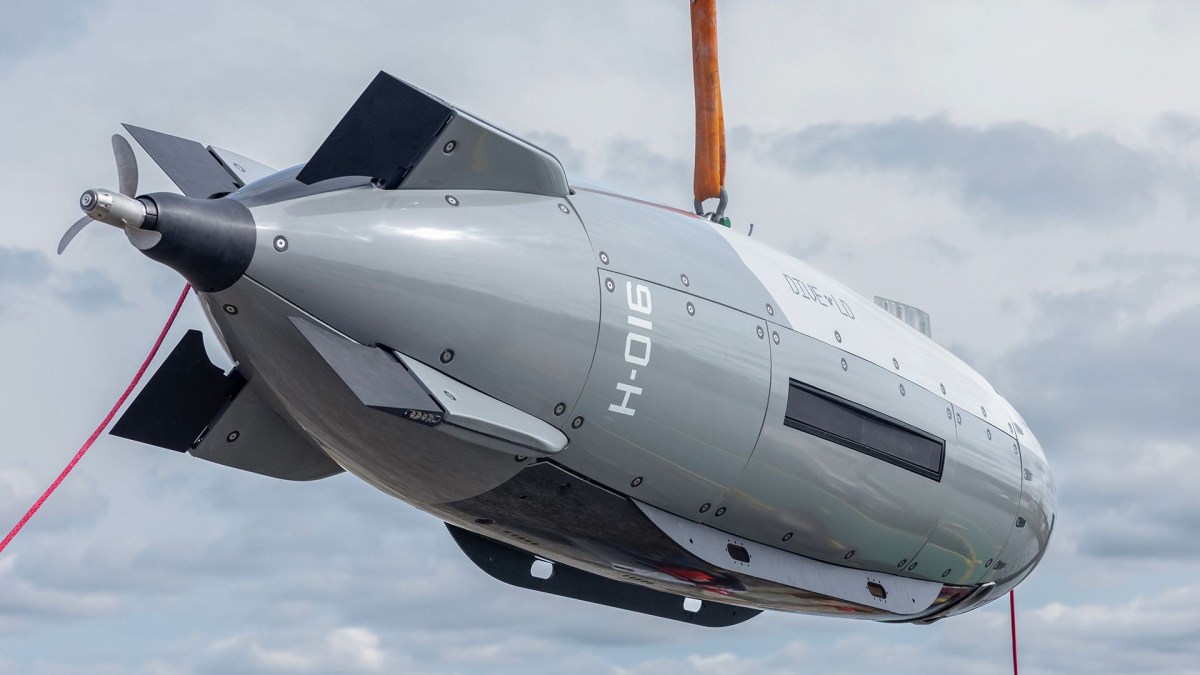
Authorities in Iran said earlier today that they had retrieved a U.S. Dive-LD uncrewed underwater vehicle (UUV) largely intact near the Strait of Hormuz. The regime in Tehran subsequently released pictures and video clips of the UUV being lifted out of the water, seen at various points below. This looks to be the first known instance of an operational deployment of the Dive-LD. This is still a relatively new capability for the U.S. Navy that only began entering service a little more than a year and a half ago. American officials have previously confirmed the use of UUVs , in general, to help keep the Strait of Hormuz free of Iranian naval mines , one of many threats that have dramatically slowed maritime traffic through this critical waterway.
Iran’s Islamic Revolutionary Guard Corps (IRGC) “captured one of the most modern, unmanned, and smart submarines … at the entrance to the Strait of Hormuz in a complex intelligence and operational action at dawn today,” according to a statement shared earlier today via Iranian state media. The exact circumstances surrounding the seizure remain unconfirmed.
“An underwater drone operated by U.S. forces malfunctioned more than a day ago,” a U.S. official said in response to our queries about the Iranian claims. “It was surveying regional waters in support of ongoing operations. The defective drone was an older model that neither collected sensitive data nor carried any classified sonar or radar equipment. U.S. operations in area waters continue.”
An image showing the Dive-LD UUV Iran said it recovered being hoisted out of the water. Iranian quasi-state media via X
The Dive-LD markings, with the “V” worn away, seen on the side of the UUV. Iranian quasi-state media via X
The official did not confirm or deny the type of UUV in question, or that Iran had retrieved it. They also did not elaborate on the nature of the malfunction. TWZ also reached out to Anduril, which initially deferred any questions to U.S. Central Command (CENTCOM). However, they subsequently confirmed the loss of a Dive-LD operating in the region.
“Dive-LD is an attritable autonomous system, meaning it is designed from the outset to operate in dangerous environments where loss of the vehicle is an expected possibility. Its purpose is to keep warfighters out of the most dangerous parts of the undersea mission,” an Anduril spokesperson told us in a statement. “This vehicle had already delivered significant value operating thousands of hours in months-long operations in CENTCOM.”
Categorized as a large UUV, the Dive-LD is 19 feet (approximately 5.8 meters) long, four feet (around 1.2 meters) in diameter, and has a gross weight of close to three tons. The design features a 3D-printed exterior, but is said to be capable of diving down to depths of some 19,685 feet (3.7 miles or 6,000 meters). The UUVs can also remain at sea for around 10 days at a time, depending on their exact configuration, and do so with a high degree of autonomy. Dive-LD was originally developed by U.S.-based Dive Technologies, which was founded in 2018 and then acquired by Anduril in 2022 .
Anduril announced the delivery of the first Dive-LD to the U.S. Navy’s Unmanned Undersea Vehicle Group One (UUVGRU-1) in April 2025. The Navy had already released a picture of personnel training with one of these UUVs five months earlier. How many Dive-LDs are now in U.S. service is unclear.
Members of Unmanned Undersea Vehicle Group One (UUVGRU-1) and Undersea Vehicle Squadron Three (UUVRON-3) train with a Dive-LD UUV in December 2024. USN
The Dive-LD has a highly modular design. Anduril’s website says that the UUV can be configured for various military missions, including so-called intelligence preparation of the operational environment (IPOE); general intelligence, surveillance, and reconnaissance (ISR); mine warfare; and precision placement of objects underwater. IPOE refers to the collection of various types of intelligence on a specific area as part of planning for upcoming operations.
As mentioned, U.S. officials have previously stated that UUVs have been supporting mine-clearance operations in and around the Strait of Hormuz. Broadly speaking, uncrewed underwater platforms offer a way to find and record the location of naval mines using sonars, cameras, and other sensors, while helping keep friendly forces further away from potential threats. Afterward, depending on the type of mines that are found, various methods can be employed to neutralize them. Mine sweeping is time-consuming and dangerous, even in permissive environments, let alone when conducted under the threat of enemy attack .
This past weekend, the Financial Times newspaper in the United Kingdom published a story saying U.S. forces have been using UUVs in exactly this way to help clear Iranian mines, citing “people familiar with the operation.”
“Mostly at night, it [the U.S. military] sent Navy Seal [sic SEAL] divers, robot boats and specialised underwater craft into the perilous strait for a four-month mine-clearance mission,” according to FT ‘s report. “U.S. Navy divers worked in small teams using inflatable-hulled craft. They located Iranian mines with the help of robot boats and submersibles – such as the U.S. Navy’s Common Uncrewed Surface Vessel – operating towed sonar arrays.”
The Common Uncrewed Surface Vessel (CUSV) is a speedboat-sized drone boat that has been in Navy inventory since the early 2020s, explicitly for counter-mine operations. FT ‘s story does not say where any USVs, UUVs, and/or boats full of divers were launched from as part of these operations in and around the Strait of Hormuz, but it posited that the Navy’s Expeditionary Sea Base ship USS Miguel Keith could have been involved.
A stock picture of the US Navy’s Expeditionary Sea Base ship USS Miguel Keith . USMC/Sgt. Luis Agostini
A trio of Independence class Littoral Combat Ships specifically configured for mine-sweeping duties , including using CUSVs, had been forward deployed in Bahrain before the start of the conflict with Iran in February. At least two of those ships, USS Santa Fe and USS Tulsa , emerged thousands of miles away in Southeast Asia in March, something TWZ was the first to report on . At the time of writing, those ships currently appear to be in Singapore. The exact disposition of the third of these LCSs, the USS Canberra , is unclear, but USNI News reported today that it is sailing in the South China Sea.
The Navy has a host of other warships in the Middle East that could support counter-mine missions. With a 10-day endurance, Dive-LDs, specifically, could potentially have been launched from locations away from the Strait of Hormuz, including friendly ports.
Dive-LDs could also be used for other missions beyond mine clearance in the region. As mentioned, the U.S. official told TWZ the UUV had malfunctioned while “surveying regional waters.” While this would be a relevant task in the context of a larger mine-sweeping operation, underwater surveys would be valuable for other purposes , too. For months now, U.S. forces have been facilitating the movement of ships in and out of the Persian Gulf via a route that hugs the Omani coastline , keeping them as far from Iranian threats as possible. Having up-to-date and highly accurate maps of the seafloor in these areas would be critical to ensuring they are deep enough for large commercial vessels to pass through safely.
Chief of Naval Operations Adm. Daryl Caudle, at right, is shown a Dive-LD UUV during a visit to Naval Base Kitsap-Keyport, Washington, in June 2026. USN
IPOE and general ISR support, above and below the waves, would be part of any current or future U.S. activities in the region. This includes a new campaign of strikes targeting Iranian tanker ships that began last month and monitoring general port activity in Iran as part of the ongoing blockade .
Employing Dive-LDs in operations against Iran also provides a valuable real-world opportunity to prove out new UUV capabilities and associated tactics, techniques, and procedures, which could prove critical in future high-end fight against a peer opponent like China. Dive-LD has been feeding into Anduril’s development of an even more capable large UUV called Ghost Shark , the first customer for which is the Royal Australian Navy . Ghost Shark is a militarized version of a design called the Dive-XL that followed the Dive-LD. In March, Anduril announced it was among those selected for the Combat Autonomous Maritime Platform Project (CAMP), an extra-large uncrewed underwater vehicle rapid prototyping effort being run by the Pentagon’s Defense Innovation Unit (DIU) and the Navy. Anduril did not say what platform it would be supplying for that project, but used a picture of Ghost Shark to illustrate the announcement.
The U.S. military is already known to have taken advantage of the ongoing conflict with Iran to demonstrate new weapon systems and other capabilities, including uncrewed maritime systems. In June, a Saronic Corsair drone boat conducted a first-of-its-kind at-sea rescue of the crew of a U.S. Army AH-64 Apache attack helicopter that had gone down in the Gulf of Oman. The following month, U.S. forces launched their first known kamikaze USV attack on Iran’s Bandar Abbas Naval Base using explosive-laden Corsairs.
With all this in mind, it is worth noting that the apparent loss of a Dive-LD intact to Iran is still significant, even if the core design is not brand new and if it does not have any especially sensitive mission systems onboard. It is not necessarily ‘exquisite,’ bleeding-edge technology as it is designed to be optionally attritable, but is still an advanced modern system in operational U.S. service now. Insights into its capabilities and limitations would certainly be of interest to Iran and others. What attempts the U.S. military made to recover the Dive-LD are also unknown. However, the fact that it was not destroyed before or while the Iranians were retrieving it points to American forces having completely lost any sense of its location beforehand.
For its part, Iran has long been a collector of foreign military hardware, primarily U.S. and Israeli, including drones of all types. The capture of a largely intact RQ-170 Sentinel in 2011 is the most famous (or infamous) example. The regime in Tehran also regularly works to reverse engineer what it recovers to varying degrees , and has promised to do the same with the Dive-LD. It could also share its latest prize with its own international partners, including Russia and China, for further analysis and exploitation. The Chinese People’s Liberation Army Navy (PLAN) notably has its own very active UUV programs .
On top of all this, the seizure offers propaganda benefits for the Iranian government, which is already making heavy use of the information space to push back against U.S. military and economic pressure.
Countries seizing foreign USVs and UUVs is certainly not new at this point , even in ostensible peacetime periods . TWZ pointed out that this was only likely to become commonplace, and that steps would need to be taken to address these risks, after a pair of incidents involving Iran in 2022. On August 29 of that year, the Iranian Islamic Revolutionary Guard Corps (IRGC) attempted to capture a U.S. Navy Saildrone USV in the Persian Gulf. Just days later, the IRGC briefly commandeered a pair of American Saildrones in the Red Sea.
The current conflict with Iran has only further underscored the important roles that uncrewed maritime platforms are playing in U.S. operations now, which are only set to keep growing as time goes on. As those same operations expand, so will the risks of capture and other losses.
Contact the author: joe@twz.com
Comments couldn’t be loaded. Please refresh the page.
作者:约瑟夫·特雷维西克
发布于美国东部时间2026年9月8日晚上8:26
一张Dive-LD无人水下航行器的库存照片。安杜里尔
美国海军丢失了一架先进的无人水下航行器(UUV),目前落入伊朗手中。以下是我们目前了解到的关于Dive-LD无人机及其被扣押事件和相关影响的信息。
伊朗当局今天早些时候表示,他们在霍尔木兹海峡附近打捞起一艘基本完好无损的美国Dive-LD无人水下航行器(UUV)。随后,德黑兰政权发布了该UUV被吊出水面的图片和视频片段,视频中可以看到它在不同位置的画面。这似乎是Dive-LD首次投入实际作战部署。对于美国海军来说,这仍然是一项相对较新的能力,该航行器在一年半前才开始服役。美国官员此前曾证实,他们使用UUV的目的是为了帮助清除霍尔木兹海峡的水雷,伊朗水雷是严重阻碍这条重要水道海上交通的众多威胁之一。
据伊朗国家媒体今天早些时候发布的一份声明称,伊朗伊斯兰革命卫队(IRGC)“今天黎明在霍尔木兹海峡入口处,通过一次复杂的情报和作战行动,缴获了一艘最先进的无人潜艇”。此次缴获行动的具体情况尚未得到证实。
针对伊朗方面的说法,一位美国官员回应称:“一架由美军操作的水下无人机一天多前发生故障。当时它正在对区域水域进行勘测,以支援正在进行的军事行动。这架故障无人机是较老的型号,既不收集敏感数据,也不携带任何机密声呐或雷达设备。美国在该区域水域的行动仍在继续。”
一张图片显示,伊朗方面称已回收的Dive-LD无人水下航行器正被吊出水面。伊朗准官方媒体通过X发布
在无人水下航行器(UUV)侧面可以看到Dive-LD的标记,其中“V”字已经磨损。伊朗准官方媒体通过X发布
该官员既未证实也未否认涉事无人潜航器的具体型号,也未说明伊朗是否已将其回收。他们也未详细说明故障的具体情况。TWZ 还联系了安杜里尔公司,该公司最初将所有问题转给了美国中央司令部(CENTCOM)。然而,他们随后证实,一艘在该地区作业的 Dive-LD 无人潜航器确实发生了故障。
“Dive-LD 是一款可损耗的自主系统,这意味着它从一开始就被设计用于在危险环境中运行,而这种环境中,车辆的损失是不可避免的。它的目的是让作战人员远离水下任务中最危险的区域,”安杜里尔公司的一位发言人在一份声明中告诉我们。“这辆车已经在中央司令部长达数月的行动中运行了数千小时,展现了显著的价值。”
Dive-LD 被归类为大型无人水下航行器 (UUV),长 19 英尺(约 5.8 米),直径 4 英尺(约 1.2 米),总重近 3 吨。该 UUV 采用 3D 打印外壳,据称能够下潜至约 19,685 英尺(3.7 英里或 6,000 米)的深度。根据具体配置,Dive-LD 一次可在海上停留约 10 天,并具有高度自主性。Dive-LD 最初由总部位于美国的 Dive Technologies 公司开发,该公司成立于 2018 年,后于 2022 年被 Anduril 收购。
安杜里尔公司宣布将于2025年4月向美国海军第一无人水下航行器大队(UUVGRU-1)交付首艘Dive-LD无人水下航行器。此前五个月,海军已发布一张人员使用该型无人水下航行器进行训练的照片。目前尚不清楚美国海军共服役了多少艘Dive-LD无人水下航行器。
2024年12月,美国海军第一无人水下航行器大队(UUVGRU-1)和第三水下航行器中队(UUVRON-3)的成员正在使用Dive-LD型无人水下航行器进行训练。
Dive-LD采用高度模块化设计。Anduril公司网站称,该无人水下航行器(UUV)可配置用于多种军事任务,包括所谓的作战环境情报准备(IPOE)、通用情报、监视和侦察(ISR)、水雷战以及水下精确投放目标。IPOE指的是为即将开展的行动进行规划,收集特定区域内各种类型的情报。
如前所述,美国官员此前曾表示,无人水下航行器(UUV)一直在支持霍尔木兹海峡及其周边地区的扫雷行动。总的来说,无人水下平台利用声呐、摄像头和其他传感器来发现并记录水雷的位置,同时帮助友军远离潜在威胁。之后,根据发现的水雷类型,可以采用不同的方法将其排除。扫雷工作耗时且危险,即使在条件允许的情况下也是如此,更不用说在敌方攻击的威胁下进行扫雷了。
上周末,英国《金融时报》发表了一篇报道,称美军一直在以这种方式使用无人水下航行器(UUV)帮助清除伊朗地雷,报道援引了“熟悉此次行动的人士”的话。
据英国《金融时报》报道,“美军主要在夜间派遣海豹突击队潜水员、无人艇和专用水下航行器进入危险的海峡,执行为期四个月的扫雷任务。” “美国海军潜水员组成小组,使用充气艇作业。他们借助无人艇和潜艇(例如美国海军的通用无人水面艇)拖曳式声呐阵列定位伊朗水雷。”
通用无人水面艇(CUSV)是一种快艇大小的无人艇,自2020年代初以来一直列装美国海军,专门用于反水雷行动。英国《金融时报》的报道并未说明在霍尔木兹海峡及其周边地区执行这些行动的无人水面艇(USV)、无人水下航行器(UUV)和/或载有潜水员的船只是从何处发射的,但推测海军的远征海上基地舰“米格尔·基思”号可能参与其中。
美国海军远征海上基地舰“米格尔·基思”号的库存照片。美国海军陆战队/路易斯·阿戈斯蒂尼中士
2月份伊朗冲突爆发前,三艘专门用于扫雷任务的“独立”级濒海战斗舰(包括配备近海巡航艇的扫雷舰)已前沿部署在巴林。其中至少两艘——“圣达菲”号和“塔尔萨”号——于3月份出现在数千英里之外的东南亚,TWZ率先报道了此事。截至发稿时,这两艘舰艇似乎位于新加坡。第三艘濒海战斗舰“堪培拉”号的具体部署情况尚不清楚,但美国海军学会新闻网(USNI News)今天报道称,该舰正在南海航行。
美国海军在中东地区还拥有许多其他军舰,可以支援反水雷任务。特别是Dive-LD水下推进器,其续航能力可达10天,理论上可以从霍尔木兹海峡以外的地点发射,包括友方港口。
除了在该地区进行扫雷作业外,水下航行器(Dive-LD)还可以用于其他任务。正如前文所述,美国官员告诉TWZ,这艘无人水下航行器(UUV)在“勘测区域水域”时发生故障。虽然这在更大规模的扫雷行动中是一项重要任务,但水下勘测对于其他用途也同样重要。几个月来,美军一直在协助船只经由一条紧贴阿曼海岸线的航线进出波斯湾,尽可能地使其远离伊朗的威胁。掌握这些区域最新且高度精确的海底地图对于确保水深足以让大型商船安全通行至关重要。
2026年6月,美国海军作战部长达里尔·考德尔海军上将(右)在访问华盛顿州基萨普-基波特海军基地期间,参观了Dive-LD无人水下航行器。
在水面和水下,IPE(海上情报监视侦察)和一般ISR(情报、监视和侦察)支持将是美国在该地区当前或未来行动的一部分。这包括上个月开始的针对伊朗油轮的新一轮打击行动,以及作为持续封锁措施的一部分,对伊朗港口活动的监控。
在针对伊朗的行动中使用Dive-LD无人机,也为验证新型无人水下航行器(UUV)的性能及其相关战术、技术和程序提供了宝贵的实战机会,这在未来与中国等势均力敌的对手进行高端对抗时可能至关重要。Dive-LD无人机为安杜里尔公司(Anduril)研发性能更强大的大型无人水下航行器“幽灵鲨”(Ghost Shark)提供了支持,该航行器的首个客户是澳大利亚皇家海军。“幽灵鲨”是Dive-LD之后研发的Dive-XL无人机的军用版本。今年3月,安杜里尔公司宣布入选“作战自主海上平台项目”(CAMP),该项目是由五角大楼国防创新部门(DIU)和海军联合开展的超大型无人水下航行器快速原型研发项目。安杜里尔公司并未透露将为该项目提供何种平台,但用“幽灵鲨”无人机的图片来配合公告。
众所周知,美军已利用与伊朗的持续冲突展示了新型武器系统和其他能力,包括无人海上系统。今年6月,一艘萨罗尼克海盗无人艇在阿曼湾成功营救了一架坠毁的美国陆军AH-64阿帕奇武装直升机的机组人员,这是此类行动中的首次海上救援。次月,美军使用装载炸药的海盗无人艇对伊朗阿巴斯港海军基地发动了已知的首次自杀式无人水面艇攻击。
考虑到以上种种,值得注意的是,即便其核心设计并非全新,且机载并无特别敏感的任务系统,伊朗完整缴获一架Dive-LD仍然意义重大。该装备并非尖端科技,其设计可选择性消耗,但仍然是目前美国现役的先进现代化系统。对其性能和局限性的深入了解无疑会引起伊朗和其他国家的兴趣。美军曾尝试回收Dive-LD,但目前尚不得而知。然而,该装备在伊朗回收之前或回收过程中并未被摧毁,这表明美军此前已完全失去了对其位置的任何信息。
伊朗长期以来一直热衷于搜集外国军事装备,主要来自美国和以色列,包括各种类型的无人机。2011年缴获一架基本完好的RQ-170“哨兵”无人机便是最著名(或臭名昭著)的例子。德黑兰政权也经常对缴获的装备进行不同程度的逆向工程,并承诺对Dive-LD无人机也采取同样的做法。伊朗还可能与包括俄罗斯和中国在内的国际伙伴分享此次缴获的装备,以进行进一步的分析和利用。值得注意的是,中国人民解放军海军(PLAN)拥有非常活跃的无人水下航行器(UUV)项目。
除此之外,此次查获行动还为伊朗政府提供了宣传上的好处,伊朗政府已经大量利用信息空间来反击美国的军事和经济压力。
即使在表面上的和平时期,各国扣押外国无人水面艇(USV)和无人水下航行器(UUV)也并非新鲜事。TWZ指出,这种情况很可能会变得司空见惯,在2022年伊朗卷入两起事件后,必须采取措施应对这些风险。当年8月29日,伊朗伊斯兰革命卫队(IRGC)试图在波斯湾扣押一艘美国海军的Saildrone无人水面艇。仅仅几天后,IRGC又在红海短暂扣押了两艘美国Saildrone无人水面艇。
当前与伊朗的冲突进一步凸显了无人海上平台在美国军事行动中扮演的重要角色,而且随着时间的推移,这些角色只会越来越重要。随着这些行动的扩大,被俘获和其他损失的风险也会随之增加。
联系作者:joe@twz.com
评论加载失败,请刷新页面。