Man arrested in cargo ship crash with tanker carrying US military fuel一名男子因货船与载有美国军用燃料的油轮相撞而被捕
U.K. police have opened a criminal investigation into a collision between two ships in the North Sea and have arrested a man on suspicion of manslaughter.
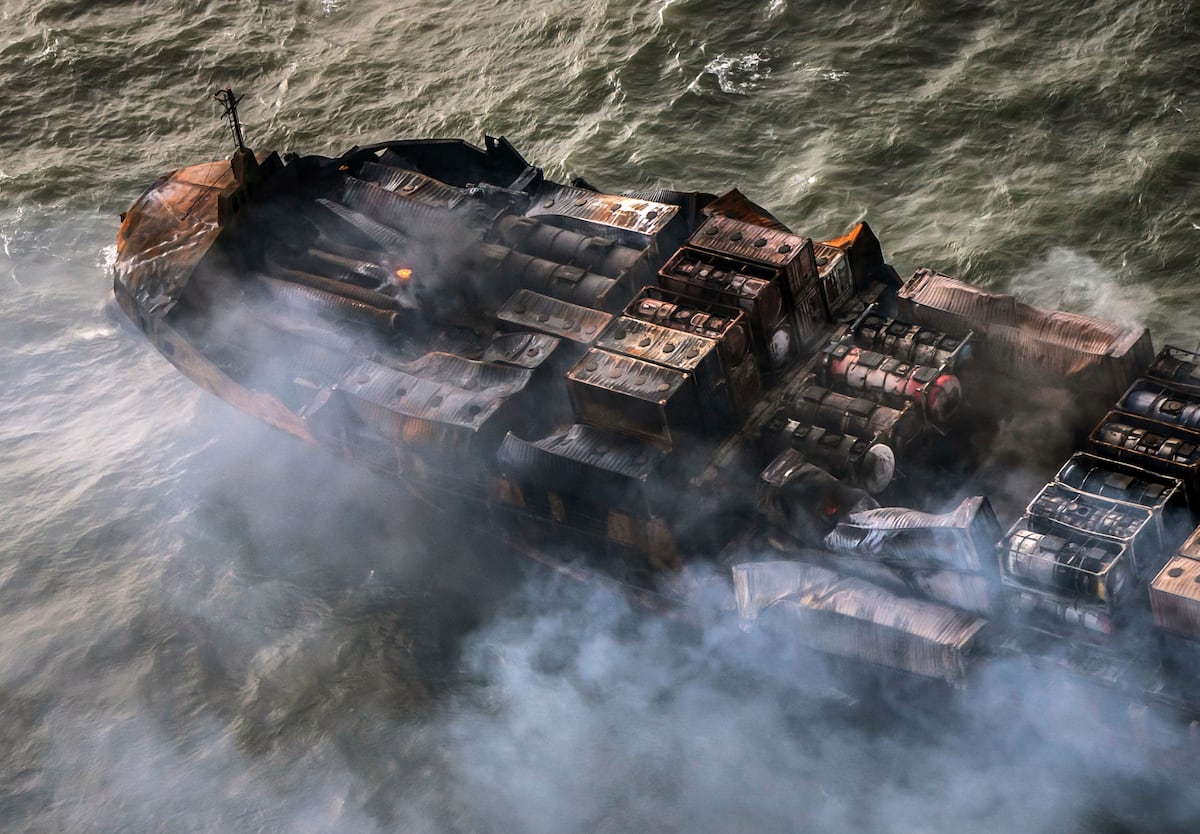
LONDON — British police arrested a man on suspicion of manslaughter as they searched for answers about why a cargo ship hit a tanker transporting jet fuel for the U.S. military off eastern England, setting both vessels ablaze. One sailor was presumed dead.
Humberside Police said the 59-year-old was detained “on suspicion of gross negligence manslaughter in connection with the collision.” The man, who was not named by police, has not been charged.
U.K. officials were watching for damage to birds and sea life after jet fuel from a ruptured tank poured into the North Sea when the Portugal-registered container ship Solong broadsided the U.S.-flagged tanker MV Stena Immaculate on Monday. The collision sparked explosions and fires that burned for more than 24 hours.
Footage filmed from a helicopter on Tuesday morning showed the fire appeared to largely be out on the tanker, which had a large gash on its port side.
The U.K. coast guard agency said Tuesday that “the Solong is still alight and the fire on board the Stena Immaculate has greatly diminished.” It said the cargo ship was drifting south, away from the tanker, and a half-mile exclusion zone had been put in place around both ships. The government said the cause of the collision was being investigated, but there was no indication of foul play.
“No sign of pollution from vessels is observed at this time,” Transport Minister Mike Kane told lawmakers in the House of Commons. But he cautioned that it was a fast-changing situation, and said the cargo ship is likely to sink.
The government said air quality readings were normal and the risk to public health onshore was “very low.”
The collision triggered a major rescue operation by lifeboats, coast guard aircraft and commercial vessels in the foggy North Sea.
All but one of the 37 crew members from the two vessels were brought safely ashore in the port of Grimsby, about 150 miles north of London, with no major injuries. One crew member was missing, and the coast guards called off the search late Monday.
“Our working assumption is that, very sadly, the sailor is deceased,” Kane said.
The U.K. Marine Accident Investigation Branch has begun gathering evidence of what caused the Solong, bound from Grangemouth, Scotland, to Rotterdam, Netherlands, to hit the stationary tanker, which was anchored about 10 miles off the English coast.
The investigation will be led by the U.S. and Portugal, the countries where the vessels are flagged.
The 596-foot Stena Immaculate was operating as part of the U.S. government’s Tanker Security Program, a group of commercial vessels that can be contracted to carry fuel for the military when needed. Its operator, U.S.-based maritime management firm Crowley, said that it was carrying 220,000 barrels of Jet-A1 fuel in 16 tanks, at least one of which was ruptured.
The company said that it was unclear how much fuel had leaked into the sea.
The owner of the Solong, shipping company Ernst Russ, said that contrary to earlier reports, the vessel wasn’t carrying containers of sodium cyanide, which can produce harmful gas when combined with water. It said that four empty containers had previously contained the chemical.
“Our team is actively engaged with all local authorities, and we will work with cleanup teams to ensure every effort is made to mitigate further impacts on the marine environment,” the company said in a statement.
Greenpeace U.K. said that it was too early to assess the extent of any environmental damage from the collision, which took place near busy fishing grounds and major seabird colonies.
Environmentalists said that oil and chemicals posed a risk to sea life, including whales and dolphins and to birds, including puffins, gannets and guillemots that live on coastal cliffs.
Tom Webb, senior lecturer in marine ecology and conservation at the University of Sheffield, said that wildlife along that stretch of coast “is of immense biological, cultural and economic importance.”
“In addition to the wealth of marine life that is present all year round, this time of the year is crucial for many migratory species,” he said.
Alex Lukyanov, who models oil spills at the University of Reading, said that the environmental impact would depend on multiple factors, including “the size of the spill, weather conditions, sea currents, water waves, wind patterns and the type of oil involved.”
“This particular incident is troubling because it appears to involve persistent oil, which breaks up slowly in water,” he said. “The environmental toll could be severe.”
伦敦——英国警方逮捕了一名涉嫌过失杀人的男子,并正在调查一艘货船为何在英格兰东部海域撞上一艘为美国军方运送航空燃油的油轮,两艘船均起火燃烧。一名船员被推定死亡。
亨伯赛德郡警方表示,这名59岁的男子因涉嫌与这起交通事故有关的过失杀人罪被拘留。警方没有透露该男子的姓名,目前他尚未被起诉。
周一,葡萄牙籍集装箱船“索隆号”(Solong)与美国籍油轮“斯特纳·伊玛库拉特号”(MV Stena Immaculate)发生侧撞,导致油箱破裂,航空燃油泄漏入北海,英国官员正密切关注事故对鸟类和海洋生物造成的损害。碰撞引发的爆炸和大火持续燃烧超过24小时。
周二上午从直升机上拍摄的画面显示,油轮上的火势似乎基本已被扑灭,但油轮左舷有一道很大的裂口。
英国海岸警卫队周二表示,“索隆号仍在燃烧,而斯特纳·伊玛库拉特号上的火势已大大减弱。” 海岸警卫队称,这艘货船正向南漂移,远离油轮,并在两艘船周围设立了半英里的禁区。政府表示,碰撞原因正在调查中,但没有迹象表明存在人为因素。
“目前尚未发现船舶污染迹象,”交通部长迈克·凯恩在下议院向议员们表示。但他同时警告说,情况瞬息万变,并表示这艘货船很可能沉没。
政府表示,空气质量读数正常,对陆上公众健康的风险“非常低”。
这次碰撞引发了北海浓雾中救生艇、海岸警卫队飞机和商船参与的大规模救援行动。
两艘船上的37名船员中,除一人外,其余全部安全抵达位于伦敦以北约150英里的格里姆斯比港,无人受重伤。一名船员失踪,海岸警卫队于周一晚些时候停止了搜救行动。
“我们目前的初步判断是,非常遗憾的是,这名水手已经遇难了,”凯恩说。
英国海事事故调查局已开始收集证据,以查明导致从苏格兰格兰杰茅斯驶往荷兰鹿特丹的“索隆”号撞上停泊在英国海岸约 10 英里外的油轮的原因。
此次调查将由涉事船只悬挂国旗的美国和葡萄牙牵头进行。
这艘长596英尺的“史丹纳·伊玛库拉特”号油轮当时正在执行美国政府的“油轮安全计划”。该计划是一项商业船舶运输任务,可在需要时为军方运送燃料。其运营商,总部位于美国的海洋管理公司克劳利表示,该船当时载有22万桶Jet-A1航空煤油,共16个油箱,其中至少有一个油箱破裂。
该公司表示,目前尚不清楚有多少燃料泄漏到海里。
“索隆”号货轮的船东,恩斯特·鲁斯航运公司表示,与之前的报道相反,该船并未装载氰化钠集装箱。氰化钠与水混合会产生有害气体。该公司称,此前有四个空集装箱曾装载过这种化学品。
该公司在一份声明中表示:“我们的团队正积极与所有地方当局合作,并将与清理团队合作,确保尽一切努力减轻对海洋环境的进一步影响。”
英国绿色和平组织表示,现在评估此次碰撞造成的环境破坏程度还为时过早,碰撞地点靠近繁忙的渔场和主要的海鸟栖息地。
环保人士表示,石油和化学品对海洋生物(包括鲸鱼和海豚)以及生活在沿海悬崖上的鸟类(包括海鹦、塘鹅和海鸠)构成威胁。
谢菲尔德大学海洋生态与保护高级讲师汤姆·韦伯表示,沿海岸线的野生动物“具有巨大的生物、文化和经济重要性”。
他说:“除了全年都有丰富的海洋生物外,每年的这个时候对于许多迁徙物种来说也至关重要。”
雷丁大学研究石油泄漏的亚历克斯·卢基扬诺夫表示,环境影响将取决于多种因素,包括“泄漏的规模、天气状况、海流、水浪、风型以及所涉及的石油类型”。
他说:“这次事件尤其令人担忧,因为它似乎涉及持久性石油,这种石油在水中分解缓慢。对环境造成的损失可能非常严重。”