US Army’s new precision missile hit moving target in Pacific exercise美国陆军新型精确导弹在太平洋演习中击中移动目标
The service used its Precision Strike Missile for the first time in an exercise outside of U.S. territory.
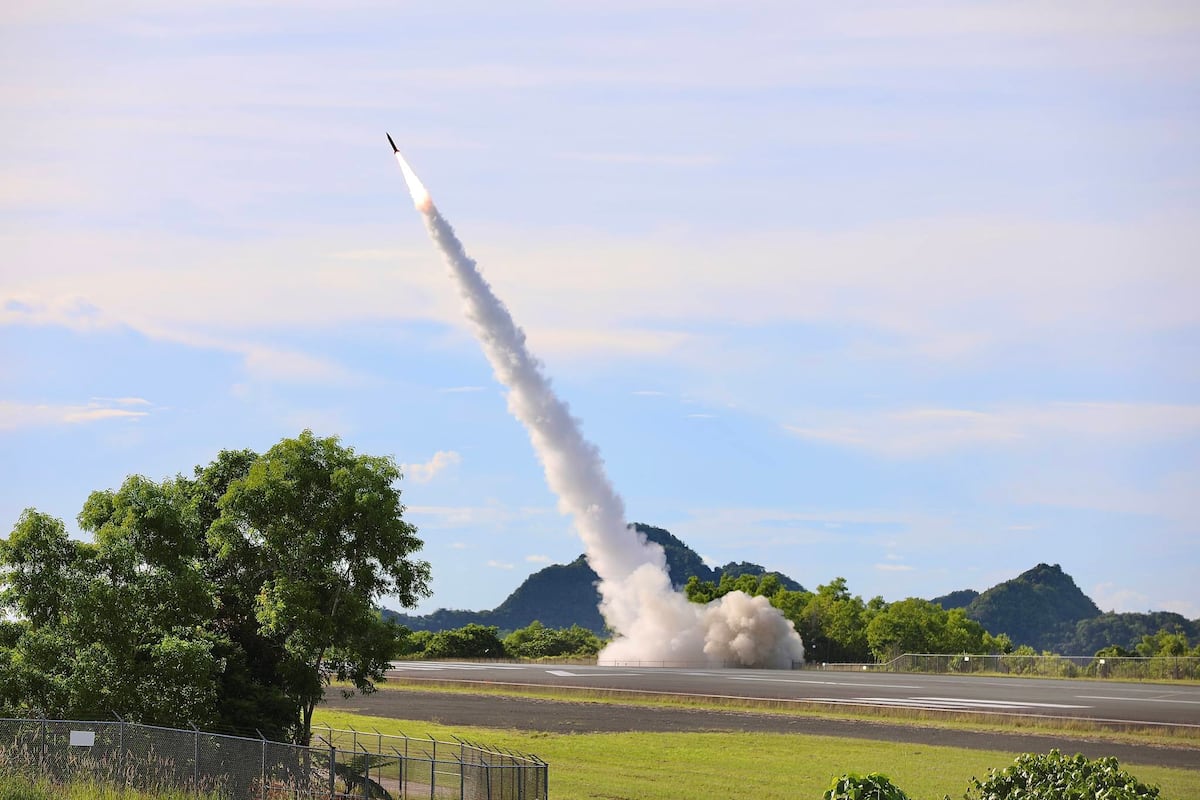
The U.S. Army said it fired its newly fielded Precision Strike Missile from the Pacific island of Palau and engaged a moving target at sea, marking the first time the weapon has been used outside of American-based testing sites.
The first set of Precision Strike Missiles, or PrSM , were delivered to the Army in December 2023 to begin replacing the legacy Army Tactical Missile System.
Soldiers from the 3rd Multidomain Task Force and the 1-181 Artillery Regiment of the Tennessee National Guard participating in Valiant Shield – a major U.S. Pacific Command exercise – launched two PrSMs from the Army’s Autonomous Multi-Domain Launcher (AML) and “was able to engage a moving maritime target in conjunction with other joint assets,” the Army said in a statement.
The participation of PrSM and AML in the Combined Joint Live Fire “SINKEX” in Palau is “a significant milestone in the Army’s development of long-range fires capabilities,” according to the statement.
The AML launcher, still in prototype form, will be able to operate in a convoy and use autonomous way point navigation, tele-operation and remote launcher turret and fire control operations.
The missile — which can launch from both the M142 High Mobility Artillery Rocket System and the M270A2 Multiple Launch Rocket System — will be critical to the service as it seeks a deep-strike capability that can counter Russian and Chinese technologies. Both European- and Indo-Pacific-based U.S. commanders have been eager to receive the capability that can hit targets at standoff locations greater than 400 kilometers.
Hitting a moving target at sea from land is extremely challenging . For example, the Army’s HIMARS rockets missed a ship during a live-fire exercise off the coast of a Philippine training facility near Subic Bay in 2023. The service identified challenges with targeting because the munitions were not able to easily account for drift. Drifting at sea is a complex problem because ships can move 30 to 40 meters in the time it takes to lock in a target and fire a munition.
A PrSM with a ship-killing seeker would make the task much easier.
Lockheed development
The program originally began as a competition between Lockheed Martin and RTX (formerly Raytheon Technologies), but the latter struggled to get the weapon ready for flight tests during the program’s technology maturation and risk reduction phase. The Army and RTX mutually decided to end the effort in March 2020 .
Lockheed continued alone in development and flight testing for the first increment. The Army approved the PrSM program to move into the engineering and manufacturing development phase in September 2021, awarding the company a $62 million contract for early operational capability production.
The service again awarded Lockheed another $158 million a year later for additional early operational-capability PrSMs.
The Army is planning add-ons, including an enhanced seeker to better defeat moving targets at sea as well as technology to provide increased lethality and extended range. The priority for the PrSM in the near term is to pursue a maritime, ship-killing capability.
Lockheed and an RTX and Northrop Grumman team will compete for a subsequent phase of the PrSM program. The Army awarded RTX a $97.7 million contract in February 2023 to advance its design for a Long Range Maneuverable Fires program, planned to become the PrSM Increment 4 effort.
Lockheed won a $33 million contract to develop capability for the increment around the same time. That increment focuses on dramatically extending the range of PrSM, possibly from its planned 499 kilometers (310 miles) to more than double that distance.
America’s 2019 withdrawal from the Intermediate-Range Nuclear Forces Treaty with Russia has allowed the U.S. Army to develop the missile to fly farther. The treaty had prevented the development of missiles with ranges between 499 kilometers and 5,000 kilometers.
In October 2021, the Army conducted a long-range flight test of PrSM that is believed to have exceeded the current range requirement of 499 kilometers.
Jen Judson is an award-winning journalist covering land warfare for Defense News. She has also worked for Politico and Inside Defense. She holds a Master of Science degree in journalism from Boston University and a Bachelor of Arts degree from Kenyon College.
美国陆军表示,他们从太平洋岛国帕劳发射了新部署的精确打击导弹,并击中了海上移动目标,这标志着该武器首次在美国本土试验场之外使用。
第一批精确打击导弹(PrSM)于 2023 年 12 月交付陆军,开始取代老旧的陆军战术导弹系统。
陆军在一份声明中表示,参加“英勇之盾”(美国太平洋司令部一项重大演习)的田纳西州国民警卫队第3多域特遣部队和第1-181炮兵团的士兵从陆军的自主多域发射器(AML)发射了两枚PrSM导弹,“能够与其他联合力量协同打击移动的海上目标”。
声明称,PrSM 和 AML 参加在帕劳举行的联合实弹射击“SINKEX”演习是“陆军发展远程火力能力的一个重要里程碑”。
AML发射器目前仍处于原型阶段,它将能够在车队中运行,并能使用自主航点导航、远程操作以及远程发射器炮塔和火控操作。
这款导弹可从M142高机动火箭炮系统和M270A2多管火箭炮系统发射,对于寻求能够对抗俄罗斯和中国技术的纵深打击能力的美国陆军来说至关重要。驻扎在欧洲和印太地区的美国指挥官都渴望获得这种能够打击400公里以外目标的能力。
从陆地击中海上移动目标极具挑战性。例如,2023年,美国陆军的HIMARS火箭在菲律宾苏比克湾附近一处训练设施沿岸进行的一次实弹演习中,未能击中一艘舰船。军方指出,目标瞄准存在困难,因为这些弹药难以有效应对漂移。海上漂移是一个复杂的问题,因为舰船在锁定目标并发射弹药的时间内,可能会移动30到40米。
配备反舰导弹的PrSM导弹会让这项任务变得容易得多。
洛克希德公司开发
该项目最初是洛克希德·马丁公司和RTX公司(前身为雷神技术公司)之间的竞争,但在项目技术成熟和风险降低阶段,RTX公司难以使武器做好飞行测试的准备。陆军和RTX公司于2020年3月共同决定终止该项目。
洛克希德公司继续独立完成第一阶段的研发和飞行测试。2021年9月,陆军批准PrSM项目进入工程和制造开发阶段,并授予该公司一份价值6200万美元的早期作战能力生产合同。
一年后,军方再次向洛克希德公司授予 1.58 亿美元的合同,用于生产额外的早期作战能力 PrSM。
陆军正在计划为其添加附加组件,包括增强型导引头,以便更好地打击海上移动目标,以及提升杀伤力和射程的技术。PrSM近期的首要任务是发展海上反舰能力。
洛克希德·马丁公司、RTX公司和诺斯罗普·格鲁曼公司组成的联合团队将竞标PrSM项目的后续阶段。2023年2月,美国陆军授予RTX公司一份价值9770万美元的合同,用于推进其远程机动火力系统(Long Range Maneuverable Fires)的设计,该项目计划成为PrSM的第四阶段。
大约在同一时间,洛克希德公司赢得了一份价值3300万美元的合同,用于开发该改进型导弹的能力。该改进型导弹的重点是大幅提升PrSM导弹的射程,可能从原计划的499公里(310英里)提升至两倍以上。
美国于2019年退出与俄罗斯签署的《中导条约》,这使得美国陆军得以研发射程更远的导弹。该条约此前限制了射程在499公里至5000公里之间的导弹的研发。
2021 年 10 月,陆军进行了 PrSM 的远程飞行测试,据信其射程超过了目前 499 公里的要求。
珍·贾德森是一位屡获殊荣的记者,为《防务新闻》报道陆地战争。她也曾为《政治报》和《内幕防务》工作。她拥有波士顿大学新闻学硕士学位和凯尼恩学院文学学士学位。