The US needs more munitions to deter China美国需要更多军火来威慑中国。
Opinion: The U.S. risks being drawn into fights in three regions at the same time. This will be more than the U.S. can manage with its current munitions stores.
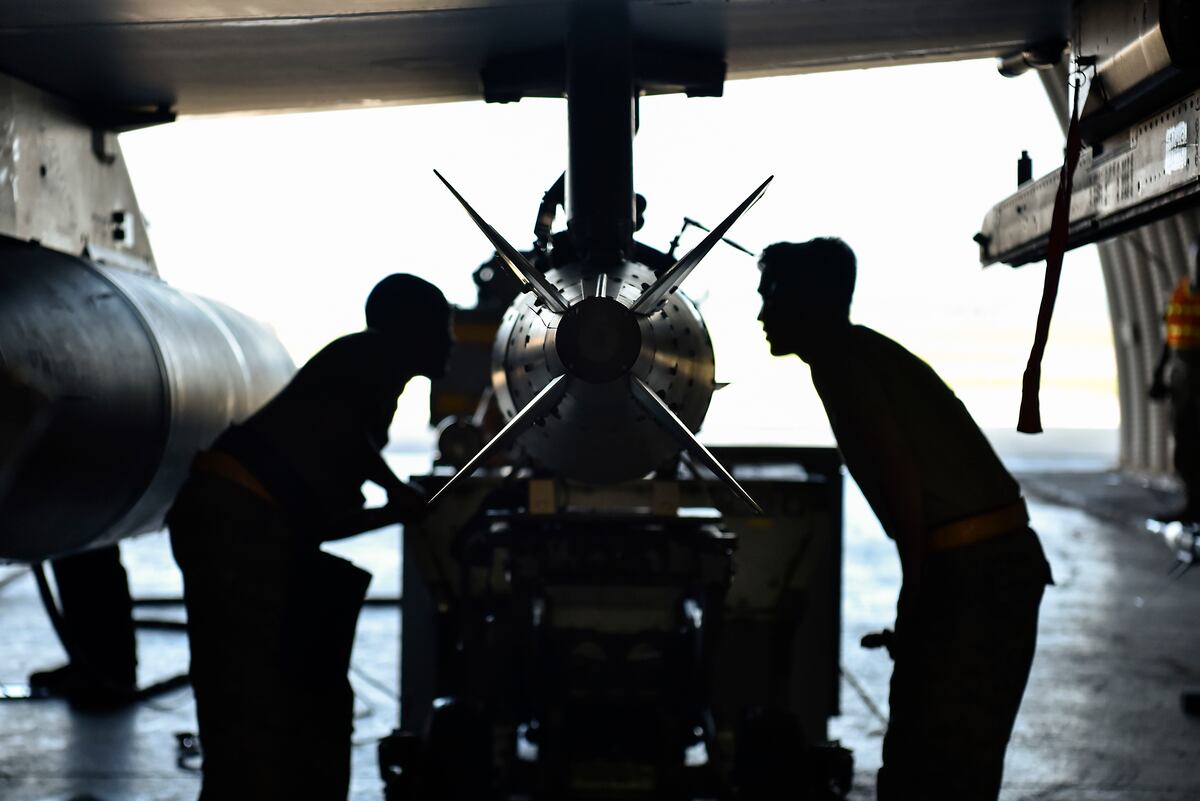
In early 2023, the U.S. transferred 300,000 155mm artillery shells from its War Reserve Material stockpile in Israel to Ukraine. At the time, it was the only conflict with heavy U.S. involvement. After Hamas’s Oct. 7 terrorist attack , that’s no longer true.
Now, Israel too has requested munitions, putting a strain on already stretched U.S. stockpiles and calling into question both the Defense Department’s munitions planning and the budgetary priorities of congressional appropriators. The U.S. military is already tasked to do more than it has been equipped to do. At present, our armed forces do not have the munitions needed for a contingency in the Indo-Pacific region , and we certainly aren’t producing enough munitions to sustain operations in all three theaters at once.
For example, Ukraine is expending between 110,000 155mm shells per month , with a stated minimum need to fire 356,400 shells per month , and a desire to be able to shoot 594,000 shells per month .
Even after doubling shell production, the U.S. produces only 28,000 per month . That means Ukraine’s current 155mm shell expenditure outstrips U.S. monthly production by a multiple of about 3.6.
Adding to the problem is Israel’s request for 155mm shells from the United States. But with U.S. global stockpiles severely depleted by the war in Ukraine, it remains to be seen where the Pentagon can find shells for Israel without diverting shells bound for Ukraine.
Poor munitions planning on the part of both the Pentagon and congressional appropriators could mean at least some of the Pacific theater’s War Reserve Material stockpile could be transferred, weakening U.S. capabilities for contingency situations in the Indo-Pacific. This hardly makes sense when the National Defense Strategy has identified China as the primary challenge to the United States.
But the Pentagon’s shortfall in artillery shells isn’t the only munitions planning issue. Israel has also requested precision-guided munitions such as Small Diameter Bombs and Joint Direct Attack Munitions. The U.S. has promised to deliver both, but it’s unclear how that can be done without inhibiting overall U.S. capacity for other contingency situations. According to procurement documents , fiscal 2022 U.S. purchases of Joint Direct Attack Munitions and Small Diameter Bombs totaled only approximately 3,000 and 2,000, respectively.
That’s fewer JDAMs and SDMs in a year than Israel used in six days. And FY23 procurements don’t make the situation much better.
Beyond the Pentagon’s past failures in munitions planning, its future planning might be even more worrying. Wargames have repeatedly shown that the U.S. will run out of critical munitions only eight days into a high-intensity conflict with China over Taiwan.
Ukrainian servicemen load a French TRF-1 155mm weapon prior to firing at Russian positions on March 27, 2023, amid the Russian invasion of Ukraine. (Aris Messinis/AFP via Getty Images)
The Navy’s annual procurement of Tomahawk missiles and MK 48 torpedoes, for example, falls woefully short of the needs of the fleet. If all 73 Arleigh Burke-class destroyers are available, the Navy’s FY22 procurement of 70 Tomahawks only allows each to launch 0.96 Tomahawks. If all 22 Virginia-class submarines were available, the 58 MK 48 torpedoes procured by the Navy that fiscal year would not fill their 88 torpedo tubes even once.
Dipping into U.S. military inventory does not make the situation much better. An educated guess is that there are about 4,000 Tomahawks in the Navy’s possession. If 20% of the vertical launching system cells in the U.S. surface fleet and 100% of the VLS cells in the submarine fleet are equipped with Tomahawks, and if 80% of the U.S. surface fleet, 60% of U.S. attack submarines and 33% of U.S. strategic submarines are deployable in a conflict, then the Navy can fire roughly 2,300 Tomahawks without reloading.
In sum, the Navy’s Tomahawk inventory is so low that it likely can’t reload all its ships even once.
The situation is the same with most other munitions. Previously produced Joint Air-to-Surface Standoff Missiles total only about 3,000 , not taking into account the hundreds already spent in combat. And the Long Range Anti-Ship Missile inventory likely does not exceed 120 .
The U.S. military’s current mission is dependent on deterrence and delivery of munitions to allies. Its projected failure to do enough of the latter surely undermines the former in the minds of Chinese military planners.
It could get even worse: A fundamental precept of war is its unpredictability in both timing and contours.
America is preparing for a conflict with China over Taiwan, but North Korea could decide to invade South Korea at any time — and the most dangerous window might be while the U.S. is engaged in a war over Taiwan. The United States has treaty obligations to help South Korea defend itself, and expending munitions in such a war would further endanger America’s capacity to fight China.
Frederick the Great once said that when you defend everything, you defend nothing. With U.S. attention fixated on supplying Ukraine with munitions needed for its war with Russia, and a probable continuation of violence in the Middle East, the U.S. risks being drawn into fights in three regions at the same time. This will be more than the U.S. can manage with its current munitions stores.
It is more important than ever to prioritize use based on grand strategy and national interest, and to rework munitions acquisition and production plans to deter threats to America’s most vital interests.
As others have written, the first step in fixing America’s long-term munitions problem is the increased use of multiyear procurement authorities for munitions across the board. The use of multiyear contracts sends a long-term demand signal to industry that enables the defense-industrial base to both expand and quicken production of these munitions.
Likewise, multiyear buys have consistently been shown to decrease costs over time, resulting in a positive outcome both for the military and for the American taxpayer. To its credit, this fiscal year’s National Defense Authorization Act approves six new munitions for multiyear procurement, but this funding ultimately still depends on congressional appropriators, who still haven’t fully funded the multiyear procurement of munitions authorized in last year’s NDAA.
Wilson Beaver, a former Senate staffer and U.S. Army veteran, is the senior policy analyst for defense budgeting at the Heritage Foundation’s Center for National Defense. Jim Fein is a former member of the think tank’s Young Leaders Program.
2023年初,美国从其位于以色列的战争储备物资库中向乌克兰转移了30万枚155毫米炮弹。当时,这是美国深度介入的唯一一场冲突。但在哈马斯10月7日发动恐怖袭击后,情况已发生改变。
现在,以色列也提出了弹药需求,这无疑加剧了美国本已捉襟见肘的弹药储备,并引发了人们对国防部弹药规划和国会拨款委员会预算优先事项的质疑。美军目前承担的任务已经超过了其装备所能承受的范围。目前,我们的武装部队没有足够的弹药来应对印太地区的突发事件,而且我们显然也无法生产足够的弹药来同时维持在三个战区的作战行动。
例如,乌克兰每月消耗 110,000 发 155 毫米炮弹,并声称每月至少需要发射 356,400 发炮弹,而希望每月能够发射 594,000 发炮弹。
即使炮弹产量翻番,美国每月也仅生产2.8万发。这意味着乌克兰目前155毫米炮弹的支出是美国月产量的约3.6倍。
雪上加霜的是,以色列还向美国请求提供155毫米炮弹。但由于乌克兰战争严重消耗了美国的全球炮弹储备,五角大楼如何在不挪用原本用于乌克兰的炮弹的情况下,为以色列找到炮弹,目前仍是未知数。
五角大楼和国会拨款机构在军需品规划上的失误,可能意味着太平洋战区的部分战争储备物资将被转移,从而削弱美国在印太地区应对突发事件的能力。鉴于《国防战略》已将中国列为美国面临的主要挑战,这种情况显然难以理解。
但五角大楼炮弹短缺并非唯一的弹药规划问题。以色列还要求提供精确制导武器,例如小直径炸弹和联合直接攻击弹药。美国承诺提供这两种弹药,但如何在不影响美国应对其他突发事件的整体能力的前提下做到这一点,目前尚不清楚。根据采购文件,2022财年美国采购的联合直接攻击弹药和小直径炸弹分别仅约3000枚和2000枚。
一年内使用的JDAM和SDM数量比以色列六天使用的还少。而2023财年的采购计划也未能使情况好转多少。
除了五角大楼过去在军备规划方面的失败之外,其未来的规划可能更令人担忧。兵棋推演反复表明,一旦与中国因台湾问题爆发高强度冲突,美国的关键军备可能在短短八天内就会耗尽。
2023年3月27日,在俄罗斯入侵乌克兰期间,乌克兰士兵在向俄军阵地开火前装填一门法国TRF-1型155毫米榴弹炮。(Aris Messinis/AFP via Getty Images)
例如,海军每年采购的“战斧”导弹和MK 48鱼雷远远无法满足舰队的需求。假设73艘“阿利·伯克”级驱逐舰全部投入使用,海军在2022财年采购的70枚“战斧”导弹也仅够每艘驱逐舰发射0.96枚。假设22艘“弗吉尼亚”级潜艇全部投入使用,海军在该财年采购的58枚MK 48鱼雷甚至无法装满其88个鱼雷发射管一次。
动用美国军方库存并不能使情况好转多少。据估计,海军大约拥有4000枚战斧巡航导弹。假设美国水面舰艇20%的垂直发射系统单元和潜艇100%的垂直发射系统单元都配备了战斧导弹,并且假设美国水面舰艇80%、攻击型潜艇60%和战略潜艇33%在冲突中可以部署,那么海军无需重新装填即可发射大约2300枚战斧导弹。
总之,海军的战斧导弹库存量太低,可能连一次重新装填所有舰艇都做不到。
其他大多数弹药的情况也类似。此前生产的联合空对地防区外导弹总数仅约3000枚,还不包括已在实战中消耗的数百枚。而远程反舰导弹的库存可能不超过120枚。
美国军方目前的任务依赖于威慑和向盟友运送弹药。预计其在后者方面做得不够,这无疑会在中国军方策划者看来削弱前者。
情况可能会变得更糟:战争的一个基本原则是其在时间和格局上的不可预测性。
美国正为与中国就台湾问题发生的冲突做准备,但朝鲜随时可能入侵韩国——而最危险的时机或许正是美国深陷台湾战争之际。美国有条约义务帮助韩国自卫,而将军费开支用于此类战争将进一步削弱美国对抗中国的能力。
腓特烈大帝曾说过,如果你什么都想保卫,那就等于什么都保卫不了。美国目前正集中精力向乌克兰提供其与俄罗斯战争所需的弹药,而中东地区的暴力冲突也可能持续,这使得美国面临同时卷入三个地区冲突的风险。以美国目前的弹药储备,恐怕难以应对如此局面。
现在比以往任何时候都更重要的是,要根据大战略和国家利益来优先考虑军火的使用,并重新制定军火采购和生产计划,以遏制对美国最重要利益的威胁。
正如其他人所写,解决美国长期弹药问题的首要步骤是全面增加多年期弹药采购授权的使用。多年期合同的使用向业界发出长期需求信号,使国防工业能够扩大并加快这些弹药的生产。
同样,多年采购已被反复证明能够随着时间的推移降低成本,从而对军方和美国纳税人都带来积极影响。值得肯定的是,本财年的《国防授权法案》批准了六种新型弹药的多年采购,但这些资金最终仍取决于国会拨款委员会,而他们尚未全额拨付去年《国防授权法案》授权的多年弹药采购资金。
威尔逊·比弗曾任参议院工作人员,也是一名美国陆军退伍军人,现任传统基金会国防中心国防预算高级政策分析师。吉姆·费恩曾是该智库青年领袖计划的成员。