Air Force Fighters Almost Got An Air-Launched Ballistic Missile 40 Years Ago, Now They’re A Hot Item40年前,空军战斗机差点就拥有了一枚空射弹道导弹,如今它们成了热门话题。
The system would have let jet fighters rain guided ballistic missiles down on enemy forces, a concept that has now come of age.
Updated Jan 26, 2021 4:38 PM EST
In the early 1980s, the U.S. Air Force planned to arm its tactical fighter jets with an air-launched ballistic missile. The Joint Tactical Missile System program was run jointly with the U.S. Army and would have given the Air Force its own improved version of the Lance quasi-ballistic missile. In some ways, the program had parallels with Russia’s Kinzhal missile, which The War Zone has examined in detail in the past and, more loosely, it shared similarities with the types of air-launched ballistic missiles now under development in China .
During the 1970s, the Defense Advanced Research Projects Agency (DARPA) began to look at ways of attacking Warsaw Pact armor deep in enemy territory, without necessarily having to use nuclear weapons. The resulting Assault Breaker program brought together a range of different technologies — among them lasers, electro-optical sensors, airborne radars , and precision-guided munitions — to defeat these kinds of targets.
Two XMGM-52 Lance missiles are fired from A and C Battery, 1st Battalion, 12th Artillery Regiment, at the White Sands Missile Range in 1987. The Lance served as the basis for the Assault Breaker, and later Vought’s JTACMS proposal. , Public Domain
However, the ambitious Assault Breaker program had begun to fragment by the early 1980s, with the Army focusing more on ground systems and helicopters, while the Air Force eyed new methods of delivering munitions from manned aircraft.
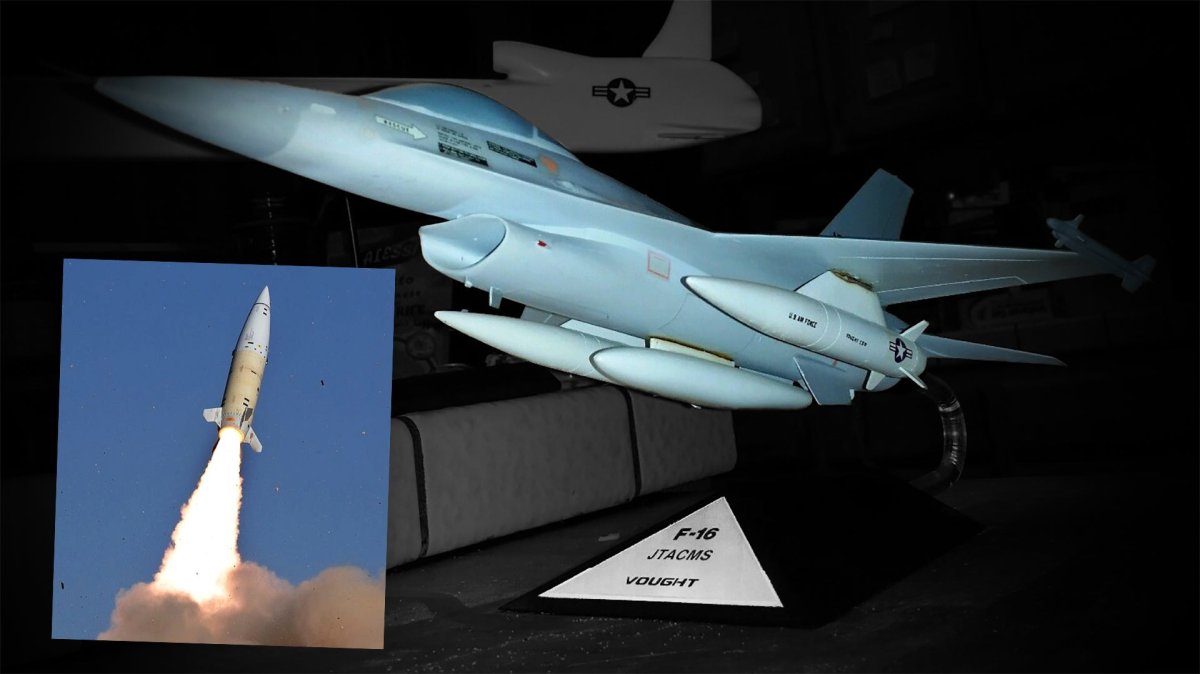
This model shows that the American ATACMS ballistic missile may have an air-launched variant. pic.twitter.com/LMgo5x2hlS — Caesar (@Ninja998998) January 26, 2021
This model shows that the American ATACMS ballistic missile may have an air-launched variant. pic.twitter.com/LMgo5x2hlS
Amid pressure from the U.S. Congress to more closely align similar programs across the services, the Department of Defense drew up plans for new Joint programs in 1983, still with the broad aim of defeating rear-echelon targets. These new J-programs included the Joint Surveillance Target Attack Radar System (JSTARS), as well as the Joint Tactical Missile System (JTACMS), both of which were essentially spinoffs of Assault Breaker technologies.
JTACMS took shape when the previous Army-led Corps Support Weapon System (CSWS), intended to replace the MGM-52 Lance short-range ballistic missile, was integrated with the Air Force’s Conventional Standoff Weapon (CSW) program. The Army criteria for the weapon included a range greater than the existing tube-launched and rocket artillery systems, while the Air Force required a standoff weapon to attack high-priority targets.
Pre-development contracts were awarded to several companies, among them the Vought Corporation, the firm responsible for the Lance, as well as the Boeing Aerospace Company, and Martin Marietta Aerospace. These contracts were funded on a 50/50 basis by the Army and Air Force. However, the airframe competition was limited to Vought and Martin Marietta, who offered the same basic designs as they had for Assault Breaker: the T22 and T16, respectively.
The T22, Vought’s entrant in the Storm Breaker program, was repurposed as the JTACMS., Lockheed Martin
Vought produced an Improved Lance concept to meet the JTACMS requirement and, based on the firm’s publicity material, it seems that this reached the stage of a mock-up carried under the wing of an F-16. Desktop models were also produced showing Vought’s weapon carried by both the F-16 and by A-7 attack aircraft , while company advertising promoted the air-launched version of the Improved Lance as a potential B-52 weapon, as well.
In the 1980s, did you think the US Army had a truck-mounted Lance ballistic missile launcher? pic.twitter.com/cQFoP1SNUA — Caesar (@Ninja998998) May 23, 2019
In the 1980s, did you think the US Army had a truck-mounted Lance ballistic missile launcher? pic.twitter.com/cQFoP1SNUA
While specifications for the air-launched version of the weapon are not available, it is known that the Vought T22-derived JTACMS was broadly similar in size to the original Lance, which had a length of 20 feet and weighed roughly 3,000 pounds, depending on the warhead type. Unlike the Lance, the new weapon featured cruciform-shaped mid-body wings, plus elevon control surfaces at the rear. For propulsion, the air-launched JTACMS traded the liquid-propellant rocket of the original Lance for a solid-fuel motor using low-cost propellant taken from the MLRS, which would have offered greater range, reliability, and safety. While the original Lance could deliver a conventional or nuclear warhead to a distance of up to 75 miles, in the Improved Lance version, this was extended to over 200 miles, and this is likely to have been the same for the ground-launched JTACMS, too.
The rival to the Vought airframe proposal, Martin Marietta’s T16 was derived from its Patriot surface-to-air missile . This retained the Patriot’s booster section but added a new nosecone carrying a submunitions warhead and inertial guidance package. It is likely that the Vought proposal featured the same warhead/guidance.
A rare image apparently showing the Martin Marietta JTACMS carried by an F-16. , PUBLIC DOMAIN
In both cases, the primary source of targeting data was expected to be via data-link to a Pave Mover moving target indication and synthetic aperture capable radar, which would also be able to correct the course of the missiles once in flight. This same technology would later provide the basis of the JSTARS system, now mounted onboard the Air Force’s E-8C platform.
Launching a ballistic missile from the air, rather than from the ground, would have had the advantage of increasing range even further (by a factor of approximately four), deployability, and flexibility. The aircraft carrying the missile would be able to release it without having to enter the engagement zones of hostile tactical surface-to-air missiles, striking key targets such as massed formations of armor, air defense sites, communications nodes, and airfields, with relative impunity.
It would have provided a serious headache for enemy air defense operators and systems, otherwise optimized for targeting manned aircraft and slower-flying cruise missiles. Indeed, the presence of air-launched JTACMS would have demanded an appropriate response from the Soviet side, in the form of additional, more layered ballistic missile defenses, new targeting sensors, and longer-range anti-aircraft missiles to down the F-16, for example, before it could unleash its missiles.
A Cold War-era Department of Defense image of an SA-6 Gainful mobile surface-to-air missile system. The air-launched JTACMS promised to allow aircraft to launch the missiles before penetrating much of the Warsaw Pact’s air defense network., PUBLIC DOMAIN
Despite this promise, the Air Force only remained in the JTACMS program until 1985, when it left to pursue its own goals once again, shelving the idea of an air-launched ballistic missile (ALBM) altogether.
In any event, the end of the Cold War changed almost entirely the types of targets that the Air Force was likely to be assigned anyway, at least in the short term, and instead of prioritizing speed and size for its munitions, the service’s next generation of standoff weapons was tailored for range and low-observable characteristics.
The Army was left to continue what was now known as the Army Tactical Missile System (ATACMS), which resulted in Vought being chosen as prime contractor for the MGM-140 missile that was first test-flown in prototype form in 1988. This weapon is also roughly similar to its Lance predecessor in terms of weight, but is somewhat more compact, with a length of 13 feet. The ATACMS — pronounced “attack-ums” — can carry a 500-pound warhead to targets approximately 186 miles away.
An ATACMS is fired over the cab of an M142 High Mobility Artillery Rocket System (HIMARS) launcher. , U.S. Army
The MGM-140A ATACMS became operational in January 1991 and saw its first combat use during Operation Desert Storm in the same year. Today, improved versions of the ATACMS remain in use with the U.S. Army and Marine Corps and have been widely exported. The current prime contractor for ATACMS is Lockheed Martin Missiles and Fire Control and the same contractor is now working on a planned replacement, under the Precision Strike Missile program , or PrSM.
While the Air Force had tried and failed to field a strategic air-launched ballistic missile in the 1960s, the concept of a tactical ALBM proved just as unsuccessful in the early 1980s. But that is not to say that the air-launched JTACMS would not have been successful.
One modern parallel to the air-launched JTACMS is the Russian Kinzhal, an adaptation of the Iskander tactical ballistic missile, which is itself broadly comparable to the ATACMS. While the Iskander on which the Kinzhal is based is similar in length to the Lance, at 24 feet, it is a substantially heavier missile, weighing around 8,400 pounds. This requires the missile to be carried by the MiG-31 heavy interceptor, which can accommodate a single Kinzhal under the fuselage.
A MiG-31 armed with a Kinzhal air-launched ballistic missile., Russian Ministry of Defense
China, for its part, is also developing ALBMs. Apparently intended primarily for the anti-ship mission, these include an air-launched version of the DF-21D and they will be expected to function as part of the anti-access/area-denial strategy aimed at keeping U.S. Navy carrier strike groups at bay. Potentially, we may also in the future see some of China’s short-range ballistic missile designs migrated to air-launched applications, provided that isn’t already happening.
A closer modern counterpart to the air-launched JTACMS is perhaps the Israeli Rampage, an air-launched derivative of IMI Systems’ ground-launched Extended Range Artillery guided artillery rocket, or EXTRA. You can read more about the Rampage here , suffice to say, it is also suitable for carriage aboard the F-16 and is similarly intended to strike fixed targets at standoff range, using its speed to confound complex air defense environments.
Test launch of the Rampage missile from an Israeli Air Force F-16., IMI SYSTEMS
Meanwhile, the Israeli Rocks missile is also similar, an air-launched ballistic missile that combines features from existing precision-guided bombs and a ballistic missile defense surrogate target missile. Like JTACMS and Rampage, this weapon has also been certified for carriage by the F-16, although it seems to be intended primarily for attacking hardened targets.
Weapons like the Kinzhal, Rampage, and Rocks are potentially ideal for short-notice strikes on time-sensitive and highly defended targets, including mobile air defense systems and mobile ballistic missiles , giving them little, if any time to fire, seek cover, or otherwise relocate. There is no reason why the JTACMS couldn’t have provided the U.S. Air Force with similar capabilities. These would have provided a relatively low-cost means to holding key targets at risk across the enemy rear area and could have engaged them rapidly at the onset of hostilities.
The Rafael Rocks missile bears a striking resemblance to the Cold War-era JTACMS., Rafael
Today, the focus of related activity in the United States is firmly on the B-52, set to become a major launch platform for oversized weapons . While the AGM-183A Air-launched Rapid Response Weapon, or ARRW, might look like an air-launched ballistic missile, its centerpiece is a hypersonic boost-glide vehicle payload that is capable of maneuvering inside the atmosphere at extreme speeds. The Air Force is looking to integrate other boost-glide vehicles, as well as air-breathing hypersonic missiles onto the B-52 in the future.
These weapons all promise high speed and impressive range but, for now, as far we know, the United States is not working on a true ALBM, and certainly not one that could also be mounted onboard a relatively small fighter jet, like the F-16.
However, the growing interest in ALBMs — especially those that are lower-cost adaptations of existing ground-launched systems — suggests that a weapon like the JTACMS could still be a useful part of the Air Force armory today.
Contact the author: thomas@thedrive.com
Comments couldn’t be loaded. Please refresh the page.
更新于美国东部时间2021年1月26日下午4:38。
20世纪80年代初,美国空军计划为其战术战斗机配备空射弹道导弹。联合战术导弹系统(JTMS)项目由空军和美国陆军联合开展,旨在为空军研发改进型的“长矛”(Lance)准弹道导弹。在某些方面,该项目与俄罗斯的“匕首”(Kinzhal)导弹有相似之处(《战区》栏目此前曾对此进行过详细分析);此外,它与中国目前正在研发的空射弹道导弹也有相似之处。
20世纪70年代,美国国防高级研究计划局(DARPA)开始研究如何在不使用核武器的情况下,攻击深入敌后、部署在华沙条约组织控制区的装甲目标。由此产生的“突击突破者”(Assault Breaker)计划整合了多种技术,包括激光、光电传感器、机载雷达和精确制导武器,旨在摧毁这类目标。
1987年,在白沙导弹靶场,美国陆军第12炮兵团第1营A连和C连发射了两枚XMGM-52“长矛”导弹。“长矛”导弹是“突击破坏者”导弹的基础,后来又成为沃特公司联合战术空中作战管理系统(JTACMS)方案的基础。(公共领域)
然而,到了 20 世纪 80 年代初,雄心勃勃的“突击突破者”计划开始瓦解,陆军更加专注于地面系统和直升机,而空军则着眼于从有人驾驶飞机投放弹药的新方法。
该模型显示,美国ATACMS弹道导弹可能存在空射型。pic.twitter.com/LMgo5x2hlS — Caesar (@Ninja998998) January 26, 2021
该模型显示,美国ATACMS弹道导弹可能存在空射型。pic.twitter.com/LMgo5x2hlS
在美国国会要求各军种更紧密地协调类似项目的压力下,国防部于1983年制定了新的联合项目计划,其总体目标仍然是打击后方目标。这些新的联合项目包括联合监视目标攻击雷达系统(JSTARS)和联合战术导弹系统(JTACMS),这两个系统本质上都是“突击突破者”(Assault Breaker)技术的衍生产品。
联合战术空中作战管理系统(JTACMS)的雏形源于此前由陆军主导的军级支援武器系统(CSWS)与空军常规防区外武器(CSW)项目的整合。CSWS旨在取代MGM-52“长矛”短程弹道导弹。陆军对该武器的要求是射程要超过现有的管式发射和火箭炮系统,而空军则需要一种能够攻击高优先级目标的防区外武器。
前期研发合同授予了多家公司,其中包括负责“兰斯”战斗机项目的沃特公司、波音航空航天公司和马丁·玛丽埃塔航空航天公司。这些合同由陆军和空军各出资50%。然而,机身设计竞标仅限于沃特公司和马丁·玛丽埃塔公司,它们分别提供了与“突击破坏者”战斗机相同的基本设计:T22和T16。
沃特公司参与“风暴破坏者”计划的T22战机被重新设计为联合战术空中作战管理系统(JTACMS)。洛克希德·马丁公司
为了满足联合战术空中作战管理系统(JTACMS)的要求,沃特公司开发了一种改进型长矛导弹概念。根据该公司的宣传资料,该导弹似乎已经研制出模型,并被挂载在F-16战斗机的机翼下。沃特公司还制作了桌面模型,展示了F-16和A-7攻击机携带该导弹的情况。与此同时,该公司的广告宣传了改进型长矛导弹的空射版本,并将其作为B-52轰炸机的潜在武器。
你觉得上世纪80年代美国陆军会用卡车搭载“长矛”弹道导弹发射器吗? pic.twitter.com/cQFoP1SNUA — Caesar (@Ninja998998) 2019年5月23日
你觉得上世纪80年代美国陆军有车载式“长矛”弹道导弹发射器吗? pic.twitter.com/cQFoP1SNUA
虽然目前尚无空射型武器的具体规格,但已知基于沃特T22改进型的JTACMS在尺寸上与最初的“长矛”(Lance)导弹大致相同,后者长20英尺,重约3000磅(具体重量取决于弹头类型)。与“长矛”不同的是,新型武器采用了十字形中段翼,并在尾部配备了升降副翼。在推进方面,空射型JTACMS用固体燃料发动机取代了最初“长矛”的液体火箭发动机,并使用了来自多管火箭炮(MLRS)的低成本推进剂,从而提高了射程、可靠性和安全性。最初的“长矛”导弹可将常规弹头或核弹头投送到75英里以外,而改进型“长矛”的射程则超过了200英里,地面发射型JTACMS的射程可能也与之相同。
与沃特公司方案竞争的是马丁·玛丽埃塔公司的T16型导弹,它源自其“爱国者”地对空导弹。该导弹保留了“爱国者”导弹的助推器部分,但增加了一个新的弹头,用于装载子弹药战斗部和惯性制导组件。沃特公司的方案很可能也采用了相同的战斗部/制导系统。
一张罕见的照片,似乎显示了一架F-16战斗机携带的马丁·玛丽埃塔联合终端攻击控制模块(JTACMS)。(公共领域)
在这两种情况下,目标数据的主要来源预计都是通过数据链传输到“铺路机”(Pave Mover)移动目标指示和合成孔径雷达,该雷达还能在导弹飞行过程中修正其航向。这项技术后来成为联合监视目标攻击雷达系统(JSTARS)的基础,该系统目前已安装在空军的E-8C预警机上。
从空中而非地面发射弹道导弹的优势在于,射程可进一步提升(约四倍),部署能力和灵活性也更强。携带导弹的飞机无需进入敌方战术地对空导弹的交战区即可投放导弹,从而相对安全地打击装甲集群、防空阵地、通信节点和机场等关键目标。
这无疑会给敌方防空人员和系统带来严重的麻烦,因为这些系统原本是为拦截有人驾驶飞机和速度较慢的巡航导弹而设计的。事实上,空射型联合终端攻击控制导弹系统(JTACMS)的存在,必然会迫使苏联方面做出相应的应对,例如部署更多层级的弹道导弹防御系统、新型目标指示传感器以及射程更远的防空导弹,以便在F-16战斗机发射导弹之前将其击落。
一张冷战时期美国国防部拍摄的SA-6“增益”(Gainful)移动式地对空导弹系统的照片。这种空射型联合终端攻击导弹系统(JTACMS)有望使飞机在突破华沙条约组织大部分防空网络之前发射导弹。(公共领域)
尽管空军做出了这样的承诺,但它只在 JTACMS 计划中坚持到 1985 年,之后便退出该计划,再次追求自己的目标,彻底搁置了空射弹道导弹 (ALBM) 的想法。
无论如何,冷战的结束几乎完全改变了空军可能被分配的目标类型,至少在短期内是如此。空军的下一代防区外武器不再优先考虑弹药的速度和尺寸,而是根据射程和低可观测性特点量身定制。
陆军继续推进当时被称为陆军战术导弹系统(ATACMS)的项目,最终沃特公司被选为MGM-140导弹的主承包商。该导弹于1988年首次进行原型试飞。这种武器在重量上与其前身“长矛”(Lance)导弹大致相同,但尺寸更小,长度为13英尺(约4米)。ATACMS(发音为“attack-ums”)可携带500磅(约227公斤)重的弹头,射程约为186英里(约300公里)。
一枚ATACMS导弹正从M142高机动性火箭炮系统(HIMARS)发射车的驾驶室上方发射。(美国陆军)
MGM-140A ATACMS导弹于1991年1月投入使用,同年在“沙漠风暴”行动中首次投入实战。如今,ATACMS的改进型仍在美军陆军和海军陆战队服役,并已广泛出口。ATACMS目前的主承包商是洛克希德·马丁导弹与火控公司,该公司目前正在根据“精确打击导弹”(PrSM)计划研发其替代型号。
虽然空军在20世纪60年代尝试部署战略空射弹道导弹但以失败告终,但战术空射弹道导弹的概念在20世纪80年代初也同样被证明是不成功的。但这并不意味着空射联合战术空中作战导弹系统(JTACMS)不会成功。
与空射型联合终端攻击控制导弹系统(JTACMS)类似的现代武器是俄罗斯的“匕首”(Kinzhal)导弹,它是“伊斯坎德尔”(Iskander)战术弹道导弹的改进型,而“伊斯坎德尔”本身又与联合终端攻击控制导弹系统(ATACMS)大致相当。“匕首”导弹所基于的“伊斯坎德尔”导弹长度与“匕首”导弹系统相近,均为24英尺(约7.3米),但其重量却重得多,约为8400磅(约3900公斤)。因此,该导弹需要由米格-31重型截击机携带,米格-31的机身下方可以挂载一枚“匕首”导弹。
一架装备“匕首”空射弹道导弹的米格-31战斗机。(俄罗斯国防部)
中国也在研发空射弹道导弹。这些导弹显然主要用于反舰作战,其中包括东风-21D的空射版本,预计将作为反介入/区域拒止战略的一部分,旨在阻止美国海军航母打击群的行动。未来,我们或许还会看到中国的一些短程弹道导弹设计被改造为空射型,前提是这种情况尚未发生。
与空射型联合终端攻击控制导弹(JTACMS)更为接近的现代同类产品或许是以色列的“横冲直撞”(Rampage)导弹,它是以色列军事工业公司(IMI Systems)陆基增程型火炮火箭(EXTRA)的空射衍生型号。您可以在这里阅读更多关于“横冲直撞”导弹的信息。简而言之,它也适用于F-16战斗机,同样旨在利用其速度扰乱复杂的防空环境,打击远距离固定目标。
以色列空军F-16战斗机试射“横冲直撞”导弹,IMI系统公司
与此同时,以色列的“岩石”(Rocks)导弹也与之类似,它是一种空射弹道导弹,融合了现有精确制导炸弹和弹道导弹防御替代靶弹的特点。与联合终端攻击导弹系统(JTACMS)和“横冲直撞”(Rampage)导弹一样,该武器也已获得F-16战斗机的挂载认证,尽管它似乎主要用于攻击加固目标。
像“匕首”(Kinzhal)、“横冲直撞”(Rampage)和“岩石”(Rocks)这样的武器,对于快速打击时间敏感且防御严密的目标(包括移动防空系统和移动弹道导弹)来说,堪称理想之选,几乎不给目标任何开火、寻找掩护或转移的时间。联合战术空中作战管理系统(JTACMS)完全可以为美国空军提供类似的能力。这些武器能够以相对较低的成本,使敌方后方的关键目标处于危险之中,并在战争爆发之初迅速对其发起攻击。
拉斐尔“岩石”导弹与冷战时期的联合终端攻击控制导弹系统(JTACMS)极为相似。
如今,美国相关活动的重点完全集中在B-52轰炸机上,该机将成为超大型武器的主要发射平台。虽然AGM-183A空射快速反应武器(ARRW)看起来像是一枚空射弹道导弹,但其核心部件是一种高超音速助推滑翔飞行器,能够在大气层内以极高的速度进行机动飞行。美国空军计划未来将其他助推滑翔飞行器以及吸气式高超音速导弹集成到B-52轰炸机上。
这些武器都承诺具有高速和令人印象深刻的射程,但就目前我们所知,美国并没有研发真正的空射弹道导弹,当然也没有研发可以安装在像 F-16 这样的相对较小的战斗机上的空射弹道导弹。
然而,人们对陆基弹道导弹(尤其是那些对现有陆基系统进行低成本改进的陆基弹道导弹)的兴趣日益浓厚,这表明像JTACMS这样的武器在今天仍然是美国空军武器库中有用的一部分。
联系作者:thomas@thedrive.com
评论加载失败,请刷新页面。