This Crazy Militarized Semi Is Bristling With 240 Artillery Rockets这辆疯狂的军用半挂车上装满了240枚火箭弹。
No this is not a prop from the latest Fast And The Furious movie.
新闻视频
Updated Jul 3, 2020 4:17 AM EDT
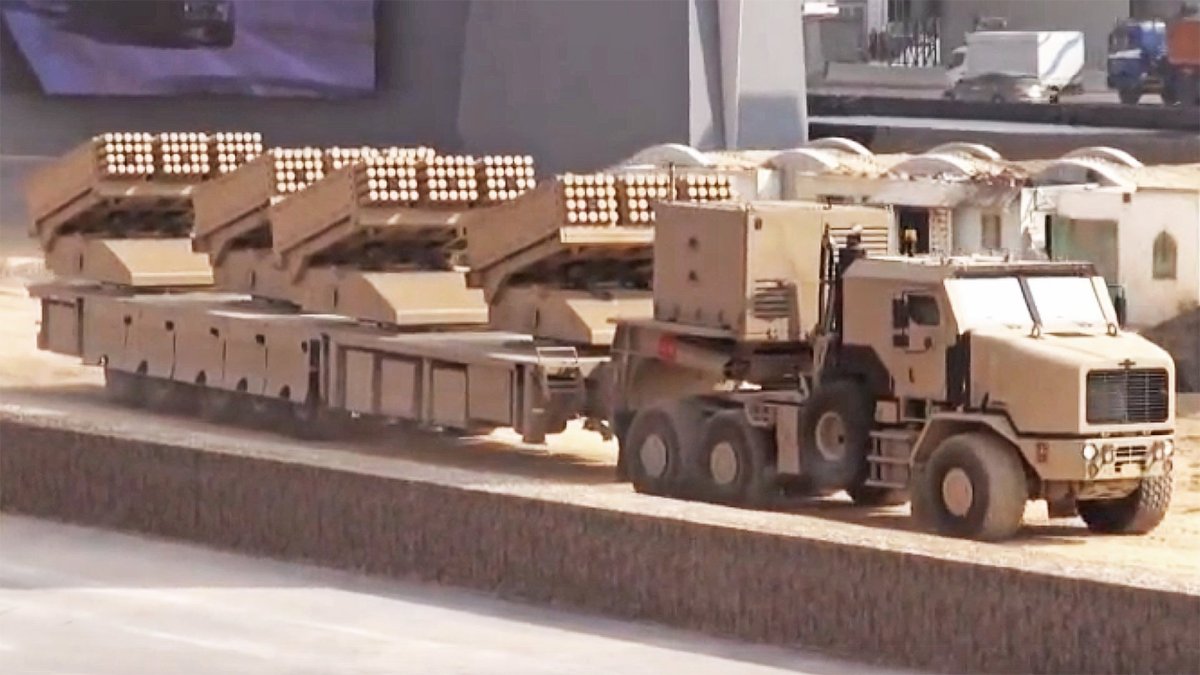
It looks like it belongs on the G.I. Joe aisle of a toy store rather than on an actual battlefield, but there is no doubt the UAE’s Jobaria Defense Systems were thinking big when they designed their Multiple Cradle Launcher (MCL). The concept combines an Oshkosh M1070 Heavy Equipment Transporter with a 29-meter trailer outfitted with four multiple rocket launchers that hold 60 122mm rockets each. That’s a grand total of 240 rockets at the operator’s disposal and a whole lot of firepower for a single land combat system to bring to the table.
The main armament for the MCL is the Roketsan TR/TRB-122 Extended Range Artillery Rocket of Turkish origin. These rockets come in high-explosive and steel-ball warhead varieties, the latter of which sends thousands of steel balls flying at very high velocities after being detonated by proximity fuse. Nasty, nasty stuff. The high-explosive TR-122 has an effective radius of 20 meters, while the steel shot slinging TRB-122’s effective radius of double that. Both warheads weight about 40 pounds.
Both types of rockets have a range of roughly two dozen miles. The fact that MCL has 240 of them to play with means that the system can rain down incredible destruction over a huge area in a single volley, and putting a lot of ordnance on a target in a short amount of time is what short-range rocket artillery is all about.. The MCL’s advanced fire control system is totally automated and each rocket can be fired individually, or all of them at once in one giant salvo at roughly two rockets per second. As such, the operator can vary the pattern density and warhead choice depending on the target in mind.
For instance, to take out large formations of personnel and material scattered over a wide area, TRB-122 rockets can continuously blanket the widest area possible with hot shrapnel. If a highly localized group of structures or armored vehicles are the target, the system can be set to fire a string of high-explosive rockets over a small geographical area, pounding the target to pieces. A mix of both rockets can also be deployed for “mixed” effects.
The size of the MCL, although visually impressive, has some drawbacks and advantages. The UAE procured the system because it cuts manning requirements down to just one tenth that of a traditional rocket artillery unit that would require six individual vehicles and 30 people to deploy the same amount of firepower. Also by putting all those rockets into one integrated system, its ease of operation and tactical flexibility can be leveraged to adapt fast to battlefield demands and to create tailored effects on the fly. Even rearming the system is simplified, requiring just one support vehicle that can rearm the entire MCL’s magazine in about 30 minutes during wartime operations.
On the other hand, the MCL concept also presents a pretty large and unmaneuverable target to enemy forces. Unlike smaller truck-mounted rocket artillery that can speed about rough terrain and hide in many places, the lumbering MCL is far less survivable under certain circumstances. And if the MCL is successfully targeted, its 240 rocket payload can be wiped out by one strike. The relatively short-range of the rockets it carries also means the MCL will have to work in fairly close proximity to enemy forces. Still, the firepower and efficiency of the system is impressive, and for some sorts of warfare, such a protecting a country’s desert borders from attack, it make some sense.
Jobaria is in the process of making a longer-range, harder-hitting companion to the MCL, dubbed the Twin Cradle Launcher (TCL). The concept was shown off at this year’s IDEX weapons expo in Dubai. Instead of four launchers for hundreds of smaller artillery rockets, two sets of four massive 300mm rocket launch canisters are incorporated into the system’s trailer which is about eight meters shorter than the one used by the MCL.
This new system can supposedly accommodate two types of existing rockets. The Turkish-built TR/TRB-300 “Tiger” rockets , which have a range of up to 75 miles, or Chinese-built A300 rockets which have a range up nearly 180 miles. Either way, this system gives standoff capability that could help negative its size disadvantage. Although either of these rockets can be used against single targets or area targets, they do not possess the overwhelming area sanitization capability that the far shorter-range MCL offers.
Long-range guided artillery rockets have become especially popular in recent years, as their quick employment time and easy deployability can offer aerial precision attack-like capabilities in a much more persistent and inexpensive manner. The Army and Marine Corps’ HiMARS system , and its GPS guided 277mm rockets, have become an all star in Iraq , and is likely to become the same in Syria . Meanwhile, in the highly contested South China Sea, Vietnam quietly forward deployed the Israeli-made “EXTRA” long-range GPS guided rocket artillery system to one of their own islands in the disputed body of water—putting some of China’s man-made island outposts in range of sudden and highly accurate bombardment.
It is thought that the MCL, which was first unveiled in 2013, has been used operationally, most likely against Iranian-backed Houthi rebels in Yemen .
Hat tip to Task and Purpose for the video.
Contact the author: Tyler@thedrive.com
Comments couldn’t be loaded. Please refresh the page.
更新于美国东部时间2020年7月3日凌晨4:17
它看起来更像是玩具店里特种部队(GI Joe)货架上的商品,而不是真正的战场,但毫无疑问,阿联酋的乔巴里亚防务系统公司(Jobaria Defense Systems)在设计其多管火箭炮发射架(MCL)时,确实雄心勃勃。该概念将一辆奥什科什M1070重型装备运输车与一辆29米长的拖车相结合,拖车上装有四个多管火箭炮发射架,每个发射架可容纳60枚122毫米火箭弹。这意味着操作员总共可以动用240枚火箭弹,对于一套陆地作战系统而言,这无疑是极其强大的火力。
MCL的主要武器是土耳其制造的Roketsan TR/TRB-122增程型火箭弹。这种火箭弹有高爆弹头和钢珠弹头两种类型,后者在近炸引信引爆后会将数千颗钢珠以极高的速度射出。威力巨大。高爆弹头TR-122的有效射程为20米,而钢珠弹头TRB-122的有效射程是其两倍。两种弹头的重量都约为40磅。
两种火箭的射程都约为24英里。MCL拥有240枚火箭,这意味着该系统能够在一次齐射中对大片区域造成毁灭性打击,而短程火箭炮的精髓就在于在短时间内向目标倾泻大量弹药。MCL先进的火控系统完全自动化,每枚火箭既可以单独发射,也可以以每秒约两枚的速度进行齐射。因此,操作员可以根据目标的不同调整弹着点密度和弹头选择。
例如,要摧毁分散在广阔区域的大量人员和物资,TRB-122火箭可以持续不断地用高温弹片覆盖尽可能大的范围。如果目标是高度集中的建筑物或装甲车辆群,该系统可以设置为向小范围区域发射一连串高爆火箭,将目标彻底摧毁。两种火箭也可以混合使用,以达到“混合”打击效果。
MCL火箭炮系统虽然体积庞大,视觉效果震撼,但也存在一些优缺点。阿联酋之所以采购该系统,是因为它所需的人员数量仅为传统火箭炮部队的十分之一,而传统火箭炮部队部署同等火力则需要六辆独立车辆和三十名人员。此外,由于所有火箭弹都集成在一个系统中,其操作简便性和战术灵活性得以充分发挥,能够快速适应战场需求,并即时产生定制化的作战效果。就连重新装填也十分便捷,战时只需一辆支援车辆即可在约30分钟内完成整个MCL火箭炮弹仓的重新装填。
另一方面,MCL火箭炮系统体积庞大,机动性差,对敌军而言目标难度较高。与小型车载火箭炮不同,后者能够快速穿梭于崎岖地形,并能隐蔽于各种地形,而笨重的MCL在某些情况下生存能力较差。一旦MCL被成功锁定,其携带的240枚火箭弹就可能被一次打击全部摧毁。此外,由于其火箭弹射程相对较短,MCL必须在敌军附近作战。尽管如此,该系统的火力和效率仍然令人印象深刻,对于某些类型的战争,例如保卫国家沙漠边境免受攻击,它仍然具有一定的实用价值。
Jobaria公司正在研发一款射程更远、威力更大的MCL配套武器,名为双联摇篮式火箭发射器(TCL)。该概念在今年的迪拜IDEX防务展上亮相。与MCL使用四个发射器发射数百枚小型火箭弹不同,TCL将两组各四个300毫米巨型火箭发射筒集成到其拖车中,拖车比MCL使用的拖车短约8米。
据称,这套新系统可兼容两种现有的火箭:土耳其制造的TR/TRB-300“虎”式火箭(射程可达75英里)和中国制造的A300火箭(射程可达近180英里)。无论使用哪种火箭,该系统都具备防区外打击能力,这或许可以弥补其尺寸上的劣势。虽然这两种火箭都可用于打击单个目标或区域目标,但它们并不具备射程更短的MCL火箭所拥有的那种压倒性的区域清扫能力。
近年来,远程制导火箭炮因其快速部署和便捷的作战方式,能够以更持久、更经济的方式提供类似空中精确打击的能力,而变得尤为流行。陆军和海军陆战队的HiMARS系统及其GPS制导的277毫米火箭炮在伊拉克大放异彩,很可能在叙利亚也同样如此。与此同时,在争议不断的南海,越南悄然将以色列制造的“EXTRA”远程GPS制导火箭炮系统前沿部署到其在争议海域的一个岛屿上,这使得中国的一些人工岛礁处于突然且高精度的炮击范围之内。
据信,MCL于2013年首次亮相,并已投入实战,很可能是用于对抗也门伊朗支持的胡塞武装。
感谢 Task and Purpose 提供视频。
联系作者:Tyler@thedrive.com
评论加载失败,请刷新页面。