Here’s Why The Destroyer USS Kidd Was Flying A Huge Pirate Flag As It Pulled Into Port这就是驱逐舰“基德”号驶入港口时悬挂巨大海盗旗的原因。
The ship has a unique relationship with the Jolly Roger and is the only one in the Navy officially authorized to fly it.
By Joseph Trevithick
Updated Nov 27, 2020 6:25 PM EST
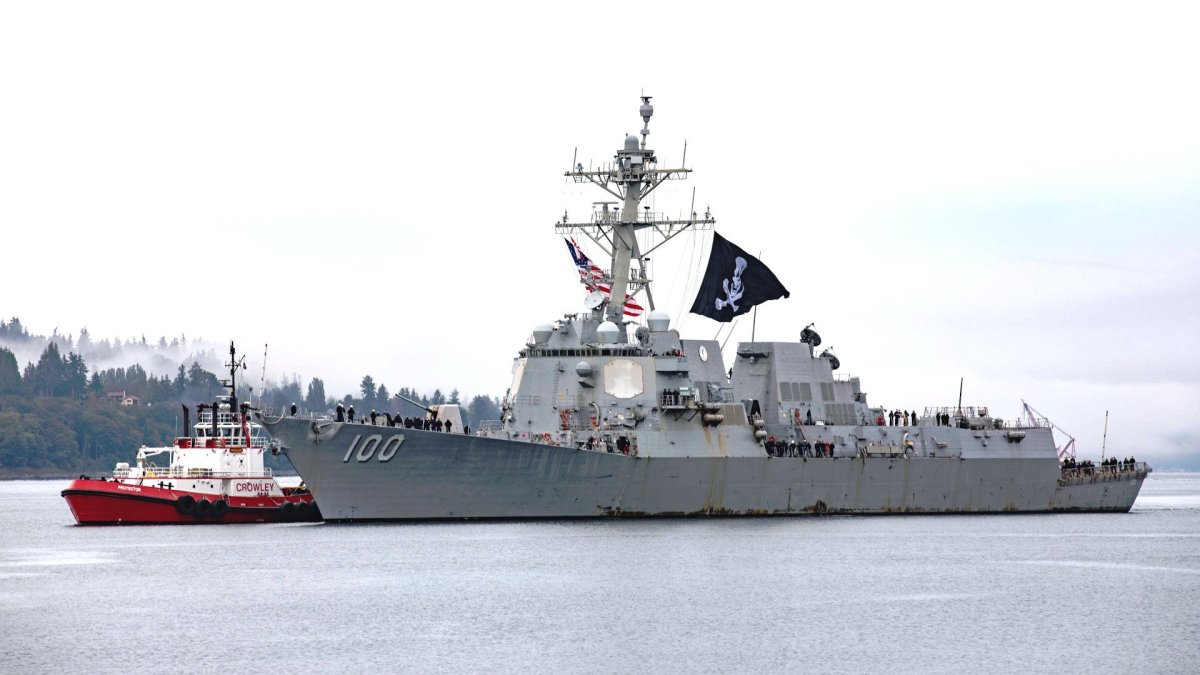
The U.S. Navy’s Arleigh Burke class destroyer USS Kidd recently returned from a cruise flying a large black pirate flag with a white skull and crossbones motif, better known as a Jolly Roger. The modern display of this flag, which traces its roots back to the 17th century, on a naval vessel, especially submarines , at the conclusion of a deployment generally reflects some kind of notable achievement. However, this particular ship has its own unique history with the skull and crossbones, which has to do with its namesake, Rear Admiral Isaac Kidd, and Captain William Kidd, a Scottish sailor executed for piracy in 1701.
returned to Naval Station Everett in Washington State on Sept. 21, 2020, after completing a patrol focused on countering drug smuggling in the Eastern Pacific Ocean and Caribbean. The destroyer had set out for this patrol in April as part of a then-new Enhanced Counter-Narcotics Operations effort led by U.S. Southern Command (SOUTHCOM). For this deployment, the ship also had an MH-60R Seahawk helicopter from Helicopter Maritime Strike Squadron 75 (HSM-75) and a U.S. Coast Guard Law Enforcement Detachment (LEDET) embarked.
“This deployment has been extremely challenging, but Kidd set the standard for operational mission execution and readiness,” Navy Commander Nathan Wemett, the destroyer’s commanding officer, said in a statement. “I thank all the Sailors and U.S. Coast Guardsmen who overcame many obstacles in order to carry out our mission.”
The Navy said that the destroyer had assisted the Coast Guard LEDET in seizing 805 kilograms of cocaine, nearly a ton of drugs, with an estimated value of $30 million during this patrol. The ship had also rendered assistance to a fishing vessel, towing it more than 200 miles to safety.
The USS Kidd towed the fishing boat seen here more than 200 miles to safety during its recently completed deployment., USN
Kidd also suffered an outbreak of the COVID-19 novel coronavirus among its crew, forcing it to make an unscheduled stop in San Diego at the end of April . The ship’s crew eventually got things under control and the ship headed back out to sea in June to finish its deployment.
The official news item marking the ship’s return to Everett made no mention of the pirate flag or its significance with regards to the USS Kidd . As already noted, the white skull and crossbones on a solid black flag trace back to pirates operating in the Atlantic and Caribbean during the 17th and 18th centuries. Skeletons, the devil, and hourglasses, as well as red accents, such as hearts and drops of blood, were also common. You can read more about the background of these symbols in this past War Zone story .
A closeup of the Jolly Roger that USS Kidd was flying when it returned to its homeport of Naval Station Everett on Sept. 21, 2020., USN
The broad modern return of these flags on naval vessels, particularly in submarine communities, dates back to World War I, when U.K. Royal Navy submarine crews began flying them after returning from patrols in which they sunk enemy ships. This practice subsequently expanded to reflect a wide array of other achievements at, including successfully completing sea trials or otherwise having a “perfect” deployment. Crews would add additional symbols to their flags to mark the completion of different tasks and missions. You can read more about this in this previous War Zone story .
Various symbols used on Jolly Roger flags flown by British submarine crews during World War II and their meanings., navynews.co.uk
However, the crew of the USS Kidd fly the Jolly Roger for an entirely different reason, which traces its roots to Japan’s infamous surprise attack on Pearl Harbor in Hawaii on Dec. 7, 1941. At that time, Rear Admiral Isaac Kidd, Sr. was Commander of Battleship Division One and the Chief of Staff and Aide to the Commander, Battleship Battle Force.
After the Japanese attack began, he made his way to his flagship, the Pennsylvania class battleship USS Arizona , and took part in the ensuing battle until the ship exploded after bombs hit one of its ammunition magazines. Rear Admiral Kidd was among the 1,177 officers and crew who died on the battleship, which still lies at the bottom of Pearl Harbor and is now a memorial to the events of that day.
USS Arizona burns and lists after Japanese bombs triggered a massive explosion that ripped through the ship during the attack on Pearl Harbor on Dec. 7, 1941., NARA
In April 1943, the Navy commissioned a Fletcher class destroyer , also known by its hull number DD 661, named after Rear Admiral Kidd. Even at the time of that ship’s delivery, the crew had already adopted Scottish Captain Kidd as a mascot.
The first USS Kidd ., USN
That Kidd is typically referred as a pirate, but also operated at times as a privateer in service of the French Crown and hunted pirates. He was finally arrested in Boston, in what was then the British colony of Massachusetts, in 1699. He was subsequently sent to England, tried, and eventually executed for piracy and murder in 1701. Tales of his purported buried treasure became a thing of legend and served as the inspiration for songs, books, and actual real-life expeditions hoping to find it.
A portrait of the Scottish Captain William Kidd by painter James Thornhill., Public Domain
“The crew of the [first] Kidd … had also painted the famed buccaneer’s image high on the forward smokestack,” according to a 2013 edition of the official newsletter of the current USS Kidd . “Not wishing to dishonor the ship’s namesake, however, the crew obtained permission from Mrs. Inez Kidd, widow of RADM Kidd, first.”
As it turned out, Kidd’s nickname at the Naval Academy had been “Cap” in reference to Captain Kidd, as well. With help from Mrs. Kidd, the ship’s crew obtained formal permission to both have the Jolly Roger painted on the smokestack and fly the flag. “Subsequently, the Sailors of DD 661 were known to rescue downed aviators in the Pacific Ocean during World War II and return them to their aircraft carrier, for a hefty ransom of ice cream first of course,” the 2013 newsletter says. They also became known as the Pirates of the Pacific.
A scan of a contemporary photograph of the crew of the first USS Kidd with a Jolly Roger flag., USN
The Navy decommissioned the first USS Kidd in 1946, before returning it to service in 1951 to serve in the Korean War. It remained in service this second time around until 1964 and was finally stricken from the rolls for good in 1974. It is now a museum ship, parked on the Mississippi River in Baton Rouge, Louisiana.
In 1981, the service commissioned a new USS Kidd , the first of four destroyers originally built for Iran, which were never delivered to that country owing to the overthrow of the Shah in 1979. This ship inherited the formal approval to fly the Jolly Roger. In 1998, all four Kidd class destroyers were transferred to Taiwan, where they remain in service as the Kee Lung class .
The second USS Kidd in 1984., USN
The Navy then commissioned the current USS Kidd , a Flight IIA Arleigh Burke class destroyer, in 2007. As the latest ship to be named after Rear Admiral Kidd, it now has the official sanction to fly the Jolly Roger.
The appearance of the Jolly Roger on Kidd upon its return home comes after the Pentagon issued a new set of policies for the U.S. military as a whole regarding the display of flags and other symbols in July. There had been concerns that this could prohibit ships’ crews from flying the Jolly Roger, among other flags . It remains unclear exactly how those regulations will get applied, but the case of this particular destroyer makes clear that the Navy has the power to give official sanction to such things.
The latest USS Kidd at Naval Station Everett flying her Jolly Roger in 2017., USN
With all this in mind, we want to congratulate the Pirates of the Pacific on successfully completing their most recent patrol.
Contact the author: Joe@thedrive.com
Comments couldn’t be loaded. Please refresh the page.
作者:约瑟夫·特雷维西克
更新于美国东部时间2020年11月27日下午6:25。
美国海军阿利·伯克级驱逐舰“基德”号近日结束巡航返回,舰上悬挂着一面巨大的黑色海盗旗,旗面绘有白色骷髅头和交叉骨图案,俗称“骷髅旗”。这种旗帜起源于17世纪,如今在海军舰艇,尤其是潜艇上,于部署结束后悬挂,通常象征着某种值得称道的成就。然而,这艘驱逐舰与骷髅头和交叉骨的渊源却有着一段特殊的历史,这与它的命名者——海军少将艾萨克·基德,以及1701年因海盗罪被处决的苏格兰水手威廉·基德船长有关。
2020年9月21日,该驱逐舰结束了在东太平洋和加勒比海打击毒品走私的巡逻任务,返回位于华盛顿州埃弗雷特的海军基地。这艘驱逐舰于4月启程执行此次巡逻任务,这是当时由美国南方司令部(SOUTHCOM)领导的“加强型反毒品行动”的一部分。此次部署期间,舰上还搭载了来自第75海上打击直升机中队(HSM-75)的一架MH-60R“海鹰”直升机和一个美国海岸警卫队执法分遣队(LEDET)。
“这次部署极具挑战性,但‘基德’号驱逐舰为作战任务执行和战备树立了标杆,”该舰舰长、海军指挥官内森·韦梅特在一份声明中表示。“我感谢所有克服重重困难完成任务的水兵和美国海岸警卫队队员。”
海军方面表示,这艘驱逐舰在本次巡逻中协助海岸警卫队缉毒特遣队缴获了805公斤可卡因,约一吨重,估计价值3000万美元。此外,该舰还救助了一艘渔船,将其拖行200多英里至安全地带。
“基德”号驱逐舰在最近完成的部署期间,将图中这艘渔船拖曳了200多英里至安全地带。
“基德”号航母也曾爆发新冠病毒疫情,迫使其在4月底临时停靠圣地亚哥。最终,船员们控制住了疫情,该舰于6月重新出海,完成了部署任务。
官方新闻稿中并未提及“基德”号驱逐舰返回埃弗雷特港时出现的海盗旗,也未说明其与该舰的关联。正如前文所述,黑色底白色骷髅头和交叉骨图案的旗帜可以追溯到17至18世纪活跃于大西洋和加勒比海的海盗。骷髅、魔鬼、沙漏以及红色装饰,例如心形和血滴,也十分常见。您可以在之前的“战区”专题报道中了解更多关于这些符号的背景信息。
2020年9月21日,美国海军“基德”号驱逐舰返回其位于埃弗雷特海军基地的母港时,舰上悬挂的骷髅旗特写。(美国海军)
这些旗帜在现代海军舰艇上,尤其是在潜艇部队中广泛回归,其历史可以追溯到第一次世界大战。当时,英国皇家海军潜艇艇员在击沉敌舰巡逻归来后开始悬挂这些旗帜。此后,这一做法扩展到反映其他各种成就,例如成功完成海上试航或完成“完美”部署。艇员们会在旗帜上添加其他符号,以标记不同任务和行动的完成。您可以在之前的“战区”报道中了解更多相关信息。
二战期间英国潜艇艇员悬挂的骷髅旗上使用的各种符号及其含义,navynews.co.uk
然而,基德号巡洋舰上的船员悬挂海盗旗的原因却截然不同,这可以追溯到 1941 年 12 月 7 日日本对夏威夷珍珠港的臭名昭著的偷袭。当时,艾萨克·基德海军少将担任第一战列舰分队司令兼战列舰战斗部队司令的参谋长和副官。
日军偷袭开始后,他前往旗舰——宾夕法尼亚级战列舰“亚利桑那”号,并参与了随后的战斗,直到炸弹击中弹药库后,这艘战舰爆炸沉没。基德少将与舰上其他1177名官兵一同牺牲。这艘战舰至今仍沉睡在珍珠港海底,如今已成为纪念当年事件的纪念碑。
1941年12月7日,日本偷袭珍珠港,亚利桑那号战列舰在遭到炸弹袭击后发生剧烈爆炸,舰体燃烧并倾斜。(图片来源:美国国家档案馆)
1943年4月,海军订购了一艘弗莱彻级驱逐舰,舷号为DD 661,以基德海军少将的名字命名。甚至在该舰交付之时,舰员们就已经将苏格兰上校基德奉为吉祥物。
第一艘“基德”号驱逐舰,美国海军
基德通常被认为是海盗,但他有时也曾为法国王室效力,担任私掠船船长,并追捕海盗。1699年,他最终在当时的英国殖民地马萨诸塞的波士顿被捕。随后,他被押往英国受审,并于1701年因海盗罪和谋杀罪被处决。关于他埋藏宝藏的传说流传开来,成为传奇,并激发了人们创作歌曲、书籍,甚至组织真正的探险队去寻找这笔宝藏。
画家詹姆斯·索恩希尔所绘的苏格兰船长威廉·基德的肖像,公共领域
据现役“基德”号驱逐舰2013年官方通讯记载,“第一艘‘基德’号的船员……还在前烟囱高处绘制了这位著名海盗的画像。然而,为了不辜负这艘舰艇的命名者,船员们事先征得了基德少将遗孀伊内兹·基德夫人的许可。”
原来,基德在海军学院的绰号也是“船长”,正是取自基德上校的名字。在基德夫人的帮助下,舰上的船员获得了正式许可,可以在烟囱上绘制海盗旗并升起这面旗帜。2013年的通讯中写道:“后来,DD 661号驱逐舰的水兵们在二战期间以在太平洋上营救被击落的飞行员并将他们送回航母而闻名,当然,前提是先要收到一大笔冰淇淋作为‘赎金’。”他们也因此被称为“太平洋海盗”。
一张当时拍摄的照片扫描件,照片中是第一艘“基德”号驱逐舰的船员,他们手持骷髅旗。(美国海军)
美国海军于1946年将第一艘“基德”号驱逐舰退役,后于1951年重新服役,参加朝鲜战争。第二次服役期间,该舰一直服役到1964年,并于1974年彻底从名册中除名。如今,它已成为一艘博物馆舰,停泊在路易斯安那州巴吞鲁日市的密西西比河上。
1981年,美国海军接收了新的“基德”号驱逐舰,这是最初为伊朗建造的四艘驱逐舰中的第一艘,但由于1979年伊朗国王被推翻,这四艘驱逐舰最终未能交付伊朗。该舰继承了悬挂海盗旗的正式许可。1998年,所有四艘“基德”级驱逐舰都移交给了台湾,并继续在台湾服役,更名为“基隆”级。
1984年,第二艘“基德”号驱逐舰(USS Kidd)下水。
2007 年,海军正式启用了现役的“基德”号驱逐舰,这是一艘“阿利·伯克”级驱逐舰的 Flight IIA 型。作为最新一艘以基德少将命名的军舰,它现在获得了正式授权悬挂海盗旗。
“基德”号驱逐舰返航时舰身上出现了骷髅旗,此前五角大楼于7月发布了一系列针对美军整体的旗帜和其他标志展示新政策。此前人们曾担心,这些新政策可能会禁止舰艇人员悬挂骷髅旗以及其他旗帜。目前尚不清楚这些规定将如何具体实施,但这艘驱逐舰的案例表明,海军有权对这类行为给予官方批准。
2017年,美国海军“基德”号驱逐舰在埃弗雷特海军基地升起了海盗旗。
鉴于以上种种,我们谨祝贺太平洋海盗成功完成最近一次巡逻任务。
联系作者:Joe@thedrive.com
评论加载失败,请刷新页面。