Report unlocks mystery of why Chinese bombers flew near Alaska in 2024报告揭开中国轰炸机2024年飞越阿拉斯加附近的神秘面纱
A new report reveals China's joint patrols with Russia near Alaska may have had motives beyond a political message.
Deploying military forces is the strongest of political signals, and the most potent of these deployments is to move nuclear weapons or launch platforms near a potential adversary.
So when nuclear-capable Chinese bombers joined their Russian counterparts in joint patrols near Alaska in 2024 , as well as similar flights deep into the Pacific, Western observers assumed there was a political message. Russia had been conducting such provocative flights dating back to the Cold War, but this is something new for China. Was Beijing signaling its displeasure with America over Taiwan, or warning NATO not to get involved in Asia? Was invoking the specter of Chinese bombers over America a reminder that the vast Pacific was no barrier to the long arm of Chinese power?
However, China may have had other motives for these flights, according to a U.S. expert. Beijing may have been demonstrating that nuclear bombers were now a fully functional part of its strategic triad, alongside ICBMs and ballistic missile submarines.
“It is clear that their true significance lies in China’s years-long effort to complete its nuclear triad,” Derek Solen, a researcher at the U.S. Air Force’s China Aerospace Studies Institute, wrote in a report for the Japan Air Self-Defense Force’s Air and Space Studies Institute.
Another possibility is that the flights were intended as a warning to the U.S. not to engage in “nuclear sharing,” in which America would station nuclear weapons in non-nuclear allies, especially Japan and South Korea. “China probably fears that the limited exchange between NATO and America’s Asian allies will eventually lead to the integration of America’s European and Asian alliance networks, resulting in the formation of a global, nuclear-armed anti-China alliance,” Solen wrote.
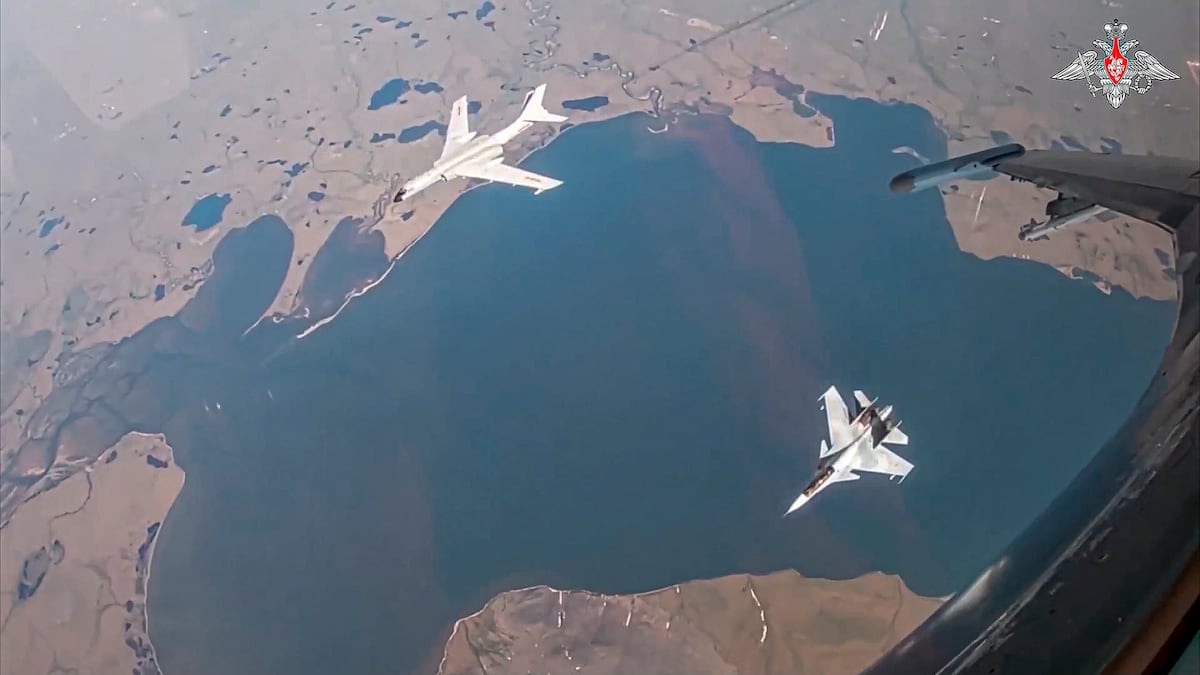
NORAD scrambled fighters to track and intercept Chinese and Russian military aircraft after they were detected in international airspace near Alaska in July 2024.
Deciphering Beijing’s intentions behind the bomber missions isn’t easy. There have been just nine Sino-Russian flights since the first mission in 2019 , when two Chinese H-6K and two Russian Tu-95MS bombers flew over the Sea of Japan and East China Sea. Though the actual number of flights is somewhat larger — China counts multiple flights on the same day as a single flight — this leaves a small dataset to analyze.
The joint flights were mostly confined to the Sea of Japan and East China Sea until July 24, 2024, when two H-6Ks and two Tu-95s flew near Alaska . Though they didn’t penetrate U.S. airspace, they did enter the air defense identification zone, triggering interception by U.S. and Canadian fighters.
“This represented the first time that PLAAF [People’s Liberation Army Air Force] aircraft participating in a combined patrol sortied from a foreign country as well as the first time that PLAAF aircraft approached U.S. territory,” Solen noted.
A few days later came more joint flights over the Sea of Japan, East China Sea and Western Pacific, which included more advanced H-6N bombers from the 106th Brigade in Henan province, which is primarily tasked with delivering nuclear weapons. The H-6N has a range of 3,700 miles and can launch KD-21 air-launched cruise missiles with an estimated range of up to 1,300 miles. Particularly ominous was a Nov. 30, 2024, flight in which H-6Ns came within cruise missile range of Guam in what Solen believes may have been “the first serious training to conduct a nuclear strike against Guam from the air.”
Solen told Defense News that he initially believed that the flights were a political signal.
“I thought that Beijing was signaling two things simultaneously,” he said. “It was signaling that its relationship with Russia was tight and, by using the H-6, sending an indirect message to Washington that it possesses the means and the will to counter what it perceived as Washington’s moves with respect to nuclear sharing.”
But Solen was troubled by some inconsistencies. For example, the Chinese government was incensed by a July 2024 NATO summit that criticized China for supporting Russia’s invasion of Ukraine, as well as suggestions that NATO might expand its focus to Asia. Yet if the November 2024 flights near Guam were intended as a signal, then why wait until four months after the summit?
The joint flights also coincided with the deployment of the long-range and nuclear-capable H-6N.
“In 2019 the PLAAF officially adopted the H-6N, and in the same year renovations to the 106th Brigade’s base were likely finished,” Solen wrote. “It is interesting that the Sino-Russian combined patrols began that same year.”
Of course, the Alaska flights may have both a military and political purpose. However, Solen thinks that purely military training flights would have been confined to the East China Sea or the Sea of Japan.
Perhaps the West may never know China’s true motivations. Nonetheless, the question remains: Will China again send bombers near — or into — American airspace? China continues to be an indispensable supplier of Russia’s campaign in Ukraine, and the Chinese and Russian navies have just announced joint patrols in the Pacific. A Chinese government spokesman last year urged “relevant countries to abolish the nuclear sharing arrangement, withdraw the large number of nuclear weapons deployed in Europe, and refrain from replicating such arrangements in any form in the Asia-Pacific region.”
For now, China isn’t provoking the Trump administration, especially in the midst of a fight over tariffs.
“The fact that China and Russia still haven’t done any combined flights this year is probably a political decision,” Solen said. “At a time when they are trying to work things out with the new administration, they probably decided that it’s best to avoid action that may agitate Washington or distract from the agenda in the negotiations.”
Regular flights near U.S. territory are unlikely “because the training juice won’t be worth the squeeze,” Solen added. On the other hand, China has an incentive to practice long-range bomber flights, even just for non-nuclear missions like striking ships and bases.
“I suppose that once they’ve either resolved things with Washington or just given up on negotiations, we’ll see the combined flights resume and eventually see regular flights without the Russians,” Solen said.
Michael Peck is a correspondent for Defense News and a columnist for the Center for European Policy Analysis. He holds an M.A. in political science from Rutgers University. Find him at theuncommondefense.com. His email is mikedefense1@gmail.com.
部署军事力量是最强烈的政治信号,而其中最有力的部署就是将核武器或发射平台部署到潜在对手附近。
因此,当中国具备核打击能力的轰炸机在2024年与俄罗斯同行在阿拉斯加附近进行联合巡逻,以及在太平洋深处进行类似飞行时,西方观察家们认为这其中蕴含着某种政治信息。俄罗斯早在冷战时期就进行过此类挑衅性飞行,但这对于中国而言却是前所未有的。北京此举是在表达对美国在台湾问题上的不满,还是在警告北约不要介入亚洲事务?中国轰炸机出现在美国上空的景象,是否意在提醒世人,浩瀚的太平洋并不能阻挡中国强大的影响力?
然而,一位美国专家认为,中国进行这些飞行可能另有动机。北京或许是在表明,核轰炸机如今已成为其战略三位一体中与洲际弹道导弹和弹道导弹潜艇并驾齐驱、功能完备的一部分。
“很明显,它们的真正意义在于中国多年来为完善其核三位一体所做的努力,”美国空军中国航天研究所的研究员德里克·索伦在为日本航空自卫队航空航天研究所撰写的一份报告中写道。
另一种可能性是,这些飞行旨在警告美国不要参与“核共享”,即美国在无核盟友(尤其是日本和韩国)部署核武器。索伦写道:“中国可能担心,北约与美国亚洲盟友之间有限的交流最终会导致美国欧洲和亚洲联盟网络的整合,从而形成一个全球性的、拥有核武器的反华联盟。”
2024年7月,北美防空司令部在阿拉斯加附近的国际空域发现中国和俄罗斯军用飞机后,紧急出动战斗机进行跟踪和拦截。
解读北京此次轰炸任务背后的意图并非易事。自2019年首次任务以来,中俄联合飞行仅有九次。当时,两架中国轰-6K轰炸机和两架俄罗斯图-95MS轰炸机飞越了日本海和东海。尽管实际飞行次数可能更多——中国将同一天的多次飞行计为一次——但这仍然导致可供分析的数据集较小。
在2024年7月24日之前,联合飞行主要限于日本海和东海。当天,两架轰-6K和两架图-95飞机飞越阿拉斯加附近空域。虽然它们没有侵入美国领空,但进入了防空识别区,引发了美国和加拿大战斗机的拦截。
索伦指出:“这是中国人民解放军空军飞机首次从外国起飞参与联合巡逻,也是中国人民解放军空军飞机首次接近美国领土。”
几天后,双方在日本海、东海和西太平洋上空进行了更多联合飞行演习,其中包括来自河南省第106旅的更先进的H-6N轰炸机,该旅的主要任务是投送核武器。H-6N的航程为3700英里,可以发射射程估计达1300英里的KD-21空射巡航导弹。尤其令人担忧的是2024年11月30日的一次飞行,H-6N进入了关岛的巡航导弹射程范围,索伦认为这可能是“首次从空中对关岛进行核打击的严肃训练”。
索伦告诉《防务新闻》,他最初认为这些飞行是政治信号。
“我认为北京同时发出了两个信号,”他说。“一方面,它表明其与俄罗斯的关系紧密;另一方面,通过使用轰-6导弹,它间接地向华盛顿发出信号,表明它有能力也有意愿反制它认为华盛顿在核共享问题上的举动。”
但索伦对一些前后矛盾之处感到困惑。例如,中国政府对2024年7月北约峰会感到愤怒,该峰会批评中国支持俄罗斯入侵乌克兰,并暗示北约可能将其关注重点扩大到亚洲。然而,如果2024年11月在关岛附近的飞行活动意在发出某种信号,那么为何要等到峰会结束四个月之后?
此次联合飞行也恰逢远程核动力轰炸机 H-6N 的部署。
索伦写道:“2019年,中国人民解放军空军正式列装轰-6N直升机,同年,第106旅基地的翻新工程可能也已完工。有趣的是,中俄联合巡逻也是在同一年开始的。”
当然,阿拉斯加航线的飞行可能兼具军事和政治目的。然而,索伦认为,纯粹的军事训练飞行应该仅限于东海或日本海。
或许西方永远无法得知中国的真实动机。然而,问题依然存在:中国是否会再次派遣轰炸机靠近甚至进入美国领空?中国仍然是俄罗斯在乌克兰行动中不可或缺的支持者,而中俄海军也刚刚宣布将在太平洋进行联合巡逻。中国政府发言人去年曾敦促“有关国家废除核共享安排,撤出部署在欧洲的大量核武器,并避免在亚太地区以任何形式复制此类安排”。
目前,中国并没有挑衅特朗普政府,尤其是在双方就关税问题争执不休之际。
索伦表示:“中国和俄罗斯今年至今仍未进行任何联合飞行,这很可能是出于政治考量。在他们试图与新政府达成和解之际,他们可能认为最好避免采取任何可能激怒华盛顿或分散谈判焦点的行动。”
索伦补充说,美国领空附近不太可能进行常规飞行,“因为训练的收益不值得付出”。另一方面,中国有动力进行远程轰炸机飞行训练,即使只是执行打击舰艇和基地等非核任务。
索伦说:“我猜想,一旦他们与华盛顿达成协议,或者干脆放弃谈判,我们就会看到联合航班恢复,并最终看到没有俄罗斯人的定期航班。”
迈克尔·佩克是《防务新闻》的通讯员,也是欧洲政策分析中心的专栏作家。他拥有罗格斯大学政治学硕士学位。您可以在theuncommondefense.com找到他。他的邮箱是mikedefense1@gmail.com。