Denmark to complete $3.4 billion of air defense purchases by year-end丹麦将在年底前完成价值34亿美元的防空武器采购
Governments across the continent are scrambling to either bolster what they already have or put in place the means to defend their skies.
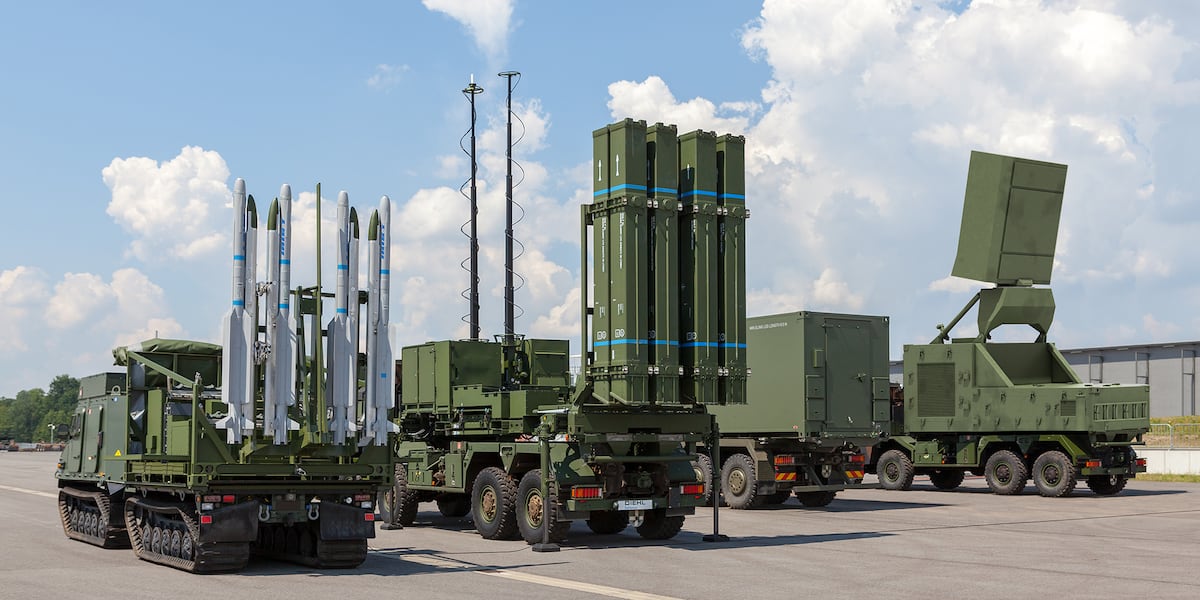
PARIS – Denmark plans to wrap up its acquisition of ground-based air defense systems by the end of the year, with a total planned investment of as much as 25 billion Danish kroner (US$3.4 billion), according to the country’s Defence Ministry.
For the long-range component, Denmark expects to choose between the U.S. Patriot and the French-Italian SAMP/T system during fall 2025, the ministry told Defense News. The country intends to conclude all contracts by year-end, including a potential purchase of additional short- to medium-range systems, the MoD said.
With European policymakers observing the devastation wrought by Russian aerial attacks on Ukrainian cities, and with NATO having identified air defense as an investment priority, governments across the continent are scrambling to either bolster what they already have or put in place the means to defend their skies.
Denmark in the past two months secured air defense systems from three different producers in order to build an initial capability as soon as possible, 20 years after decommissioning its air defense units operating Hawk missile systems.
The country will lease a NASAMS system from Norway, buy two VL MICA fire units from MBDA and an IRIS-T SLM system from Germany’s Diehl Defence.
“The systems will be operational from approximately around end of 2025 to the beginning of 2027, NASAMS anticipated to be the first,” the ministry said.
The bill for pulling together the initial capacity will be more than 6 million kroner, which includes operating costs for “a certain amount of time,” the MoD said.
The four systems cover the initial capacity requirement, with no further systems in the pipeline for now, the ministry said.
For the longer term, Denmark has “not yet fully decided” whether it needs more short- to medium-range systems, nor whether the country will continue to operate multiple systems or eventually pivot to a single system, according to the ministry.
The planned purchase of the long-range system is referred to as “a permanent solution,” the Danish MoD said, with the combined budget for short- to medium-range and long-range systems about 19 billion to 25 billion kroner, including operating costs for a certain amount of time.
For comparison, Belgium, another country that lacks any ground-based missile defense , last month announced a budget of €2 billion (US$2.3 billion) to buy and operate 10 NASAMS systems from Kongsberg, as well as another €2 billion for three long-range air-defense systems.
Around the Baltic Sea, other countries are also building up their defenses, with Estonia on July 30 announcing plans to establish a dedicated air-defense brigade and buy additional IRIS-T, Piorun and Mistral systems, as part of €10 billion in defense spending over 2026-29.
Denmark’s neighbor Sweden in June announced the purchase of seven additional IRIS-T SLM systems for around 9 billion Swedish kronor (US$805 million), while Norway that same month contracted new NASAMS systems for as much as 4.8 billion Norwegian kroner ($468 million) to replace equipment donated to Ukraine.
Denmark and Sweden acquired their IRIS-T systems under the umbrella of the German-coordinated European Sky Shield Initiative, with countries including Slovakia and Switzerland also buying the Diehl system through the initiative this year.
Rudy Ruitenberg is a Europe correspondent for Defense News. He started his career at Bloomberg News and has experience reporting on technology, commodity markets and politics.
巴黎——丹麦国防部表示,丹麦计划在今年年底前完成陆基防空系统的采购,计划总投资额高达 250 亿丹麦克朗(34 亿美元)。
丹麦国防部告诉《防务新闻》,丹麦预计将在2025年秋季在美国的“爱国者”导弹系统和法意联合研制的SAMP/T系统之间做出选择,以解决远程导弹系统的问题。国防部还表示,丹麦计划在年底前完成所有合同的签订,包括可能采购额外的中短程导弹系统。
欧洲决策者目睹了俄罗斯空袭乌克兰城市造成的破坏,北约也已将防空列为投资重点,因此欧洲各国政府都在争先恐后地加强现有防空能力或建立保卫领空的手段。
丹麦在过去两个月里从三家不同的生产商那里采购了防空系统,以便在退役其使用“鹰”式导弹系统的防空部队 20 年后尽快建立初始能力。
该国将从挪威租赁一套 NASAMS 系统,从 MBDA 购买两套 VL MICA 火力装置,并从德国 Diehl Defence 购买一套 IRIS-T SLM 系统。
该部表示:“这些系统预计将于 2025 年底至 2027 年初投入运行,NASAMS 预计将是第一个投入运行的系统。”
国防部表示,组建初期产能的费用将超过 600 万克朗,其中包括“一定时间”的运营成本。
该部表示,这四个系统满足了最初的产能需求,目前没有其他系统正在建设中。
据该部称,从长远来看,丹麦“尚未完全决定”是否需要更多短程至中程系统,也未决定该国是否会继续运营多个系统,或者最终转向单一系统。
丹麦国防部表示,计划采购远程系统被称为“永久性解决方案”,短程至中程和远程系统的总预算约为 190 亿至 250 亿克朗,其中包括一定时期的运营成本。
相比之下,比利时是另一个没有任何陆基导弹防御系统的国家,上个月宣布拨款 20 亿欧元(23 亿美元)从康斯伯格公司购买和运营 10 套 NASAMS 系统,并另拨款 20 亿欧元用于购买三套远程防空系统。
在波罗的海周边,其他国家也在加强防御。爱沙尼亚于 7 月 30 日宣布计划组建一支专门的防空旅,并购买额外的 IRIS-T、Piorun 和 Mistral 系统,作为 2026-29 年 100 亿欧元国防开支的一部分。
丹麦的邻国瑞典在 6 月份宣布购买 7 套额外的 IRIS-T SLM 系统,价值约 90 亿瑞典克朗(8.05 亿美元);而挪威也在同月签订了新的 NASAMS 系统合同,价值高达 48 亿挪威克朗(4.68 亿美元),用于替换捐赠给乌克兰的设备。
丹麦和瑞典在德国协调的欧洲天空之盾计划下获得了 IRIS-T 系统,包括斯洛伐克和瑞士在内的国家今年也通过该计划购买了 Diehl 系统。
鲁迪·鲁伊滕贝格是《防务新闻》的欧洲记者。他的职业生涯始于彭博新闻社,拥有报道科技、大宗商品市场和政治方面的经验。