Japan closes in on biggest ever defense export with frigate selection日本通过选择护卫舰,即将完成有史以来规模最大的国防出口。
Japan recently won selection for a lucrative Australian frigate requirement worth up to US$6.5 billion.
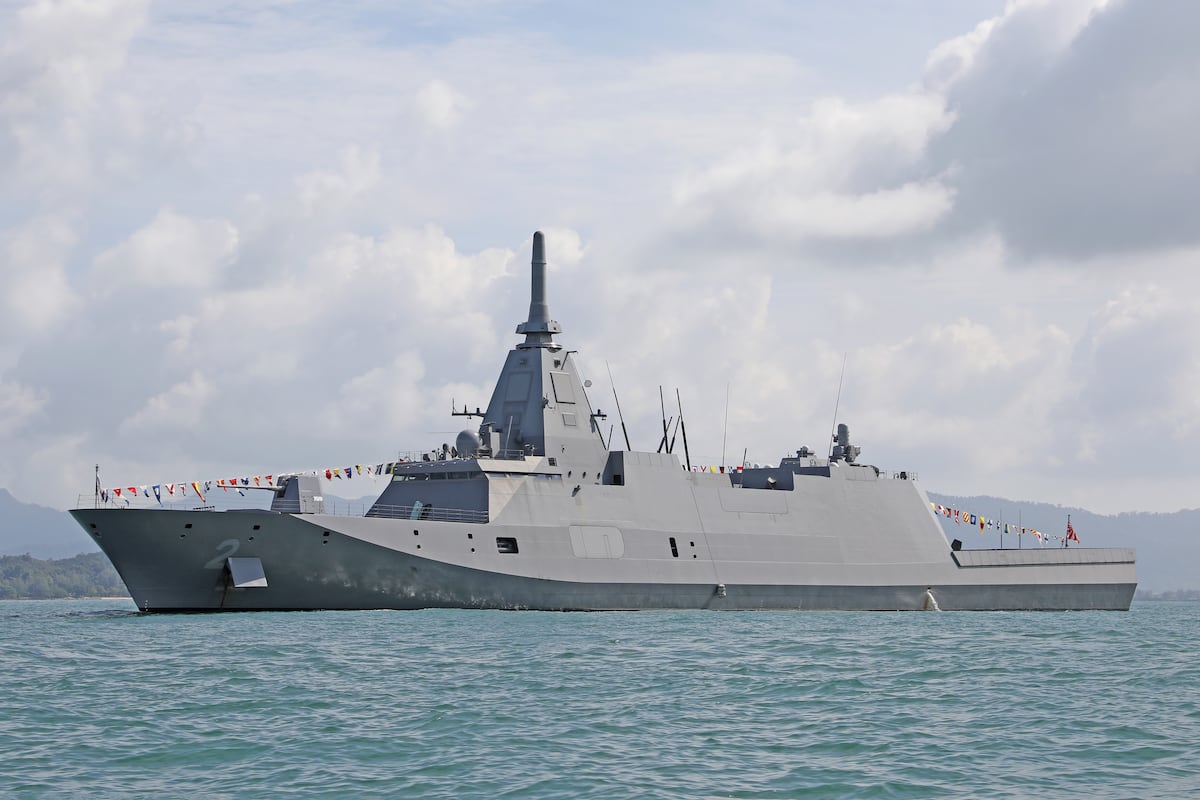
Japan has struggled to export cutting-edge defense equipment. However, past disappointments have been turned on their head after Japan won selection for a lucrative Australian frigate requirement worth up to US$6.5 billion.
With its shortlisting confirmed by Canberra on Aug. 5, Japan’s Ministry of Defense immediately tweeted that “we welcome this decision as it marks a major step toward elevating our security cooperation as ‘Special Strategic Partner’ to even greater heights.”
The Royal Australian Navy – or RAN for short – plans to procure 11 well-armed upgraded Mogami-class frigates. The Japanese platform emerged the victor after a fierce contest with the MEKO A-200 frigate from Germany.
“Following a rigorous and competitive tender process, Mitsubishi Heavy Industries’ Mogami-class frigate was assessed as best able to quickly meet the capability requirements and strategic needs of the Australian Defence Force,” Australia’s DOD said in a press release.
It is not a done deal yet, as negotiations now start “with the aim to enter early into binding, commercial contracts with Mitsubishi Heavy Industries (MHI) and the government of Japan in 2026,” according to the statement.
Nor is this frigate program without significant risk.
One peril stems from the fact that the upgraded Mogami does not yet exist. It is a modified version of the Mogami class, of which Japan’s navy will soon have a dozen. On June 19, Japan commissioned its eighth such frigate, valued at JPY47.4 billion (US$332 million).
After completing these warships, Japanese attention shifts to 12 upgraded Mogami frigates from Fiscal Year 2028. MHI received a contract for the first two in May.
Discussing this yet-to-be-built platform, Jennifer Parker, a defense expert at the Australian National University, noted in the Australasian university-affiliated website, The Conversation, that “this risk is mitigated, however, by Japan’s fantastic track record in building ships.”
However, the nascent upgraded Mogami leads to another risk factor, that of schedule. Canberra said the first Japanese-built frigate would be delivered in 2029 and enter service in 2030. The plan calls for the first three ships to be built in Japan, before construction transfers to Western Australia.
Yet Australian shipbuilders have accrued a poor record in meeting schedules. With existing shipbuilding programs already running well behind schedule, there is already speculation that Japan might end up constructing more than three frigates at home.
Another difficulty arises because the upgraded Mogami class has little commonality with the RAN’s outgoing Anzac class or the BAE Systems Hunter class that is slated to arrive in 2034.
An additional risk factor is that MHI has never built naval vessels overseas before. In recent times, Australian pickiness has rankled shipbuilders such as Naval Group of France and Luerssen of Germany.
This prompted Parker to warn, “The danger with this frigate deal is that it could damage our relationship if something doesn’t go right.”
Nonetheless, the Japanese government is extremely committed to this program, rating its strategic partnership with Australia as second only to that with the U.S.
As Australian Defence Minister Richard Marles pointed out, “This does represent a very significant moment in the bilateral relationship between Australia and Japan.”
The RAN desperately needs these new frigates to replace its retiring Anzac class. In fact, the navy’s surface combatant fleet will reach a nadir of nine warships next year, the lowest it has been since World War II.
While the government plans to lift the warship fleet to 26 hulls, Parker pointed out to Defense News, “Most predict an increased period of risk in the late 2020s, and that’s where Australia has the capability gap.”
As for its capabilities, the upgraded Mogami displaces 4,800 tons, which is 700 tons more than its predecessor. At 466 feet, it is also 30 feet longer.
The new frigate features a 32-cell vertical launch system, which is double the magazine capacity that its MEKO A-200 rival could offer. Additionally, it possesses a design life of 40 years.
In a press release, MHI said it believed Australia’s decision was based on the Mogami’s “proven performance, reliability, technology, capabilities, multi-functionality … as well as reduced manpower requirements compared to conventional frigates, and scalability to easily enhance capabilities in the future.”
Gordon Arthur is an Asia correspondent for Defense News. After a 20-year stint working in Hong Kong, he now resides in New Zealand. He has attended military exercises and defense exhibitions in about 20 countries around the Asia-Pacific region.
日本在出口尖端国防装备方面一直举步维艰。然而,过去的挫败感已被扭转,日本成功中标澳大利亚价值高达65亿美元的护卫舰项目。
8月5日,堪培拉方面确认日本入选候选名单后,日本防卫省立即在推特上发文称:“我们欢迎这一决定,因为它标志着我们作为‘特殊战略伙伴’的安全合作朝着更高水平迈出了重要一步。”
澳大利亚皇家海军(简称RAN)计划采购11艘装备精良的升级版最上级护卫舰。此前,日本的这款护卫舰在与德国MEKO A-200型护卫舰的激烈竞争中胜出。
澳大利亚国防部在一份新闻稿中表示:“经过严格而激烈的招标程序,三菱重工的‘最上’级护卫舰被评估为最能快速满足澳大利亚国防军的能力要求和战略需求。”
声明称,此事尚未最终敲定,谈判现已开始,“目标是在 2026 年与三菱重工 (MHI) 和日本政府尽早签订具有约束力的商业合同”。
但这项护卫舰计划也并非没有重大风险。
其中一个隐患在于,升级后的“最上”号尚未建成。它是“最上”级护卫舰的改进型,日本海军很快将拥有12艘该级护卫舰。6月19日,日本接收了第八艘“最上”级护卫舰,造价474亿日元(约合3.32亿美元)。
这些战舰建造完成后,日本的注意力将转移到从 2028 财年开始建造 12 艘升级版最上级护卫舰上。三菱重工于 5 月份获得了前两艘的建造合同。
澳大利亚国立大学的国防专家詹妮弗·帕克在澳大利亚大学附属网站“对话”上讨论这个尚未建造的平台时指出,“然而,日本在造船方面有着辉煌的记录,这降低了这种风险。”
然而,正在升级的“最上”号护卫舰也带来了另一个风险因素,即工期问题。堪培拉方面表示,首艘日本建造的护卫舰将于2029年交付,并于2030年服役。该计划要求前三艘舰艇在日本建造,之后再将建造工作转移到西澳大利亚。
然而,澳大利亚造船厂在按时完工方面一直劣迹斑斑。由于现有的造船项目已经严重滞后,目前已有猜测认为,日本最终可能会在国内建造三艘以上的护卫舰。
另一个困难在于,升级后的最上级战舰与澳大利亚皇家海军即将退役的澳新军团级战舰或计划于 2034 年交付的 BAE 系统公司猎人级战舰几乎没有共同之处。
另一个风险因素是,三菱重工此前从未在海外建造过海军舰艇。近年来,澳大利亚的挑剔态度令法国海军集团和德国吕尔森等造船企业感到不满。
这促使帕克警告说:“这笔护卫舰交易的危险在于,如果出现问题,可能会损害我们的关系。”
尽管如此,日本政府对该计划极其重视,将与澳大利亚的战略伙伴关系置于仅次于与美国的战略伙伴关系之上。
正如澳大利亚国防部长理查德·马尔斯所指出的那样,“这确实代表了澳大利亚和日本双边关系中一个非常重要的时刻。”
澳大利亚皇家海军急需这些新型护卫舰来替换即将退役的安扎克级护卫舰。事实上,明年该海军的水面作战舰艇数量将降至9艘的最低点,这是自二战以来的最低水平。
帕克向《防务新闻》指出,虽然政府计划将军舰舰队规模扩大到 26 艘,“但大多数人预测,2020 年代后期风险将会增加,而这正是澳大利亚的能力差距所在。”
性能方面,升级后的最上号排水量为4800吨,比其前身增加了700吨。船长466英尺,也比前身长了30英尺。
新型护卫舰配备了32单元垂直发射系统,其弹药库容量是竞争对手MEKO A-200的两倍。此外,它的设计寿命长达40年。
三菱重工在一份新闻稿中表示,他们相信澳大利亚的决定是基于“最上”号护卫舰“久经考验的性能、可靠性、技术、能力、多功能性……以及与传统护卫舰相比更少的人力需求,以及未来可以轻松扩展能力”等因素。
戈登·阿瑟是《防务新闻》的亚洲特派记者。在香港工作20年后,他现居新西兰。他曾到访亚太地区约20个国家,参加过军事演习和防务展览。