Behold The SR-71 Blackbird’s Raw Power In This Crazy Low-Light Afterburner Photo (Updated)看看SR-71黑鸟侦察机在低光照条件下开启加力燃烧室的惊人威力(更新版)
The SR-71's Blackbird's J58 engine was one of the biggest triumphs in aerospace history and it put on one hell of a light show at dusk.
新闻视频
Updated Nov 3, 2019 6:14 PM EST
The SR-71 Blackbird continues to capture the public’s imagination like no other aircraft on Earth even two decades after it was retired. Any new stories , video , pilot interviews , historical tidbit , or whatever about the jet are gobbled up like fine desserts by fans of the plane, or of just engineering, technology, and history, in general. Case in point the crazy photo above.
The image’s backstory is unknown, as far as I can tell ( see update at the bottom of this post ). It popped up in my Twitter feed after @Kobaz4 posted it and I retweeted it with what was probably pretty much everyone else’s reaction:
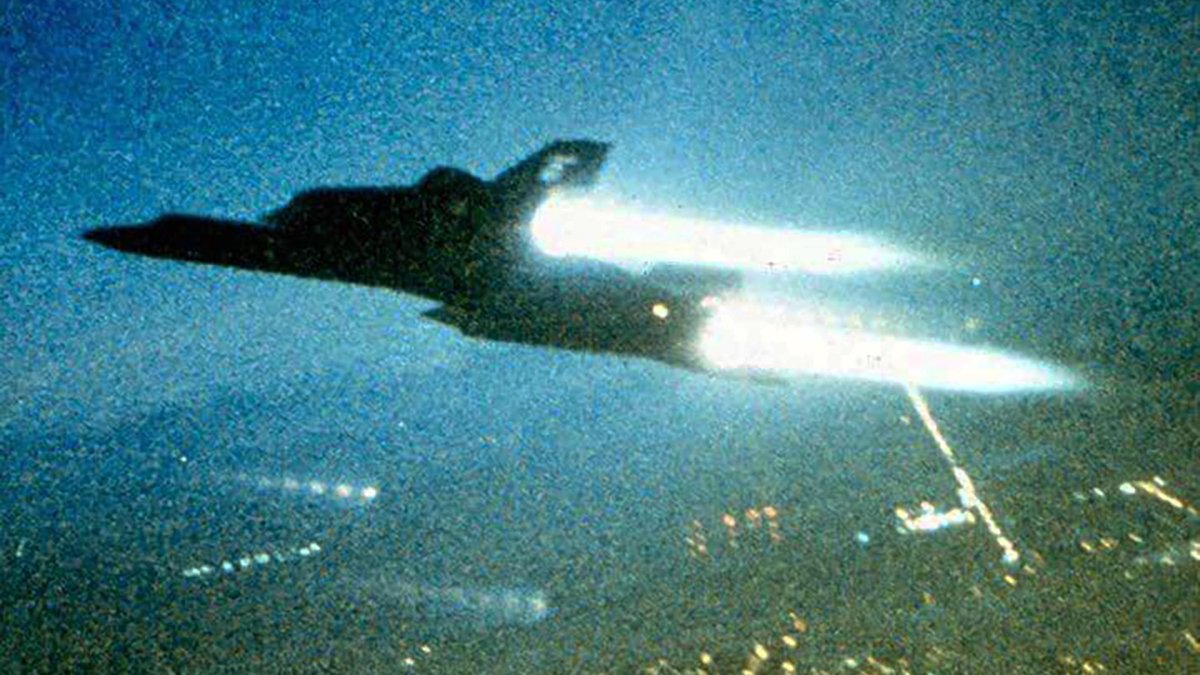
It shows a Blackbird with a Skunk Works tail-flash maneuvering relatively low over a populated area at twilight with full afterburner selected. The only way to capture such a shot was with high-speed, grainy film, but that quality actually adds to the photo’s mystique, in my opinion. Multiple SR-71’s wore the Skunk Works tail flash, so it is near impossible to understand what aircraft this was. Best guess was it was a test bird out of Palmdale towards the end of the SR-71’s career, but that is just a wild guess.
The Blackbird’s Pratt & Whitney J58 turbojet engines were one of the biggest triumphs of aerospace development in the history of manned flight. Their thrust wasn’t extreme by today’s standards—they put about the same amount in afterburner and in military power on the test stand as an F119 engine in an F-22—but they were specially designed to retain high thrust at extreme speeds beyond Mach 3 and very high altitudes, double that of what a fighter typically flew at. They also ran on special JP-7 fuel and were capable of burning special additives to create a stealthy cloud of plasma behind them to hide from enemy radars. All of this happened internally, of course, but one of the coolest byproducts of the J58’s operation was its huge afterburner plume that included a string of shock diamonds measuring dozens of feet trailing from behind the Blackbird’s barrel-like exhaust.
During the day, the Blackbird’s burners looked awesome, but at night, it turned the SR-71 into something that looked otherworldly. This is probably the best shot I have seen that captures this. In fact, it is probably the best photo that shows off the incredible thrust that made the “Sled” slide through the atmosphere like a hot knife through butter, ever.
The highest time SR-71 pilot ever, BC Thomas , reached out to me about the photo. Here is its awesome backstory:
The photographer was Lt Col Bill Flanagan, taken from our SR-71 Flight Test T-38 chase plane #10363. Lt Col Tom Tilden was the T-38 pilot. I was the SR-71 pilot and my RSO was Lt Col JT Vida. The takeoff was from Air Force Plant 42 at Palmdale, CA, around 1986, with Palmdale in the background. Note the two small Mach diamond reflections, lower left, in the canopy of the T-38. The aircraft was #972, the SR-71 which graces the entrance to the Udvar-Hazy Center of the National Air and Space Museum at Dulles International Airport, and the aircraft which holds the world’s speed record coast-to-coast (Lt Cols Ed Yeilding and JT Vida crew).
So, there you go! We now know the origin of this amazing photograph.
You can read about one of BC’s most eventful SR-71 missions in this piece I published with him in 2016.
Contact the author: Tyler@thedrive.com
Comments couldn’t be loaded. Please refresh the page.
更新于美国东部时间2019年11月3日下午6:14
即使在SR-71“黑鸟”退役二十年后,它依然像地球上任何其他飞机一样,持续吸引着公众的想象力。任何关于这架喷气式飞机的新故事、视频、飞行员采访、历史趣闻,或者任何相关内容,都会被飞机爱好者,或者仅仅是工程、技术和历史爱好者们津津乐道,如同品尝美味甜点一般。上面这张令人惊叹的照片就是最好的例证。
据我所知,这张图片的背景故事尚不清楚(参见本文末尾的更新)。@Kobaz4 发布了这张图片后,它出现在我的推特信息流中,我转发了它,我的反应可能也和大多数人一样:
照片显示一架带有臭鼬工厂尾标的黑鸟侦察机在黄昏时分低空飞越人口稠密区,并开启了加力燃烧室。拍摄这样的照片只能使用高速胶片,但这种颗粒感反而增添了照片的神秘感。由于多架SR-71都涂有臭鼬工厂的尾标,因此几乎不可能确定照片中的飞机型号。目前最合理的猜测是,这是一架SR-71服役末期在帕姆代尔基地进行的测试机,但这仅仅是猜测而已。
黑鸟侦察机的普惠J58涡轮喷气发动机是载人飞行史上航空航天发展最伟大的成就之一。以今天的标准来看,它们的推力并不算惊人——在试验台上,它们在加力燃烧室和军事动力输出方面与F-22战斗机上的F119发动机的推力大致相当——但它们经过特殊设计,能够在超过3马赫的极端速度和极高的高度(通常是战斗机飞行高度的两倍)下保持高推力。它们使用特殊的JP-7燃料,并且能够燃烧特殊的添加剂,在其后方形成一团隐蔽的等离子体云,从而躲避敌方雷达的探测。当然,所有这些都是在发动机内部实现的,但J58发动机运行中最酷炫的副产品之一是其巨大的加力燃烧室尾焰,其中包含一串长达数十英尺的冲击波菱形,从黑鸟的桶状排气管后方拖曳而出。
白天,黑鸟的燃烧室看起来就很壮观,但到了晚上,SR-71 简直变成了另一个世界里的怪物。这张照片大概是我见过最能捕捉到这种景象的。事实上,它可能是迄今为止最能展现“雪橇”在大气层中滑行如切黄油般轻松的惊人推力的照片。
SR-71飞行时间最长的飞行员BC Thomas联系了我,跟我谈起了这张照片。以下是这张照片背后精彩的故事:
摄影师是比尔·弗拉纳根中校,照片拍摄于我们的SR-71飞行测试T-38伴飞机(编号10363)。汤姆·蒂尔登中校是T-38的飞行员。我是SR-71的飞行员,我的无线电安全官是JT·维达中校。起飞地点是加利福尼亚州帕姆代尔的空军42号工厂,时间大约在1986年,背景是帕姆代尔的景色。请注意T-38座舱盖左下角的两个小小的马赫菱形反射。这架飞机是编号972的SR-71,它现在矗立在杜勒斯国际机场国家航空航天博物馆乌德瓦尔-哈齐中心的入口处,也是保持着横跨美国大陆飞行速度世界纪录的那架飞机(机组人员是埃德·耶尔丁中校和JT·维达中校)。
好了,真相大白了!我们现在知道这张神奇照片的来历了。
你可以阅读我在 2016 年与 BC 合著的这篇文章,了解 SR-71 最精彩的一次任务。
联系作者:Tyler@thedrive.com
评论加载失败,请刷新页面。