The Definitive Answer On Why F-16s Carry AIM-120 AMRAAMs On Their Wingtip Rails关于F-16战斗机为何在翼尖挂架上携带AIM-120 AMRAAM导弹的最终答案
The answer to why the Viper flies with heavier AIM-120s on its wingtips and lighter AIM-9 Sidewinders under its wings may surprise you.
新闻视频
Published May 6, 2021 4:57 PM EDT
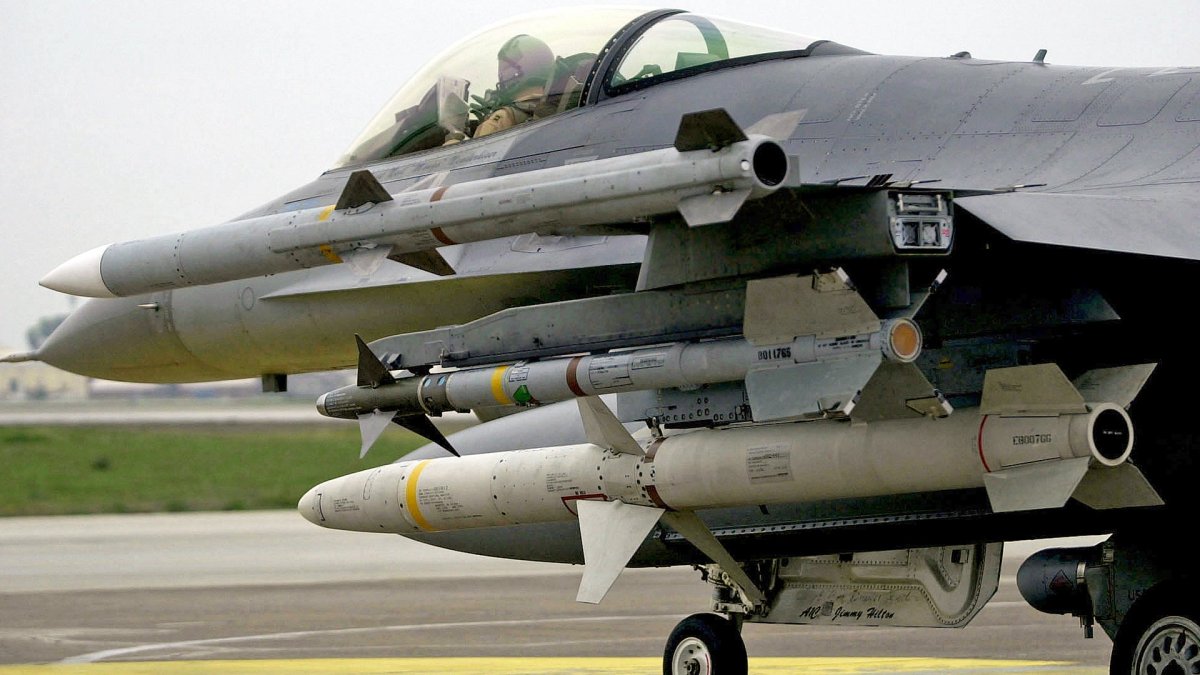
We recently posted a story about U.S. Air Force F-16Cs flying a long-range counter-air patrol mission into the South China Sea while fully armed with air-to-air missiles. The unusual weapons configuration, with five AIM-120 AMRAAMs on wingtip rails and underwing stores pylons and one AIM-9 Sidewinder underwing, as well, spurred a flurry of very familiar questions that I have gotten repeatedly for a decade: Why do F-16s carry AIM-120 AMRAAMs on their wingtip rails almost exclusively, instead of AIM-9 Sidewinders? I thought it was time to settle this once and for all with an answer straight from the F-16’s manufacturer, Lockheed Martin.
The AIM-9 was carried on the Viper’s wingtip rails for well over the first decade and a half of F-16 operations. After the AIM-120, introduced in the early 1990s, proliferated throughout the USAF’s F-16 fleet, the Sidewinders largely moved onto the outer underwing stations. Even today, with the advanced AIM-9X and its high-off-boresight targeting ability , the Sidewinder is still largely mounted under the Viper’s wings. Some have even mentioned this may impact the missile’s ability to lock up targets far off the jet’s centerline, but that doesn’t seem to be a major concern for the USAF.
Misawa-based F-16s seen fully armed with air-to-air missiles after returning from their South China Sea patrol., IORI
There have been various explanations given in forums and on social media for the near-omnipresence of the AIM-120s on the Viper’s wingtip rails, even during training where air-to-air combat isn’t the focus. These have included issues with the missiles themselves, as well as the idea that the AIM-120s act similar to winglets, offering the F-16 better efficiency when they are mounted. Another common explanation is that this configuration cuts down on wing flutter.
Prior to the AIM-120’s entry into service, the Viper’s wingtip rail was almost exclusively the domain of the AIM-9. Even with the introduction of the AIM-7 Sparrow to the F-16 ADF, air-to-air configured Vipers were still heavily laden with AIM-9s. , USAF photo via F-16.net
Wing flutter is defined as “a dynamic instability of a flight vehicle associated with the interaction of aerodynamic, elastic, and inertial forces (aeroelastic phenomena).” Flutter has airframe fatigue and even performance impacts in particular areas of the flight envelope and can be minor to catastrophic in nature. If you have ever seen an armed F-16 taxi by you in person, the AIM-120s on the wingtips certainly bounce around, almost to a comical degree.
South Carolina Air National Guard F-16C gets ready to launch on an alert mission armed with two AIM-120s and two AIM-9Xs., U.S. Air National Guard photo by Senior Airman Megan Floyd
With all this in mind, I asked Lockheed Martin directly about this for a definitive answer. Here is their response:
The F-16 is able to carry different missiles on multiple stations at the same time, such as the AIM-120 and AIM-9. Because of that capability, the AIM-120 is positioned on the wingtip to reduce wing flutter, while still ensuring mission performance.
So, the wing flutter explanation is indeed the right one. This would explain why most F-16s fly with AIM-120 captive training rounds, which weigh 335 pounds, just like their live counterparts, on their wingtips regardless of the training situation.
Some air arms that fly the F-16 are not cleared to purchase the active radar homing AIM-120, such as Iraq and Egypt. So, these aircraft are often seen flying with AIM-9s, which weigh about half as much as an AIM-120, on their wingtip rails, as the semi-active radar homing AIM-7 Sparrow that they are allowed to buy is not capable of being mounted there.
An Iraqi Air Force F-16IQ with an AIM-9 on its wingtip rail along with laser-guided bombs underwing., Iraqi Air Force
With over 4,600 F-16s delivered to air forces around the globe, roughly half of which are still flying, the F-16 has been studied incredibly closely over the decades and evolved accordingly. This includes insights into wing flutter , including with different stores configurations , and their impact on performance and airframe life. In fact, these studies continue to this very day:
Thomas ‘t-b0ne’ Richter ( @b0neyt on Twitter ), who spent his career in the military flying Marine F/A-18s, before transitioning to the Michigan Air National Guard to fly F-16s, gave The War Zone a pilot’s perspective on the issue:
The AMRAAM is primarily a beyond-visual-range weapon, and would most likely be off-the-rails before entering the merge and turning with an adversary in a within-visual-range dogfight scenario. In which case, having the moment arm of a bit heavier (than an AIM-9) AIM-120 on the wingtips would affect performance. Still, it was not anything I specifically recall making a big deal about in any tactics briefing. Going further with regard to the flying characteristics when carrying AIM-120s vs AIM-9 on the tips, the Viper is a beast, and in my opinion, if you’re ripping the hell out of it in a BFM encounter, you’re not noticing if the roll rate is so many degrees per second slower or faster, you are trusting your skill, and the jet, to maneuver to the control zone of the hostile for the kill. But it really is more about wing flutter than anything else. Our loadout for Operation Iraqi Freedom in 2004 was all air-to-ground (laser-guided bombs and JDAM), yet look at our wingtips. Most certainly, the odds of an air-to-air encounter over Iraq were very low. The configuration was largely to keep the flutter in check and the remote air-to-air contingency capability was a bonus.
The AMRAAM is primarily a beyond-visual-range weapon, and would most likely be off-the-rails before entering the merge and turning with an adversary in a within-visual-range dogfight scenario. In which case, having the moment arm of a bit heavier (than an AIM-9) AIM-120 on the wingtips would affect performance.
Still, it was not anything I specifically recall making a big deal about in any tactics briefing. Going further with regard to the flying characteristics when carrying AIM-120s vs AIM-9 on the tips, the Viper is a beast, and in my opinion, if you’re ripping the hell out of it in a BFM encounter, you’re not noticing if the roll rate is so many degrees per second slower or faster, you are trusting your skill, and the jet, to maneuver to the control zone of the hostile for the kill.
But it really is more about wing flutter than anything else. Our loadout for Operation Iraqi Freedom in 2004 was all air-to-ground (laser-guided bombs and JDAM), yet look at our wingtips. Most certainly, the odds of an air-to-air encounter over Iraq were very low. The configuration was largely to keep the flutter in check and the remote air-to-air contingency capability was a bonus.
Thomas inspecting his Viper’s AIM-120 prior to launch on a sortie over Iraq. , Thomas ‘t-b0ne’ Richter
Live AIM-120s on the wings of Thomas’ jet and another, along with various stores, including GBU-12s, GBU-32, and a TARS reconnaissance pod., Thomas ‘t-b0ne’ Richter
Considering the USAF sees its newest F-16s—the last of which was delivered 16 years ago — flying for decades to come in upgraded form , as do many other air arms around the globe, getting the most out of the airframes and their life-extending structural enhancements will be key. Flying with AIM-120s on their wingtips appears to be part of this solution.
Beyond the existing fleets of F-16s, the fourth-generation fighters remain in remarkably high demand , with the relatively new South Carolina production line set to remain in good shape for years to come. With the acquisition of the F-15EX and a possible push for a far more affordable, lower-end aircraft than the F-35, it is not outside the realm of possibility that the U.S. Air Force could once again order more F-16s in their new standardized production configuration.
Regardless, at least we finally know now for certain why most F-16s spend most of their time in the air with ‘Slammers’ hanging off their wingtips.
Contact the author: Tyler@thedrive.com
Comments couldn’t be loaded. Please refresh the page.
发布于美国东部时间2021年5月6日下午4:57
我们最近报道了美国空军F-16C战机在南海执行远程反空袭巡逻任务,机上满载空空导弹。这种不寻常的武器配置——翼尖挂架和机翼下挂架上各挂载五枚AIM-120 AMRAAM导弹,机翼下还挂载一枚AIM-9“响尾蛇”导弹——引发了一系列我过去十年反复被问到的老生常谈的问题:为什么F-16战机几乎只在翼尖挂架上挂载AIM-120 AMRAAM导弹,而不是AIM-9“响尾蛇”导弹?我认为现在是时候让F-16的制造商洛克希德·马丁公司直接给出答案,彻底解决这个问题了。
在F-16“蝰蛇”战斗机服役的最初十五年多时间里,AIM-9导弹一直挂载在机翼翼尖挂架上。20世纪90年代初,AIM-120导弹投入使用后,迅速在美军F-16机队中普及,此后“响尾蛇”导弹则主要转移到了外侧机翼下方挂架。即使在今天,随着先进的AIM-9X导弹及其高离轴角瞄准能力的出现,“响尾蛇”导弹仍然主要挂载在“蝰蛇”战斗机的机翼下方。有人甚至指出,这可能会影响导弹锁定远离机身中心线目标的能力,但这似乎并非美国空军的主要担忧。
驻扎在三泽基地的F-16战机在完成南海巡逻任务返回后,被发现机身上挂满了空空导弹。(IORI)
关于AIM-120导弹几乎无处不在地挂载在F-16“蝰蛇”战斗机的翼尖挂架上,甚至在非空战训练中也能看到,论坛和社交媒体上对此给出了各种解释。这些解释包括导弹本身存在问题,以及AIM-120导弹的作用类似于翼梢小翼,可以提高F-16的作战效率。另一种常见的解释是,这种配置可以减少机翼颤振。
在AIM-120投入使用之前,F-16“蝰蛇”战斗机的翼尖挂架几乎完全被AIM-9导弹所占据。即使AIM-7“麻雀”导弹被引入F-16 ADF系统后,空对空配置的“蝰蛇”战斗机仍然大量挂载AIM-9导弹。(图片来自美国空军F-16.net)
机翼颤振被定义为“飞行器由于空气动力、弹性力和惯性力相互作用而产生的动态不稳定性(气动弹性现象)”。颤振会导致机身疲劳,甚至在飞行包线的特定区域影响性能,其严重程度可从轻微到灾难性不等。如果你曾亲眼目睹一架武装的F-16滑行而过,就会发现翼尖上的AIM-120导弹确实会上下弹跳,几乎到了滑稽的程度。
南卡罗来纳州空中国民警卫队一架F-16C战斗机准备执行警戒任务,机上携带两枚AIM-120和两枚AIM-9X导弹。(美国空中国民警卫队高级空军兵梅根·弗洛伊德摄)
考虑到以上因素,我直接向洛克希德·马丁公司询问了此事,以获得明确的答复。以下是他们的回复:
F-16 能够同时在多个挂点携带不同的导弹,例如 AIM-120 和 AIM-9。由于具备这种能力,AIM-120 被安装在翼尖,以减少机翼颤动,同时仍能确保任务性能。
所以,机翼颤振的解释确实是正确的。这就能解释为什么大多数F-16战斗机无论在何种训练情况下,翼尖都会挂载AIM-120训练弹(重量与实弹相同,均为335磅)。
一些装备F-16战斗机的国家,例如伊拉克和埃及,由于种种原因无法采购主动雷达制导的AIM-120导弹。因此,这些国家的飞机经常在翼尖挂载AIM-9导弹,其重量约为AIM-120的一半。这是因为他们获准采购的半主动雷达制导AIM-7“麻雀”导弹无法安装在翼尖。
一架伊拉克空军的F-16IQ战斗机,翼尖挂架上挂载了一枚AIM-9导弹,机翼下挂载了激光制导炸弹。
全球已有超过4600架F-16战斗机交付给世界各地的空军,其中约一半仍在服役。几十年来,F-16战斗机得到了极其深入的研究,并根据研究结果不断改进。这包括对机翼颤振(包括不同挂载配置下的颤振)及其对性能和机身寿命影响的研究。事实上,这些研究至今仍在继续。
曾在军队服役期间驾驶海军陆战队 F/A-18 战斗机,之后转入密歇根州空中国民警卫队驾驶 F-16 战斗机的 Thomas 't-b0ne' Richter(推特账号:@b0neyt)从飞行员的角度向《战区》栏目讲述了他对这个问题的看法:
AMRAAM主要用于超视距空战,在与敌机进行近距离空战时,它很可能在进入交战区域并转向之前就失去控制。在这种情况下,翼尖挂载比AIM-9稍重的AIM-120导弹会影响其性能。不过,我记得在任何战术简报中,都没有特别强调过这一点。进一步来说说翼尖挂载AIM-120和AIM-9时的飞行特性,蝰蛇战机性能强劲。在我看来,如果你在近距离空战中全力驾驶,你不会注意到滚转速率是快了还是慢了多少度,你只会相信自己的技术和战机能够机动到敌机的控制区并完成击落。但实际上,这主要取决于机翼颤振,而不是其他因素。 2004年“伊拉克自由行动”期间,我们的武器装备全部是空对地武器(激光制导炸弹和联合直接攻击弹药),但看看我们的翼尖。可以肯定的是,在伊拉克上空发生空战的概率非常低。这种配置主要是为了控制颤振,而远程空对空应急能力则是一个额外的优势。
AMRAAM主要用于超视距空战,在与敌机进行近距离空战时,很可能在进入交战区域并完成转向之前就失去控制。在这种情况下,如果在翼尖挂载比AIM-9稍重一些的AIM-120导弹,其力臂会影响AMRAAM的性能。
不过,我并不记得在任何战术简报中对此大加强调过。进一步来说说AIM-120和AIM-9在机尖挂载时的飞行特性,蝰蛇战机简直就是一头猛兽。在我看来,如果你在近距离空战中全力以赴,你根本不会注意到滚转速率是快了还是慢了多少度,你只会相信自己的技术和战机能够机动到敌机的控制区并完成击落。
但实际上,这主要还是与机翼颤振有关。2004年伊拉克自由行动中,我们的武器装备全部是空对地武器(激光制导炸弹和联合直接攻击弹药),但看看我们的翼尖就知道了。当然,在伊拉克上空发生空战的概率非常低。这种配置主要是为了控制机翼颤振,而远程空对空应急能力则是一个额外的优势。
托马斯在执行伊拉克上空作战任务前,正在检查他的蝰蛇战机上的AIM-120导弹。托马斯·“t-b0ne”·里希特
托马斯的喷气式飞机和另一架飞机的机翼上挂载了AIM-120导弹,以及包括GBU-12、GBU-32和TARS侦察吊舱在内的各种外挂物品。托马斯·“t-b0ne”·里希特
考虑到美国空军计划将其最新的F-16战机(最后一架交付于16年前)升级后继续服役数十年,就像世界其他许多国家的空军一样,充分利用机身及其延长寿命的结构增强功能至关重要。在翼尖挂载AIM-120导弹似乎是解决方案的一部分。
除了现有的F-16机队之外,第四代战斗机的需求依然非常旺盛,而位于南卡罗来纳州的这条相对较新的生产线预计在未来几年内仍将保持良好的生产状态。随着F-15EX的采购,以及美国空军可能寻求比F-35更经济实惠的低端机型,美国空军再次订购更多采用新标准化生产配置的F-16并非不可能。
不管怎样,至少我们现在终于可以确定为什么大多数 F-16 战机在空中飞行时,翼尖上都挂着“Slammer”炸弹。
联系作者:Tyler@thedrive.com
评论加载失败,请刷新页面。