No current plans to designate Tagore forest as a nature reserve: Chee Hong Tat目前没有将泰戈尔森林划为自然保护区的计划:谢鸿达
The forest located near Upper Thomson Road is zoned for residential use.
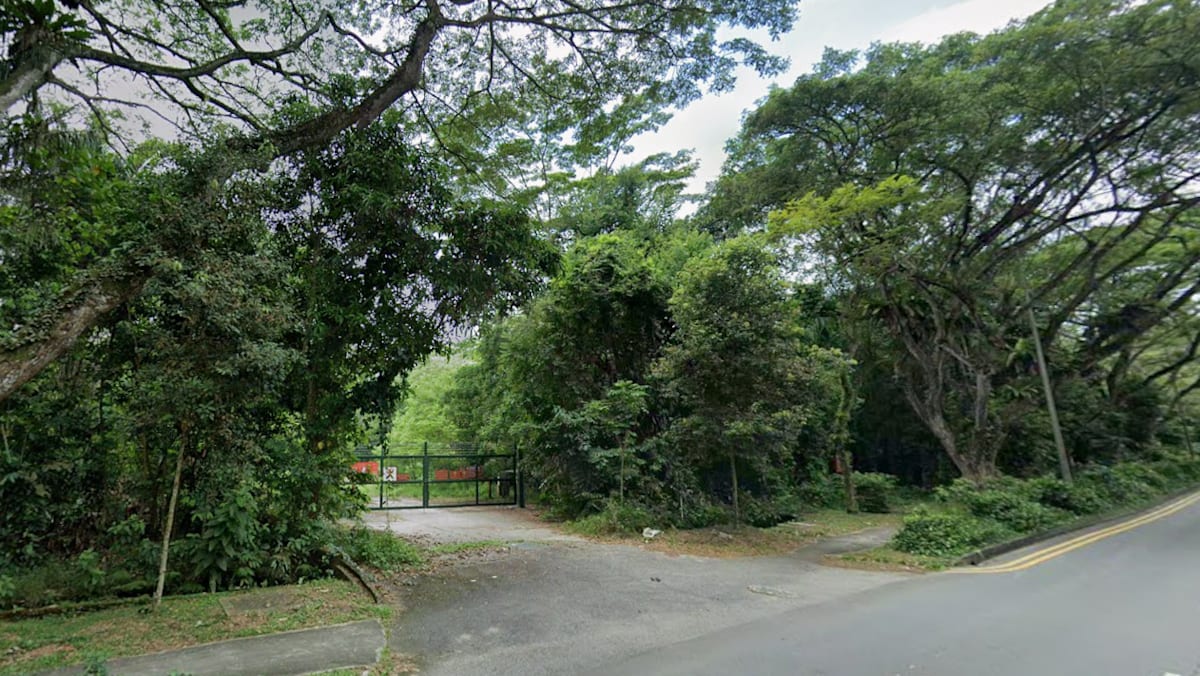
The forest located near Upper Thomson Road is zoned for residential use.
Tagore forest is located near the Central Catchment Nature Reserve. (Image: Google Street View)
This audio is generated by an AI tool.
SINGAPORE: The government currently has no plans to designate Tagore forest as a nature reserve, Minister for National Development Chee Hong Tat said on Tuesday (Sep 8).
Mr Chee was responding to questions from Members of Parliament (MPs) on land planning assessment and decision-making for ecologically significant sites.
MP Kenneth Tiong (WP-Aljunied) asked about nature reserves gazetted under the Parks and Trees Act, and whether the government will consider designating Tagore forest as a nature reserve.
The forest, located southeast of the intersection between Seletar Expressway and Upper Thomson Road, is currently zoned for residential use under the Urban Redevelopment Authority’s (URA) masterplan.
CNA Games Guess Word Crack the word, one row at a time Buzzword Create words using the given letters Mini Sudoku Tiny puzzle, mighty brain teaser Mini Crossword Small grid, big challenge Word Search Spot as many words as you can Show More Show Less In 2024, over 40 scientists and conservationists proposed studying the protection of the forest as a nature park in a document called the Singapore Terrestrial Conservation Plan. The forest represents a buffer zone surrounding the Central Catchment Nature Reserve that is a refuge for rare wildlife such as the Raffles' banded langur. Mr Chee said in his written parliamentary answer that the government adopts a “science-based” approach to prioritising what and how they conserve. In deciding to designate an area as a nature reserve, the government considers its biodiversity and ecological value, and its importance to Singapore’s native biodiversity. These considerations are weighed alongside Singapore’s other land-use needs, he said. Singapore has four nature reserves protected and conserved under the Park and Trees Act. Bukit Timah Nature Reserve and Central Catchment Nature Reserve were gazetted in 1990, while Labrador Nature Reserve and Sungei Buloh Wetland Reserve were gazetted in 2002. “These are assessed to be the most biodiverse areas in Singapore and are representative of Singapore’s native landscapes. They also safeguard a range of habitats and serve as strongholds for various endemic and threatened species,” Mr Chee said. Mr Chee said URA works closely with the National Parks Board (NParks) to consider ecology and biodiversity in the Long-Term Plan and Master Plan, and integrates development and conservation upstream in their land use planning processes. He noted that more than 7,800ha of green spaces have been set aside in Singapore, which would increase to 8,800ha by 2035. The minister said the government has designated nature areas and nature parks as buffers to nature reserves, and set aside parks and other green spaces that serve both ecological and recreational functions. NParks’ island-wide Ecological Profiling Exercise helps agencies identify key ecological corridors that support connectivity between core habitats, and locate critical wildlife corridors that require monitoring, such as EcoLink@BKE, he said. "This enables us to integrate nature into our urban environment and everyday lives," he added.
In 2024, over 40 scientists and conservationists proposed studying the protection of the forest as a nature park in a document called the Singapore Terrestrial Conservation Plan. The forest represents a buffer zone surrounding the Central Catchment Nature Reserve that is a refuge for rare wildlife such as the Raffles' banded langur.
Mr Chee said in his written parliamentary answer that the government adopts a “science-based” approach to prioritising what and how they conserve.
In deciding to designate an area as a nature reserve, the government considers its biodiversity and ecological value, and its importance to Singapore’s native biodiversity.
These considerations are weighed alongside Singapore’s other land-use needs, he said.
Singapore has four nature reserves protected and conserved under the Park and Trees Act. Bukit Timah Nature Reserve and Central Catchment Nature Reserve were gazetted in 1990, while Labrador Nature Reserve and Sungei Buloh Wetland Reserve were gazetted in 2002.
“These are assessed to be the most biodiverse areas in Singapore and are representative of Singapore’s native landscapes. They also safeguard a range of habitats and serve as strongholds for various endemic and threatened species,” Mr Chee said.
Mr Chee said URA works closely with the National Parks Board (NParks) to consider ecology and biodiversity in the Long-Term Plan and Master Plan, and integrates development and conservation upstream in their land use planning processes.
He noted that more than 7,800ha of green spaces have been set aside in Singapore, which would increase to 8,800ha by 2035.
The minister said the government has designated nature areas and nature parks as buffers to nature reserves, and set aside parks and other green spaces that serve both ecological and recreational functions.
NParks’ island-wide Ecological Profiling Exercise helps agencies identify key ecological corridors that support connectivity between core habitats, and locate critical wildlife corridors that require monitoring, such as EcoLink@BKE, he said.
"This enables us to integrate nature into our urban environment and everyday lives," he added.
MEETING HOUSING SUPPLY
On planning new housing supply, Mr Chee said the agencies take into account demographic and socioeconomic trends, prevailing market conditions, and the supply of resale flats on the open market to meet Singaporeans’ needs across different locations and time periods.
This includes providing housing near existing estates as many Singaporeans, including young families, seniors and singles, want to continue living near their families for mutual care and support, he said.
“It is not possible to predict future housing demand with 100 per cent accuracy as the key demand drivers have varying degrees of uncertainty. Nevertheless, we expect housing demand to remain strong in the near to medium term, due to strong household formation rates and decreasing household sizes,” he said.
MP Dennis Tan (WP-Hougang) asked whether the government would consider intensifying existing or planned low-density residential areas, including good class bungalow areas and developments near MRT stations.
Mr Chee said that where feasible, the government will intensify land usage, co-locate facilities and make better use of under-utilised spaces. This includes suitable brownfield sites in the area “as far as possible”, if they are available within the required timeframe, before activating sites with greenery or heritage.
The government will also intensify low-density residential areas where possible, by injecting high-density public housing into predominantly landed areas, such as Turf City, he said.
“However, it is not practical to assume that we can meet the bulk of public housing supply through redevelopment of landed residential areas as this will require extensive acquisition of existing landed properties, as well as significant upgrading of transport and other essential infrastructure to support higher housing densities,” he added.
MP Pritam Singh (WP-Aljunied) asked whether public housing supply could be met through additional Selective En bloc Redevelopment Scheme (SERS) projects at older HDB estates with large surface car parks, to retain “as many secondary forests across Singapore as possible”.
In response, Mr Chee said that SERS can only apply to a small proportion of sites in certain parts of Singapore.
“We also need to be mindful of the disruption to residents who have to relocate when their flats undergo SERS. Hence, doing SERS alone will not be enough to meet our overall housing demand,” he said.
MP Nadia Ahmad Samdin (PAP-Ang Mo Kio) asked what ecological criteria and thresholds determine whether a site should be avoided for development, and how they support Singapore’s long-term city in nature vision.
In cases where development does proceed on sites where there is “potentially significant environmental impact”, Mr Chee said an Environmental Impact Assessment (EIA) study will be conducted to assess the nature and magnitude of the impact and develop mitigation measures.
During the EIA process, agencies carefully consider the potential impact and adequacy of the proposed mitigation measures.
They also consult with nature and community stakeholders to minimise impacts, retain areas of higher ecological value, strengthen ecological connectivity, and integrate greenery into the built environment.
The agencies will also implement Environmental Management and Monitoring Plans to monitor the effectiveness of mitigation measures, he said.
“Today, Singapore is both a thriving global city and one of the greenest cities in the world. We got here by planning for development and nature together,” said Mr Chee.
“The government will continue to integrate development and conservation holistically within our broader planning framework, underpinned by science, so that our people and the environment can thrive together in our City in Nature.”
Get our pick of top stories and thought-provoking articles in your inbox
Stay updated with notifications for breaking news and our best stories
Join our channel for the top reads for the day on your preferred chat app
位于汤申路上段附近的森林被划为住宅用地。
泰戈尔森林位于中央集水区自然保护区附近。(图片来源:谷歌街景)
这段音频由人工智能工具生成。
新加坡:国家发展部长徐芳达周二(9月8日)表示,政府目前没有计划将泰戈尔森林指定为自然保护区。
Chee先生是在回答国会议员们关于具有重要生态意义的地点的土地规划评估和决策的问题时作出的回答。
议员张建宗(工人党-阿裕尼)询问根据《公园和树木法令》设立的自然保护区,以及政府是否会考虑将泰戈尔森林指定为自然保护区。
这片森林位于实里达高速公路和汤申路上段交叉口的东南方向,目前根据市区重建局(URA)的总体规划,被划为住宅用地。
CNA游戏 猜词游戏 逐行破解单词 流行词游戏 用给定的字母组成单词 迷你数独 小谜题,脑力挑战 迷你填字游戏 小方格,大挑战 单词搜索 尽可能多地找出单词 显示更多 显示更少 2024年,超过40位科学家和环保人士在一份名为《新加坡陆地保护计划》的文件中提议研究将这片森林保护为自然公园。这片森林是中央集水区自然保护区的缓冲区,该保护区是莱佛士长尾叶猴等珍稀野生动物的栖息地。徐顺全先生在书面国会答复中表示,政府采用“科学”方法来确定保护工作的优先顺序和方式。在决定将某个区域划为自然保护区时,政府会考虑其生物多样性和生态价值,以及其对新加坡本土生物多样性的重要性。他表示,这些考虑因素会与新加坡的其他土地利用需求一并权衡。新加坡目前有四个自然保护区,根据《公园和树木法》受到保护和保育。武吉知马自然保护区和中央集水区自然保护区于1990年被列入宪报,而拉布拉多自然保护区和双溪布洛湿地保护区则于2002年被列入宪报。“这些区域被评估为新加坡生物多样性最丰富的地区,代表了新加坡的本土景观。它们也保护着多种栖息地,并为各种特有和濒危物种提供了重要的庇护所。”徐顺全先生说。徐先生表示,市区重建局与国家公园局密切合作,在长期规划和总体规划中考虑生态和生物多样性,并在土地利用规划过程中将发展和保护纳入上游考量。他指出,新加坡已划定超过7800公顷的绿地,到2035年将增加到8800公顷。部长表示,政府已将自然区域和自然公园指定为自然保护区的缓冲区,并划定了兼具生态和休闲功能的公园和其他绿地。他表示,国家公园局在全岛范围内开展的生态概况调查工作,有助于各机构识别支撑核心栖息地连通性的关键生态廊道,并定位需要监测的重要野生动物廊道,例如EcoLink@BKE。“这使我们能够将自然融入城市环境和日常生活,”他补充道。
2024年,超过40位科学家和自然保护主义者在一份名为《新加坡陆地保护计划》的文件中提议研究将这片森林保护为自然公园的可行性。这片森林是中央集水区自然保护区的缓冲区,也是莱佛士长尾叶猴等珍稀野生动物的栖息地。
Chee先生在书面国会答复中表示,政府采取“基于科学”的方法来优先考虑保护哪些资源以及如何保护。
政府在决定将某个地区划为自然保护区时,会考虑其生物多样性和生态价值,以及其对新加坡本土生物多样性的重要性。
他表示,这些因素需要与新加坡的其他土地利用需求一并权衡。
新加坡有四个自然保护区,受《公园和树木法》保护和保育。武吉知马自然保护区和中央集水区自然保护区于 1990 年被列入宪报,而拉布拉多自然保护区和双溪布洛湿地保护区于 2002 年被列入宪报。
“这些地区经评估是新加坡生物多样性最丰富的地区,代表了新加坡的本土景观。它们也保护了多种栖息地,并为各种特有物种和濒危物种提供了重要的庇护所,”谢先生说。
Chee先生表示,市区重建局与国家公园局密切合作,在长期规划和总体规划中考虑生态和生物多样性,并在土地利用规划过程中将发展和保护纳入上游考量。
他指出,新加坡已划出超过 7800 公顷的绿地,到 2035 年将增加到 8800 公顷。
部长表示,政府已指定自然区域和自然公园作为自然保护区的缓冲区,并划出公园和其他绿地,以发挥生态和休闲功能。
他说,国家公园局在全岛范围内开展的生态概况调查活动,有助于各机构识别支持核心栖息地之间连通性的关键生态走廊,并确定需要监测的关键野生动物走廊,例如 EcoLink@BKE。
“这使我们能够将自然融入到我们的城市环境和日常生活中,”他补充道。
住房供应会议
Chee先生在谈到规划新的住房供应时表示,各机构会考虑人口和社会经济趋势、当前的市场状况以及公开市场上转售组屋的供应情况,以满足新加坡人在不同地点和时期的需求。
他说,这包括在现有住宅区附近提供住房,因为许多新加坡人,包括年轻家庭、老年人和单身人士,都希望继续与家人住在一起,以便相互照顾和支持。
“由于关键需求驱动因素存在不同程度的不确定性,因此不可能百分之百准确地预测未来的住房需求。尽管如此,我们预计在中短期内,由于家庭组建率高和家庭规模不断缩小,住房需求将保持强劲,”他说道。
国会议员陈志远(工人党-后港)询问政府是否会考虑提高现有或计划中的低密度住宅区的密度,包括优质洋房区和地铁站附近的开发项目。
徐顺全先生表示,政府将在可行的情况下提高土地利用率,集中建设各类设施,并更好地利用未充分利用的空间。这包括尽可能优先开发该地区合适的棕地,前提是这些棕地能够在规定的时间内可用,然后再考虑开发绿地或具有历史意义的地块。
他还表示,政府还将尽可能提高低密度住宅区的密度,在以土地为主的地区(如草坪城)注入高密度公共住房。
“然而,认为我们可以通过重建有地住宅区来满足大部分公共住房供应是不切实际的,因为这将需要大量收购现有的有地房产,以及对交通和其他基本基础设施进行重大升级,以支持更高的住房密度,”他补充道。
议员毕丹星(工人党-阿裕尼)询问,能否通过在老旧组屋区(设有大型地面停车场)实施额外的选择性整体重建计划(SERS)项目来满足公共住房供应需求,从而“尽可能多地保留新加坡的次生林”。
对此,谢先生表示,SERS只能适用于新加坡某些地区的一小部分地点。
“我们还需要考虑到,当公寓进行选择性整体重建(SERS)时,居民需要搬迁,这会给他们带来不便。因此,单靠SERS不足以满足我们整体的住房需求,”他说道。
国会议员娜迪亚·艾哈迈德·萨姆丁(人民行动党-宏茂桥)询问,哪些生态标准和阈值决定了某个地点是否应该避免开发,以及它们如何支持新加坡的长期“自然之城”愿景。
Chee先生表示,如果开发项目确实在“可能造成重大环境影响”的地点进行,将会开展环境影响评估(EIA)研究,以评估影响的性质和程度,并制定缓解措施。
在环境影响评价过程中,各机构会仔细考虑拟议缓解措施的潜在影响和充分性。
他们还会与自然和社区利益相关者协商,以最大限度地减少影响,保留生态价值较高的区域,加强生态连通性,并将绿化融入建筑环境中。
他还表示,各机构还将实施环境管理和监测计划,以监测缓解措施的有效性。
“如今,新加坡既是繁荣的国际化大都市,也是世界上最绿色的城市之一。我们之所以能取得今天的成就,是因为我们把发展与自然规划在一起,”徐顺全先生说道。
“政府将继续在更广泛的规划框架内,以科学为基础,将发展与保护进行整体整合,从而使我们的人民和环境能够在我们这座自然之城中共同繁荣发展。”
订阅我们的邮件,即可获取精选热点新闻和引人深思的文章。
订阅通知,第一时间获取突发新闻和精彩报道。
加入我们的频道,即可在您常用的聊天应用上获取当日热门文章。