Singapore’s food resilience not about guaranteeing every food product remains available: Grace Fu新加坡的食品韧性并非在于保证每一种食品都能持续供应:傅海燕
The minister was responding to a private member's motion on food resilience. Read more at straitstimes.com.
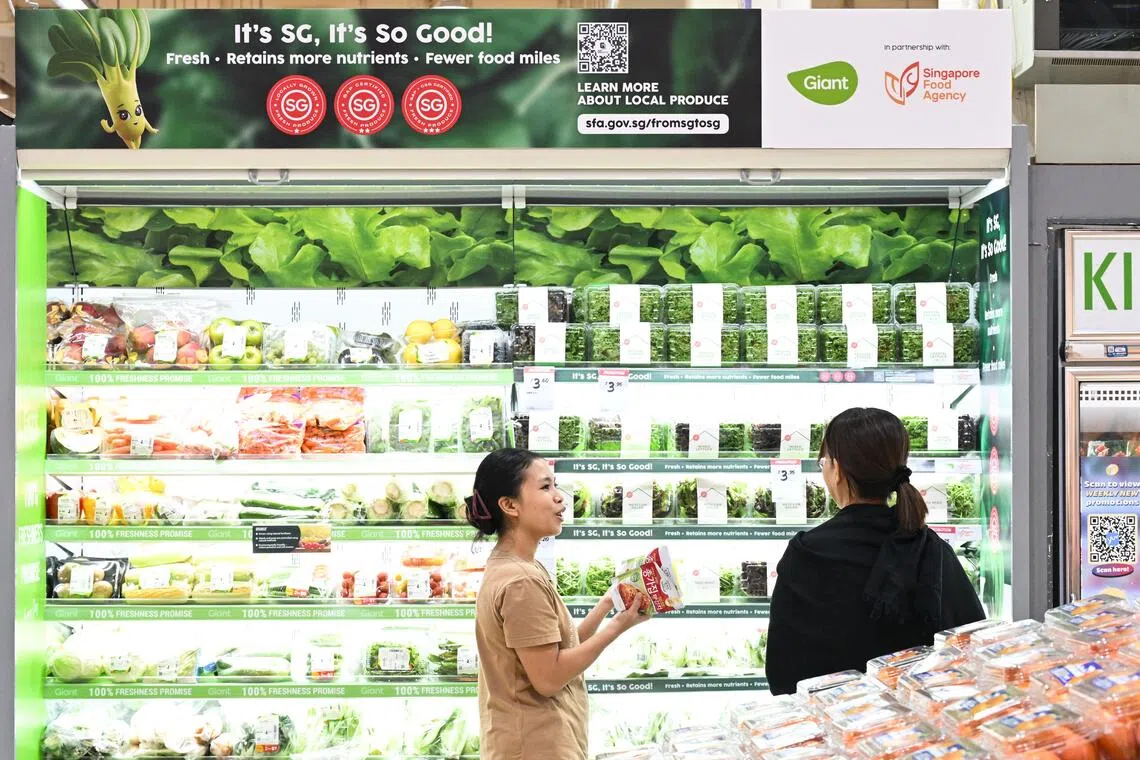
Customers at three Giant supermarkets can buy locally grown live seafood, including tilapia, sea bass, grouper and vannamei prawns.
ST PHOTO: LIM YAOHUI
Published Sep 09, 2026, 08:25 PM
Updated Sep 09, 2026, 08:25 PM
Singapore’s food resilience aims to balance availability, assurance, and affordability, not guarantee every preferred product during disruptions.
The government supports local farms with $240 million since 2019, improving productivity and encouraging adoption of suitable technologies.
Efforts include helping farms become commercially sustainable and strengthening global partnerships to secure food supply.
SINGAPORE - During a crisis, food resilience is not about guaranteeing that every preferred food product remains available in every form – fresh, chilled, or air-flown – with low prices, Minister for Sustainability and the Environment Grace Fu told Parliament on Sept 9.
Instead, her ministry’s objective is to ensure that Singaporeans can, even during disruptions, continue to have reliable access to essential food types – carbohydrates, proteins, and fibre – while taking into account different dietary preferences.
The minister was responding to a private member’s motion on food resilience raised by four PAP MPs. They had urged the Government to enhance food resilience and reduce food waste, so as to ensure that Singaporeans will have access to affordable food despite geopolitical uncertainties and climate risks.
Fu noted that while Singapore has managed to keep shelves stocked throughout the ongoing conflict in the Middle East, it is not totally out of the woods yet, as the effects of the geopolitical tensions continue to ripple through global supply chains and fertiliser supply remains tight. This is exacerbated by the El Nino weather phenomenon bringing hotter and drier weather.
“Two shock s – one geopolitical, one climatic – compounding each other, threatening the supply of rice, the world’s most consumed staple,” she said.
Singapore adopts a number of measures to safeguard its food security.
These include diversifying imports from a range of sources, stockpiling food items like rice and frozen meat , locally producing certain food types such as vegetables and seafood , and securing international partnerships to ensure food supplies can flow even during a crisis.
During the debate, nominated MP Kenneth Goh asked if diversifying imports was a sufficient safeguard of Singapore’s food security, as suppliers in different countries could still be impacted by the same event, such as an El Nino, for instance. He was one of 12 MPs who took part in the debate.
Fu said the strength of this framework lies in the different combinations that the country can deploy, depending on the food, the disruption and how long it lasts.
For example, Singapore cannot grow rice locally, so it relies on the three othe r ways , Fu said. Singapore has an extensive network of over 20 sources, including Thailand, Vietnam, India, Japan and the US, so the country has sources to import from even if supply from one country is disrupted.
Rice cooperation agreements signed with countries like Vietnam, Thailand and Cambodia can help increase supply in times of need, she added. For prolonged disruptions, industry and government stockpiles provide an additional buffer .
She said: “We want food to be available, across a range of commodities from many different countries . We want food supply to be assured, even when disruptions occur. And we want food to remain affordable to all Singaporeans, not just those who can afford to pay a premium.”
“We want all three, but there are trade-offs. We cannot maximise all three at the same time,” Fu added.
For instance, importing food from farther away may incur higher logistics costs, but it gives the country options in times of needs, she noted. Similarly, local farms can provide an assured food supply during supply chain disruptions, but prices may be higher due to the higher land and manpower costs.
Fu said: “That balance is a shared responsibility – for Government, businesses, and people – in accepting trade-offs and developing solutions today for the risks of tomorrow.”
The local farming sector has been beset with challenges in recent years, with rising costs leading to multiple farm closures.
During the sitting, Nadia Ahmad Samdin (Ang Mo Kio GRC) and Joan Pereira (Tanjong Pagar GRC) asked whether the Government would consider funding farms’ operating expenses and infrastructure needs to ensure they remain viable.
Poh Li San (Sembawang West) also noted that just as Singapore spends billions of dollars to build up its military defence capabilities, the government can also raise the national budget for local food production as part of its total defence strategy. This could go toward helping local farmers mitigate the high land, manpower and utilities costs of local production.
Fu said in response that Singapore’s approach is to help farms build the capabilities and scale needed to become commercially sustainable, rather than permanently offset higher operating costs, while improving inputs that local farms rely on.
For example, local farms can tap the existing Agri-food Cluster Transformation Fund, which helps local farms upgrade, to offset the cost of energy efficient infrastructure.
Giving updated figures on the projects that have benefited from the ACT , which was launched in 2021, Fu said SFA has awarded nearly $60 million to over 160 projects.
This has supported farms ranging from open cage to closed containment fish farms, as well as both traditional soil-based and urban indoor vegetable farms.
Fu added that the government has set aside more than $240 million to support local production since 2019 when the Singapore Food Agency (SFA) was formed . This includes funding for the Singapore Food R&D Programme.
She noted that overall productivity has improved since then, citing how productivity per hectare per year rose by 20 per cent for vegetable farms, 46 per cent for seafood farms, and 40 per cent for egg farms.
Responding to concerns that Singapore’s approach places too much emphasis on technology, Fu said the Government supports any technology - traditional or otherwise - that can raise production, lower environmental impact, and improve resilience against climate change and disease outbreaks.
She said: “ Supporting traditional farmers does not mean preserving traditional methods unchanged.”
“Our approach is to help farms – whatever their starting point – adopt solutions suited to them, produce more with less, withstand shocks better, and build viable businesses.”
She pointed out that the government’s support goes beyond technology adoption, such as by giving veterinary support.
Since the launch of the SFA’s Aquatic Animal Health Services in 2023, the subsidised service has been activated more than 70 times and helped more than 20 farms address animal health issues early and minimise losses.
During the sitting, MPs also gave suggestions on how the authorities can grow demand for local produce.
For example, WP’s D ennis Tan (Hougang) and Gerald Giam (Aljunied GRC) proposed that the government guarantee offtake for farmers by requiring large buyers like the Singapore Armed Forces’ cookhouses and public hospitals t o source a minimum share of produce from local farms.
Similarly, PAP’s Cai Yinzhou (Bishan-Toa Payoh GRC) asked if the Singapore Agro-Food Enterprises Federation (SAFEF), a not-for-profit organisation that promotes the interests of farmers, can broker long-term contracts that give farmers reliable buyers they can count on before stocking their ponds with fish.
In response, Fu said: “We could shield the farmers from competition by limiting imports or mandating procurement, as several members have suggested. But this would reduce choice and competition, and push up food prices.
“Instead, we help local farms become more productive and competitive, while strengthening offtake channels and buying local.”
For instance, SFA is supporting the SAFEF in its effort to aggregate supply from farms and match it with demand, such as by developing new demand channels for institutional buyers and caterers serving large organisations.
Said Fu: “This is not about simply increasing the number of farms, subsidising operating costs indefinitely, or guaranteeing demand.
“It is about helping farms make structural changes, reap economies of scale, and become more viable, so that local production can contribute meaningfully to food resilience for the long term.”
Acknowledging concerns raised by MPs about rising food prices, Fu said the government cannot fully insulate Singapore from the upward pressure on food prices over the long term, but it can better manage the impact of disruptions on the country’s food supply.
She said: “The Government will continue to do our part.
“We will build relationships with partners around the world, invest in local capabilities, open up new sources with new countries, strengthen safeguards, and put in place the policies and infrastructure for our food system to thrive.”
Ang Qing is a journalist covering local and international breaking news at The Straits Times, with a focus on the environment, crime, technology and social issues.
Ministry of Sustainability and the Environment
在三家 Giant 超市,顾客可以购买本地养殖的鲜活海鲜,包括罗非鱼、鲈鱼、石斑鱼和南美白对虾。
ST 照片:林耀辉
发布于 2026 年 9 月 9 日晚上 8:25
更新于2026年9月9日晚上8:25
新加坡的食品韧性旨在平衡供应、保障和价格可承受性,而不是在供应中断期间保证每一种受欢迎的产品。
自 2019 年以来,政府已投入 2.4 亿美元支持当地农场,以提高生产力并鼓励采用合适的技术。
相关努力包括帮助农场实现商业可持续发展,以及加强全球伙伴关系以确保粮食供应。
新加坡——9月9日,永续发展及环境部长傅海燕在国会表示,在危机期间,食品韧性并非保证每一种受欢迎的食品都能以各种形式(新鲜的、冷藏的或空运的)低价供应。
相反,她所在的部门的目标是确保新加坡人即使在供应中断期间也能继续可靠地获得基本食品类型——碳水化合物、蛋白质和纤维——同时考虑到不同的饮食偏好。
部长是在回应四位人民行动党议员提出的关于粮食安全保障的私人动议。他们敦促政府增强粮食安全保障,减少食物浪费,以确保新加坡民众即使在面临地缘政治不确定性和气候风险的情况下,也能获得价格合理的食物。
傅先生指出,尽管新加坡在中东持续冲突期间设法维持了货架供应,但尚未完全脱离险境,因为地缘政治紧张局势的影响仍在波及全球供应链,化肥供应依然紧张。厄尔尼诺现象带来的更热更干燥的天气加剧了这一局面。
她说:“两大冲击——一个是地缘政治冲击,一个是气候冲击——相互叠加,威胁着世界上消费量最大的主食——大米的供应。”
新加坡采取多项措施保障粮食安全。
这些措施包括:使进口来源多样化,储备大米和冷冻肉等食品,在当地生产蔬菜和海鲜等特定类型的食品,以及建立国际伙伴关系,以确保即使在危机期间也能保证食品供应。
在辩论中,委任议员吴庆炎提出,进口多元化是否足以保障新加坡的粮食安全,因为不同国家的供应商仍可能受到同一事件(例如厄尔尼诺现象)的影响。他是参与辩论的12名议员之一。
傅表示,该框架的优势在于,国家可以根据粮食情况、中断情况及其持续时间,部署不同的组合方案。
例如,新加坡无法在本地种植水稻,因此依赖其他三种进口方式,傅先生说。新加坡拥有超过20个进口来源的庞大网络,包括泰国、越南、印度、日本和美国,因此即使某个国家的供应中断,新加坡也有其他进口渠道。
她补充说,与越南、泰国和柬埔寨等国签署的大米合作协议有助于在需要时增加供应。对于持续时间较长的供应中断,行业和政府的储备可以提供额外的缓冲。
她说:“我们希望各种食品,包括来自不同国家的各类商品,都能供应充足。我们希望即使出现供应中断,食品供应也能得到保障。我们希望所有新加坡人都能买得起食品,而不仅仅是那些付得起高价的人。”
“我们想要这三者兼顾,但凡事都有取舍。我们不可能同时最大限度地发挥这三者的优势,”傅补充道。
她指出,例如,从较远的地方进口食品可能会产生更高的物流成本,但这能在需要时为国家提供更多选择。同样,本地农场可以在供应链中断期间提供稳定的食品供应,但由于土地和人力成本较高,价格可能也更高。
傅先生表示:“这种平衡是政府、企业和人民共同的责任——我们需要权衡利弊,并为应对未来的风险制定解决方案。”
近年来,当地农业部门面临诸多挑战,成本上升导致多家农场倒闭。
在会议期间,纳迪亚·艾哈迈德·萨姆丁(宏茂桥集选区)和琼·佩雷拉(丹戎巴葛集选区)询问政府是否会考虑资助农场的运营费用和基础设施需求,以确保农场继续生存下去。
宝丽珊(三巴旺西选区)也指出,正如新加坡斥资数十亿新元提升军事防御能力一样,政府也可以增加本地食品生产的国家预算,作为其整体国防战略的一部分。这笔资金可以帮助本地农民减轻本地生产在土地、人力和公用事业方面的高昂成本。
傅先生回应说,新加坡的做法是帮助农场建立实现商业可持续发展所需的能力和规模,而不是永久性地抵消更高的运营成本,同时改善当地农场所依赖的投入。
例如,当地农场可以利用现有的农业食品集群转型基金(该基金旨在帮助当地农场进行升级改造),来抵消节能基础设施的成本。
傅先生提供了从 2021 年启动的 ACT 计划中受益的项目的最新数据,称新加坡金融管理局 (SFA) 已向 160 多个项目拨款近 6000 万美元。
这为从开放式网箱养鱼场到封闭式养殖场的各种养殖场,以及传统的土壤种植和城市室内蔬菜种植提供了支持。
傅先生补充说,自2019年新加坡食品局(SFA)成立以来,政府已拨出超过2.4亿美元用于支持本地生产,其中包括为新加坡食品研发计划提供的资金。
她指出,自那时以来,整体生产力有所提高,并举例说明,蔬菜农场的每公顷年生产力提高了 20%,海鲜农场提高了 46%,鸡蛋农场提高了 40%。
针对有人担心新加坡的做法过于重视技术,傅先生表示,政府支持任何能够提高产量、降低环境影响、增强应对气候变化和疾病爆发的能力的技术——无论是传统的还是其他的。
她说:“支持传统农民并不意味着要一成不变地保留传统耕作方式。”
“我们的方法是帮助农场——无论其起点如何——采用适合自身的解决方案,以更少的资源生产更多产品,更好地抵御冲击,并建立可行的业务。”
她指出,政府的支持不仅限于技术应用,还包括提供兽医支持等。
自新加坡食品局 (SFA) 于 2023 年推出水生动物健康服务以来,这项补贴服务已启动 70 多次,帮助 20 多个农场及早解决动物健康问题,最大限度地减少损失。
在会议期间,议员们还就当局如何增加对本地产品的需求提出了建议。
例如,工人党议员陈丹尼斯(后港)和严燕松(阿裕尼集选区)提议,政府应通过要求新加坡武装部队食堂和公立医院等大型买家从本地农场采购最低比例的农产品来保证农民的农产品销售。
同样,人民行动党议员蔡银洲(碧山-大巴窑集选区)也询问,新加坡农粮企业联合会(SAFEF)——一个促进农民利益的非营利组织——能否促成长期合同,为农民提供可靠的买家,让他们在池塘里放养鱼苗之前就能有所依靠。
对此,傅先生回应道:“我们可以像一些议员建议的那样,通过限制进口或强制采购来保护农民免受竞争。但这会减少选择和竞争,并推高食品价格。”
“相反,我们帮助当地农场提高生产力和竞争力,同时加强销售渠道并采购本地产品。”
例如,SFA 正在支持 SAFEF 努力整合农场的供应并将其与需求相匹配,例如为机构买家和为大型组织服务的餐饮企业开发新的需求渠道。
傅先生说:“这不仅仅是增加农场数量、无限期补贴运营成本或保证需求的问题。”
“这关乎帮助农场进行结构性变革,实现规模经济,提高生存能力,从而使本地生产能够为长期粮食韧性做出有意义的贡献。”
傅海燕承认议员们对食品价格上涨表示担忧,并表示政府无法在长期内完全使新加坡免受食品价格上涨压力的影响,但可以更好地应对食品供应中断对国家食品供应的影响。
她说:“政府将继续尽我们的一份力量。”
“我们将与世界各地的合作伙伴建立关系,投资于当地能力建设,与新的国家开拓新的资源,加强保障措施,并制定政策和基础设施,使我们的粮食系统蓬勃发展。”
Ang Qing是《海峡时报》的一名记者,负责报道本地和国际突发新闻,重点关注环境、犯罪、科技和社会问题。
可持续发展与环境部