Maven is becoming the Pentagon’s everything appMaven 正在成为五角大楼的万能应用
MSS has replaced “six, eight, ten” systems that the military used to analyze data, AI chief says.
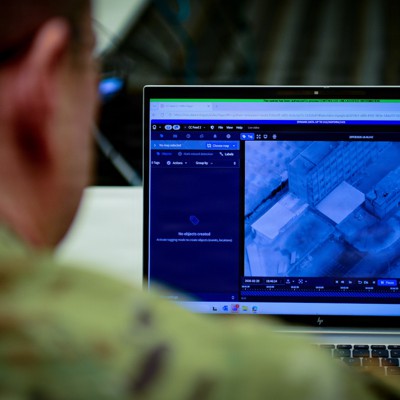
A National Guard soldier looks at the interface of the Maven Smart System in Arlington, Virginia, Feb. 20, 2026. U.S. Army / Master Sgt. Whitney Hughes
MSS has replaced “six, eight, ten” systems that the military used to analyze data, AI chief says.
Artificial Intelligence
The Pentagon is finding ever more uses for the AI-powered command-and-control system called Maven Smart System, including logistics, force readiness, supply chain and budgeting data, the Defense Department’s AI chief said Tuesday.
Maven, which is used by all U.S. combatant commands for intelligence and operations data analysis, drew attention in the early days of President Donald Trump’s war with Iran by facilitating strikes on thousands of targets in lightning-quick succession.
But the war also revealed DOD’s need for a better way to plan operations against a 90-day picture of its munitions inventory, Cameron Stanley, chief digital and artificial intelligence officer, said at the Billington CyberSecurity Summit in Washington, D.C.
Already, MSS has replaced “six, eight, ten” different IT systems that U.S. military personnel previously used to analyze data, said Stanley, adding that the goal was to build a “golden thread” of data from sensors, to aggregation and visualization, to decision-making and acting based on those decisions.
While MSS started as a tool to bridge intelligence and operations efforts, the department is working to include readiness and disposition of forces, supply chain and budgetary considerations, modeling and simulation to improve decision-making processes—what Stanley called a “horizontal integration” of directorates’ data functions.
Stanley also pointed to GenAI.mil , the Pentagon’s main portal for AI tools, which recently added tools from OpenAI and xAI in addition to Google’s Gemini. It’s deploying “real, no-kidding frontier AI algorithms, and the full user experience, inside of a government environment,” he said.
The organizations that have been most successful are integrating AI in new ways and changing how they operate, versus simply automating existing processes, Stanley added. Whereas commanders used to wait hours for new satellite imagery, they now see images complete with target detection in minutes, requiring a rethink of military decision-making processes.
“Basically, we need to make better decisions faster with data,” Stanley said. “Everything seems confusing until you break it down to making better decisions faster.”
He also discussed procurement timelines, noting that recent use of other transaction authorities and marketplaces had shortened the time vendor selection took “from months to single-digit days,” compared to traditional requests for information and proposals at DOD. He recommended vendors use Tradewinds, DOD’s digital marketplace, saying it “satisfies the competitive requirement” with a five-minute video, “way better than writing a bunch of RFIs and RFPs.”
The department is also exploring AI pilot programs for drafting and concluding contracts, as well as legal advice, though humans would remain in the process. Stanley said that “90%” of the language used in other transaction agreements or Federal Acquisition Regulation-based contracts was standard, and AI could often be used to make straightforward updates as needed.
He noted that interim authority to test and authority to operate on department networks were “one of those clear bottlenecks that are really really hard to get around,” and that AI pilot programs were being trialed to speed approval times.
While the full timeline from a broad agency announcement to authority to operate right now “could be 18 months,” his office is “progressively looking at every single piece of that schedule.”
The department was historically “standoffish” about software delivery models like software as a service and platform as a service, but “meeting the industry where they are” would allow the Pentagon to invest in and integrate commercial offerings more readily, Stanley said. He said that DOD would adopt commercial AI models, use its own data to customize them for its own use cases, and build its own bespoke capabilities as necessary.
Instead of owning the software, “I'll pay a license for that, so you don't have to worry about development. We can just iterate inside of that license period,” he said. The department is “a commercial-first organization.”
Allies often “are aligned” but “don’t have the resources … the experience … the scale that we do,” Stanley said. DOD is actively working with partners including the Five Eyes (the U.S., U.K., Canada, Australia, and New Zealand) and “a few” NATO and Asian allies to understand their needs and help them avoid making mistakes DOD has already made, he noted.
Stanley added that “AI in everything” would happen naturally, regardless of DOD’s actions. The department would need to digitize older processes and integrate AI into all decision-making to adapt. “The way we've always done it is not the least risky option. The way we've always done it is the most risky course of action,” he said.
NEXT STORY: NSA wants AI to help analysts sift vast data troves
2026年2月20日,在弗吉尼亚州阿灵顿,一名国民警卫队士兵正在查看Maven智能系统的界面。美国陆军/一级军士长惠特尼·休斯
人工智能负责人表示,MSS 已经取代了军方过去用于分析数据的“六个、八个、十个”系统。
人工智能
美国国防部人工智能主管周二表示,五角大楼正在发现人工智能驱动的指挥控制系统 Maven Smart System 的更多用途,包括后勤、部队战备、供应链和预算数据。
Maven 系统被美国所有作战司令部用于情报和作战数据分析,在唐纳德·特朗普总统对伊朗发动战争初期,该系统因能够以闪电般的速度连续打击数千个目标而引起关注。
但这场战争也暴露出国防部需要一种更好的方法来根据其90天的弹药库存情况来规划作战行动,首席数字和人工智能官卡梅伦·斯坦利在华盛顿特区举行的比灵顿网络安全峰会上表示。
斯坦利表示,MSS 已经取代了美国军方人员之前用于分析数据的“六个、八个、十个”不同的 IT 系统,并补充说,目标是构建一条从传感器到聚合和可视化,再到决策和基于这些决策采取行动的“黄金线”。
虽然 MSS 最初是作为连接情报和作战工作的工具而开发的,但该部门正在努力将其纳入部队的战备和部署、供应链和预算考虑、建模和仿真等方面,以改进决策过程——斯坦利称之为各部门数据功能的“横向整合”。
斯坦利还提到了五角大楼的主要人工智能工具门户网站GenAI.mil,该网站最近除了谷歌的Gemini之外,还新增了来自OpenAI和xAI的工具。他说,该网站正在政府环境中部署“真正前沿的人工智能算法,并提供完整的用户体验”。
斯坦利补充说,那些最成功的组织正在以新的方式整合人工智能并改变其运作方式,而不仅仅是自动化现有流程。过去指挥官需要等待数小时才能获得新的卫星图像,而现在他们只需几分钟就能看到包含目标检测信息的完整图像,这需要重新思考军事决策流程。
斯坦利说:“归根结底,我们需要利用数据更快地做出更好的决策。一切看起来都很混乱,但只要你把它分解成更快地做出更好的决策,一切就都清楚了。”
他还讨论了采购时间表,指出与国防部传统的征求信息和提案请求相比,近期使用其他交易授权和市场平台已将供应商选择时间“从数月缩短至个位数天”。他建议供应商使用国防部的数字市场平台 Tradewinds,称其只需一段五分钟的视频即可“满足竞争性要求”,“远胜于撰写大量征求信息和提案请求”。
该部门还在探索利用人工智能试点项目来起草和签署合同以及提供法律咨询,但整个过程中仍将有人工参与。斯坦利表示,其他交易协议或基于《联邦采购条例》的合同中使用的语言“90%”都是标准化的,人工智能通常可以用于根据需要进行简单的更新。
他指出,测试的临时授权和在部门网络上运行的授权是“那些非常非常难以克服的明显瓶颈之一”,并且正在试行人工智能试点项目以加快审批时间。
虽然从机构发布广泛公告到获得运营授权的完整时间表“可能需要 18 个月”,但他的办公室正在“逐步审视该时间表的每一个环节”。
斯坦利表示,国防部历来对软件即服务(SaaS)和平台即服务(PaaS)等软件交付模式持“谨慎态度”,但“与业界接轨”将使五角大楼能够更便捷地投资和整合商业产品。他还表示,国防部将采用商业人工智能模型,利用自身数据根据具体应用场景进行定制,并根据需要构建专属功能。
他说:“我不会拥有这款软件,而是会购买授权许可,这样你们就不用担心开发问题了。我们可以在授权许可期限内进行迭代开发。” 该部门是一个“以商业为先的机构”。
斯坦利表示,盟友们往往“目标一致”,但“缺乏我们拥有的资源、经验和规模”。他指出,国防部正积极与包括“五眼联盟”(美国、英国、加拿大、澳大利亚和新西兰)在内的伙伴以及“少数”北约和亚洲盟友合作,了解他们的需求,并帮助他们避免重蹈国防部的覆辙。
斯坦利补充说,“人工智能无处不在”的趋势将自然而然地发生,与国防部的行动无关。国防部需要将旧流程数字化,并将人工智能融入所有决策过程以适应这一变化。“我们一直以来的做法并非风险最小的选择,而是风险最大的做法。”他说道。
下一篇报道:美国国家安全局希望利用人工智能帮助分析人员筛选海量数据