Where Are The American Aircraft Carriers?: September 9, 2026美国航空母舰在哪里?:2026年9月9日
The Navy is applying lessons learned from recent marathon carrier cruises to the USS Theodore Roosevelt, which conducted an unreported maintenance availability ahead of deployment.
新闻视频
Published Sep 9, 2026 4:49 PM EDT
The Navy says it is making a concerted effort to apply the hard lessons learned from the marathon deployments of the USS Gerald R. Ford and USS Abraham Lincoln , both in combat and in quality of life for the crew, according to a new video posted by the Chief of Naval Operations, Adm. Daryl Caudle. The changes will be rolled out when USS Theodore Roosevelt deploys following a brief, last-minute, and previously unreported maintenance availability, TWZ has learned. Meanwhile, the United States and Iran are quickly climbing the escalation ladder again, as the latest series of tit-for-tat strikes has resulted in a massive overnight ballistic missile attack on a Jordanian base hosting U.S. forces and the destruction of ten Iranian commercial oil tankers over the past week.
Here’s TWZ’s weekly carrier tracker monitoring America’s flattop fleet, including deployed Carrier Strike Groups (CSG) and Amphibious Ready Groups (ARG), using publicly available open-source information. Check out last week’s report here .
TWZ/IAN ELLIS-JONES (High Resolution)
George Washington Strike Group Evades Iranian Ballistic Missiles
Less than a month after taking up station in the Middle East, elements of the George Washington CSG reportedly came under ballistic missile fire from the Islamic Revolutionary Guard Corps (IRGC) on September 5, according to Iranian media. “A U.S. aircraft carrier and guided-missile destroyer successfully evaded multiple unprovoked Iranian attacks,” U.S. Central Command (CENTCOM) confirmed in a statement , without identifying which warships were targeted. TWZ cannot independently verify the Iranian reports, and the Islamic Republic has frequently leveraged disinformation throughout the war.
U.S. forces responded swiftly the same day, striking three Iranian commercial oil tankers, part of the “shadow fleet” that funds IRGC operations, in a notable step beyond U.S. President Donald Trump’s recently announced tanker-for-tanker policy . “Let the message to the IRGC be clear: If you shoot at two of our ships, we will impose an even higher economic cost – taking out three of yours,” Adm. Brad Cooper, the CENTCOM commander, warned. “We will not hesitate to defend American forces, and if necessary, destroy Iran’s limited and exposed oil fleet,” he added. No U.S. casualties or damage to the American ships was reported.
Video of U.S. Central Command forces striking three Iranian crude oil carriers on September 5, 2026. (USCENTCOM video)
Details surrounding the attack on September 5 are limited, but Iranian-affiliated channels claimed the IRGC fired the Qassem Basir medium-range anti-ship ballistic missile (ASBM) for the first time. If true, it would represent the first known combat employment of the ASBM since it was unveiled in May 2025 and pose a new threat to Navy warships operating within the 1,200-kilometer, or roughly 750-mile, stated range (although that figure is more than likely overstated). Generally speaking, American cruisers and destroyers can engage ASBMs in two layers, in some cases using Standard Missile-3 (SM-3) in the midcourse phase and SM-6 during the terminal phase. Both are finite resources, and only so many can be loaded in their Vertical Launch System (VLS) cells.
Since the initial exchange on September 5, the tit-for-tat strikes have continued to escalate. CENTCOM destroyed another five crude oil tankers on September 8, bringing the total to ten in a week, after the IRGC targeted an unidentified Navy warship again with ballistic missiles. Iran answered overnight, launching a huge salvo of ballistic missiles toward Muwaffaq Salti Air Base in Jordan, where a significant contingent of U.S. forces is forward-deployed. Dramatic videos on social media show Patriot batteries firing against the incoming projectiles, with open-source analysts counting at least 60 interceptors employed.
U.S. destroys another 5 Iranian tankers after the IRGC targets another American warship. (CENTCOM video)
The USS George Washington arrived in the CENTCOM area of responsibility (AOR) on or around August 19, escorted by a single guided-missile destroyer, USS Shoup . The pairing matches the composition described in CENTCOM’s statement about the IRGC attack on September 5. Washington’s public affairs team reposted the statement on their social media accounts.
The possibility that the second Nimitz class flattop operating alongside Washington in the Middle East, the USS George H.W. Bush , was the target of the attack cannot be ruled out. Both carriers are the same class and look alike from a distance (or through a seeker). The George H.W. Bush CSG is currently composed of a guided-missile cruiser, USS Princeton , and two guided-missile destroyers, USS Ross and USS Donald Cook .
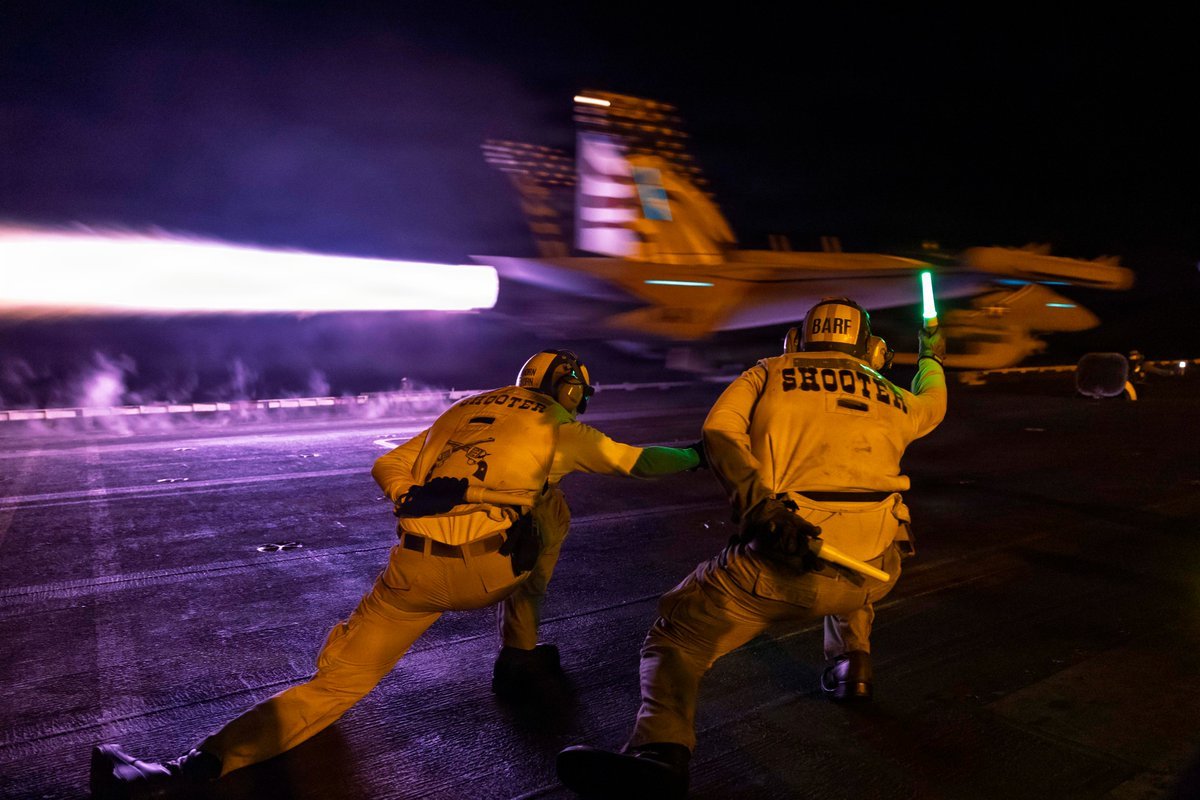
An E/A-18G Growler launches from the flight deck of USS George H.W. Bush during night flight operations. (CENTCOM photo)
An F/A-18F Super Hornet on the flight deck of aircraft carrier USS George H.W. Bush (CVN 77). (U.S. Navy photo) U.S. Central Command Public Affa
Bush was pictured conducting nighttime flight ops in CENTCOM’s most recent update detailing the status of the ongoing blockade: U.S. forces redirected 94 commercial vessels, kinetically disabled three, and boarded two to ensure compliance, as of September 7.
USS Theodore Roosevelt Undergoes Last-Minute Maintenance Ahead of Deployment
The next carrier scheduled to deploy from the U.S., the USS Theodore Roosevelt , recently got underway after a brief maintenance period. While there was no mention of an upcoming availability in budget documents, we noticed what appeared to be pierside work in commercial satellite imagery , similar to the brief stints Washington and Vinson completed recently while in homeport. In response to our inquiry, a Navy official told TWZ , “ Nimitz -class aircraft carrier USS Theodore Roosevelt (CVN 71) is currently in port at Naval Air Station North Island in San Diego conducting routine, planned maintenance. While we do not comment on future operations or movements due to operations security, aircraft carriers follow an optimized fleet response plan that provides full realignment of maintenance, training, and deployment cycles to fit in a standard 36-month rotation.”
Roosevelt’s upcoming deployment has been the subject of heavy speculation, as there will soon be no carriers available in Asia should a contingency arise. While Lincoln is currently in the South China Sea, she’s at the tail end of her deployment and in the process of heading home. The same official addressed the coverage gap, telling us, “U.S. Pacific Fleet’s posture across the region remains strong, adaptive, and ready. The U.S. Navy is purpose-built to flex, surge, and sustain across multiple theaters simultaneously – and that flexibility is a strategic advantage, not a vulnerability. U.S. Pacific Fleet’s commitment to the region is enduring – backed by the Joint Force and a strong network of allies and partners – and we will continue to fly, sail, and operate wherever international law allows to support a free and open Indo-Pacific.”
Flight operations on USS Theodore Roosevelt (CVN 71), Sept. 7, 2026. (U.S. Navy photo) Petty Officer 3rd Class Alexander Bussman
Sailors direct the launch of an F/A-18E Super Hornet on USS Theodore Roosevelt (CVN 71). (U.S. Navy photo) Petty Officer 3rd Class Alexander Bussman
Roosevelt departed San Diego on September 5 and is still at sea as of publication. Imagery posted two days later on DVIDS, the military’s content-sharing platform, shows the flattop carrying out flight operations in the U.S. 3rd Fleet AOR and conducting “advanced training to bolster strike group readiness and capability.” The carrier was last tracked broadcasting a position publicly with her Automatic Identification System (AIS) transponder on, operating to the west of Baja California, Mexico, according to MarineTraffic . It’s unclear if the maintenance has been completed or if additional modifications and training will be required before the CSG deploys.
Transit of USS Theodore Roosevelt off the west coast while working up. Source: MarineTraffic/KPLER (Reprinted with permission)
As noted above, the Chief of Naval Operations, Adm. Daryl Caudle, alongside Master Chief Petty Officer of the Navy (MCPON) John Perryman, posted a video yesterday with new information on Roosevelt’s upcoming deployment. “The lessons you’re bringing home are helping us better prepare the next team to deploy,” Perryman explained, addressing Lincoln’s crew. “Right now USS Theodore Roosevelt is putting those lessons into action using what we learned from Abraham Lincoln and Gerald R. Ford ,” Caudle continued. On logistics, that means maximizing the loadout of food, retail products, and hygiene items by converting available spaces into additional storage facilities. Regarding quality of life, improvements include new entertainment, more fitness equipment, and holiday materials purchased in advance.
“Small things matter during a long deployment because taking care of our Sailors is part of maintaining combat readiness,” Perryman noted. Watch the full video below.
CNO Adm. Daryl Caudle and MCPON John Perryman provide an update on USS Theodore Roosevelt’s upcoming deployment. (U.S. Navy video)
Three other U.S.-based carriers, USS Carl Vinson , USS Dwight D. Eisenhower , and USS Ronald Reagan , were recently underway for training but have returned to their respective homeports since our last report on September 1.
Eisenhower returned to Pier 14S at Naval Station Norfolk on September 2 after a 12-day underway for Fleet Replacement Squadron (FRS) and Training Command (TRACOM) Carrier Qualifications (CQ) in the Virginia Capes and Jacksonville operating areas. Vinson completed 25 days of Tailored Ship’s Training Availability (TSTA) and Final Evaluation Period (FEP) before mooring at Juliet Pier on Naval Air Station North Island, San Diego, on September 4. And Reagan , which just finished a nearly 18-month Drydocking Planned Incremental Availability (DPIA), returned to Naval Base Kitsap-Bremerton in Washington state on September 7 after a four-day post-availability shakedown and sea trials. It’s unknown how many rounds of sea trials will be required before Reagan returns to the fleet.
For the time being, America has one carrier coming back online, but the net gain will be short-lived, as Lincoln is expected to begin a DPIA after returning home.
USS Abraham Lincoln Leaves Thailand Looking Like A Different Ship
Elements of the Abraham Lincoln CSG, as well as escort cruiser USS Robert Smalls , arrived in Thailand on September 2 for what the Navy characterized as the “first full port call” of their nine-plus-month deployment. The crew of roughly 5,000 Sailors and Marines was finally able to leave the ship for liberty, with the majority standing on solid ground for the first time since November 2025.
“This port visit to Pattaya was a tremendous opportunity for this crew to recharge and a highlight for the strike group,” Abraham Lincoln’s commanding officer, Capt. Dan Keeler, said in a press release . “Thailand has such a rich culture and history, coupled with incredible hospitality, and that all shone through in this port visit. We are grateful to our Thai allies for hosting us, and we look forward to continuing our mission here in 7th Fleet, alongside Thailand and our other regional allies and partners.”
The USS Abraham Lincoln (CVN-72) arrives at Laem Chabang Port in Thailand on September 2, 2026. (Photo by Thananuwat Srirasant/Getty Images; Reprinted with permission)
According to the press release, the crew “experienced all the sights and sounds Thailand has to offer, deepening their understanding of the Thai people and strengthening interpersonal bonds.” Lincoln pulled into port looking worse for wear after 286 days at sea, with noticeable algae and rust spots, conditions that are expected given the high operational tempo endured during nearly seven months of combat. Videos surfaced of the hull being scrubbed by Thai contract crews at a fraction of what the same job would cost stateside. The carrier departed five days later on September 6 in much better shape.
Timelapse video of USS Abraham Lincoln leaving Thailand on September 6, 2026. (Abraham Lincoln video by MC3 Castro)
Lincoln is now continuing the journey home to San Diego, though whether any additional stops will be made along the way is unknown. A single-sourced report from Newsweek , which TWZ has not verified, claimed that another port call might be added, according to the wife of an officer aboard. As of publication, Lincoln is 293 days into the deployment, just 33 days short of the 326-day record set by USS Gerald R. Ford earlier this year.
U.S. Navy Big-Deck Fleet At A Glance
Overall, three U.S. carriers are deployed (with one heading home), one is preparing to deploy in the near term, three are working up in various states of readiness, three are in current or upcoming maintenance, and one is being used primarily for training before deactivation next year. One amphibious ready group is deployed, one is forward-deployed and at homeport, four are working up or in port, and three are in maintenance.
Note: Positions are general approximations. Non-deployed LHA/LHD amphibious warships are not shown.
Contact the author: ian.ellis-jones@recurrent.io
Comments couldn’t be loaded. Please refresh the page.
发布于美国东部时间2026年9月9日下午4:49
据海军作战部长达里尔·考德尔海军上将发布的一段新视频显示,海军表示正齐心协力地吸取“杰拉尔德·R·福特”号和“亚伯拉罕·林肯”号航母长期部署中汲取的惨痛教训,改进作战和提升船员生活质量。据TWZ获悉,这些改进措施将在“西奥多·罗斯福”号航母完成短暂、临时且此前未公开的维护后部署时实施。与此同时,美国和伊朗的紧张局势再次迅速升级。过去一周,双方持续的针锋相对袭击导致一处驻有美军的约旦基地遭到大规模弹道导弹袭击,十艘伊朗商用油轮被摧毁。
以下是TWZ每周发布的航母追踪报告,监测美国航母舰队,包括已部署的航母打击群(CSG)和两栖戒备群(ARG),数据来源于公开的开源信息。点击此处查看上周报告。
TWZ/IAN ELLIS-JONES(高分辨率)
“乔治·华盛顿”号航母打击群躲避伊朗弹道导弹
据伊朗媒体报道,乔治·华盛顿号航母战斗群抵达中东不到一个月,其部分舰艇于9月5日遭到伊朗伊斯兰革命卫队(IRGC)的弹道导弹袭击。美国中央司令部(CENTCOM)在一份声明中证实,“一艘美国航母和一艘导弹驱逐舰成功躲避了伊朗多次无端袭击”,但并未透露具体是哪些军舰遭到袭击。TWZ无法独立核实伊朗方面的报道,而且伊朗在整个战争期间经常散布虚假信息。
当天,美军迅速做出反应,袭击了三艘伊朗商用油轮,这些油轮属于为伊朗伊斯兰革命卫队(IRGC)行动提供资金的“影子舰队”的一部分。此举标志着美军采取了比美国总统特朗普近期宣布的“以油轮换油轮”政策更为强硬的举措。美国中央司令部司令布拉德·库珀海军上将警告说:“我要向伊朗伊斯兰革命卫队明确传达一个信息:如果你们攻击我们的两艘舰艇,我们将让你们付出更高的经济代价——摧毁你们的三艘舰艇。”他还补充道:“我们将毫不犹豫地保卫美国军队,并在必要时摧毁伊朗数量有限且暴露在外的石油舰队。”据报道,美军没有人员伤亡,美军舰艇也没有受损。
2026年9月5日,美国中央司令部部队袭击了三艘伊朗原油运输船的视频。(美国中央司令部视频)
关于9月5日袭击事件的细节有限,但伊朗官方媒体声称,伊朗伊斯兰革命卫队首次发射了“卡西姆·巴希尔”中程反舰弹道导弹(ASBM)。如果属实,这将是该导弹自2025年5月亮相以来首次投入实战,并对在其1200公里(约750英里)射程范围内活动的美国海军舰艇构成新的威胁(尽管该射程很可能被夸大了)。一般来说,美国巡洋舰和驱逐舰可以分两层拦截反舰弹道导弹,在某些情况下,会在中段使用标准-3型导弹(SM-3),在末段使用SM-6。这两种导弹都是有限的资源,垂直发射系统(VLS)的装载量也有限。
自9月5日首次交火以来,针锋相对的袭击持续升级。9月8日,美国中央司令部又摧毁了五艘原油油轮,一周内被摧毁的油轮总数达到十艘。此前,伊朗伊斯兰革命卫队再次用弹道导弹袭击了一艘身份不明的美国海军军舰。伊朗当晚立即做出回应,向约旦穆瓦法克·萨尔蒂空军基地发射了大量弹道导弹,该基地驻扎着大量美军前沿部队。社交媒体上流传的视频显示,爱国者导弹系统正在拦截来袭导弹,据开源分析人士统计,至少使用了60枚拦截导弹。
在伊朗伊斯兰革命卫队袭击另一艘美国军舰后,美国又击沉了5艘伊朗油轮。(中央司令部视频)
“乔治·华盛顿”号航空母舰于8月19日左右抵达中央司令部责任区,由一艘导弹驱逐舰“舒普”号护航。这一舰艇编组与中央司令部9月5日就伊朗伊斯兰革命卫队袭击事件发表的声明中所述相符。“华盛顿”号的公共事务团队在其社交媒体账户上转发了该声明。
不能排除在中东与华盛顿号航母并肩作战的第二艘尼米兹级航母“乔治·H·W·布什”号是此次袭击目标的可能性。两艘航母同属一个级别,从远处(或通过导引头)看去外形相似。“乔治·H·W·布什”号航母战斗群目前由一艘导弹巡洋舰“普林斯顿”号和两艘导弹驱逐舰“罗斯”号和“唐纳德·库克”号组成。
一架E/A-18G“咆哮者”电子战飞机在夜间飞行作业中从“乔治·H·W·布什”号航空母舰的飞行甲板上起飞。(中央司令部照片)
一架F/A-18F超级大黄蜂战斗机停在“乔治·H·W·布什”号航空母舰(CVN 77)的飞行甲板上。(美国海军照片)美国中央司令部公共事务
在中央司令部最新发布的更新中,布什被拍到正在执行夜间飞行任务,该更新详细介绍了正在进行的封锁的状况:截至 9 月 7 日,美军已改变 94 艘商船的航向,用武力摧毁了 3 艘,并登船检查了 2 艘,以确保遵守封锁规定。
“西奥多·罗斯福”号航空母舰在部署前进行最后阶段的维护保养
下一艘计划从美国部署的航母“西奥多·罗斯福”号在完成短暂的维护后近日重新起航。虽然预算文件中并未提及即将到来的维护,但我们从商业卫星图像中注意到,该航母似乎正在进行码头作业,这与“华盛顿”号和“文森”号近期在母港进行的短暂维护类似。针对我们的询问,一位海军官员告诉TWZ:“尼米兹级航空母舰‘西奥多·罗斯福’号(CVN 71)目前正在圣地亚哥北岛海军航空站进行例行计划维护。出于行动安全考虑,我们不对未来的行动或调动发表评论。但航空母舰遵循一套优化的舰队响应计划,该计划对维护、训练和部署周期进行全面调整,以符合标准的36个月轮换周期。”
罗斯福号航母即将部署引发了诸多猜测,因为一旦发生紧急情况,亚洲将很快没有航母可用。林肯号航母目前在南海,但已接近部署尾声,正在返回母港的途中。同一位官员就航母覆盖缺口问题回应道:“美国太平洋舰队在整个地区的部署依然强大、灵活且随时待命。美国海军的建设宗旨就是在多个战区同时灵活部署、快速增援和持续作战——这种灵活性是一种战略优势,而非弱点。美国太平洋舰队对该地区的承诺是持久的——这得益于联合部队以及强大的盟友和伙伴网络的支持——我们将继续在国际法允许的任何地方飞行、航行和行动,以支持自由开放的印太地区。”
2026年9月7日,西奥多·罗斯福号航空母舰(CVN 71)上的飞行作业。(美国海军照片)三级士官亚历山大·布斯曼
水兵们在“西奥多·罗斯福”号航空母舰(CVN 71)上指挥一架F/A-18E“超级大黄蜂”战斗机起飞。(美国海军照片)三级士官亚历山大·布斯曼
罗斯福号航母于9月5日离开圣地亚哥,截至发稿时仍在海上。两天后,军方内容共享平台DVIDS上发布的图像显示,这艘航母正在美国第三舰队责任区内进行飞行作业,并开展“高级训练以增强打击群的战备状态和作战能力”。据MarineTraffic网站显示,该航母最后一次被追踪到是在墨西哥下加利福尼亚州以西海域,当时其自动识别系统(AIS)应答器处于开启状态并公开广播位置。目前尚不清楚维护工作是否已经完成,或者在航母打击群部署前是否还需要进行额外的改装和训练。
“西奥多·罗斯福”号航空母舰在西海岸进行训练航行时的航迹。图片来源:MarineTraffic/KPLER(经许可转载)
正如上文所述,海军作战部长达里尔·考德尔海军上将与海军总军士长约翰·佩里曼昨日发布了一段视频,公布了“罗斯福”号航母即将部署的最新信息。佩里曼在视频中对“林肯”号航母的官兵们说道:“你们带回来的经验教训将帮助我们更好地为下一支部署队伍做好准备。”考德尔继续说道:“目前,‘西奥多·罗斯福’号航母正在运用我们从‘亚伯拉罕·林肯’号和‘杰拉尔德·R·福特’号航母上学到的经验。”在后勤方面,这意味着通过将可用空间改造成额外的储藏设施,最大限度地装载食品、零售商品和卫生用品。在生活质量方面,改进措施包括增加娱乐设施、健身器材以及提前采购节日用品。
佩里曼指出:“在长期部署期间,细节决定成败,因为照顾好我们的水兵是保持战备状态的重要组成部分。” 请观看下方完整视频。
美国海军作战部长达里尔·考德尔海军上将和海军总军士长约翰·佩里曼就“西奥多·罗斯福”号航空母舰即将进行的部署进行了最新通报。(美国海军视频)
另外三艘美国本土的航空母舰,即“卡尔·文森”号、“德怀特·D·艾森豪威尔”号和“罗纳德·里根”号,最近出海进行训练,但自我们9月1日上次报道以来,它们已经返回各自的母港。
艾森豪威尔号航母在弗吉尼亚海角和杰克逊维尔作战区域进行了为期12天的舰队替换中队(FRS)和训练司令部(TRACOM)航母资格认证(CQ)后,于9月2日返回诺福克海军基地14S号码头。文森号航母在完成为期25天的定制舰艇训练可用性(TSTA)和最终评估期(FEP)后,于9月4日停靠在圣地亚哥北岛海军航空站的朱丽叶码头。里根号航母刚刚完成近18个月的干船坞计划增量可用性(DPIA)维护,在进行了为期四天的维护后试航和海上试验后,于9月7日返回华盛顿州基萨普-布雷默顿海军基地。目前尚不清楚里根号航母在重返舰队前还需要进行多少轮海上试验。
目前,美国有一家航空公司恢复运营,但这种净收益将是短暂的,因为林肯预计在恢复运营后将开始实施DPIA。
“亚伯拉罕·林肯”号航空母舰离开泰国时,看起来就像换了一艘船。
“亚伯拉罕·林肯”号航母战斗群的部分舰艇以及护航巡洋舰“罗伯特·斯莫尔斯”号于9月2日抵达泰国,这是海军所称的他们长达九个多月的部署中的“首次完整港口访问”。大约5000名水兵和海军陆战队员终于可以离开军舰休假,其中大多数人自2025年11月以来首次踏上陆地。
“此次芭堤雅港口访问对舰员来说是一次绝佳的休整机会,也是打击群的一大亮点,”亚伯拉罕·林肯号航母舰长丹·基勒上校在新闻稿中表示。“泰国拥有丰富的文化和历史,以及令人赞叹的热情好客,这些都在此次访问中得到了充分体现。我们感谢泰国盟友的热情款待,并期待继续在第七舰队执行任务,与泰国及其他地区盟友和伙伴并肩作战。”
2026年9月2日,美国海军“亚伯拉罕·林肯”号航空母舰(CVN-72)抵达泰国林查班港。(图片由Thananuwat Srirasant/Getty Images提供;经授权转载)
根据新闻稿,船员们“体验了泰国的一切,加深了对泰国人民的了解,并加强了彼此之间的联系。”林肯号航母在海上航行286天后靠岸,看起来破旧不堪,船体上明显有藻类和锈迹,考虑到近七个月高强度的作战节奏,这种情况也在意料之中。有视频显示,泰国承包商正在清洗船体,而费用仅为美国本土同等工作成本的一小部分。五天后,即9月6日,林肯号航母以更好的状态再次启航。
2026年9月6日,美国海军“亚伯拉罕·林肯”号航空母舰离开泰国的延时视频。(由三级军士长卡斯特罗拍摄)
“林肯”号目前正继续返回圣地亚哥的航程,但途中是否会停靠其他港口尚不得而知。据《新闻周刊》一篇未经TWZ核实的单方报道称,一位舰上军官的妻子表示,“林肯”号可能会增加一次停靠港口。截至发稿时,“林肯”号已部署293天,距离今年早些时候“杰拉尔德·R·福特”号创下的326天纪录仅差33天。
美国海军大型舰艇舰队概览
总体而言,美国目前部署了三艘航母(其中一艘正在返航),一艘正在准备近期部署,三艘正在进行不同程度的战备训练,三艘正在进行或即将进行维护,还有一艘主要用于训练,将于明年退役。两栖戒备群方面,一个已部署,一个已前沿部署并停泊在母港,四个正在进行战备训练或停泊在港口,三个正在进行维护。
注:位置均为大致估计。未部署的LHA/LHD两栖攻击舰未显示。
联系作者:ian.ellis-jones@recurrent.io
评论加载失败,请刷新页面。