‘Truly concerns me’: DAWG director warns funding lapse could kill ‘momentum’“这真的让我担忧”:DAWG主任警告称,资金短缺可能会扼杀“发展势头”
DAWG is Trump administration initiative that essentially absorbed the Biden-era Replicator initiative designed to acquire thousands of low-cost “attritable” drones, particularly for use in the Pacific.
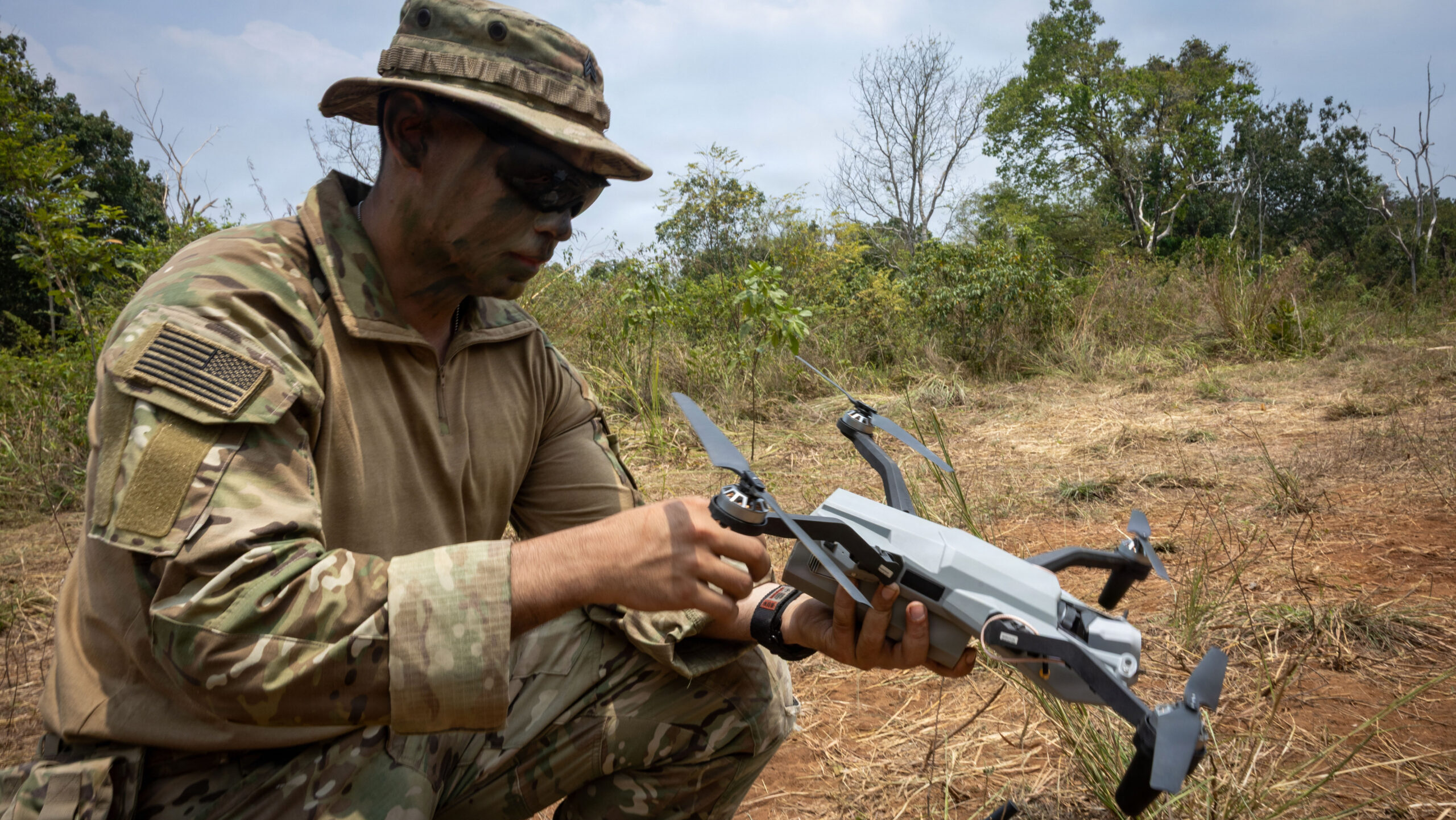
A U.S. Soldier assigned to 1st Battalion, 38th Infantry Regiment, 1st Stryker Brigade, 4th Infantry Division, checks a drone during Super Garuda Shield 26 at Baturaja Combat Training Center, Indonesia, Sept. 7, 2026. Super Garuda Shield is an annual exercise between the Indonesian National Armed Forces and U.S. Military designed to strengthen bilateral interoperability capabilities, and cooperation. (U.S. Navy photo by Mass Communication Specialist 2nd Class Alfredo Marron)
WASHINGTON — The three-star chief of the Pentagon’s ambitious drone development task force said today he didn ’ t know if his Defense Autonomous Working Group (DAWG) would get the nearly $54 billion the Trump administration has requested from lawmakers — and warned the program could stumble if it didn’t get “something.”
“We’re at a point where there is a potential for us to get, uh, some money out of the FY27 budget, the president’s budget, that will go directly to DAWG,” Lt. Gen. Steven Marks told the NDIA Emerging Technologies Conference . “[I] don’t know if we’re going to get the full ask of $53.6 billion, but my greatest concern is, if we don’t get something, then the momentum that we have created since DAWG has been stood up, over a year ago , will be waning.
“And it truly concerns me, because I have looked over and seen what they’re doing in Ukraine ,” he said. “I see what’s going on with Operation … Epic Fury ” in the Middle East.
The administration requested $54.6 billion for DAWG in FY27, but $53.6 of that amount was requested through the budget reconciliation process, alongside funding for other top Trump priorities like the Golden Dome missile defense system , rather than in the normal base budget request.
If reconciliation fails to pass in Congress, as seems increasingly likely , then DAW G could be left with $1 billion requested through the base budget. T hat figure is four times the $226 million DAWG received for FY 26 — dramatic growth by the standards of most Pentagon programs — but it’s less th an 2 percent of th e expansive original plan.
RELATED: Pentagon officials broadly detail $55 billion drone plan under DAWG
“I see what’s going on, and, truthfully, the world has woken up. They can’t keep up with our exquisite capability, and they know that,” Marks said of US adversaries. “[But] they can take a $100,000 drone and conduct an attack against a $2 billion vessel. … We are on the losing end of that cost imposition curve.”
DAWG is Trump administration initiative that essentially absorbed the Biden-era Replicator initiative designed to acquire thousands of low-cost “attritable” drones, particularly for use in the Pacific. In its latest iteration, the departme nt has been lo oking to supercharge development investments across an array of platforms and collaborative autonomy efforts.
Marks declined to describe the specific DAWG programs at stake. “Unfortunately, all of our systems are all classified, and so I will not be talking in detail about those,” he told the conference.
However, the general seemed particularly concerned about the impact of budget cuts on his efforts to impose common standards, control interfaces, and training on the current array of unmanned systems — the topic he was speaking on right before he transitioned to his budget concerns.
“Recently, I was in Alabama at Camp Clark, outside of Birmingham, at 20th Special Forces Group, ” said Marks, who also serves as vice-commander of Special Operations Command . “What I heard … is we have six to eight systems that we’re operating and we’re conducting this [exercise] with. We n eed to identify and pick one or two and standardize it, standardize it across the entire formation, because each one of the systems, as I mentioned before, requires a different skill set….so standardizing the systems [is] are [sic] critical to the future of autonomous warfare.”
Ashley Roque contributed to this report.
2026年9月7日,在印度尼西亚巴图拉贾作战训练中心举行的“超级迦楼罗之盾26”联合军演期间,一名隶属于美国陆军第4步兵师第1斯特赖克旅第38步兵团第1营的美军士兵正在检查一架无人机。“超级迦楼罗之盾”是印尼国民军和美军之间的年度联合演习,旨在加强双边互操作能力和合作。(美国海军二级大众传播专家阿尔弗雷多·马龙摄)
华盛顿——五角大楼雄心勃勃的无人机研发工作组的三星级负责人今天表示,他不知道他的国防自主工作组(DAWG)能否获得特朗普政府向国会议员申请的近 540 亿美元拨款,并警告说,如果得不到“一些资助”,该计划可能会陷入困境。
“我们现在有机会从2027财年预算,也就是总统预算中,争取到一些资金,直接拨给国防航空工作组(DAWG)。”史蒂文·马克斯中将告诉美国国防工业协会(NDIA)新兴技术大会。“我不知道我们能否获得全部536亿美元的拨款,但我最担心的是,如果我们得不到任何资金,那么自DAWG成立一年多以来我们所取得的进展势头将会减弱。”
“这真的让我很担忧,因为我看到了他们在乌克兰的所作所为,”他说。“我看到了他们在中东进行的‘史诗狂怒行动’。”
政府在 2027 财年申请了 546 亿美元的 DAWG 拨款,但其中 5360 亿美元是通过预算协调程序申请的,同时还申请了其他特朗普优先项目(如金穹顶导弹防御系统)的资金,而不是在正常的基本预算申请中申请的。
如果预算协调协议未能在国会获得通过(这种情况似乎越来越有可能发生),那么国防采办工作组(DAWG)最终可能只能获得通过基本预算申请的10亿美元拨款。这个数字是DAWG在2026财年获得的2.26亿美元拨款的四倍——按照大多数五角大楼项目的标准来看,这无疑是一次巨大的增长——但它却不到最初庞大计划的2%。
相关报道:五角大楼官员详细阐述了国防航空工作组(DAWG)下价值550亿美元的无人机计划。
“我看清了形势,说实话,世界已经觉醒了。他们跟不上我们精湛的作战能力,他们自己也心知肚明,”马克思谈到美国的对手时说道。“[但是]他们可以用价值10万美元的无人机攻击价值20亿美元的舰艇……在成本竞争中,我们处于劣势。”
DAWG是特朗普政府的一项计划,它实际上吸收了拜登时代的“复制者”计划,该计划旨在采购数千架低成本的“消耗型”无人机,尤其是在太平洋地区使用。在最新版本中,该部门正寻求大幅增加对一系列平台和协同自主研发项目的投资。
马克思拒绝透露具体涉及的DAWG项目。“很遗憾,我们所有的系统都属于机密,所以我不会详细讨论这些项目,”他在会议上说道。
然而,这位将军似乎特别担心预算削减会对他努力在现有无人系统上推行通用标准、控制接口和培训产生影响——这是他在谈到预算问题之前正在谈论的话题。
“最近,我在阿拉巴马州伯明翰郊外的克拉克营,也就是第20特种部队群,”马克思说道,他同时也是特种作战司令部的副司令。“我了解到……我们正在使用六到八个系统进行演习。我们需要从中挑选一两个系统进行标准化,在整个部队范围内推广,因为正如我之前提到的,每个系统都需要不同的技能……所以,系统标准化对于未来的自主作战至关重要。”
Ashley Roque对本报道亦有贡献。