Interview: Gen. Ronald Clark, US Army Pacific commander采访对象:美国太平洋陆军司令罗纳德·克拉克将军
For Clark, who has headed USARPAC since Nov. 8, 2024, this 41st iteration of Balikatan represents a “full-circle event.”
CLARK, Philippines — “In the big scheme of things, our highest duty is to deter,” Gen. Ronald Clark, commander of U.S. Army Pacific (USARPAC), says. “For those of us that have served in conflict and served in combat, that’s really what it’s about – deterring war. The best way to do that is to be ready.”
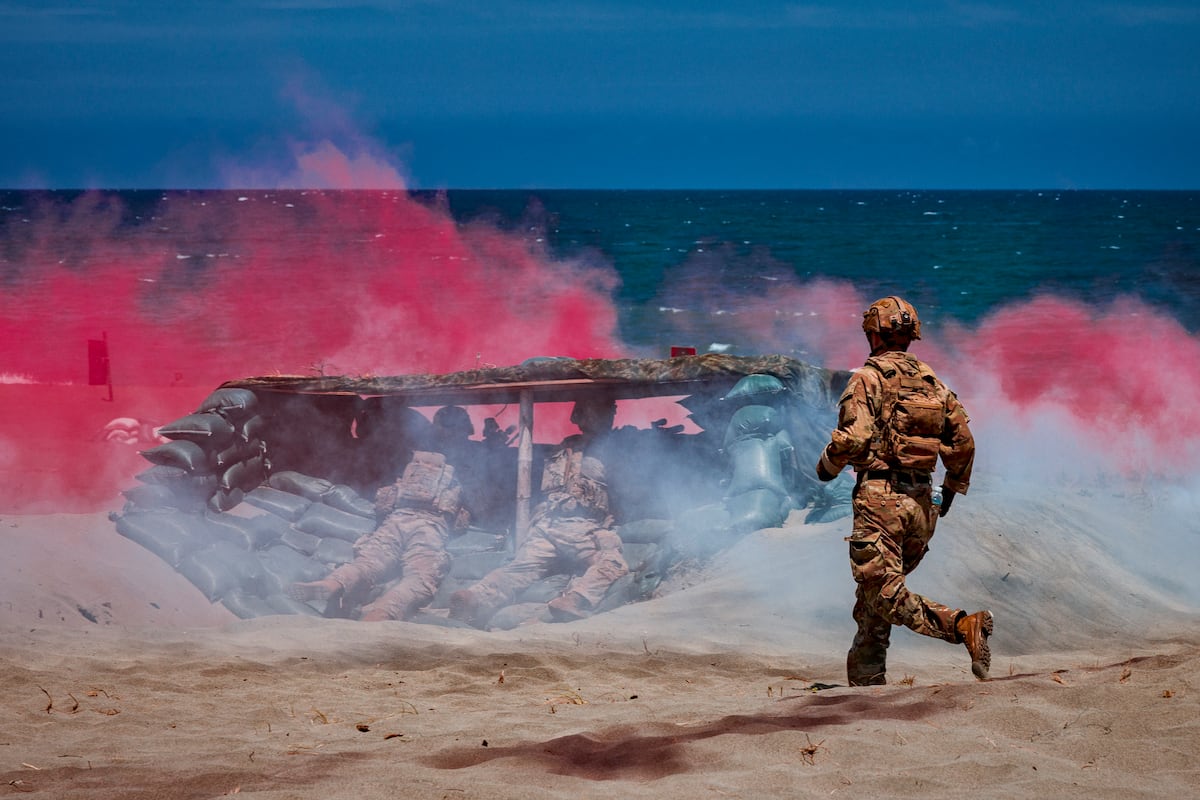
This helps explain why Exercise Balikatan 2026 , held in the Philippines from Apr. 20 to May 8, is the largest-ever drill in the series. It features troops from seven countries: the Philippines, United States, Australia, Canada, France, Japan and New Zealand.
The latter four nations have boots on the ground for the first time, marking a significant growth trajectory for Balikatan.
For Clark, who has headed USARPAC since Nov. 8, 2024, this 41st iteration of Balikatan represents a “full-circle event.” As a young 25th Infantry Division company commander, he attended the annual exercise series back in 1994.
The general told Defense News that it really underscores the growth of the relationship over many years. “It’s those touchpoints that allow us to build the relations that are necessary to strengthen our partnerships, because the partnerships are really the secret sauce. We never go into a conflict by ourselves.”
Clark said Balikatan “is an opportunity for us to train in a way [where] you’d simulate the kinds of tasks we’d perform together in combat at the invitation of the Philippine government on their sovereign soil.”
He also acknowledged Balikatan has changed focus over the years. Whereas counterinsurgency and counterterrorism once predominated, now the focus is “large-scale combat operations” and territorial defense. “It’s the willingness of the partner to train on the task that they think that they’re going to have to perform in crisis and conflict,” Clark noted.
Balikatan 2026 therefore featured two distinct counter-landing, live-fire exercises , as well as maritime key terrain seizure operations in far-flung islands in the Luzon Strait that sit south of Taiwan.
U.S. Army Gen. Ronald Clark, U.S. Army Pacific commander, speaks to U.S., Philippine and Japanese soldiers during a visit to Fort Magsaysay, Philippines, on April 30, 2026, as part of Exercise Balikatan 2026. (US Army/Pfc. Peter Bannister)
These types of operations would be critical to contain the Chinese navy in the event of a conflict over Taiwan. The U.S. military thus rehearsed rapidly moving HIMARS rocket launchers and NMESIS anti-ship missile systems to remote islands, for example.
Clark pointed out: “Everything we can do to build the trust that’s necessary, in times where we’re able to train together prior to any kind of crisis or conflict, is golden.” Further, “Building that kind of trust with one another right now, where we have the confidence in ourselves, our soldiers, our weapons and equipment, our leadership, our tactics – and we’re doing that along with our partners – it’s just invaluable.”
Asked to describe his command focus, Clark replied succinctly, “It’s always the same: it’s people and partnerships so that we can prevail in competition, crisis and conflict.” Balikatan contributes to such purposes, though it is just one of 50-plus exercises that USARPAC conducts annually under its Operation Pathways umbrella.
He said Operation Pathways “changes our mindset in terms of how we think about operationally deploying forces in the theater. … What it is is our ability to set conditions with our partners, allies and the joint force, and conduct rehearsals on key terrain inside the First and Second Island Chains.”
One of the command’s assigned divisions is the Hawaii-based 25th Infantry Division, one of two original Transformation in Contact formations. It is among the vanguard fielding new equipment like M7 rifles, M250 machine guns, drones and Infantry Squad Vehicles, for instance. Clark highlighted that 25th ID is the Army’s only infantry division to possess HIMARS too.
He added that Transformation in Contact also brings industry alongside and gives them direct feedback from soldiers.” The opportunity for soldiers to “take, shake and break” new equipment permits faster iteration.
Clark also noted 25th ID and 4th ID are piloting next-generation, command-and-control suites to enable headquarters to make decisions faster, communicate more securely and grant greater situational awareness.
“What you’re seeing is the Army’s most lethal and technologically advanced mobile infantry formation,” he said.
The Army has three Multi-Domain Task Forces (MDTF), two of them in USARPAC. Clark said the next development will be putting these theater-level MDTF capabilities under a two-star multi-domain command. “That then allows us to be more responsive and plug into the higher headquarters of the joint force.”
Clark promised this will make MDTFs more responsive to the needs of combatant force commanders in time and space. The first of these, Multi-Domain Command Pacific, will be the 7th ID, set to be activated at Joint Base Lewis-McChord in June.
Complementary and challenging
Asked whether the Army is simply trying to replicate what the Marine Corps already does, Clark responded: “The Marine Corps, as part of the land power network in the theater, is a great partner, a great teammate, and we work hand in hand with the capabilities that are resident inside of our formations in order to really cause dilemmas for our adversaries.”
As an example of their complementary nature, Marines did not bring an air wing to Balikatan, so it relied upon the Army’s 25th Combat Aviation Brigade. “What we’re going to try to do is bring the best of both of our capabilities to assist the joint force in the process of solving hard problems,” Clark said.
The Army brings strengths in robust sustainment formations and capabilities, but getting those supplies and sustainment forward in the theater is always challenging. “What we’re trying to do over the course of time is to continue identify places, not bases, where we can forward-locate the sustainment that’s necessary for our teammates to utilize in crises and conflicts,” Clark said. “Setting the theater is one of our primary responsibilities, and we try to do that through campaigning.”
Clark said leveraging new technologies “makes us more lethal, more survivable. If we can see first, sense first, strike first, protect always, sustain as required, then that’s really where we want to focus technology.”
Gordon Arthur is an Asia correspondent for Defense News. After a 20-year stint working in Hong Kong, he now resides in New Zealand. He has attended military exercises and defense exhibitions in about 20 countries around the Asia-Pacific region.
菲律宾克拉克——美国太平洋陆军司令罗纳德·克拉克将军说:“从大局来看,我们最重要的职责是威慑。对于我们这些参加过冲突和战斗的人来说,这才是真正的意义所在——威慑战争。而做到这一点的最佳方法就是做好准备。”
这有助于解释为什么2026年4月20日至5月8日在菲律宾举行的“肩并肩”联合军演是该系列演习中规模最大的一次。此次演习汇集了来自七个国家的军队:菲律宾、美国、澳大利亚、加拿大、法国、日本和新西兰。
后四个国家首次派出地面部队,标志着“肩并肩”联合军演取得了显著进展。
对于自 2024 年 11 月 8 日起担任美国陆军太平洋司令部司令的克拉克来说,此次第 41 届“肩并肩”联合军演具有“圆满意义”。1994 年,年轻的他作为第 25 步兵师的一名连长,就曾参加过这项年度演习。
这位将军告诉《防务新闻》,这确实凸显了多年来两国关系的不断发展。“正是这些接触点让我们能够建立起必要的联系,从而加强我们的伙伴关系,因为伙伴关系才是真正的制胜法宝。我们从不单独卷入冲突。”
克拉克表示,“肩并肩”演习“为我们提供了一个训练的机会,让我们能够模拟应菲律宾政府邀请,在其主权领土上共同执行的战斗任务。”
他还承认,“肩并肩”联合军演的重点近年来有所转变。过去,反叛乱和反恐是其主要任务,而现在则侧重于“大规模作战行动”和领土防御。“关键在于合作伙伴是否愿意针对他们认为在危机和冲突中需要执行的任务进行训练,”克拉克指出。
因此,“肩并肩2026”演习包括两次截然不同的反登陆实弹演习,以及在台湾以南吕宋海峡偏远岛屿上进行的海上关键地形夺取行动。
2026年4月30日,作为“肩并肩2026”联合军演的一部分,美国陆军太平洋司令部司令罗纳德·克拉克将军在菲律宾马格赛赛堡访问期间,与美军、菲律宾军和日本军人交谈。(美国陆军/一等兵彼得·班尼斯特摄)
一旦发生台湾冲突,这类行动对于遏制中国海军至关重要。例如,美军就曾演练过将HIMARS火箭发射器和NMESIS反舰导弹系统快速部署到偏远岛屿。
克拉克指出:“在任何危机或冲突发生之前,如果我们能够一起训练,那么我们所能做的一切,只要能建立必要的信任,都至关重要。”他还表示:“现在彼此建立这种信任,让我们对自身、我们的士兵、我们的武器装备、我们的领导层、我们的战术充满信心——而且我们正在与我们的伙伴一起这样做——这简直太宝贵了。”
当被问及他的指挥重点时,克拉克简洁地回答说:“始终如一:那就是人与伙伴关系,这样我们才能在竞争、危机和冲突中取得胜利。”“肩并肩”联合军演正是为此目的而努力,尽管它只是美国陆军太平洋司令部每年在其“行动路径”框架下开展的50多项演习之一。
他表示,“路径行动”改变了我们对战区部队作战部署的思维方式……它使我们能够与伙伴、盟友和联合部队共同设定条件,并在第一和第二岛链的关键地形上进行演练。
该司令部下属的部队之一是驻扎在夏威夷的第25步兵师,它是最初两支“接触转型”部队之一。该师是率先装备新式装备的部队之一,例如M7步枪、M250机枪、无人机和步兵班组车辆等。克拉克强调,第25步兵师也是陆军唯一装备HIMARS系统的步兵师。
他还补充说,“接触式转型”项目还能让工业界参与其中,并让他们直接获得士兵的反馈。士兵有机会“体验、试用和测试”新装备,从而加快了迭代速度。
克拉克还指出,第 25 步兵师和第 4 步兵师正在试用下一代指挥控制系统,以使总部能够更快地做出决策、更安全地进行通信并提高态势感知能力。
他说:“你们现在看到的是陆军最致命、技术最先进的机动步兵部队。”
陆军拥有三个多域特遣部队(MDTF),其中两个位于美国陆军太平洋司令部(USARPAC)。克拉克表示,下一步是将这些战区级多域特遣部队的能力置于一个两星级多域司令部的指挥之下。“这样一来,我们就能更迅速地响应,并与联合部队的高级司令部更好地对接。”
克拉克承诺,这将使多域特遣部队在时间和空间上更能响应作战部队指挥官的需求。首个成立的多域特遣部队——太平洋多域司令部——将隶属于第7步兵师,计划于6月在刘易斯-麦科德联合基地正式启用。
互补且具有挑战性
当被问及陆军是否只是试图复制海军陆战队已经做的事情时,克拉克回答说:“海军陆战队作为战区陆地力量网络的一部分,是一个很棒的合作伙伴,一个很棒的队友,我们与各自部队内部的能力密切合作,以便真正给我们的对手制造难题。”
为了体现双方的互补性,海军陆战队没有携带航空联队参加“肩并肩”联合军演,而是依靠陆军第25战斗航空旅。“我们将努力发挥双方的优势,协助联合部队解决难题,”克拉克说道。
陆军在后勤保障部队和能力方面拥有强大的优势,但将这些物资和保障物资前沿部署到战区始终是一项挑战。“我们一直在努力寻找合适的地点,而不是基地,以便将战友在危机和冲突中所需的保障物资前沿部署到位,”克拉克说。“战区部署是我们的主要职责之一,我们努力通过作战行动来实现这一目标。”
克拉克表示,利用新技术“能让我们更具杀伤力,更能生存下来。如果我们能先发制人,先发制人,先发制人,始终提供保护,并根据需要维持生存,那么这才是我们真正想要将技术投入到的方向。”
戈登·阿瑟是《防务新闻》的亚洲特派记者。在香港工作20年后,他现居新西兰。他曾到访亚太地区约20个国家,参加过军事演习和防务展览。