An Eagle Named Opus: The Legend Of The Air Force’s Most Notorious F-15一只名叫奥普斯的雄鹰:空军最臭名昭著的F-15战斗机的传奇故事
Aircraft have their own unique personalities. One F-15 Eagle, in particular, had an especially 'colorful' disposition and history, to say the least.
新闻视频
Updated Dec 21, 2020 7:28 PM EST
Every fighter jet ever made comes with its own unique quirks and personality. The pilots that fly and airmen that maintain these aircraft know this all too well. But occasionally an aircraft will roll off the production line destined for unique notoriety and will continue to stand out from the rest—for better or worse. Enter F-15C tail number 80-0002—or just 0002 in USAF parlance—nicknamed “Opus.”
Unlike ships of the Navy that generally enjoy a well-documented and public-facing service career, jets in the Air Force are much harder to keep track of. It makes it difficult as airmen move on from their tours of duty to keep up with their favorite aircraft. As a result, much of the history of Opus is shrouded in the folklore that comes from countless retellings of its stories and the verbal “you just had to be there” history surrounding it.
Opus awaiting its next flight., Patrick Koepke
I like to imagine that Opus rolled off the McDonnell Douglas production line in 1980 looking like Stephen King’s Christine: painted bright red and ready to rock. While the truth is much more pedestrian, it wouldn’t have been surprising given what the future would hold.
During this time, the 36th Tactical Fighter Wing, later renamed the 36th Fighter Wing, stationed at Bitburg Air Base in Germany, began receiving F-15C/D models to replace their A/B models. Opus and many of her sisters were ferried over to Europe and distributed amongst the wing’s three resident fighter squadrons, the 525th, 22nd, and 53rd. They were immediately put to work for U.S. Air Forces in Europe (USAFE), but Opus was already primed to stand out.
US National Archives
The story goes that while being towed back to the hangar, the towbar broke and Opus rolled down a graded pathway and collided with a building. There does not seem to be a record of this incident on file anywhere. It was not found on the Class A/B/C Mishap reports from the era, but that may be due to the incident occurring over 35 years ago. What is known is that the brand new F-15 spent more than a year up on jack stands while the Air Force decided whether it was worth the investment to repair her.
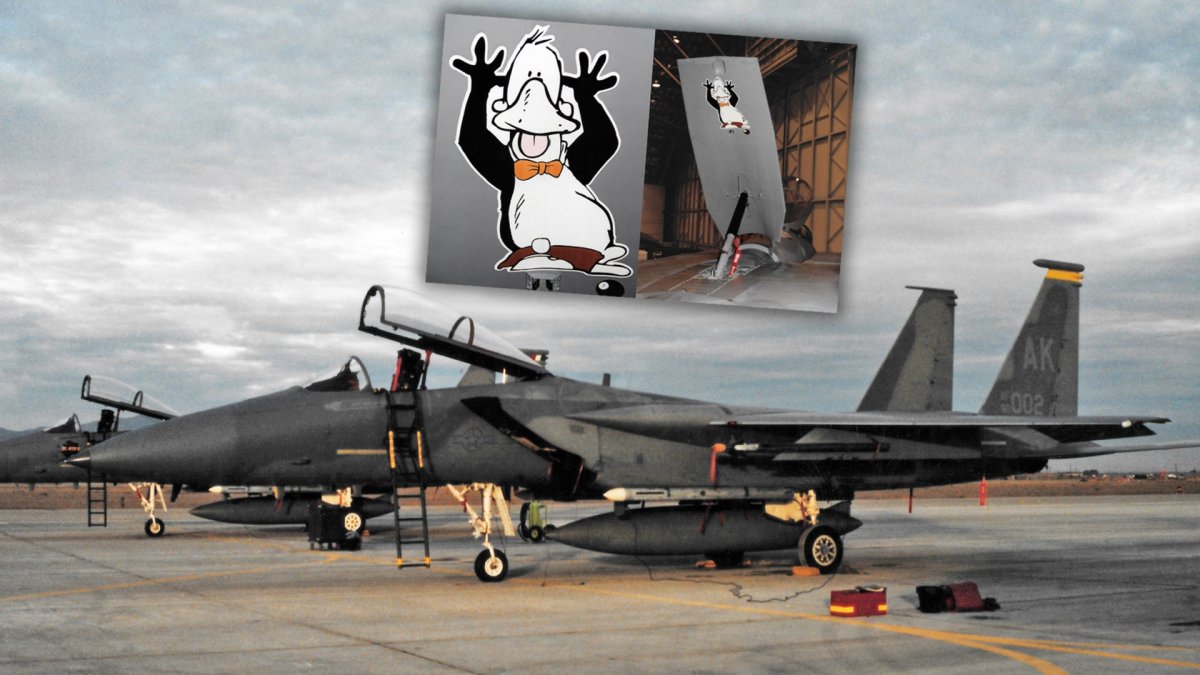
This is where the nickname Opus originated. The jet was named after the penguin in the Bloom County comic strip. This must have seemed fitting since a penguin is a bird that can’t fly.
Eventually, the decision was made to get Opus airworthy again, which leads us to Elmendorf Air Force Base.
By May of 1987, Bitburg was in the process of reshuffling its stable of Eagles and some of its aircraft were being moved to squadrons located at other bases around the globe. A number of these jets went to Spangdahlem Air Base in Germany and Elmendorf Air Force Base in Anchorage, Alaska. Opus was assigned to the latter, joining the 54th Tactical Fighter Squadron of World War II fame.
The next big incident with Opus made the national news and marked a dubious first for an F-15. On March 19th, 1990, a two-ship flight including the squadron commander, Lieutenant Colonel Harris, flying 1054, and Lieutenant Lynch flying Opus, took off for “the sites”—small forward operating bases in Western Alaska. A number of circumstances coincided where a live AIM-9M Sidewinder air-to-air missile sat on Opus’s right pylon (station 8 A or B), while a captive training AIM-9 had been loaded on the left side. It wasn’t out of the ordinary at the time to ferry a live missile to King Salmon or Galena.
Elmendorf F-15s high over the Alaska wilderness. , U.S. National Archives
The pilots spent a portion of the mission dogfighting and when Lynch got a tone from the sidewinder signifying it had locked onto Harris’s jet, he hit the pickle button to simulate firing the missile. Suddenly, the live AIM-9 jumped off the launcher and raced towards 1054. Lieutenant Colonel Harris was able to break and evade, but the missile still shredded the tail of his F-15 and damaged its engine. And so Opus became the first F-15 to have hit another F-15 with live ordnance.
Both jets were able to return to base and the incident brought several changes to the T.O.s (Technical Orders) at the time. An emphasis on visual indicators on the missiles was also mandated, to differentiate “CAP 9s” from live missiles. 1054 was repaired and continued to serve as the ‘squadron jet.’
Like many airmen whose careers take them to the flightline, I experienced some minor hazing when I first arrived. While on the flightline learning how to pull my first pylon, I was sent in to tell Support (the tool room) that we needed prop wash. I could hear the laughter all the way across Hangar 1’s expanse as I made my way back out to the flightline.
But my experience pales in comparison to another airman whose tour of duty with the 54th Fighter Squadron preceded mine. As the story goes, he was told to report to Opus, which was going to be doing an engine run up test. He was instructed to don the “wash rack” gear, which included full-length waterproof coveralls, safety goggles, and thick gloves—gear usually meant to be worn while washing the aircraft. Waiting for the airman was a small six-foot ladder set up about five feet behind Opus’s jet engine exhaust nozzles.
Following instructions, this airman climbed to the top of the ladder, facing the business end of Opus, under the pretense of “measuring the thrust.” Had he actually attempted it, he would have been blown several hundred feet down the flightline.
A1C Koepke checks flight controls while the pilot cycles through each using the stick and rudders. Getting this wrong could cost the pilot his life., Patrick Koepke
They say he stood up there on the ladder like a statue, even as the JFS (Jet Fuel Starter that spools up Engine 1) began to howl. The crew that was in on the joke had to shut down the JSF before the airman got hurt.
He was either incredibly naive or was willing to risk life and limb to call their bluff.
Opus notched another first in 1995, while the 54th Fighter Squadron (now under 3rd Wing’s command) was on a detachment to Luke Air Force Base outside of Phoenix, Arizona. Typically the Air Force ground crews you see on a flightline are made up of three primary maintenance flights within the squadron: Crew Chiefs who maintain, launch, and recover the aircraft, Weapons Troops who load ordnance and assist with launch and recovery, and Avionics Technicians who deal with the aircraft’s electronic systems.
View from the left main gear, the B-Man is waiting for the signal to kick the chocks so Opus can taxi. A1C Koepke waits for the signal., Patrick Koepke
The entire launch process was a choreography of motion and coordination that was a sight to behold. The Crew Chief was the A-Man, a role that inspected the aircraft (usually before and with the pilot), helped the pilot buckle in, walked through the pre-launch checklist with the pilot, and confirmed flight surface checks were nominal. From there, the A-Man stood in front of the jet ready to marshal the aircraft out of its parking spot.
The Weapons Troops owned the B-Man’s job, which was to pull safety pins and kick the chocks on launch, and be ready with the halon bottle should a fire occur. This makes sense because many of the safety pins are inserted into the Eagle’s weapons systems.
I always wanted the A-Man role. I didn’t mind kicking chocks, but was envious of the Crew Chiefs. I somehow convinced my Flight Chief to let me get A-Man qualified, and spent some time prior to the trip to Luke training with Opus’s DCC (Dedicated Crew Chief).
One early morning at Luke, the Quality Assurance team watched me launch Opus and declared me A-Man qualified. I remember being pretty nervous, especially during the flight control check, and remember telling the pilot “good hunting” as I disconnected the cable and moved to the front of the jet. To my knowledge, I was the first Weapons Troop member that got A-Man qualified from Elmendorf and it was fitting that Opus was the one being launched.
A-Man qualifying in progress as A1C Koepke talks to Capt. Russell, the pilot of Opus just prior to launch., Patrick Koepke
Opus was a different kind of aircraft. The life of a Crew Chief is such that you stayed on a broken aircraft until it was fixed. That meant many late nights under the hangar lights with every engine panel opened and every tool and diagnostic tool utilized. I remember Opus’s DCC often staying behind trying to chase an elusive “red X” (a serious problem impacting flying status) while nearly everyone else ended their shift and went home. As a Weapons Troop, I didn’t take part in this recurring “tradition,” other than occasionally helping pull panels on the aircraft when time permitted.
We all had our nicknames for planes that were troublesome. “Pig.” “Hog.” “Hangar Queen.” One jet was broken down so long in Hangar 1 that someone taped a picture of an ear of corn to the nose cone. In Opus’s case, she was never out of commission long, but no repair was easy and no solution clear cut. Her reputation was as a high-visibility melodrama at all times.
Maintaining an Eagle is a huge endeavor, but not all F-15s are alike when it comes to how much tender loving care they need to keep in the air., U.S. National Archives
The next “first” involved a nose art initiative, this time in 1996. In talking with Opus’s DCC, we cooked up an idea to paint the Bloom County penguin character on Opus. At the time the Air Force was pretty strict regarding nose art and/or individualizing the aircraft, though they have lightened up a bit since then. As a result, we had the idea to conceal the artwork on the underside of the air brake, which is a huge panel that extends from the upper fuselage of the jet when the pilot wants to slow down fast. So, it wouldn’t be visible under normal circumstances.
I wrote a proposal to the 3rd Wing’s Commander explaining how nose art fostered squadron unity and identity, and helped both the pilots and maintenance troops feel pride in their aircraft. I was expecting it to be rejected, but it was not only approved, but it was given the ‘wing king’s’ full support. This meant we could involve the Paint Shop—the hangar and airmen that paint the jets—in our ideas and they would make it happen. They helped make vinyl-like images that were applied with soap and water and were designed so they could withstand the weather.
It made sense for Opus to carry the first artwork, which ended up being the character Opus with thumbs in its ears and its tongue sticking out. It was a way to “give the bird” to your opponent in a dogfight.
Opus’s namesake cartoon mascot art lives beneath its ‘board.’, Patrick Koepke
Other jets in the wing started being seen taxiing to EOR with artwork on the backside of their air brakes, and it was fun to see what others were coming up with.
I don’t know how long the artwork stayed on the jets at Elmendorf. I out-processed near the end of 1997, but they were there when I left.
The author with Opus doing the Opus., Patrick Koepke
A few years after I left Alaska I heard the older F-15C/D aircraft (built between ‘78-82) were replaced with newer models (I believe ‘84-87). This sent Opus to Nellis Air Force Base, where she joined the 65th Aggressor Squadron.
When the 65th was inactivated in 2014, Opus landed with the 159th Fighter Wing, flying for the 122nd Fighter Squadron. As of the time of writing this story, Opus is still flying high down in Belle Chasse for the Louisiana Air National Guard.
In talking to a few maintenance members from the 159th, Opus took part in the F-15 Persistent Air Dominance Enabler test , which meant she was fitted with Conformal Fuel Tanks and used in the Boeing program. It is safe to say any maintenance issues Opus may have had up in Alaska seem to have cleared up. One crew chief called Opus a “code 1 machine”—code 1 meaning an aircraft with no broken systems and is fully mission capable before a flight.
Opus wearing the “Persistent Air Dominance” Conformal Fuel Tanks and special missile rails during the Boeing test in 2018. The aircraft was and remains assigned to the “Bayou Militia.”, Jody Fisher
No doubt the pilots and maintenance troops in Louisiana have their own Opus stories to tell.
No one person can claim sole ownership over the rich folklore surrounding Opus. This article only scratches the surface. It’s a safe bet nearly every pilot and maintenance crew that worked around 0002 has their own stories.
One thing is certain, out of the 1,500 F-15s built over the years, Opus truly is one of a kind, and belongs to every pilot that has flown her and airman that have maintained her.
Patrick Koepke served as a 462/2W1 “Load Toad” in the mid-’90s with the 54th FS “Fighting Leopards” at Elmendorf AFB, Alaska. Now he lives in central Texas where he is a writer and occasional songwriter.
Contact the author: Tyler@thedrive.com
Comments couldn’t be loaded. Please refresh the page.
更新于美国东部时间2020年12月21日晚上7:28。
每一架战斗机都有其独特的特性和个性。驾驶这些飞机的飞行员和维护这些飞机的空军人员对此都深有体会。但有时,一架飞机从生产线下线后,注定会因其独特的特性而声名狼藉,并始终与众不同——无论好坏。F-15C 的尾号 80-0002(或美国空军简称的 0002)就是这样一架飞机,它的绰号是“Opus”。
与海军舰艇通常拥有详尽的服役记录和公众视野不同,空军喷气式飞机的行踪很难追踪。这使得飞行员在结束服役后很难继续关注他们心爱的飞机。因此,Opus 的大部分历史都被无数次口口相传的故事和“你必须亲身经历才能体会”的口口相传的历史所掩盖。
Opus 正等待下一次飞行。——帕特里克·科普克
我喜欢想象,1980年Opus从麦克唐纳·道格拉斯生产线下线时,就像斯蒂芬·金笔下的克莉丝汀一样:通体鲜红,蓄势待发。虽然事实远没有那么惊艳,但考虑到未来的发展,这样的设想也并不令人意外。
在此期间,驻扎在德国比特堡空军基地的第36战术战斗机联队(后更名为第36战斗机联队)开始接收F-15C/D型战斗机,以替换其原有的A/B型。奥普斯和她的许多姊妹机被运往欧洲,并分配到该联队的三个常驻战斗机中队:第525中队、第22中队和第53中队。它们立即投入美国驻欧洲空军(USAFE)的作战任务,但奥普斯早已展现出非凡的实力。
美国国家档案馆
据说,在被拖回机库的过程中,拖杆断裂,奥普斯号战机沿着一条坡道滑行,撞上了一栋建筑物。目前似乎没有任何关于这起事故的记录。当时的A/B/C级事故报告中也没有找到相关记录,但这可能是因为事故发生在35多年前。已知的是,这架崭新的F-15战机被架在千斤顶上超过一年,空军一直在权衡是否值得投资维修。
这就是“Opus”这个昵称的由来。这架喷气式飞机是以漫画《布鲁姆县》中的一只企鹅命名的。考虑到企鹅是一种不会飞的鸟,这个名字似乎很贴切。
最终,我们决定让 Opus 重新适航,这就把我们带到了埃尔门多夫空军基地。
到1987年5月,比特堡空军基地正在对其鹰式战斗机机队进行重组,部分飞机被调往全球其他基地的中队。其中一些战机被派往德国的施潘达勒姆空军基地和阿拉斯加州安克雷奇的埃尔门多夫空军基地。“奥普斯”号被分配到后者,加入了二战时期名震一方的第54战术战斗机中队。
奥普斯号的下一次重大事故登上了全国新闻,也标志着F-15战机历史上一个令人担忧的先例。1990年3月19日,由中队长哈里斯中校驾驶的1054号战机和由林奇中尉驾驶的奥普斯号战机组成的双机编队起飞前往“目标地点”——位于阿拉斯加西部的小型前沿作战基地。当时,一系列巧合导致奥普斯号的右侧挂架(8A或8B挂架)上挂载了一枚实弹AIM-9M“响尾蛇”空空导弹,而左侧挂架上则挂载了一枚训练用的AIM-9导弹。在当时,将实弹导弹运送到金鲑镇或加利纳并不罕见。
埃尔门多夫的F-15战斗机高飞越阿拉斯加荒野。(美国国家档案馆)
任务期间,飞行员们进行了一段时间的空战。当林奇收到响尾蛇导弹的提示音,表明它已锁定哈里斯的战机时,他按下模拟发射按钮。突然,一枚实弹AIM-9导弹从发射器中弹射而出,直奔1054号战机而来。哈里斯中校成功躲避,但导弹仍然击穿了他的F-15战机的尾翼,并损坏了发动机。就这样,“奥普斯”号成为了第一架用实弹击中另一架F-15战机的F-15战机。
两架战机均成功返回基地,此次事件促使当时的飞行技术指令(TO)进行了多项修改。其中一项重要内容是加强导弹的视觉标识,以便区分“CAP 9”导弹和实弹导弹。1054号战机修复后继续作为中队战机服役。
和许多职业生涯要到飞行跑道工作的空军人员一样,我刚到的时候也经历了一些小小的“磨练”。当时我正在跑道上学习如何拉起我的第一个挂架,突然被派去告诉后勤部门(工具室)我们需要螺旋桨气流。当我返回跑道时,整个1号机库都回荡着他们的笑声。
但我的经历与另一位比我早在第54战斗机中队服役的空军士兵相比,简直不值一提。据说,他当时接到命令前往“奥普斯”号飞机,该机即将进行发动机试车。他被要求穿戴“清洗架”装备,包括全套防水连体服、护目镜和厚手套——这些装备通常是清洗飞机时穿的。在“奥普斯”号喷气发动机尾喷口后方约五英尺处,架着一架六英尺长的梯子,正等着他上去。
按照指示,这名空军士兵爬到梯子顶端,面对着“奥普斯”导弹的前端,谎称是要“测量推力”。如果他真的尝试这么做,就会被炸飞到跑道几百英尺远的地方。
空军一等兵科普克正在检查飞行控制系统,飞行员则依次操作操纵杆和方向舵。如果操作失误,飞行员可能会丧命。——帕特里克·科普克
据说他像尊雕像一样站在梯子上,一动不动,即便喷气燃料启动器(1号发动机的启动装置)开始发出刺耳的轰鸣声。参与恶作剧的机组人员不得不赶紧关闭JSF发动机,以免飞行员受伤。
他要么是天真得不可思议,要么就是愿意冒着生命危险去揭穿他们的虚张声势。
1995年,奥普斯又创下了一个第一,当时第54战斗机中队(现隶属于第3联队)正驻扎在亚利桑那州凤凰城郊外的卢克空军基地。通常情况下,你在飞行线上看到的空军地勤人员由中队内的三个主要维护部门组成:负责飞机维护、起飞和回收的机组长;负责装载弹药并协助起飞和回收的武器兵;以及负责飞机电子系统的航空电子技师。
从左侧主起落架看去,B-Man正在等待信号踢掉轮挡,以便Opus滑行。一等兵科普克正在等待信号。帕特里克·科普克
整个起飞过程宛如一场精心编排的动作与协调,令人叹为观止。机组长是“A-Man”(起飞检查员),他的职责是检查飞机(通常在飞行员起飞前和飞行员一起检查),协助飞行员系好安全带,与飞行员一起核对起飞前检查清单,并确认飞行表面检查一切正常。之后,“A-Man”站在飞机前,准备引导飞机驶出停机位。
武器部队负责B-Man的工作,即在发射时拔掉安全销、踢开轮挡,并准备好哈龙灭火瓶以防起火。这很合理,因为许多安全销都安装在鹰式战斗机的武器系统中。
我一直都想当A-Man(空中机动员)。我不介意踢轮挡,但很羡慕机组长。我设法说服了我的飞行主管让我考取A-Man资格,并在前往卢克空军基地之前花了一些时间与Opus公司的专职机组长(DCC)一起训练。
在卢克空军基地的一个清晨,质量保证小组观看了我发射“奥普斯”号战机,并宣布我具备了空降兵资格。我记得当时非常紧张,尤其是在飞行控制检查的时候。我还记得在断开连接线并走到战机前部时,我对飞行员说了声“祝你好运”。据我所知,我是埃尔门多夫空军基地武器部队第一个获得空降兵资格的成员,而发射“奥普斯”号战机也算是恰如其分。
A-Man资格认证正在进行中,一等兵科普克在发射前与“奥普斯”号的飞行员拉塞尔上尉交谈。帕特里克·科普克
“奥普斯”号是一架与众不同的飞机。机组长的职责就是守在故障飞机旁,直到它修好为止。这意味着许多个夜晚要在机库灯光下熬夜,打开每一个发动机面板,用尽所有工具和诊断设备。我记得“奥普斯”号的副机组长经常留下来追查那些难以捉摸的“红X”(严重影响飞行状态的问题),而几乎所有人都已经下班回家了。作为一名武器兵,除了偶尔在空闲时帮忙拆卸飞机面板之外,我并没有参与这种反复出现的“传统”。
我们都给那些麻烦的飞机起了绰号。“猪”、“大猪”、“机库女王”。有一架喷气式飞机在1号机库里抛锚太久,以至于有人在机头锥上贴了一张玉米穗的图片。至于“奥普斯”,她虽然从未长时间停飞,但维修起来却异常艰难,也找不到明确的解决办法。她总是像一出引人注目的闹剧。
维护一架F-15战斗机是一项艰巨的任务,但并非所有F-15战斗机所需的维护保养都一样,才能保持良好的飞行状态。(美国国家档案馆)
下一个“第一”是关于机头彩绘的,这次是在1996年。在与Opus的DCC(设计、指挥和控制中心)讨论时,我们萌生了一个想法,要在Opus的机身上绘制布鲁姆县企鹅的形象。当时空军对机头彩绘和/或飞机个性化定制的规定相当严格,不过后来有所放宽。因此,我们想到将彩绘隐藏在减速板的下方。减速板是一块巨大的面板,当飞行员需要快速减速时,它会从机身上部延伸出来。这样,在正常情况下,彩绘是看不到的。
我向第三联队指挥官提交了一份提案,阐述了机头彩绘如何增强中队的凝聚力和认同感,并帮助飞行员和维护人员为自己的飞机感到自豪。我原本以为提案会被驳回,但它不仅获得了批准,还得到了“联队指挥官”的全力支持。这意味着我们可以让喷漆车间——也就是负责飞机喷漆的机库和飞行员——参与到我们的想法中来,他们会负责实施。他们帮助我们制作了类似乙烯基的图案,这些图案可以用肥皂水粘贴,并且经过特殊设计,能够经受住各种天气考验。
Opus 使用第一张原画是合情合理的,最终的原画是 Opus 把拇指塞进耳朵里,吐着舌头。这是一种在空战中向对手“竖中指”的方式。
Opus的同名卡通吉祥物图案就位于其“电路板”下方。——帕特里克·科普克
联队中的其他喷气式飞机开始滑行到EOR,它们的减速板背面都绘有艺术作品,看看其他人想出了什么主意,真是很有趣。
我不知道埃尔门多夫空军基地飞机上的那些艺术作品保留了多久。我大约在1997年底离开基地,但我离开时它们还在那里。
作者与 Opus 合作创作 Opus,帕特里克·科普克
离开阿拉斯加几年后,我听说老旧的F-15C/D型战斗机(1978-1982年间制造)被新型号(我记得是1984-1987年间制造)取代了。这使得“奥普斯”号被派往内利斯空军基地,加入了第65假想敌中队。
2014年第65战斗机联队解散后,“奥普斯”号随即加入第159战斗机联队,隶属于第122战斗机中队。截至本文撰写之时,“奥普斯”号仍在路易斯安那州贝尔查斯空军基地为路易斯安那州空中国民警卫队效力。
在与第159维修中队的几位维护人员交谈后得知,“奥普斯”号曾参与F-15“持久空中优势”赋能器测试,这意味着它加装了保形油箱,并被用于波音公司的测试项目。可以肯定的是,“奥普斯”号在阿拉斯加可能遇到的任何维护问题似乎都已解决。一位机组长称“奥普斯”号为“一级状态”——一级状态指的是飞机在飞行前没有任何系统故障,完全具备执行任务的能力。
2018年波音公司测试期间,Opus飞机配备了“持续空中优势”保形油箱和特制导弹挂架。这架飞机当时和现在都隶属于“沼泽民兵”中队。——乔迪·费舍尔
毫无疑问,路易斯安那州的飞行员和维修人员也有很多关于 Opus 的故事要讲。
没有人能独占围绕着奥普斯号的丰富传说。本文只是浅尝辄止。可以肯定的是,几乎每一位曾驾驶过0002号飞机的飞行员和维护人员都有着属于自己的故事。
可以肯定的是,在多年来建造的 1500 架 F-15 战斗机中,“作品”号绝对是独一无二的,它属于每一位驾驶过它的飞行员和维护过它的空军人员。
帕特里克·科普克在 20 世纪 90 年代中期曾在阿拉斯加埃尔门多夫空军基地的第 54 战斗机中队“战斗豹”担任 462/2W1“装载蟾蜍”的职务。现在他居住在德克萨斯州中部,是一名作家,偶尔也创作歌曲。
联系作者:Tyler@thedrive.com
评论加载失败,请刷新页面。