The Story Behind The Thunderbirds’ Black-Tailed F-4 Phantom And “Captain Carbon”雷鸟飞行表演队黑尾F-4“鬼怪”战斗机和“碳队长”背后的故事
For years, one of the Thunderbird's jets flew its routines with a slightly different paint job than the others. Here's why.
新闻视频
By Joseph Trevithick
Updated May 28, 2021 11:49 AM EDT
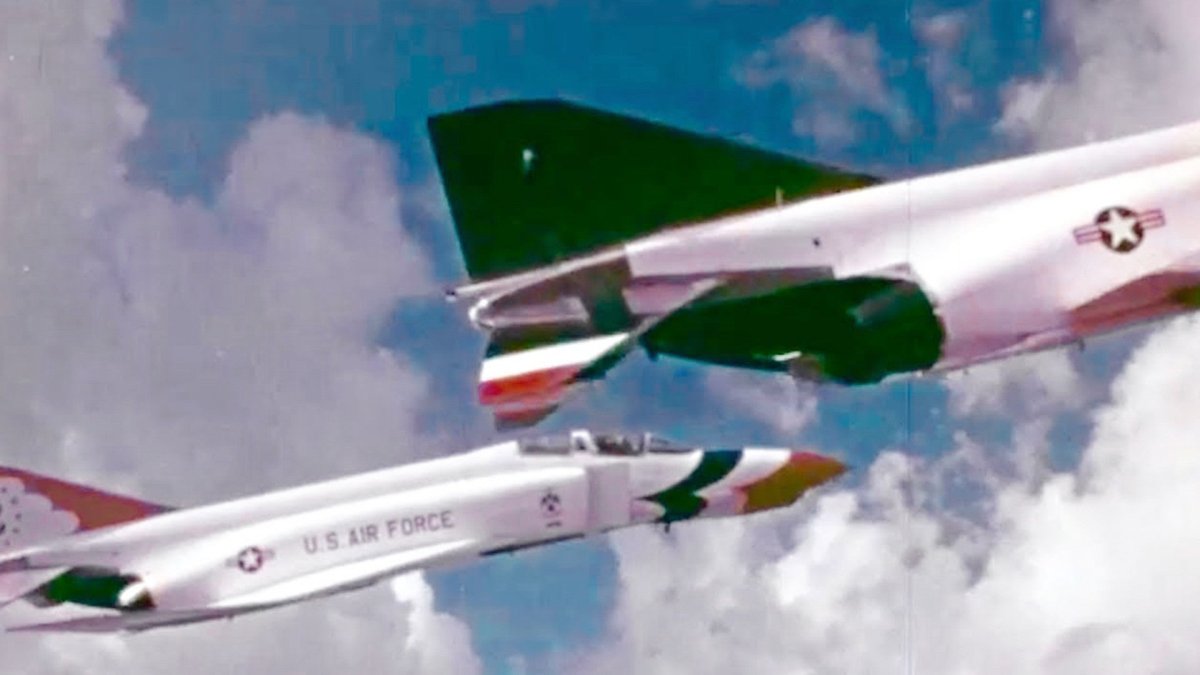
The U.S. Air Force’s Air Demonstration Squadron, better known as the Thunderbirds , has flown a number of different jets over the years, all of which have carried variations on a distinctive and instantly recognizable red, white, and blue paint scheme. It’s a patriotic, high-visibility look that’s very well suited to their already attention-grabbing airshow routines . However, between the late 1950s and early 1970s, when the team flew the F-100C Super Sabre and then the F-4E Phantom II , one of the jets always had a very distinctive variation on this livery, with an all-black tail. There’s a very good reason for why the “slot” jet, the aircraft assigned to fly in the position right behind the lead plane, was colored this way and why the individual at the controls invariably became known as ‘Captain Carbon.’
The Thunderbirds’ black-tailed jet first emerged after the squadron began flying the F-100C in 1956. The team, which was formally established three years earlier, had previously flown the F-84G Thunderjet and then the F-84F Thunderstreak .
A Thunderbird F-4E, circa 1971, with the black tail., YouTube capture
The Super Sabre, which had entered service in 1954, had given the Air Force its first fighter capable of flying at supersonic speed in level flight. The jet, and its afterburning Pratt & Whitney J57 turbojet , rated at 11,700 pounds of thrust, then brought that capability to the Thunderbirds. Sonic booms continued to be a part of the squadron’s routine, if whoever was hosting the airshow they were attending allowed it. This continued even after the team transitioned from the F-100 to the F-4, until the Federal Aviation Administration banned supersonic flight over the United States entirely in 1973.
The F-100Cs also apparently created a different problem for the Thunderbirds, as retired Air Force Colonel Steve Dwelle, who flew with the team between 1971 and 1972, after flying 198 combat missions in the F-100 during the Vietnam War, explained in an interview with the Blue Angel Phantoms YouTube channel , seen in full below, in 2018.
“Well it started, to my knowledge, in the F-100-era,” Dwelle said of the black tail. “The slot pilot, when he’s tucked into position, his tail is right up in the exhaust of the lead ship airplane.”
What this meant was that the slot aircraft was also right in the path of the lead ship’s exhaust plume, and all the sooty gasses inside it. It’s not hard to imagine how the slot jet might’ve looked after a routine. Many early tubrojet engines, including the J57, were notoriously “dirty.”
“Over the course of time, the crew chief had to keep wiping all this soot off the tail and wiping it off, and wiping it off, and wiping it off,” Dwelle continued. “Finally they decided that … they’d just leave it on there and see what happens.”
What happened is pretty obvious.
“So that’s what happened and it’s just carbon that’s coming out of the engine and sticking to the tail,” Dwelle said. “We affectionately refer to the slot pilot … as ‘Captain Carbon.'”
The use of the black tail continued when the Thunderbirds transitioned to the F-4E in 1969. These jets each had a pair of J79 turbojets rated at 17,900 pounds of thrust, at full afterburner, apiece.
The introduction of tubofan engines and smokeless combusters, the latter of which were also added to later versions of the J79, among others, eventually led to the disppearance of the black tail. The practice was gone by the time the Thunderbirds began flying the far more anemic T-38 Talon jet trainer in 1974. Each of those jets had a pair of J85 afterburning turbojets . These engines were also just substantially less powerful, but also more economical than any variant of the J79. With their afterburners going, they are rated at around 2,900 pounds of thrust.
The slot jet’s tail black did not return when the Thunderbirds began flying F-16 Vipers in 1983, either, which leveraged the far less smokey F100 turbofan. It’s not clear if that pilot in that position still gets the Captain Carbon nickname, either.
It’s also interesting to note that the Navy’s flight demonstration team, the Blue Angels , do not ever appear to have had to deal with a black tail on their slot jets, including their F-4s .
Today, the black-tailed Thunderbirds, a creation of crew chiefs fed up with having to constantly clean soot off the slot jet, are just another interesting piece of the team’s storied history.
Contact the author: joe@thedrive.com
Comments couldn’t be loaded. Please refresh the page.
作者:约瑟夫·特雷维西克
更新于美国东部时间2021年5月28日上午11:49
美国空军飞行表演队,也就是更为人熟知的“雷鸟”飞行表演队,多年来驾驶过多种不同的喷气式飞机,所有这些飞机都涂装了不同版本的标志性红、白、蓝三色涂装,极具辨识度。这种爱国主义色彩浓厚、醒目的涂装与他们本身就引人注目的飞行表演非常契合。然而,在20世纪50年代末到70年代初,当雷鸟飞行表演队先后驾驶F-100C“超级佩刀”和F-4E“鬼怪II”战斗机时,其中一架飞机的涂装却非常独特,尾翼为全黑色。这架被分配在领队飞机后方的“槽位”飞机之所以采用这种涂装,以及驾驶这架飞机的飞行员总是被称为“碳黑队长”,都是有原因的。
雷鸟飞行表演队的黑色尾翼喷气式飞机是在1956年该中队开始驾驶F-100C战斗机之后首次出现的。该队于三年前正式成立,此前曾驾驶过F-84G雷霆喷气式战斗机,后来又驾驶过F-84F雷霆战斗机。
一架1971年左右的雷鸟F-4E战斗机,黑色尾翼。(YouTube截图)
1954年服役的超级佩刀战斗机,为美国空军带来了第一款能够在平飞中以超音速飞行的战斗机。这款喷气式飞机及其配备的普惠J57涡轮喷气发动机(推力达11700磅)随后将这种能力带给了雷鸟飞行表演队。如果航展主办方允许,音爆一直是该中队的例行表演。即使在飞行表演队从F-100换装F-4之后,这种做法也一直延续,直到1973年美国联邦航空管理局全面禁止在美国上空进行超音速飞行。
F-100C 显然也给雷鸟飞行表演队带来了另一个问题。退役空军上校史蒂夫·德维尔曾在越南战争期间驾驶 F-100 执行过 198 次战斗任务,并在 1971 年至 1972 年间与该队一起飞行。他在 2018 年接受蓝天使幻影飞行表演队 YouTube 频道采访时解释道(完整采访内容如下)。
“据我所知,黑色尾翼的设计始于F-100时代,”德韦尔谈到黑色尾翼时说道。“当副驾驶飞机的机翼收拢到位时,他的尾翼正好位于领航机的尾焰中。”
这意味着,这架槽式喷气机也正好位于领头飞机尾气羽流及其内部所有烟尘气体的路径上。不难想象,这架槽式喷气机在例行飞行后会是什么样子。许多早期的涡轮喷气发动机,包括J57,都以“污染严重”而臭名昭著。
“随着时间的推移,机组长不得不不停地擦拭尾翼上的烟灰,一遍又一遍地擦,”德韦尔继续说道。“最后他们决定……就让烟灰留在上面,看看会发生什么。”
事情的经过很明显。
“事情就是这样,发动机里出来的积碳粘在了机尾上,”德韦尔说。“我们都亲切地称这位槽位飞行员为‘碳队长’。”
1969 年,雷鸟飞行表演队换装 F-4E 战斗机后,黑色尾翼的使用仍然继续。这些喷气式飞机每架都配备了两台 J79 涡轮喷气发动机,每台发动机在全加力燃烧室状态下的推力为 17,900 磅。
涡扇发动机和无烟燃烧室的引入(后者也被应用于包括J79在内的多种发动机的后续改进型)最终导致了黑色尾翼的消失。到1974年雷鸟飞行表演队开始驾驶动力远逊于J79的T-38“鹰爪”喷气式教练机时,黑色尾翼已经不再使用。每架T-38“鹰爪”教练机都配备了两台J85加力涡轮喷气发动机。这些发动机的动力虽然远不及J79的任何改进型,但也更加经济。开启加力燃烧室后,它们的推力约为2900磅。
1983年雷鸟飞行表演队开始使用F-16“蝰蛇”战斗机时,喷气式飞机尾部的黑色涂装也没有恢复,因为F-16采用的是排放烟雾少得多的F100涡扇发动机。目前还不清楚当时担任这一职务的飞行员是否仍然享有“碳队长”的绰号。
值得注意的是,海军飞行表演队“蓝天使”似乎从未遇到过他们的槽式喷气机(包括 F-4 战斗机)出现黑尾的情况。
如今,这些黑尾雷鸟飞行表演队,是那些厌倦了不断清理喷气式飞机上的烟灰的机组长们创造出来的,它们只是该队传奇历史中又一个有趣的篇章。
联系作者:joe@thedrive.com
评论加载失败,请刷新页面。