China vows not to sell arms to any party in Ukraine war中国承诺不向乌克兰战争中的任何一方出售武器
Qin Gang is the highest-level Chinese official to make such an explicit statement about arms sales to Russia.
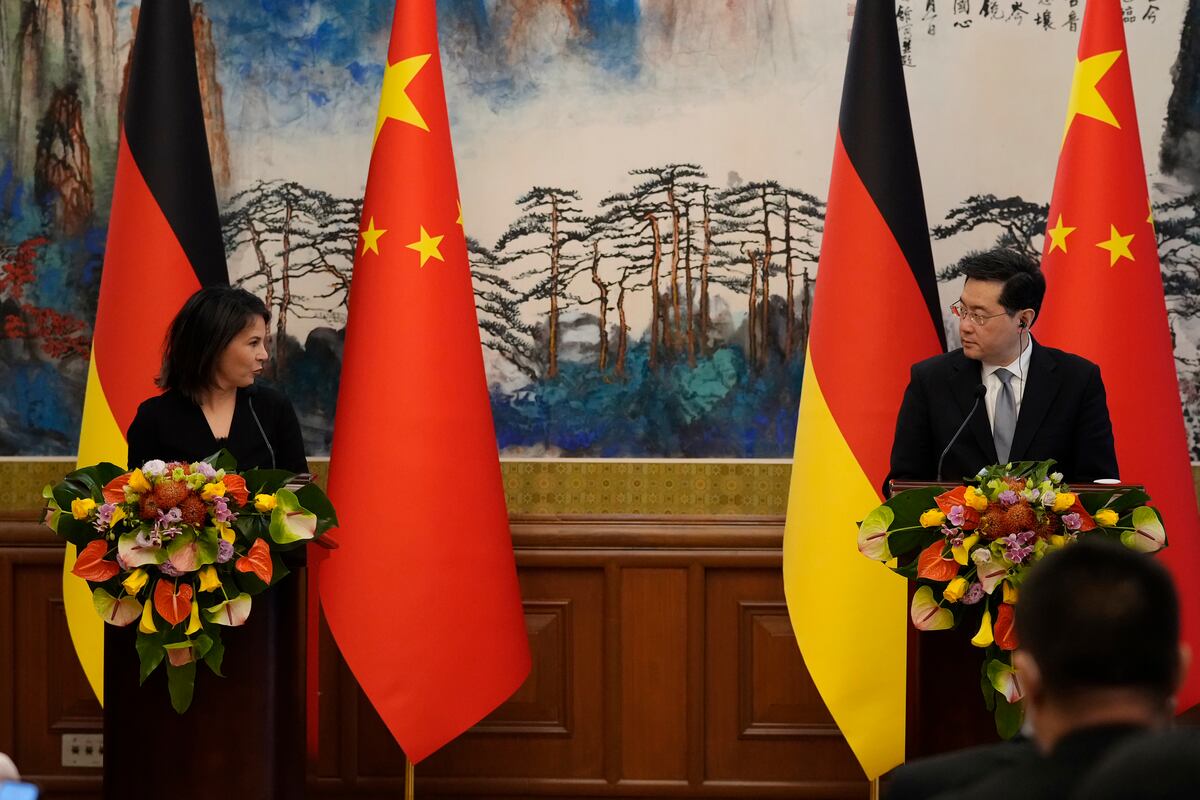
BEIJING — China won’t sell weapons to either side in the war in Ukraine, the country’s foreign minister said Friday, responding to Western concerns that Beijing could provide military assistance to Russia.
China has maintained that it is neutral in the conflict, while backing Russia politically, rhetorically and economically at a time when Western nations have imposed punishing sanctions and sought to isolate Moscow for its invasion of its neighbor .
Qin Gang is the highest-level Chinese official to make such an explicit statement about arms sales to Russia. He added that China would also regulate the export of items with dual civilian and military use.
“Regarding the export of military items, China adopts a prudent and responsible attitude,” Qin said at a news conference alongside visiting German counterpart Annalena Baerbock. “China will not provide weapons to relevant parties of the conflict, and manage and control the exports of dual-use items in accordance with laws and regulations.”
The minister also reiterated China’s willingness to help find a peaceful resolution to the conflict.
At the same news conference, Qin also blamed Taiwan’s government for heightened regional tensions after Beijing held large-scale military drills in an attempt to intimidate the island it claims as its own territory.
In February, U.S. Secretary of State Antony Blinken said the United States had intelligence suggesting China was considering providing arms and ammunition to Russia — and warned that such involvement in the Kremlin’s war effort would be a “serious problem.”
The White House on Friday welcomed Qin’s pledge that China won’t supply weapons to Russia, but expressed a measure of trepidation.
“As we’ve said all along, we don’t believe it’s in China’s best interest to move in that direction. We will continue to monitor closely,” White House National Security Council spokeswoman Adrienne Watson said in a statement.
European leaders have issued similar warnings, even as they visited China. The European Union’s foreign policy chief lashed out at Beijing, saying its support of Russia during the invasion was “a blatant violation” of its United Nations commitments.
In her remarks, Baerbock also referred to China’s role as a permanent member of the U.N. Security Council, saying it bore a special responsibility for helping end the conflict.
“But I have to wonder why the Chinese positioning so far does not include a call for the aggressor, Russia, to stop the war,” she said. “We all know that President [Vladimir] Putin would have the opportunity to do so at any time, and the people in Ukraine would like nothing more than to finally be able to live in peace again.”
A visit to Moscow last month by Chinese leader Xi Jinping underscored how Beijing is increasingly becoming the senior partner in the relationship as it provides Russia with an economic lifeline and political cover. China announced Friday that Defense Minister Gen. Li Shangfu would visit Russia next week for meetings with his counterpart Sergei Shoigu and other military officials.
On both Ukraine and Taiwan, Qin articulated well-worn defenses of Chinese policies that underscore Beijing’s rejection of criticisms from the West, particularly the U.S.
Under the ardently nationalist Xi, China has sharpened its rhetoric, particularly on the issue of Taiwan, which split from mainland China amid civil war in 1949.
Tensions around the island rose significantly after China deployed ships and fighter planes near Taiwan last weekend in retaliation for a meeting between U.S. House Speaker Kevin McCarthy and the island’s president, Tsai Ing-wen.
China insists that self-governing Taiwan submit to its rule, either peacefully or by force, and Qin said the pursuit of independence by Taiwan’s government and its foreign supporters — a veiled reference to chief ally the United States — were the reason for the tensions.
Baerbock warned that a conflict in the Taiwan Strait, through which much of the world’s international trade passes, would bring global disaster.
“We therefore view the increasing tensions in the Taiwan Strait with great concern,” she said. “Conflicts must be resolved peacefully. A unilateral change of the status quo would not be acceptable to us as Europeans.”
Apparently rejecting Baerbock’s concerns, Qin said Taiwan was “China’s internal affair.”
“Taiwan independence and peace cannot coexist,” he said.
北京——中国外交部长周五表示,中国不会向乌克兰战争的任何一方出售武器,以此回应西方对北京可能向俄罗斯提供军事援助的担忧。
中国一直声称在冲突中保持中立,但在西方国家对俄罗斯实施严厉制裁并试图孤立莫斯科以报复其入侵邻国之际,中国却在政治、言辞和经济上支持俄罗斯。
秦刚是迄今为止就对俄军售发表如此明确表态的最高级别中国官员。他还补充说,中国还将规范军民两用物品的出口。
秦平在与来访的德国外长安纳莱娜·贝尔伯克共同出席的新闻发布会上表示:“中国在军物出口问题上采取审慎负责的态度。中国不会向冲突有关各方提供武器,并将依法依规管控两用物项的出口。”
该部长还重申,中国愿帮助寻求和平解决冲突的途径。
在同一场新闻发布会上,秦平还指责台湾政府加剧了地区紧张局势,此前北京举行了大规模军事演习,试图恐吓台湾——北京声称台湾是其领土的一部分。
今年2月,美国国务卿安东尼·布林肯表示,美国掌握的情报显示,中国正在考虑向俄罗斯提供武器弹药,并警告说,中国参与克里姆林宫的战争行动将是一个“严重问题”。
白宫周五对秦始皇承诺中国不会向俄罗斯提供武器表示欢迎,但也表达了一定程度的担忧。
白宫国家安全委员会发言人艾德里安·沃森在一份声明中表示:“正如我们一直以来所说,我们认为中国朝这个方向发展并不符合其最佳利益。我们将继续密切关注事态发展。”
欧洲领导人在访问中国期间也发出了类似的警告。欧盟外交政策负责人猛烈抨击北京,称其在入侵期间支持俄罗斯是“公然违反”其在联合国所作承诺的行为。
贝尔伯克在讲话中还提到了中国作为联合国安理会常任理事国的角色,称中国对帮助结束冲突负有特殊责任。
“但我不得不质疑,为什么中国迄今为止的立场没有呼吁侵略者俄罗斯停止战争,”她说道。“我们都知道,普京总统随时都有机会这样做,而乌克兰人民最渴望的莫过于再次生活在和平之中。”
中国领导人习近平上个月访问莫斯科,凸显了北京在中俄关系中日益占据主导地位,中国为俄罗斯提供经济生命线和政治庇护。中国周五宣布,国防部长李尚福将于下周访问俄罗斯,与俄罗斯国防部长谢尔盖·绍伊古及其他军方官员举行会晤。
在乌克兰和台湾问题上,秦先生重申了中国政策一贯的辩护立场,强调北京拒绝接受西方,特别是美国的批评。
在民族主义情绪高涨的习近平领导下,中国的言辞变得更加尖锐,尤其是在台湾问题上。台湾在1949年的内战中从中国大陆分裂出来。
上周末,中国在台湾附近部署舰艇和战斗机,以报复美国众议院议长凯文·麦卡锡与台湾总统蔡英文的会晤,此后台湾周边地区的紧张局势显著升级。
中国坚持要求自治的台湾服从其统治,无论是以和平方式还是武力方式。秦始皇表示,台湾当局及其外国支持者(暗指其主要盟友美国)追求独立的举动是造成紧张局势的原因。
贝尔博克警告说,台湾海峡(世界大部分国际贸易的必经之地)一旦发生冲突,将带来全球灾难。
“因此,我们对台湾海峡日益紧张的局势深表关切,”她说。“冲突必须以和平方式解决。单方面改变现状是我们欧洲人无法接受的。”
秦显然不认同贝尔博克的担忧,称台湾是“中国内政”。
他说:“台湾独立与和平无法共存。”