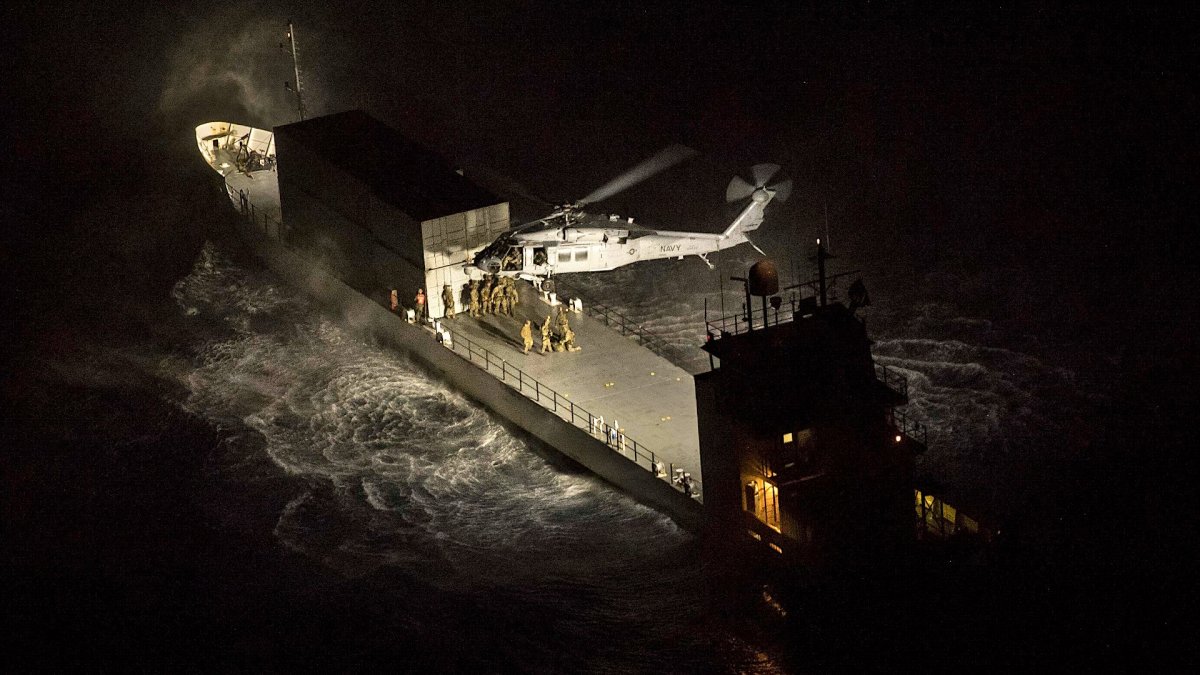
Check Out This Eerie Image Of A Navy Special Ops Seahawk Raiding A Ship In The Dead Of Night看看这张令人毛骨悚然的照片:一架海军特种作战海鹰直升机在深夜突袭一艘军舰
The unique Navy helicopter unit that supported this particular exercise could be on the chopping block next year.
By Joseph Trevithick
Updated May 10, 2021 8:34 PM EDT
The U.S. Navy’s Helicopter Sea Combat Squadron 85, or HSC-85, also known as the “Firehawks,” helped members of a specialized U.S. Coast Guard counter-terrorism unit train to rappel down and quickly board a ship where terrorists might be in control and holding hostages last month. The crews of HSC-85, the Navy’s only helicopter squadron dedicated to providing special operations forces support, are very familiar with the tactics, techniques, and procedures required for these kinds of Helicopter Visit Board Search and Seizure operations. The Navy now wants to shutter HSC-85 as part of its 2021 Fiscal Year budget proposal to help free up funds for other priorities.
The MH-60S Seahawk from HSC-85, which is part of the Navy Reserve, joined elements of the Coast Guard’s Maritime Safety Response Team West (MSRT West) and the Navy’s Aerial Target Launch Ship 9701 (ATLS 9701) for the exercise off the coast of San Diego, California on Feb. 11, 2020. Another MH-60S from the “Black Knights” of Helicopter Sea Combat Squadron 4 (HSC-4) also took part in the training.
Members of MRST West also rappeled onto the deck of ATLS 9701 from an MH-60S from HSC-4 during the night, as seen here, and during the day during the exercise in February 2020., USN
The two MH-60S helicopters flew members of MSRT West out to ATLS 9701 on simulated Helicopter Visit Board Search and Seizure (HVBSS) missions during the day and at night. The helicopters also extracted some of the Coast Guardsmen by winching them back up into the helicopter afterward.
The MH-60S from HSC-85 hovers low over the deck of Aerial Target Launch Ship 9701 during one of the day time mock HVBSS missions that took place during the February 2020 exercise., USN
Members of MSRT West fast-rope from the MH-60S from HSC-4 during the February 2020 exercise., USN
The Coast Guard established MSRT West, together with MSRT East based on the east coast, in 2006 as dedicated counter-terrorism teams capable of performing direction action missions against terrorists who might be occupying a ship or facility on shore. The MSRTs are among the most elite of the Coast Guard’s Deployable Operations Group and their personnel routinely train with members of U.S. military special operations units, such as the Navy SEALs, and tactical teams from federal law enforcement agencies, such as the Federal Bureau of Investigation and U.S. Customs and Border Protection.
The MH-60S from HSC-4 winches up Coast Guard personnel from ATLS 9701’s deck., USN
Navy personnel pull members of the Coast Guard’s MSRT West into the cabin of the MH-60S from HSC-4 during the exercise. The other MH-60S from HSC-85 is seen flying overwatch in the background., USN
The MSRTs’ mission set includes being prepared to conduct higher risk HVBSS missions, so training with units such as HSC-85 is also something that occurs regularly. Though Hollywood military and action movies make it look simple, fast-roping from a helicopter, especially onto a ship bobbing up and down, is something that definitely requires routine practice.
Helicopter crews also need to be proficient in being able to safely get into the right position and maintain a steady hover, potentially in a very confined space, while the personnel on board are rappelling down to the ground or ship’s deck below. This can be a tricky proposition under the best circumstances and even more so at night and if hostiles below are shooting back. You can read about all the planning that goes into these kinds of operations in this past War Zone piece .
The Navy and Marines, often use the 264-and-a-half-feet-long ATLS 9701, the only ship of its kind in service, for HVBSS training because it has a flat open main deck. The U.S. military, as well as the Coast Guard, also often uses chartered vessels for fast-rope training.
The nearly 860-ton-displacement ATLS 9701 is also approved for various other specialized training roles, such as carrying targets for snipers riding in helicopters and providing space for personnel to train to breach a ship’s hatches or shipping container doors, or to otherwise conduct operations in the confined spaces of a ship. As its name suggests, VT Halter Marine originally built the ship, which is capable of operating in an unmanned mode, for the Navy to support other exercises, as well as research and development and operational test and evaluation activities, by serving as a launchpad for unmanned target drones .
A Navy briefing slide describing some of ATLS 9701’s capabilities., USN
ATLS 9701 looks to set to continue to be a useful training platform for the Coast Guard’s MSRTs and other specialized units for years to come. However, the future of HSC-85 is anything but certain. In its latest budget request for the 2021 Fiscal Year, the Navy announced plans to inactivate the squadron, which would eliminate the service’s last dedicated special operations support helicopter unit.
HSC-85, which was officially established in 1970, took on the special operations support mission, as well as the Firehawks name, in 2011. This came five years after the Navy shuttered Helicopter Combat Support Squadrons (Special) 5, or HCS-5. That squadron had also been known as the Firehawks.
In 2006, the Helicopter Combat Support Squadrons (Special) 4, or HCS-4, also known as the Redwolves, had closed its doors, with Helicopter Sea Combat Squadron 84 (HSC-84) taking over its special operations support mission. HCS-4 and HCS-5, which were also Navy Reserve squadrons, had evolved from the famous Vietnam War-era Helicopter Attack Squadron (Light) 3, or HA(L)-3, the “Seawolves,” which provided support for SEALs and other specialized units in the Mekong Delta region.
The Navy had begun looking to cut HSC-84 and HSC-85 in 2013. Three years later, the service succeeded in inactivating HSC-84, but pressure from Congress help preserve HSC-85. The service is now making arguments for getting rid of the remaining squadron again.
US special operators rappel from an HH-60H Seahawk assigned to HSC-84 during Exercise Emerald Warrior 2014., USAF
“While HSC-85 is a dedicated SOF [special operations] support unit with highly trained aviators and some unique equipment, General Purpose Force HSC squadrons are trained and equipped to provide similar capability – particularly in maritime environments,” a briefing book accompanying the Navy’s 2021 Fiscal Year budget request explained. “Further, the U.S. Army and U.S. Air Force maintain aviation SOF support capability that is more robust and better resourced, and those units enjoy a close support relationship with USSOCOM [U.S. Special Operations Command].”
The helicopters assigned to the Army’s Special Operations and Air Force Special Operations Command’s CV-22B Osprey tilt-rotors are definitely much more capable than the MH-60S in the special operations support role. The Seahawks are notably not capable of refueling in flight, which significantly limits their operational range. HSC-85’s status as a Navy Reserve unit also means that its helicopters are low on the priority list to receive other important modifications and upgrades. You can read much more about these issues in detail in this past War Zone piece .
Congress still has to approve the Navy’s plan to shutter HSC-85. The fact that HSC-4’s took part in this recent Helicopter Visit Board Search and Seizure exercise does support the service’s argument that other helicopter sea combat squadrons can provide similar support for special operations and other specialized units, such as the Coast Guard’s Maritime Safety Response Teams, going forward.
Contact the author: joe@thedrive.com
Comments couldn’t be loaded. Please refresh the page.
作者:约瑟夫·特雷维西克
更新于美国东部时间2021年5月10日晚上8:34
美国海军第85海上作战直升机中队(HSC-85),又称“火鹰”,上个月协助美国海岸警卫队一支特种反恐部队的成员进行训练,学习如何速降并迅速登上可能被恐怖分子控制并劫持人质的船只。HSC-85是海军唯一一支专门为特种作战部队提供支援的直升机中队,其机组人员非常熟悉此类直升机登临检查和扣押行动所需的战术、技术和程序。然而,海军现在计划在其2021财年预算提案中关闭HSC-85,以便腾出资金用于其他优先事项。
2020年2月11日,隶属于海军预备役部队的HSC-85中队的MH-60S“海鹰”直升机与海岸警卫队西部海上安全响应小组(MSRT West)和海军空中靶舰9701号(ATLS 9701)的部分人员在加利福尼亚州圣地亚哥海岸附近参加了演习。来自第4直升机海上作战中队(HSC-4)“黑骑士”的另一架MH-60S也参加了此次训练。
如图所示,在2020年2月的演习期间,西部海上救援支援小组(MRST West)的成员在夜间以及白天,从HSC-4中队的MH-60S直升机上绳降到ATLS 9701的甲板上。
两架MH-60S直升机白天和夜间执行模拟直升机登临检查和扣押(HVBSS)任务,将西部海上救援队(MSRT West)成员送往ATLS 9701。任务结束后,直升机还用绞车将部分海岸警卫队员吊回机舱。
在2020年2月的一次演习中,美国海军第85重型轰炸机中队的MH-60S直升机在9701号空中靶舰的甲板上低空盘旋,当时正在进行白天的模拟重型轰炸机拦截任务。
2020年2月演习期间,美国海军西部海上救援队(MSRT West)成员从HSC-4中队的MH-60S直升机上快速绳降。
美国海岸警卫队于2006年成立了西部海上安全反应小组(MSRT West),与位于东海岸的东部海上安全反应小组(MSRT East)并肩作战,这两支专门的反恐队伍能够对可能占据舰船或岸上设施的恐怖分子执行定向行动任务。MSRT是海岸警卫队可部署行动小组中最精锐的部队之一,其人员经常与美国军事特种作战部队(例如海军海豹突击队)以及联邦执法机构(例如联邦调查局和美国海关与边境保护局)的战术小组进行联合训练。
美国海军HSC-4中队的MH-60S直升机使用绞车将海岸警卫队人员从ATLS 9701甲板上吊起。
演习期间,海军人员将海岸警卫队西部多用途反应小组(MSRT West)的成员拉入HSC-4中队的MH-60S直升机机舱。背景中可以看到HSC-85中队的另一架MH-60S直升机正在进行警戒飞行。
MSRT的任务包括随时准备执行高风险的直升机舰艇安全突击任务,因此与HSC-85等部队的联合训练也是他们的日常工作。虽然好莱坞军事动作片看起来轻而易举,但从直升机上快速绳降,尤其是在上下颠簸的舰艇上,绝对需要反复练习。
直升机机组人员还需要熟练掌握安全抵达指定位置并保持稳定悬停的技能,尤其是在空间非常有限的情况下,同时机上人员正通过绳索下降到地面或下方的舰艇甲板。即使在最佳情况下,这都是一项棘手的任务,在夜间或敌方火力压制下更是如此。您可以在之前《战区》杂志的一篇文章中了解此类行动的全部计划。
海军和海军陆战队经常使用长264.5英尺的ATLS 9701号舰艇进行高空跳伞安全训练,因为它拥有平坦开阔的主甲板。ATLS 9701是目前服役的同类型舰艇中唯一一艘。美国军方以及海岸警卫队也经常租用船只进行快速绳降训练。
排水量近860吨的ATLS 9701还获准执行多种其他专业训练任务,例如为乘坐直升机的狙击手运送目标,为人员提供训练空间以破拆舰船舱口或集装箱门,或在舰船狭小空间内进行其他作业。正如其名称所示,VT Halter Marine最初为海军建造这艘具备无人操作能力的舰艇,旨在支持其他演习、研发以及作战测试和评估活动,作为无人靶机的发射平台。
一份海军简报幻灯片,描述了ATLS 9701的部分功能。
ATLS 9701 似乎将在未来几年继续作为海岸警卫队海上救援队 (MSRT) 和其他特种部队的重要训练平台。然而,HSC-85 的未来却充满变数。在最新的 2021 财年预算申请中,海军宣布计划解散该中队,这将使海军最后一个专门负责特种作战支援的直升机部队消失。
HSC-85 于 1970 年正式成立,并于 2011 年接手特种作战支援任务,同时沿用“火鹰”这一名称。此前五年,海军关闭了第 5 特种直升机战斗支援中队(HCS-5)。该中队也曾被称为“火鹰”。
2006年,第4特种直升机战斗支援中队(HCS-4,又称“红狼”)解散,其特种作战支援任务由第84直升机海上作战中队(HSC-84)接管。HCS-4和HCS-5均为海军预备役中队,它们由越战时期著名的第3轻型直升机攻击中队(HA(L)-3,又称“海狼”)发展而来,该中队曾为湄公河三角洲地区的海豹突击队和其他特种部队提供支援。
海军早在2013年就开始考虑裁撤HSC-84和HSC-85中队。三年后,海军成功解散了HSC-84,但国会的压力使得HSC-85得以保留。如今,海军又开始提出裁撤剩余的HSC-85中队。
在2014年“翡翠勇士”联合军演期间,美国空军特种作战人员从隶属于HSC-84中队的HH-60H“海鹰”直升机上绳降而下。
海军2021财年预算申请的一份简报解释说:“虽然HSC-85是一支专门的特种作战支援部队,拥有训练有素的飞行员和一些独特的装备,但通用部队的HSC中队也接受过类似的训练并配备了相应的装备,能够提供类似的支援能力,尤其是在海上环境中。此外,美国陆军和空军拥有更强大、资源更充足的航空特种作战支援能力,并且这些部队与美国特种作战司令部保持着密切的支援关系。”
陆军特种作战司令部和空军特种作战司令部装备的CV-22B“鱼鹰”倾转旋翼机在特种作战支援方面无疑比MH-60S更胜一筹。值得注意的是,“海鹰”直升机不具备空中加油能力,这极大地限制了其作战半径。此外,由于HSC-85是海军预备役部队,其直升机在其他重要改装和升级方面优先级较低。您可以在之前的《战区》文章中阅读更多关于这些问题的详细内容。
国会仍需批准海军关闭 HSC-85 的计划。HSC-4 参与了最近的直升机访问委员会搜查和扣押演习,这一事实确实支持了海军的论点,即其他海上作战直升机中队可以为特种作战部队和其他专业单位(例如海岸警卫队的海上安全响应小组)提供类似的支援。
联系作者:joe@thedrive.com
评论加载失败,请刷新页面。