France and Germany sign off on future battle tank system法国和德国签署未来主战坦克系统协议
Defense officials in Berlin are expected to award contracts for an initial demonstrator phase by year's end.
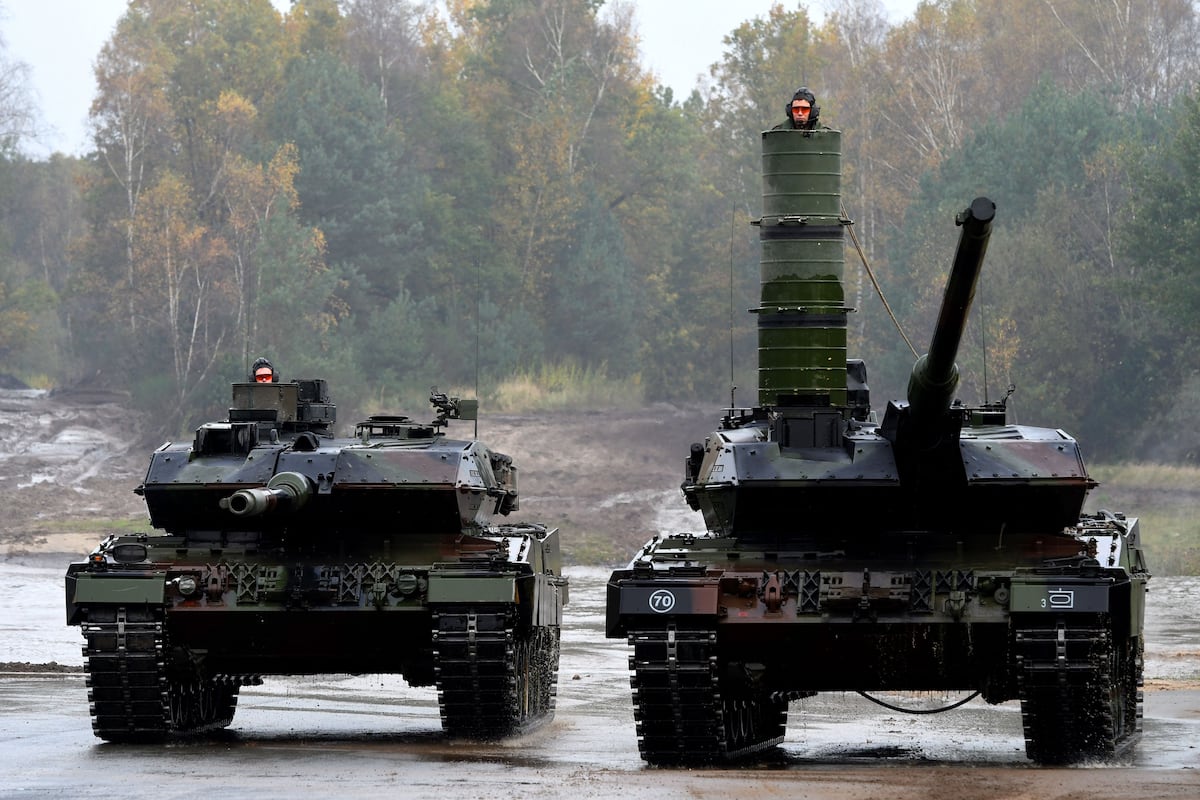
PARIS — France and Germany have formalized an agreement to develop a future battle-tank system, with the countries’ defense ministers signing off on an industrial work-share pact here on Friday.
The countries’ defense firms – KNDS, Rheinmetall and Thales, among others – can now get to work on proposals, which are expected in the coming months, French Armed Forces Minister Sebastian Lecornu said at a briefing. Germany is leading the project and will be in charge of awarding contracts for the first demonstrator phase by the end of this year.
Lecornu and his German counterpart Boris Pistorius in the past eight months have managed to reboot the project known as the Main Ground Combat System, which languished for years amid wrangling over which countries’ industries would get to work on what. The ministers, who have said they get along well, last month agreed on divvying up the workload equally between both nations .
The political agreement “will force the different industrials to work together,” Lecornu said, adding that cooperation can be decreed, or created by setting a concrete industrial target. “We can’t have this type of partnership without also creating a common culture between the industries.”
Lecornu said lessons were learned from discussions around the joint Future Combat Air System, where in some cases industrial agreement was reached before German, Spanish and French air forces were asked for their input. That is “out of the question” for the MGCS project, which is based on the needs of the countries’ two armies rather than industrial ideas, the French minister said.
Officials of the German Armed Forces, the Bundeswehr, have stressed the modular character of the envisioned system. Tank variants with different specializations, working in concert on the battlefield, will all share a common undercarriage, according to a statement on the Bundeswehr website. The concept has yet to be proven, and as of now there are no studies or models yet about a system demonstrator for the program as a whole, it adds.
Designing a completely new land combat weapon will entail pulling together the operational experience from tank warfare of the past years, including lessons learned from Ukraine’s defense against Russian invaders, which has seen hundreds of main battle tanks destroyed or incapacitated.
France and Germany will be designing “not so much the tank of the future, but the future of the tank,” Lecornu said. He said the U.S. hasn’t yet started considering the post-Abrams era, while Russia is experiencing “great difficulty” moving from its current generation of tanks to a successor.
Germany is counting on the future combat system to replace its Leopard tanks sometime in the 2040s, while France is looking for the MGCS to replace its Leclerc fleet.
Competition in the tank domain will become “tougher and tougher” towards 2040, with giants such as India and others “waking up” and potentially flooding the market for land-forces equipment in coming years, according to Lecornu. The focus on technological and innovative breakthroughs should position the MGCS in a different market segment that will boost its export prospects, the minister said.
Lecornu said work on the planned demonstrator will be split 50-50, as will future production capacity. Still, he said industrial distribution wasn’t at the core of the memorandum of understanding signed on Friday, but rather the two governments saying that they need the same tank in 2040.
The joint French-German tank effort is “something we very much welcome,” NATO Secretary General Jens Stoltenberg said at a press conference in Germany on Thursday, before the agreement was signed in Paris. “It will make NATO stronger and it will help allies to get new and modern capabilities.” Cooperation will help overcome defense-industry fragmentation, the NATO chief said.
Multiple other countries have expressed interest in the MGCS program, including Italy as well as countries in Eastern Europe, Pistorius said at the briefing in Paris. He said making Europe stronger also means including more partners.
The project will be divided into eight pillars, including for the main platform, the turret and gun combination, new types of fires, connectivity and electronic warfare. While some of those pillars are obvious areas for French-German cooperation, for some the leadership will be “purely national,” based among other things on industrial experience, according to Lecornu.
Tanks’ vulnerability to drone attacks as well as the waning effectiveness of 120mm cannons against ever-improving armor are among the pitfalls on the German military’s radar, according to Bundeswehr.
With a decision on a next cannon still outstanding, what’s clear is that it will need bigger projectiles with higher velocity, one unnamed German acquisition official is quoted as saying. Calibers of 130mm or 140mm are being considered.
According to the Bundeswehr statement, it is “highly probable” that MGCS will use some kind of hybrid diesel-electric propulsion system. A near-silent electric drive will be harder to hear on the battlefield, a tactical advantage during certain operations, the thinking in Berlin goes.
Rudy Ruitenberg is a Europe correspondent for Defense News. He started his career at Bloomberg News and has experience reporting on technology, commodity markets and politics.
Sebastian Sprenger is associate editor for Europe at Defense News, reporting on the state of the defense market in the region, and on U.S.-Europe cooperation and multi-national investments in defense and global security. Previously he served as managing editor for Defense News. He is based in Cologne, Germany.
巴黎——法国和德国正式达成协议,共同开发未来的主战坦克系统。两国国防部长于周五在此签署了一项工业合作协议。
法国国防部长塞巴斯蒂安·勒科尔努在一次简报会上表示,包括KNDS、莱茵金属和泰雷兹在内的各国国防企业现在可以着手制定方案,预计将在未来几个月内公布。德国牵头该项目,并将负责在今年年底前授予第一阶段验证机项目的合同。
过去八个月里,莱科尔努和他的德国同行鲍里斯·皮斯托瑞斯成功重启了“主战地面作战系统”项目。该项目此前因两国企业在研发分工问题上的争论而停滞多年。两位部长表示彼此关系良好,并于上个月达成协议,由两国平均分配研发工作。
莱科尔努表示,这项政治协议“将迫使不同行业的企业携手合作”,并补充说,合作可以通过法令强制执行,也可以通过设定具体的行业目标来促成。“如果我们不能在各行业之间建立共同的文化,就无法实现这种伙伴关系。”
勒科尔努表示,他们从未来作战空中系统(FCA)联合项目的讨论中吸取了教训。在FCA项目中,有时在征求德国、西班牙和法国空军的意见之前,就已经达成了工业协议。这位法国部长强调,MGCS项目“绝不可能”出现这种情况,因为MGCS项目是基于两国军队的实际需求,而非工业理念。
德国联邦国防军官员强调了该系统的模块化特性。根据联邦国防军网站上的声明,不同用途的坦克变型将在战场上协同作战,所有坦克都将共享一个通用底盘。声明还补充说,该概念尚未得到验证,目前还没有关于整个项目系统演示样机的研究或模型。
设计一种全新的陆地作战武器需要汇集过去几年坦克战争的作战经验,包括从乌克兰抵抗俄罗斯入侵者中吸取的教训,乌克兰已有数百辆主战坦克被摧毁或失去战斗力。
勒科尔努表示,法国和德国将着眼于设计“与其说是未来的坦克,不如说是坦克的未来”。他还指出,美国尚未开始考虑后艾布拉姆斯时代,而俄罗斯在从现有坦克过渡到后续型号方面正面临“巨大困难”。
德国指望未来作战系统在 2040 年代的某个时候取代其豹式坦克,而法国则希望 MGCS 取代其勒克莱尔坦克。
莱科尔努表示,到2040年,坦克领域的竞争将“愈发激烈”,印度等国等军事强国将“觉醒”,并可能在未来几年大量涌入陆军装备市场。他指出,专注于技术和创新突破应能使MGCS定位在不同的市场领域,从而提升其出口前景。
莱科尔努表示,计划中的示范坦克项目将由两国政府各承担一半,未来的产能也将如此。不过,他指出,工业分销并非周五签署的谅解备忘录的核心内容,而是两国政府都希望在2040年拥有同一款坦克。
北约秘书长延斯·斯托尔滕贝格周四在德国举行的新闻发布会上表示,法德联合研制坦克“我们非常欢迎”。此前,双方已在巴黎签署了相关协议。斯托尔滕贝格说:“这将增强北约的实力,并帮助盟国获得新的现代化能力。”他还表示,合作将有助于克服国防工业分散的局面。
皮斯托瑞斯在巴黎的新闻发布会上表示,包括意大利和东欧国家在内的多个国家都对MGCS项目表示了兴趣。他还表示,增强欧洲实力也意味着要吸纳更多合作伙伴。
该项目将分为八大支柱,包括主平台、炮塔与火炮组合、新型火力、互联互通和电子战。勒科尔努表示,虽然其中一些支柱显然是法德合作的重点领域,但另一些支柱的主导权将“完全由各国自行掌控”,主要依据包括工业经验等因素。
据德国联邦国防军称,坦克容易受到无人机攻击,以及120毫米火炮对不断改进的装甲的有效性日益下降,这些都是德国军方关注的隐患。
一位不愿透露姓名的德国军方采购官员表示,虽然下一代火炮的选型尚未最终确定,但可以肯定的是,它将需要更大口径、更高初速的炮弹。目前正在考虑的口径为130毫米或140毫米。
根据德国联邦国防军的声明,MGCS“极有可能”采用某种柴电混合动力推进系统。柏林方面认为,近乎无声的电力驱动系统在战场上更难被察觉,这在某些作战行动中具有战术优势。
鲁迪·鲁伊滕贝格是《防务新闻》的欧洲记者。他的职业生涯始于彭博新闻社,拥有报道科技、大宗商品市场和政治方面的经验。
塞巴斯蒂安·斯普伦格是《防务新闻》欧洲版副主编,负责报道该地区的防务市场状况,以及美欧在防务和全球安全领域的合作和多国投资。此前,他曾担任《防务新闻》执行主编。他现居德国科隆。