Rocket carrying new nuclear missile component explodes in late-night test一枚搭载新型核导弹部件的火箭在深夜测试中爆炸
Officials are investigating the cause of the mishap, which did not injure anyone.
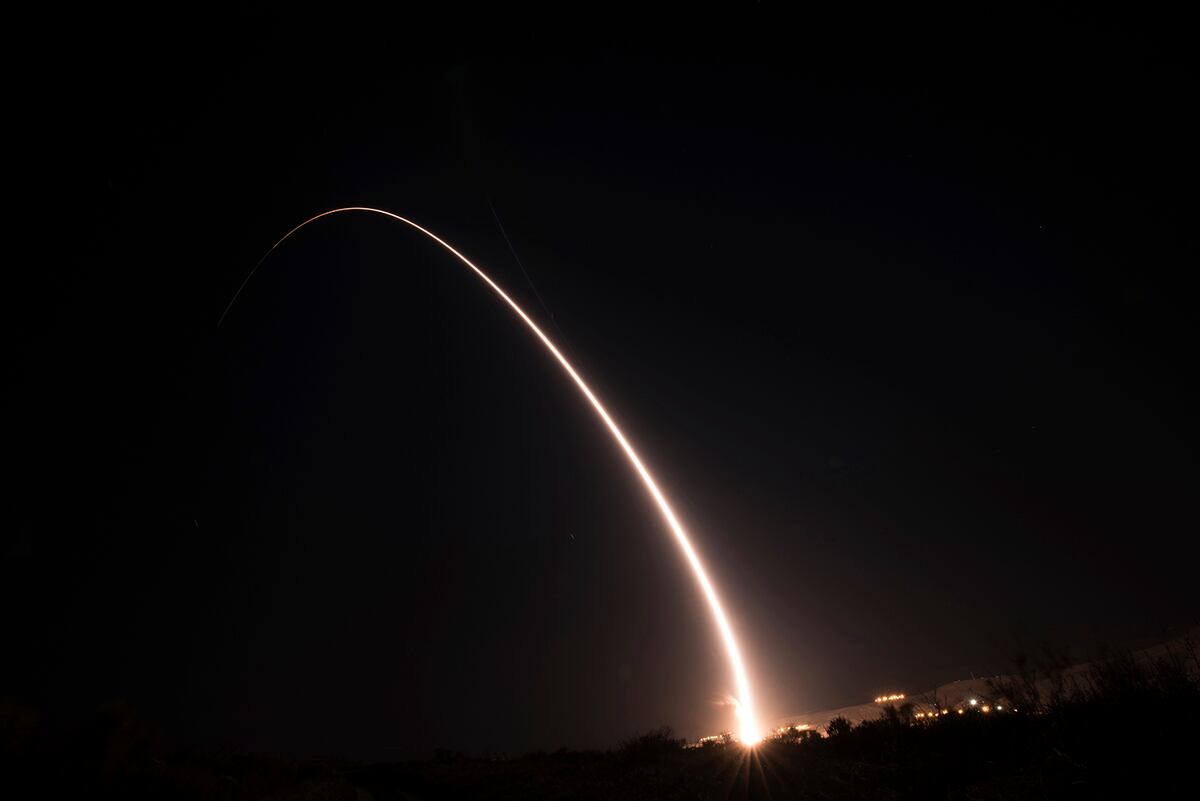
A military rocket exploded Wednesday during the first test launch of a key component of America’s future land-based nuclear missiles.
The rocket, known as the Minotaur II+, blew up about 10 seconds after launching from Vandenberg Space Force Base , California, around 11 p.m. local time.
“There were no injuries in the explosion and the debris was contained to the immediate vicinity of the launch pad,” the base said.
Officials will investigate the cause of the mishap.
The Minotaur II+ combines parts of decommissioned Minuteman intercontinental ballistic missiles and an upper segment of the current Minuteman III nuke to create a missile used for suborbital test launches.
Vandenberg routinely holds live tests of unarmed missile bodies — without a nuclear warhead inside — to check how the aging ICBMs are faring and to vet new technology.
In this case, the Air Force Nuclear Weapons Center said the practice missile was carrying a Mark 21A reentry vehicle, or the part of a nuclear weapon that would hold a real warhead.
Military officials are gathering “detailed, reliable” data that will help shape the prototype system into the final product, according to the service.
The Air Force has contracted with Lockheed Martin to redesign the Mk21A to carry 300-kiloton W87-1 nuclear warheads — 15 times the explosive power of the “Fat Man” bomb dropped on Nagasaki, Japan, in 1945 — on the LGM-35 Sentinel missile now in development at Northrop Grumman.
“The W78 is one of the oldest warheads in the stockpile, and the W87-1 modification program provides improvement in warhead security, safety and … control,” according to the Energy Department, which manages the program.
The updated reentry vehicle, which carries the warhead to the edge of space in an arc before gliding down to its target, is also expected to accommodate future warhead designs on the new ICBMs in the coming decades.
Sentinel ICBMs will replace the 400 nuclear missiles in underground silos across Montana, Wyoming and North Dakota in the late 2020s.
Rachel Cohen is the editor of Air Force Times. She joined the publication as its senior reporter in March 2021. Her work has appeared in the Washington Post, the Frederick News-Post (Md.), Air and Space Forces Magazine, Inside Defense, Inside Health Policy and elsewhere.
周三,一枚军用火箭在首次试射美国未来陆基核导弹的关键部件时发生爆炸。
这枚名为“米诺陶二号+”的火箭于当地时间晚上 11 点左右从加利福尼亚州范登堡太空部队基地发射升空约 10 秒后爆炸。
基地方面表示:“爆炸中无人受伤,碎片也仅限于发射台附近。”
官方将调查事故原因。
米诺陶 II+ 导弹结合了已退役的民兵洲际弹道导弹的部分部件和当前民兵 III 核弹的上段,用于亚轨道试验发射。
范登堡空军基地经常对未装填核弹头的导弹弹体进行实弹测试,以检验老旧洲际弹道导弹的性能,并检验新技术。
空军核武器中心表示,这枚训练导弹携带的是 Mark 21A 再入飞行器,也就是核武器中可以装载真正弹头的部件。
据军方称,军方官员正在收集“详细、可靠”的数据,这将有助于把原型系统打造成最终产品。
美国空军已与洛克希德·马丁公司签订合同,重新设计 Mk21A 导弹,使其能够携带 300 千吨级的 W87-1 核弹头——其爆炸威力是 1945 年投掷在日本长崎的“胖子”原子弹的 15 倍——该弹头将搭载在诺斯罗普·格鲁曼公司正在开发的 LGM-35 哨兵导弹上。
“W78 是库存中最老的弹头之一,而 W87-1 改进计划提高了弹头的安全性、可靠性和控制能力,”负责管理该计划的能源部表示。
更新后的再入飞行器可将弹头以弧线轨迹带到太空边缘,然后滑翔至目标位置,预计未来几十年内,它还将适用于新型洲际弹道导弹的未来弹头设计。
2020 年代末期,哨兵洲际弹道导弹将取代蒙大拿州、怀俄明州和北达科他州地下发射井中的 400 枚核导弹。
瑞秋·科恩是《空军时报》的编辑。她于2021年3月加入该刊物,担任高级记者。她的作品曾发表在《华盛顿邮报》、《弗雷德里克新闻邮报》(马里兰州)、《空军与太空部队杂志》、《国防内幕》、《卫生政策内幕》等刊物上。