What It Is Like Flying The Most Advanced F-15 Eagle Ever Built驾驶有史以来最先进的F-15“鹰”式战斗机是一种怎样的体验?
A test pilot's perspective on Qatari F-15QA trials that will pave the way to deliveries in 2021, and help the development of the USAF’s new F-15EX.
新闻视频
Updated Nov 30, 2020 5:19 PM EST
Boeing is engaged in a period of intensive flight-testing of its latest variant of the F-15, which is on order for the Qatar Emiri Air Force. The F-15QA is the most state-of-the-art variant of the Eagle to date, building upon the F-15SA that was developed for Saudi Arabia. Qatar has ordered 36 F-15QAs , which are the first to feature a new Advanced Cockpit System with Large Area Displays, among other improvements. The F-15QA is the variant upon which the U.S. Air Force’s new F-15EX will be based.
Boeing announced the first flight of the F-15QA on April 14, 2020, which took place at the manufacturer’s Lambert International Airport in St. Louis, Missouri. Three F-15QAs are currently in Boeing’s flight-test program, with two examples having been dispatched to Air Force Plant 42 at Palmdale, in California, for intensive trials in November. “This is largely a mission systems and cockpit test effort, focusing on these key areas,” explained Boeing Chief Test Pilot Matt “Phat” Giese, speaking exclusively to The War Zone .
“We are going to touch pretty much every aspect of the mission system, and make sure everything is integrated properly for this customer. This is a short part of the overall test program [for the F-15QA], and involves just a few weeks here in Palmdale. There’s some unique things we can do here from a range and airspace capability that we just can’t get at our plant in St Louis, and that’s why we have this mini deployment.”
F-15QA turning final at Plant 42 in Palmdale., Dan Stijovich
Giese explained that the current test work at Palmdale is designed to ensure that the first F-15QAs are ready for delivery to the customer in 2021. “The key is to clear the critical test points that we can’t get done in St. Louis, so we can support the first ferry next year — that’s what we are driving maturity into the system for.”
“The nearby R-2508 range complex is one of the areas we are training in, so you can get the air-to-ground, low-altitude, parts completed. One of the key things out here on the west coast is the Sea Test Range for over-water testing.” Giese said that the Palmdale detachment coincided with the Boeing test team passing the 100 flight test hour milestone across the test fleet of three F-15QAs.
An F-15QA is put through its paces during testing at Palmdale in November., Dan Stijovich
Giese has been heavily involved in test work related to the Boeing Advanced F-15 . “It was a little nostalgic bringing the F-15QA out here, as it’s been a while since we were here [testing the Royal Saudi Air Force F-15SA ]. So it was exciting to get back on the site. It reminds me of the hard work we put in over a seven year period on the Advanced F-15’s digital fly-by-wire [FBW] system.” The F-15SA was the first variant of the Eagle to feature a fly-by-wire system.
“I’ve been involved from the very beginning of this new transition, where we took an incremental leap from the — for lack of a better term — “legacy” F-15 to what is now a “digital” F-15, and that happened when we made the first flight of the Saudi jet on February 20, 2013. I was a part of the subsequent testing out here, and that was full envelope — high and fast, low and slow — all the things we had to do to verify the envelope.”
The move to fly-by-wire control was a transformational leap for the F-15, and represented one of the biggest upgrades since the very first YF-15A made its maiden flight in June 1972. It meant that the Boeing test team had to effectively start from scratch when it came to evaluating the F-15SA. “The point of the flight-test program for the digital Eagle was to verify the entire flight envelope,” explains Giese. “The Advanced F-15 has new flight control computers, and a new digital architecture — so with the complete redesign we had to go out and verify numbers that had been in the tech orders since the 1970s.”
The F-15SA was the first fly-by-wire Eagle, which first flew in 2013., Boeing
“We re-validated the envelope, and verified that the performance was as good as or better — in almost all cases better — than [earlier] F-15s. Some of that testing included flutter, where you shake the airplane at very high speeds and at varying altitudes, to determine if there’s going to be any vibrations that are objectionable or cause any structural damage. We did noise and vibration testing, and high angle-of-attack work to demonstrate that the aircraft is not just a good high and fast fighter, but also able to fly slow when the pilot needs to turn hard and point at something. It was as if it was a brand new clean sheet design, and as a test pilot, I was in heaven.”
The aim of bringing fly-by-wire to the F-15 was threefold. Reliability, redundancy, and performance. “From a reliability perspective, you have two flight control computers, and each has two channels, plus quadruple inputs to each of the flight control surfaces. A quad-redundant flight control system from the flight control computers to the stabilators provides very high levels of reliability. The mean time between failures for flight control problems rose significantly higher. I can say personally, in the six-plus years of flight-test that I did on the new digital fly-by-wire flight control system, I had zero ground aborts for flight controls.”
“In the performance realm, the F-15 has always been awesome at going high and fast — we’re the only jet that gets out to Mach 2.5 — but it’s also a really good low speed, high angle-of-attack fighter if you need to get into the fight in a phonebooth with an adversary. With helmet mounted sights there’s less of a requirement to point at an adversary to prosecute an attack, but if you need to turn, the Advanced F-15 has incredible capability. Throughout the test program I tried to spin this jet, and I was unsuccessful, even with high lateral asymmetry on the platform. This is a very stable, safe, reliable, flight control system.”
The F-15QA features the same digital FBW flight control system, as well as two significant developments over the F-15SA — the new cockpit and structural enhancements. The wings and the nose barrel were completed with Boeing’s Full-Size Determinant Assembly [FSDA] production techniques. F-15 FSDA uses a process to eliminate drilling and shimming from assembly by adding fastener holes at the supplier level. This new process significantly reduces rework, increases quality, and leads to improved ergonomics. “It’s reducing parts, it’s easier to install, and it increases the life of the platform,” says Giese.
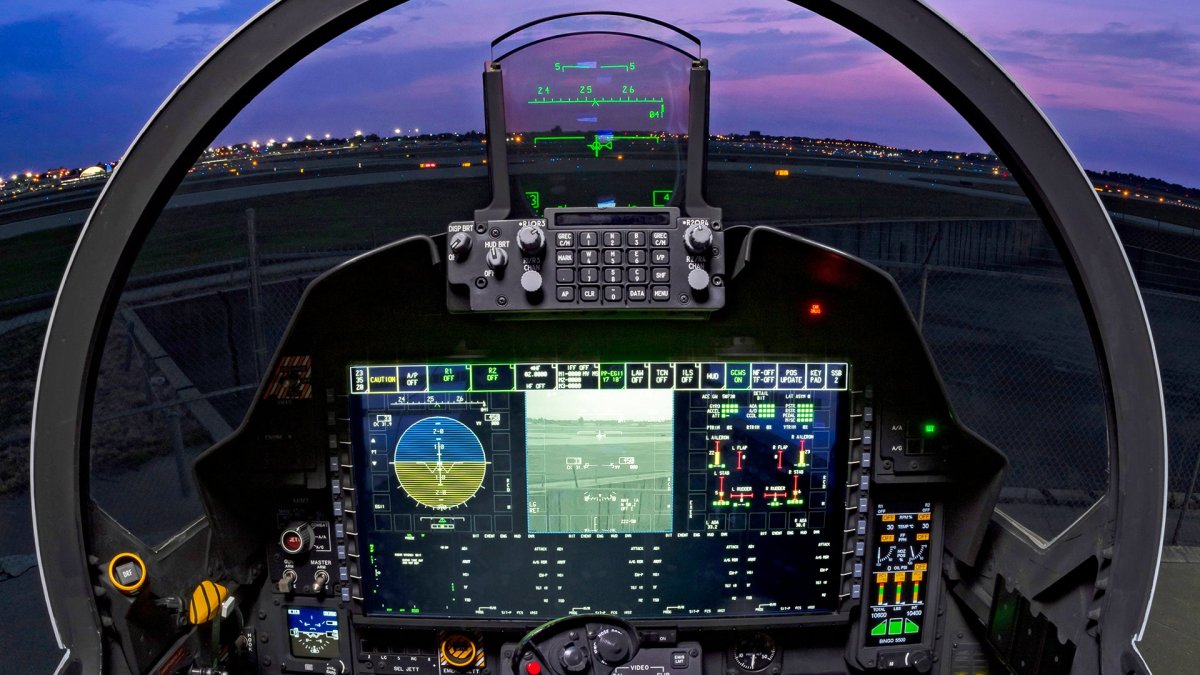
The cockpit of the Advanced F-15 complete with new Large Area Display and low-profile HUD., Boeing
“The bedrock of the new cockpit layout is the new all-glass Large Area Display [LAD],” explains Giese. “The test program for the QA is designed to mature this product.” That testing consists of verifying the major mission systems on the aircraft: such as the Raytheon AN/APG-82(v)1 Active Electronically Scanned Array (AESA) radar, and how the the LAD interfaces with what Giese calls “the heartbeat of the jet” — the ADCP II (Advanced Display Core Processor II) mission computer.
“I like to call the LAD my F-15 iPad,” smiles Giese. “It’s a 10×19-inch display that’s fitted in both cockpits, all glass, and it features an infrared [IR] touch display. Both are configurable per cockpit, so my Weapons Systems Officer can set the display in a different way to how I set up my display based on personal preference. There are a couple of different window formats that we have available and they will match the variables of the particular mission. There may be a time I’m on an eight window display, a five window display, or maybe I want two giant 9×9 windows to look at if maybe I’m doing some precise targeting. They can be changed very quickly and what we’re finding in flight-testing is that the very high-resolution color image quality of the screen allows for very precise targeting, monitoring of the sensors, and mission management.”
“We have taken a lot of lessons learned from other platforms and rolled them into this LAD technology. You can manipulate the display with a bare or gloved finger, or move individual windows around by tapping and moving them. One of the feedbacks we got from other platforms is that in turbulent environments or if you’re under G, it can be hard to manipulate the touchscreen, so we’ve made everything on the LAD to also be controllable via the Hands-On Throttle-And-Stick [HOTAS] controls — you can move cursors, change the display format — so you don’t have to actually touch the display. Other feedback we got is that some pilots just like to push a button or rotate a knob, so underneath the new low-profile Head-Up Display [HUD] is what’s called the HRCCP [HUD Radio Communications Control Panel]. This features the same digital keypad as on the LAD, so if you want to go old fashioned and hit a button or change a radio channel, you can do that — including under G or in turbulent conditions — as opposed to using the large area touch display capability. It’s the exact same format as on the LAD, so it’s not something else you have to learn.”
An F-15QA on approach to Palmdale in November., Dan Stijovich
The F-15QA also features the aforementioned new low profile HUD . Giese says: “It’s a little narrower than the previous HUD, more in line with the F-15C in terms of the size. We’ve learned as time moves on that the HUD is being used less and less — especially for tactical things — because we have helmet-mounted displays and the ability to keep eyes out of the cockpit and and display all of that data on a Digital Joint Helmet-Mounted Cueing System ( D-JHMCS ). So, reliance on the HUD is slowly diminishing. This is the baseline now, so future variants will also feature this low-profile HUD, including the F-15EX.”
A lot of the current test work, while meeting Qatari requirements, is de facto applicable to the new F-15EX for the USAF. “It’s a great effort to focus on the Qatari jets, but everything we’re doing here is going to roll into the F-15EX,” Giese endorses. “We are really going to shift our focus to delivering the F-15EX aircraft early next year for the USAF flight-test program. It’s giving us a high confidence level that this is going to be a mature delivery of those first two aircraft to the USAF early next year.”
The main difference between the F-15QA and the F-15EX is that the new USAF Eagles will include the Eagle Passive Active Warning Survivability System ( EPAWSS ). In addition, the F-15QA runs a bespoke customer Operational Flight Program (OFP) software, whereas the F-15EX will run OFP Suite 9, which dovetails with the current F-15E Strike Eagle and F-15C standard. It’s designed to promote commonality across the F-15 community. “I can see an operator that can quickly jump from platform to platform because of the commonality between the OFPs,” says Giese.
This was one of the key drivers for getting the F-15EX into USAF hands quickly — a ready solution that allows existing F-15C and E personnel to move seamlessly to the new jet with only minimal retraining.
Boeing intends to wrap-up F-15QA verification work in time for deliveries next year. The flight-test team will then move over to F-15EX verification testing. The work that is already being completed with the Qatari jets is helping to expedite that process, meaning that the USAF’s new Advanced F-15s will be able to meet the objective of being ready and available on the flightline in very short order — complete with all the latest bells and whistles found on the world’s most impressive Eagles to date, and more.
Author’s note: A big thanks to our friend Dan Stijovich for the fantastic photographs of the F-15QA at Palmdale.
Contact the editor: Tyler@thedrive.com
Comments couldn’t be loaded. Please refresh the page.
更新于美国东部时间2020年11月30日下午5:19。
波音公司正在对其最新型的F-15战斗机进行密集的飞行测试,该机型已为卡塔尔埃米尔空军订购。F-15QA是迄今为止最先进的F-15“鹰”式战斗机,它是在为沙特阿拉伯开发的F-15SA的基础上改进而来。卡塔尔订购了36架F-15QA,这些战机是首批配备新型先进座舱系统(含大面积显示屏)的战机,此外还进行了其他改进。F-15QA也是美国空军新型F-15EX战斗机的基础型号。
波音公司于2020年4月14日宣布F-15QA战斗机首飞成功,首飞地点位于该公司位于密苏里州圣路易斯的兰伯特国际机场。目前,波音公司共有三架F-15QA战斗机参与飞行测试项目,其中两架已于去年11月被送往位于加利福尼亚州帕姆代尔的空军42号工厂进行密集测试。波音首席试飞员马特·“胖子”·吉斯在接受《战区》独家采访时解释说:“这主要是一次任务系统和座舱测试,重点关注这些关键领域。”
“我们将对任务系统的各个方面进行全面测试,确保所有组件都能为客户正确集成。这只是F-15QA整体测试计划的一小部分,在帕姆代尔仅需几周时间。这里拥有圣路易斯工厂无法提供的靶场和空域能力,我们可以进行一些独特的测试,这就是我们进行此次小型部署的原因。”
F-15QA 正在帕姆代尔 42 号工厂进行最后的转弯。丹·斯蒂约维奇
吉斯解释说,目前在帕姆代尔进行的测试工作旨在确保首批F-15QA飞机能在2021年交付给客户。“关键在于完成我们在圣路易斯无法完成的关键测试点,这样我们才能支持明年的首架飞机交付——这就是我们努力提升系统成熟度的目的。”
“附近的R-2508靶场是我们训练的地点之一,可以在这里完成空对地、低空等部分的训练。西海岸的关键设施之一是海上试验靶场,用于水上测试。”吉斯表示,帕姆代尔分遣队进驻帕姆代尔的同时,波音测试团队的三架F-15QA测试机队也完成了100小时的飞行测试里程碑。
11月,一架F-15QA战斗机在帕姆代尔进行测试。(丹·斯蒂约维奇摄)
吉斯一直深度参与波音先进型F-15战斗机的测试工作。“把F-15QA带到这里有点怀旧,因为我们上次来这里(测试沙特皇家空军的F-15SA)已经是很久以前的事了。所以能回到这里真是令人兴奋。这让我想起了我们过去七年在先进型F-15的数字电传操纵系统(FBW)上付出的艰辛努力。”F-15SA是首款采用电传操纵系统的F-15“鹰”式战斗机。
“我从一开始就参与了这一新的转型,我们从——姑且称之为——‘传统’F-15逐步过渡到现在的‘数字化’F-15,这一转变始于2013年2月20日沙特阿拉伯战机的首飞。我参与了随后在这里进行的测试,那是一次全方位的测试——高空高速、低空低速——所有我们需要做的测试,以验证其飞行包线。”
对于F-15来说,采用电传操纵系统是一次变革性的飞跃,也是自1972年6月首架YF-15A首飞以来最大的升级之一。这意味着波音测试团队在评估F-15SA时实际上必须从零开始。“数字化F-15SA飞行测试项目的目的是验证其完整的飞行包线,”吉斯解释道。“先进的F-15配备了全新的飞行控制计算机和全新的数字架构——因此,在彻底重新设计之后,我们不得不重新验证自20世纪70年代以来技术指令中已有的数据。”
F-15SA是第一款采用电传操纵系统的鹰式战斗机,于2013年首飞。(波音公司)
“我们重新验证了飞行包线,并确认其性能与之前的F-15战机一样好,甚至更好——几乎所有方面都更好。部分测试包括颤振测试,即在极高速度和不同高度下抖动飞机,以确定是否存在任何令人不适或造成结构损坏的振动。我们进行了噪声和振动测试,以及大迎角飞行测试,以证明该战机不仅是一款优秀的高速高空战斗机,而且在飞行员需要急转弯并瞄准目标时也能低速飞行。这就像是一款全新的设计,作为一名试飞员,我简直欣喜若狂。”
将电传操纵系统引入F-15战斗机的目的有三:可靠性、冗余性和性能。“从可靠性角度来看,该系统配备了两台飞行控制计算机,每台计算机有两个通道,此外,每个飞行控制面都有四个输入信号。从飞行控制计算机到水平尾翼的四重冗余飞行控制系统提供了极高的可靠性。飞行控制故障的平均间隔时间显著延长。就我个人而言,在我参与的六年多新型数字电传操纵飞行控制系统的飞行测试中,从未发生过因飞行控制故障而导致的地面中止飞行。”
“在性能方面,F-15 一直以来都以高速高空飞行而著称——我们是唯一能达到 2.5 马赫的喷气式飞机——但它也是一款非常优秀的低速高攻角战斗机,如果你需要在近距离与敌机展开空战,它也能胜任。有了头盔瞄准具,飞行员无需像以前那样精确瞄准敌机即可发起攻击,但如果需要转弯,先进的 F-15 也拥有令人难以置信的能力。在整个测试过程中,我尝试让这架飞机进入旋转状态,但即使平台具有很高的横向不对称性,我也未能成功。这套飞行控制系统非常稳定、安全、可靠。”
F-15QA 采用与 F-15SA 相同的数字电传操纵 (FBW) 飞行控制系统,并在此基础上进行了两项重大改进——全新的座舱和结构增强。机翼和机头筒体均采用波音公司的全尺寸确定性装配 (FSDA) 生产技术完成。F-15 FSDA 通过在供应商层面预先添加紧固件孔,省去了装配过程中的钻孔和垫片步骤。这项新工艺显著减少了返工,提高了质量,并改善了人机工程学。“它减少了零件数量,使安装更加便捷,并延长了平台的使用寿命,”吉斯说道。
波音公司出品的先进F-15战斗机的驾驶舱配备了全新的大面积显示器和低矮型平视显示器。
“新座舱布局的核心是全新的全玻璃大面积显示器(LAD),”吉斯解释道。“质量保证测试项目旨在完善这款产品。”该测试包括验证飞机上的主要任务系统,例如雷神公司的AN/APG-82(v)1有源电子扫描阵列(AESA)雷达,以及LAD如何与吉斯所说的“喷气机的心脏”——ADCP II(高级显示核心处理器II)任务计算机进行交互。
“我喜欢把LAD(激光辅助显示系统)称为我的F-15 iPad,”吉斯笑着说。“它是一个10×19英寸的显示屏,安装在两个座舱内,采用全玻璃设计,并配备红外触摸显示屏。每个座舱的显示屏都可以单独配置,所以我的武器系统官可以根据个人喜好设置不同的显示方式。我们有几种不同的窗口格式可供选择,它们会根据具体任务的不同而有所变化。有时我可能需要八窗口显示,有时可能需要五窗口显示,或者如果我需要进行精确目标瞄准,我可能需要两个巨大的9×9窗口。这些设置可以快速切换,我们在飞行测试中发现,屏幕的高分辨率彩色图像质量可以实现非常精确的目标瞄准、传感器监控和任务管理。”
“我们从其他平台汲取了许多经验,并将它们融入到这款LAD技术中。您可以用裸指或戴手套的手指操控显示屏,也可以通过点击和移动来调整单个窗口的位置。我们从其他平台得到的反馈之一是,在湍流环境或高重力环境下,操作触摸屏可能比较困难,因此我们让LAD上的所有功能都可以通过手控油门杆(HOTAS)进行控制——您可以移动光标、更改显示格式——这样您就无需实际触摸显示屏。我们还收到反馈,一些飞行员喜欢按按钮或旋转旋钮,因此在新型低矮型抬头显示器(HUD)下方配备了一个名为HRCCP(HUD无线电通信控制面板)的装置。它配备了与LAD相同的数字键盘,因此如果您想使用传统方式按下按钮或更改无线电频道,您可以这样做——即使在高重力或湍流条件下也是如此。”使用大面积触摸显示屏的功能。它的格式与 LAD 上的完全相同,所以您无需学习其他东西。”
11月,一架F-15QA战斗机正在接近帕姆代尔。丹·斯蒂约维奇
F-15QA 也配备了前文提到的新型低轮廓 HUD。吉斯表示:“它比之前的 HUD 略窄,尺寸更接近 F-15C。随着时间的推移,我们发现 HUD 的使用越来越少——尤其是在战术方面——因为我们有了头盔显示器,飞行员可以将视线从座舱移开,并通过数字联合头盔瞄准系统 (D-JHMCS) 显示所有数据。因此,对 HUD 的依赖正在逐渐降低。这已成为目前的标配,未来的改进型,包括 F-15EX,也将配备这种低轮廓 HUD。”
目前许多测试工作虽然满足了卡塔尔的要求,但实际上也适用于美国空军的新型F-15EX战机。“专注于卡塔尔战机的研发是一项巨大的努力,但我们在这里所做的一切都将应用于F-15EX,”吉斯表示赞同。“我们将把工作重心转移到明年年初向美国空军交付F-15EX战机,用于飞行测试项目。这让我们非常有信心,明年年初向美国空军交付的首批两架战机将非常成熟。”
F-15QA 和 F-15EX 的主要区别在于,新型美国空军“鹰”式战斗机将配备“鹰”式被动主动预警生存系统 (EPAWSS)。此外,F-15QA 运行的是定制的客户作战飞行程序 (OFP) 软件,而 F-15EX 将运行 OFP Suite 9,该软件与现有的 F-15E“攻击鹰”和 F-15C 标准兼容。此举旨在提升 F-15 系列战机的通用性。“我预见到,由于 OFP 的通用性,用户能够快速地在不同平台之间切换,”吉斯说道。
这是促使美国空军迅速获得 F-15EX 的关键因素之一——这是一个现成的解决方案,可以让现有的 F-15C 和 E 人员只需进行最少的再培训即可无缝过渡到新战机。
波音公司计划在明年交付前完成F-15QA的验证工作。之后,飞行测试团队将转而进行F-15EX的验证测试。目前在卡塔尔交付的战机上开展的工作正在加速这一进程,这意味着美国空军的新型先进F-15战机将能够迅速达到交付目标,并配备迄今为止世界上最先进的F-15战机的所有最新技术和先进配置,甚至更多。
作者注:非常感谢我们的朋友 Dan Stijovich 为我们拍摄了 Palmdale 的 F-15QA 的精彩照片。
联系编辑:Tyler@thedrive.com
评论加载失败,请刷新页面。