Europe’s defense puts a fresh twist on steel, growth engine of old欧洲国防为钢铁这一昔日增长引擎注入了新的活力
Europe wants to redouble its efforts to make steel “green” – producing the key ingredient for tanks, shells and ships in an environmentally conscious way.
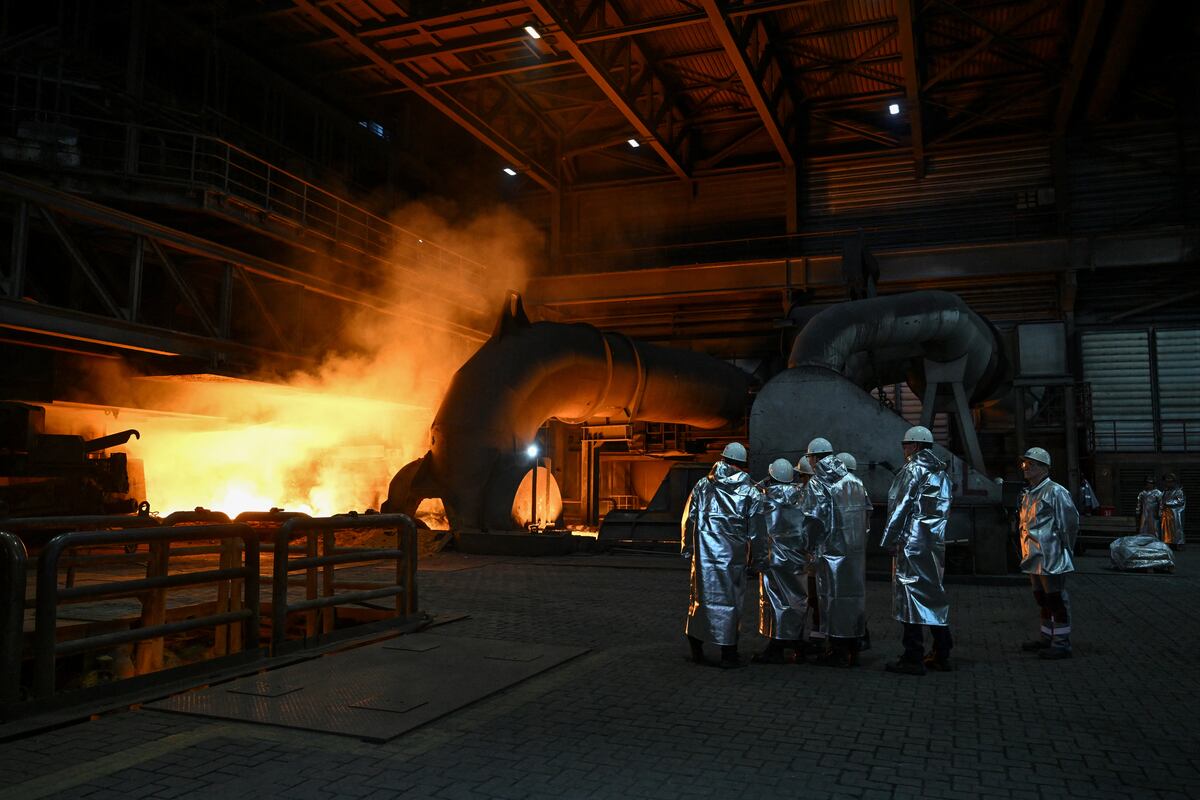
THE HAGUE, Netherlands — For generations, the blast furnaces of the Ruhr Valley, Silesia and Lorraine have formed the backbone of European heavy industry. Now, an uncertain geopolitical environment has thrust them back into the center of attention, with the European Union vowing to revitalize the continent’s metals sector.
The pitch: Europe wants to redouble its efforts to make steel “green” – producing the key ingredients for tanks, shells and ships in an environmentally conscious way.
The European Steel and Metals Action Plan , released on March 19, represents Brussels’ most comprehensive strategy yet to shore up an industry facing multiple existential threats: Chinese overcapacity, crippling energy costs, and the looming shadow of new American tariffs — all while fostering its transformation to climate neutrality.
The steel industry is one of the largest producers of greenhouse gases globally, responsible for roughly a tenth of total CO2 emissions. This is because it takes immense amounts of heat and, by extension, energy to melt the metal in blast furnaces.
But with European rearmament en vogue and free international trade out of fashion, the continent is set to experience a boom in demand for steel as a key ingredient in its buildup of its armed forces.
The plan’s linking of industrial policy to defense readiness represents a significant shift in how Brussels frames its economic priorities. Commission officials explicitly linked the question of steel production to defense readiness amid rising tensions with Russia and uncertainty about long-term American security guarantees.
The European Commission, headed by Ursula von der Leyen, serves as the executive branch of the European Union. It was the commission that floated the ambitious plan to rearm Europe, which promises to see Europe mobilize close to a trillion dollars for its defense sector in the next five years. Just days after that plan was announced, the EU followed up with its ambitious metals plan.
The EU, at its core, was built on steel, growing out of the European Coal and Steel Community established in the aftermath of World War 2. And indeed, domestic production still covers 90% of the continent’s current consumption, the European Commission said. The situation is “more worrying,” in the EU’s words, for aluminum and nickel, where domestic production covers only 46% and 25% of Europe’s demand, respectively.
“All these metals are essential for defense,” the EU’s paper reads. It goes on to list out the requirements for specific armaments: “A main battle tank contains 50 to 60 tonnes of high-quality steel; a self-propelled artillery system up to 100 tonnes; a fighter aircraft 3 tonnes of aluminium.”
Europe’s metals industry has been squeezed from multiple directions. Energy costs following Russia’s invasion of Ukraine have skyrocketed, with European producers paying up to five times more for gas and three times more for electricity than their American counterparts, the European Commission conceded in its report. Meanwhile, imports from Asia have nearly tripled over the past decade, with every third ton of steel in the EU now coming from elsewhere.
“The foreign trade policy proposals are a step in the right direction,” said Kerstin Maria Rippel, CEO of Germany’s Steel Industry Association. She said that it “is only logical in view of the increasing import pressure and the consequences of the confrontational U.S. trade policy.”
The EU’s six-pillar action plan hopes to alleviate some of the other ailments, too, by addressing energy costs, carbon leakage prevention, industrial capacity protection, metal recycling, job protection, and providing investment support in addition to protectionism.
Rheinmetall technicians work on a 120mm cannon for Leopard battle tanks at the company facility in Unterluess, northern Germany, in June 2023. (Axel Heimken/AFP via Getty Images)
Most notably, it includes a plan for a €100 billion ($108 billion) Industrial Decarbonisation Bank and a €1 billion pilot auction in 2025 aimed at electrification and low-carbon steel production.
It places “green steel” firmly at the heart of the European metals strategy. Using electrical furnaces and hydrogen, the emissions from the steel industry can be cut by as much as 95%. When burning hydrogen instead of coal or gas, the byproduct produced is water steam rather than CO2.
European steel producers have generally welcomed the plan. It demonstrates “understanding of the urgency surrounding the situation and a readiness to address key structural challenges,” praised Aditya Mittal, the CEO of ArcelorMittal, Europe’s largest steel producer. And the European Steel Association’s president, Henrik Adam, echoed the sentiment, saying that “the European Commission is sending a clear message: a strong European Union needs a strong European steel industry.”
However, both executives stressed that energy costs remain “the elephant in the room,” with Adam noting they are “dragging down entire European industrial value chains.”
Electricity costs, for instance, stubbornly hover at double or four times the price of other steelmaking locations. With the transition to electric arc furnaces, electricity consumption is expected to roughly double, industry associations say, further magnifying a cost disadvantage.
Nonetheless, electricity and producing renewable hydrogen may be a more suitable way forward for Europe than relying on old methods. Gas is used during pig iron production in blast furnaces, which account for about 60% of EU steel production but has been a sticking point since Russia’s invasion of Ukraine. During the 2022 energy crisis, energy costs reached 80% of total production costs for European steel producers.
While fossil fuel deposits cannot be conjured from thin air, renewable energy is seen by some as the solution to the continent’s energy woes, with solar, hydro and wind power available in ample quantities and ready for additional exploitation.
The third age of nuclear, still in its infancy, may play a role, too. Poland, for example, is progressing in its plans to build the country’s first nuclear power plant, with a final contract to be concluded this year. Nuclear power, while not strictly renewable, does not emit any harmful gases because no fuel is burnt. The electricity from these environmentally conscious sources can then be used to either power electric arc furnaces directly, or to split water to produce “green hydrogen,” the theory goes.
Russia’s invasion of its smaller neighbor Ukraine has brought to the fore the importance of energy resilience for the European Union. The European Defence Fund – an EU mechanism to support research and development with military applications – specifically designated this field as a “priority area” for defense investment in its 2025 work program.
The Union has called climate change “a priority for the EU’s security and defense policies” for years. It goes well beyond simply weaning the bloc off of foreign sources of gas. EU bodies warn that rising temperatures will have knock-on effects on security as societies struggle to adapt to a growing water scarcity and lower agricultural output.
The European Union’s diplomatic branch, the External Action Service, believes that “this will increasingly undermine peace and security, especially in fragile countries.” The EU estimates that 5.5% of global CO2 emissions may stem from the defense industry.
Linus Höller is Defense News' Europe correspondent and OSINT investigator. He reports on the arms deals, sanctions, and geopolitics shaping Europe and the world. He holds master’s degrees in WMD nonproliferation, terrorism studies, and international relations, and works in four languages: English, German, Russian, and Spanish.
荷兰海牙——鲁尔区、西里西亚和洛林的炼铁高炉世代以来一直是欧洲重工业的支柱。如今,地缘政治环境的不确定性使它们再次成为关注焦点,欧盟誓言要重振欧洲的金属产业。
宣传口号:欧洲希望加倍努力使钢铁“绿色化”——以环保的方式生产坦克、炮弹和船舶的关键成分。
3 月 19 日发布的《欧洲钢铁和金属行动计划》是布鲁塞尔迄今为止最全面的战略,旨在巩固一个面临多重生存威胁的行业:中国产能过剩、能源成本飙升以及美国新关税的阴影——同时还要促进该行业向气候中和转型。
钢铁行业是全球最大的温室气体排放行业之一,约占二氧化碳总排放量的十分之一。这是因为在炼钢高炉中熔化金属需要大量的热量,进而需要大量的能源。
但随着欧洲重新武装成为一种风尚,而自由国际贸易不再流行,欧洲大陆对钢铁的需求将会出现激增,因为钢铁是其武装力量建设的关键组成部分。
该计划将产业政策与国防战备挂钩,标志着布鲁塞尔在构建其经济优先事项方面发生了重大转变。鉴于与俄罗斯的紧张关系日益加剧以及美国长期安全保障的不确定性,欧盟委员会官员明确将钢铁生产问题与国防战备联系起来。
由乌尔苏拉·冯德莱恩领导的欧盟委员会是欧盟的执行机构。正是该委员会提出了雄心勃勃的“重整欧洲军备”计划,该计划承诺在未来五年内为欧洲国防领域筹集近万亿美元。就在该计划公布几天后,欧盟又推出了同样雄心勃勃的金属计划。
欧盟的核心是钢铁,它起源于二战后成立的欧洲煤钢共同体。欧盟委员会表示,事实上,目前欧洲大陆的钢铁消费量仍然有90%来自国内生产。但欧盟指出,铝和镍的情况“更加令人担忧”,这两种金属的国内产量分别仅能满足欧洲46%和25%的需求。
欧盟的文件指出:“所有这些金属对国防都至关重要。”文件还列出了特定武器装备的需求:“一辆主战坦克需要50至60吨优质钢材;一套自行火炮系统重达100吨;一架战斗机需要3吨铝材。”
欧洲金属行业正面临多重压力。欧盟委员会在其报告中承认,俄罗斯入侵乌克兰后,能源成本飙升,欧洲生产商的天然气成本是美国同行的五倍,电力成本是美国同行的三倍。与此同时,过去十年间,欧洲从亚洲的钢铁进口量几乎增长了两倍,欧盟每三吨钢铁中就有一吨来自其他地区。
德国钢铁工业协会首席执行官克斯汀·玛丽亚·里佩尔表示:“对外贸易政策提案是朝着正确方向迈出的一步。”她指出,“鉴于日益增长的进口压力和美国对抗性贸易政策的后果,这完全合乎逻辑。”
欧盟的六大支柱行动计划希望通过解决能源成本、防止碳泄漏、保护工业产能、金属回收、保护就业以及提供投资支持等问题,来缓解其他一些弊病,同时采取保护主义措施。
2023年6月,在德国北部翁特吕斯的莱茵金属公司工厂,技术人员正在为豹式主战坦克组装120毫米火炮。(Axel Heimken/AFP via Getty Images)
最值得注意的是,该计划包括设立 1000 亿欧元(1080 亿美元)的工业脱碳银行,以及在 2025 年进行 10 亿欧元的试点拍卖,旨在促进电气化和低碳钢铁生产。
它将“绿色钢铁”牢牢置于欧洲金属战略的核心地位。使用电炉和氢气,钢铁行业的排放量可减少高达95%。与燃烧煤炭或天然气相比,燃烧氢气产生的副产品是水蒸气,而不是二氧化碳。
欧洲钢铁生产商普遍对该计划表示欢迎。欧洲最大的钢铁生产商安赛乐米塔尔首席执行官阿迪亚·米塔尔称赞该计划“展现了对当前形势紧迫性的理解,以及应对关键结构性挑战的意愿”。欧洲钢铁协会主席亨里克·亚当也表达了同样的看法,他说:“欧盟委员会传递了一个明确的信息:强大的欧盟需要一个强大的欧洲钢铁产业。”
然而,两位高管都强调,能源成本仍然是“房间里的大象”,亚当指出,能源成本正在“拖累整个欧洲工业价值链”。
例如,电力成本始终居高不下,是其他炼钢地区的两到四倍。行业协会表示,随着向电弧炉的过渡,电力消耗预计将大致翻一番,这将进一步加剧成本劣势。
然而,对于欧洲而言,发展电力和生产可再生氢或许比依赖传统方法更为合适。高炉炼铁过程中使用天然气,而高炉炼铁约占欧盟钢铁总产量的60%,但自俄罗斯入侵乌克兰以来,天然气供应一直是一个棘手的问题。在2022年能源危机期间,能源成本占欧洲钢铁生产商总生产成本的80%。
虽然化石燃料储量不可能凭空变出来,但可再生能源被一些人视为解决非洲大陆能源困境的方案,太阳能、水力和风能储量丰富,随时可以进一步开发利用。
核能的第三阶段虽然仍处于起步阶段,但也可能发挥作用。例如,波兰正在推进其首座核电站的建设,最终合同将于今年签订。核能虽然并非严格意义上的可再生能源,但由于不燃烧燃料,因此不会排放任何有害气体。理论上,这些环保能源产生的电力可以直接用于驱动电弧炉,或者用于分解水以生产“绿色氢气”。
俄罗斯入侵其邻国乌克兰,凸显了能源韧性对欧盟的重要性。欧洲防务基金——欧盟支持军事应用研发的机制——在其2025年工作计划中,明确将能源韧性领域列为国防投资的“优先领域”。
多年来,欧盟一直将气候变化列为“欧盟安全和防务政策的优先事项”。这远不止是让欧盟摆脱对外国天然气的依赖。欧盟机构警告说,气温上升将对安全产生连锁反应,因为社会将难以适应日益严重的水资源短缺和农业产量下降。
欧盟外交部门对外行动署认为,“这将日益破坏和平与安全,尤其是在脆弱国家。”欧盟估计,全球5.5%的二氧化碳排放量可能来自国防工业。
林努斯·霍勒是《防务新闻》的欧洲记者和开源情报调查员。他报道影响欧洲乃至全球的军火交易、制裁和地缘政治。他拥有大规模杀伤性武器不扩散、恐怖主义研究和国际关系三个硕士学位,并精通英语、德语、俄语和西班牙语四种语言。