Regulatory hurdles, subsea cable blueprint must be ironed out for Asean Power Grid: Jeffrey Siow杰弗里·西奥:东盟电网必须解决监管障碍和海底电缆规划问题
These will be the priorities for Singapore and Thailand, which will helm the ASEAN chairmanship in 2027 and 2028 respectively. Read more at straitstimes.com.
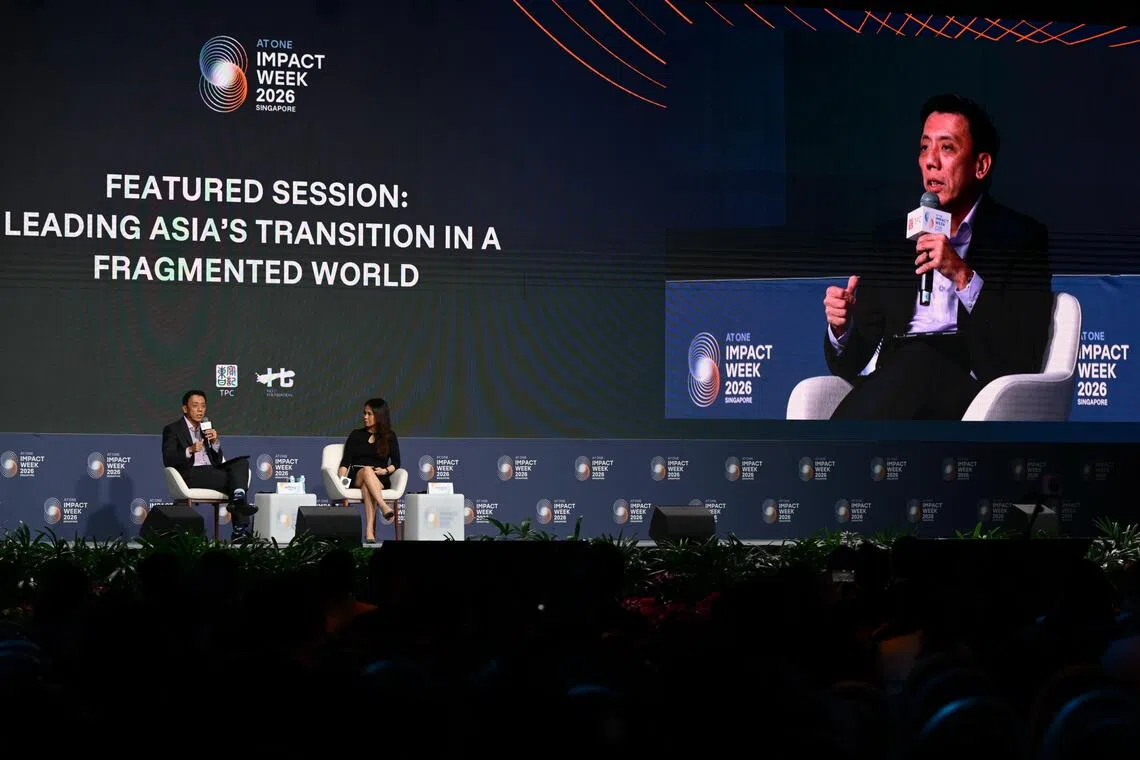
Second Minister for Finance Jeffrey Siow at a fireside chat with Eco-Business CEO Jessica Cheam at the Unlocking Capital for Sustainability Singapore summit on Sept 10.
ST PHOTO: NG SOR LUAN
Published Sep 10, 2026, 08:40 PM
Updated Sep 10, 2026, 08:40 PM
Regulatory challenges and a regional subsea cable blueprint must be resolved within two years to enable ASEAN Power Grid and clean electricity trade by 2045, says Minister Jeffrey Siow.
Differences in domestic regulations, export license durations, and maintenance for subsea cables hinder cross-border electricity projects, affecting their bankability and progress.
Singapore remains committed to net-zero by 2050 and decarbonising shipping, despite global delays and geopolitical challenges in international agreements like the IMO's net zero framework.
SINGAPORE – To push for clean electricity trading within ASEAN , the next two years must address regulatory hurdles and finalise a regional blueprint to build subsea cables that will be the lifelines for electricity flows, said Second Minister for Finance Jeffrey Siow.
These will be the priorities for Singapore and Thailand, which will take on the ASEAN chairmanship in 2027 and 2028 respectively, said Siow at the Unlocking Capital for Sustainability summit on Sept 10.
The ASEAN Power Grid , which is aimed to be realised by 2045, will allow member states to trade surplus electricity. Importing clean electricity is a key strategy for Singapore’s net zero goal.
“The reality is that cross-border projects are always hard, and the real challenge is in regulations. ASEAN doesn’t have a unified legal framework for cross-border electricity trade as of now. Domestic regulations differ in every country. We have to put together the regulations, and it’s a patchwork at the moment,” noted the Transport Minister.
Other constraints and regulatory hurdles that need to be ironed out include the duration of export licences and the lack of clear norms to inspect, maintain and repair submarine cables, he told Eco-Business chief executive Jessica Cheam during the dialogue.
“It is not just a matter of literally flicking the switch. We have to address every one of these issues for electrons to flow,” he said.
He was responding to Cheam who asked for updates on the ASEAN Power Grid and the region’s transition towards cleaner energy. The summit is part of the At One Impact Week 2026 forum at the Suntec Singapore Convention and Exhibition Centre.
Regulatory hurdles can affect the bankability of energy trading projects. Other factors include settling the fees paid to transit countries, which will transmit electricity through their national grids to buying countries like Singapore.
These hurdles have gradually come to light through reported obstacles facing Batam’s export of solar energy to Singapore and the export of hydropower from Laos to Singapore.
ST reported in March that the planned export of solar energy from Indonesia’s Batam to Singapore appears to have hit a snag as Indonesia requires energy exporters to renew their permits every five years. This creates uncertainty since the government can revoke a licence.
Moreover, for major infrastructure projects such as solar farms to secure financing, they typically have to be considered “bankable” for about 20 to 25 years.
The Laos-Thailand-Malaysia-Singapore electricity import deal, which was launched in 2022 and has served as a pilot for the regional grid, had encountered obstacles.
In mid-2024, Reuters reported that an extension of the deal was fraught with disagreements over how the energy would be transmitted through Thailand and Malaysia, as well as the amount of power to be purchased.
In late 2025, ASEAN energy ministers endorsed the bloc’s submarine power cable development framework to build submarine cables across the region.
The framework will facilitate subsea surveys and the laying, maintenance and protection of subsea power cables in the region.
Siow said: “The progress depends ultimately on the sustained willingness of all 11 governments... We have to keep pushing as hard as we can. We may not be able to get all the way to where we want, but we’ll try our best to achieve all this.”
The Minister also reiterated Singapore’s commitment to reach net-zero by 2050 – despite weakening global momentum – and to decarbonise the shipping sector.
“We will pace our strategies as we go, including decarbonisation strategies. We will scale what is viable, and finally we will capture green growth opportunities where they arise and are suited for our economy,” he said.
Siow also noted that amid geopolitics and potentially weakening commitments by other countries, global greenhouse gas emissions are showing signs of flattening.
On decarbonising the shipping sector, Siow said it was disappointing that the International Maritime Organization’s net-zero framework was delayed last year. The framework involves putting a price, or carbon tax, on shipping emissions and setting a fuel standard.
In October 2025, the United States and other oil-exporting countries opposed the framework, resulting in a one-year delay.
“This October is when we have to make another decision on what to do next... Informally, it looks optimistic. There are things that are happening. The conversations are constructive, and we hope that we can support that,” said Siow.
“Some of the countries that are very integral to the (IMO) agreement will not be able to come to terms. And so the solution is not to scupper everything... There are things that move faster. There are things that move slower. We just have to accept that and try to do our best,” he said.
Shabana Begum is a correspondent, with a focus on environment and science, at The Straits Times.
Electricity and power
Maritime and shipping
9月10日,新加坡财政部第二部长萧正非在“释放资本促进可持续发展”新加坡峰会上与Eco-Business首席执行官Jessica Cheam进行了炉边谈话。
圣徒照片:吴索銮
发布于2026年9月10日晚上8:40
更新于2026年9月10日晚上8:40
萧杰夫部长表示,监管挑战和区域海底电缆蓝图必须在两年内得到解决,才能使东盟电网在 2045 年前建成并实现清洁电力贸易。
国内法规、出口许可证期限和海底电缆维护方面的差异阻碍了跨境电力项目,影响了项目的融资可行性和进展。
尽管国际海事组织净零排放框架等国际协议面临全球延误和地缘政治挑战,新加坡仍致力于在 2050 年前实现净零排放并实现航运业脱碳。
新加坡——财政部第二部长萧正树表示,为了推动东盟内部的清洁电力交易,未来两年必须解决监管障碍,并最终确定区域蓝图,以建设海底电缆,这将成为电力流动的生命线。
萧先生在9月10日举行的“释放资本促进可持续发展”峰会上表示,这些将是新加坡和泰国的优先事项,两国将分别于2027年和2028年担任东盟轮值主席国。
东盟电网计划于2045年建成,届时成员国可以交易剩余电力。进口清洁电力是新加坡实现净零排放目标的关键战略。
“现实情况是,跨境项目总是困难重重,真正的挑战在于监管。目前东盟还没有统一的跨境电力贸易法律框架。每个国家的国内法规都不尽相同。我们必须整合这些法规,而目前的情况就像是拼凑起来的拼图,”交通部长指出。
他在与 Eco-Business 首席执行官 Jessica Cheam 的对话中表示,其他需要解决的限制和监管障碍包括出口许可证的有效期以及缺乏对海底电缆进行检查、维护和修理的明确规范。
“这并非只是简单地拨动开关那么简单。我们必须解决所有这些问题,电子才能流动,”他说。
他是在回应Cheam的提问,Cheam询问了东盟电网的最新进展以及该地区向清洁能源转型的情况。此次峰会是2026年新加坡新达城会展中心“携手共创影响力周”论坛的一部分。
监管障碍会影响能源交易项目的融资可行性。其他因素包括支付给过境国的费用,这些过境国将通过其国家电网向新加坡等购电国输送电力。
这些障碍逐渐通过报道巴淡岛向新加坡出口太阳能以及老挝向新加坡出口水力发电所面临的阻碍而浮出水面。
《海峡时报》3月份报道称,印尼巴淡岛向新加坡出口太阳能的计划似乎遇到了阻碍,因为印尼要求能源出口商每五年更新一次许可证。由于政府有权吊销许可证,这造成了不确定性。
此外,像太阳能发电厂这样的大型基础设施项目要想获得融资,通常需要被认为在 20 到 25 年内“具有融资可行性”。
老挝-泰国-马来西亚-新加坡电力进口协议于 2022 年启动,作为区域电网的试点项目,但该协议遇到了一些障碍。
2024 年年中,路透社报道称,延长该协议的谈判陷入僵局,双方在如何通过泰国和马来西亚输送能源以及购买的电力数量等问题上存在分歧。
2025 年末,东盟能源部长批准了该集团的海底电力电缆发展框架,以在该地区建设海底电缆。
该框架将促进该地区的海底勘测以及海底电力电缆的铺设、维护和保护。
萧先生表示:“最终的进展取决于所有11个国家政府的持续意愿……我们必须继续尽最大努力。我们或许无法完全实现目标,但我们会尽最大努力去实现所有这些目标。”
部长还重申了新加坡致力于在 2050 年前实现净零排放(尽管全球势头减弱)并实现航运业脱碳的承诺。
他说:“我们将根据实际情况调整战略,包括脱碳战略。我们将扩大可行的项目规模,最终抓住适合我们经济发展的绿色增长机遇。”
Siow 还指出,在地缘政治因素和其他国家承诺可能减弱的背景下,全球温室气体排放量正呈现趋于平缓的迹象。
关于航运业脱碳问题,萧女士表示,国际海事组织净零排放框架去年被推迟,令人失望。该框架包括对航运排放征税(即碳税)并制定燃油标准。
2025 年 10 月,美国和其他石油出口国反对该框架,导致其推迟一年实施。
“今年十月,我们必须再次决定下一步的行动……从目前的情况来看,前景乐观。一些事情正在发生。讨论也很有建设性,我们希望能够支持这些进展,”萧先生说道。
“一些对国际海事组织(IMO)协议至关重要的国家将无法达成协议。因此,解决办法并非彻底破坏一切……有些事情进展快,有些事情进展慢。我们只能接受这一点,并尽力而为,”他说道。
沙巴娜·贝古姆是《海峡时报》的记者,主要关注环境和科学领域。
电力
海事和航运