$1.8 million benchmark for MR4 ministers a reference point, not an entitlement: Chan Chun Sing陈振声表示,180万美元是MR4部长级预算的基准线,并非一项权利。
Singapore's MR4 ministerial pay benchmark is a reference point, with most ministers expected to earn about $1.35 million by the term's end. Read more at straitstimes.com.
新闻视频
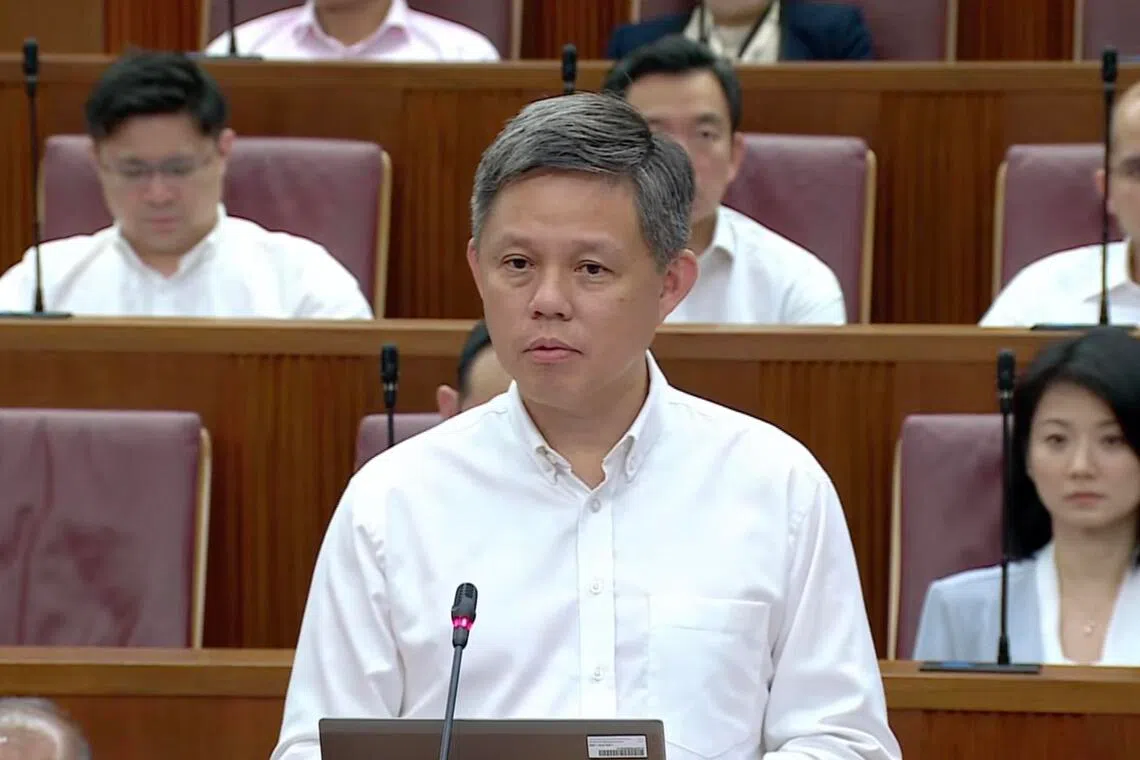
Minister for Defence Chan Chun Sing speaking in Parliament on Sept 10 after MPs debated the ministerial statements on the Government’s response to the 2026 review of salaries for political appointment holders and MPs.
Published Sep 10, 2026, 09:15 PM
Updated Sep 10, 2026, 09:15 PM
The $1.8 million salary for MR4 ministers is a reference point, not a guaranteed amount; most will earn about $1.35 million by the term's end with performance-based adjustments.
The Government aims to build a diverse leadership team with younger, experienced, and established members to ensure Singapore's future success and wider talent selection.
Further studies will explore quality-of-life indicators for national performance, and allowances for MPs and mayors will be reviewed.
SINGAPORE - There will be no immediate increase from $1.1 million to $1.8 million for an MR4 minister, and most at that entry-level grade are expected to be paid about $1.35 million by the end of the current term , Coordinating Minister for Public Services Chan Chun Sing said in Parliament on Sept 10.
“$1.8 million is not what every minister will be paid,” he stressed.
It is a reference point, not an entitlement or the actual salary of every minister, he said.
A one-off adjustment in October will be capped at 9 per cent and will depend on individual circumstances like performance and the person’s last salary adjustment.
So, a minister currently at $1.1 million will receive no more than about $ 1.2 million, with subsequent adjustments depending on performance and responsibilities, he pointed out.
Most MR4 ministers are expected to be at the lower end of the new salary range by the end of the term, at about $1.35 million.
“To put into context, this is equivalent to an average of 0.6 per cent per annum over the last 15 years.”
But Chan said the issue was ultimately not about what ministers would earn or how much MPs would receive in allowances, but about Singapore’s future and the system needed to build its next generation of leaders.
“Beyond all the numbers, beyond all the formulas, it is about building a system to give future generations a better chance to assemble a strong team to take Singapore forward, come what may,” he said.
What was needed, he said, was a diverse team comprising younger members with fresh energy, ideas and perspective, and who could develop over time to build the trust and bond with fellow Singaporeans; experienced colleagues with judgment who could take on more significant responsibilities and had room to grow; as well as established individuals with deep experience who could contribute substantially from day one.
“Finding that combination is hard enough. We should not make it harder, not just for this Government, but for any government, by narrowing the field even before the selection begins,” he said.
“The wider the pool, the more choices we have, the greater our chances of finding and composing the team that Singapore deserves.”
Chan, who is also Defence Minister, was speaking after MPs debated the ministerial statements on the Government’s response to the 2026 review of salaries for political appointment holders and MPs, delivered on Sept 8.
The widened ranges were intended to cater to the three archetypes: new entrant, experienced contributor and established individual with unique qualities.
A new political appointment holder would typically enter nearer the lower end of the range, while only those with substantially more experience may be appointed at a higher point, Chan said.
The annual salary benchmarks are also not guaranteed sums. About 65 per cent of the annual salary is fixed, while about 35 per cent is variable and depends on personal and national performance.
In strong years, when national bonus targets are far exceeded, the actual bonus may exceed the norm, while in weaker years a minister could receive zero bonus.
“That variability is by design. It is what makes the framework accountable and not misleading,” Chan said.
Since 2011, the national bonus payout has ranged from 0.75 months in low years to 5.6 months in better years.
Beyond the salary adjustments, Chan said the Government would take up or further study several suggestions raised in the review and by MPs.
It will accept the committee’s recommendation to study the use of quality-of-life indicators in assessing national performance.
Chan said the Government wanted to see how it could broaden the indicators, but these would need to be based on data that could be collected consistently. Some factors were qualitative rather than quantitative, while others involved multi-year rather than single-year results, he said.
“Some important things in life cannot be measured, and we must be careful not to make important only what we can measure,” he said.
The Public Service Division will study the issue before coming back with a proposal on what is feasible.
The Government also agreed to examine a standalone benchmark for MPs and mayors.
Chan said it was not intuitive for the MP allowance to be a fraction of the MR4 benchmark.
He stressed that it was an allowance and not a salary, as Singapore’s system generally regarded it as useful for MPs to have full-time jobs elsewhere so that they could represent diverse perspectives from their different backgrounds.
“We will study this, and we will talk to various stakeholders to try and see what can be a better benchmark,” he said.
The Government will also look at updating allowances for legislative and secretariat assistance.
No change was made in the current exercise as it was not within the terms of reference for the political salaries review, Chan said, adding that relevant agencies would be tasked to look at updating them as necessary.
He also said assessing the performance of the Government on a multi-year basis, instead of year by year, as a fair idea. But there were practical questions, including how many years should be assessed and what would happen if there was a change of government.
The time taken for results also differed between ministries, he said. At the Ministry of Defence, some projects he worked on 20 years ago were only now coming on stream, he pointed out.
“So we are fully cognisant of the challenges of using a single-year measure, but we are also cognisant of the challenges of using a multi-year assessment matrix, and we will have to find that balance,” Chan said.
On the financial impact of the salary changes, he said that assuming the maximum 9 per cent adjustment, overall spending on political appointment holder salaries is expected to remain below 0.05 per cent of government expenditure and below 0.01 per cent of GDP.
Even with the new benchmarks fully implemented, Singapore would still spend less as a percentage of government expenditure and GDP than it did in 2011, he added.
Chan also said that financial compensation could not be the number one consideration for political service.
Someone considering stepping forward would first have to consider the public scrutiny, loss of privacy, electoral uncertainty, public expectations and the potential of failure, he said.
“But for anyone considering this, the most important factor is this, and that is the burden of responsibility to get it right for Singapore and Singaporeans.
“This is not a business venture; it is about the lives and livelihoods of Singaporeans. If a business fails, we can start a new one. But if Singapore fails, we are finished.”
Singapore Parliament
国防部长陈振声于9月10日在国会发表讲话,此前议员们就政府对2026年政治任命官员和国会议员薪酬检讨的回应发表了部长声明。
发布于 2026 年 9 月 10 日晚上 9:15
更新于2026年9月10日晚上9:15
MR4部长180万美元的薪水只是一个参考点,并非保证金额;大多数部长在任期结束时将根据绩效进行调整,收入约为135万美元。
政府的目标是建立一个多元化的领导团队,成员包括年轻一代、经验丰富者和资深人士,以确保新加坡未来的成功和更广泛的人才选拔。
后续研究将探讨衡量国家绩效的生活质量指标,并审查议员和市长的津贴。
新加坡——公共服务统筹部长陈振声9月10日在国会表示,MR4级部长的薪酬不会立即从110万新元增加到180万新元,预计到本届任期结束时,该级别部长的薪酬大多约为135万新元。
他强调说:“并不是每个部长都能拿到180万美元的薪水。”
他说,这只是一个参考点,并非每位部长应得的待遇或实际薪水。
10 月份的一次性调整幅度上限为 9%,具体幅度取决于个人绩效和上次薪资调整等个人情况。
他指出,因此,目前年薪 110 万美元的部长,未来最多只能拿到 120 万美元左右,之后还会根据其表现和职责进行调整。
预计到任期结束时,大多数 MR4 部长的薪酬将处于新薪酬范围的较低水平,约为 135 万美元。
“换个角度来看,这相当于过去 15 年平均每年 0.6% 的增长率。”
但陈先生表示,问题的最终重点不在于部长们的收入或议员们能获得多少津贴,而在于新加坡的未来以及培养下一代领导人所需的制度。
他说:“抛开所有数字和公式,关键在于建立一个体系,让后代有更大的机会组建一支强大的团队,带领新加坡走向未来,无论发生什么。”
他表示,团队需要多元化,既包括充满活力、想法和新视角的年轻成员,他们能够随着时间的推移与新加坡同胞建立信任和联系;也包括经验丰富、判断力强的同事,他们能够承担更重要的责任,并有发展的空间;此外,还需要经验丰富、根基稳固的人士,他们能够从第一天起就做出实质性贡献。
他说:“找到合适的组合已经够难了。我们不应该在遴选开始之前就缩小范围,这不仅对本届政府,对任何一届政府来说都是如此,让遴选变得更加困难。”
“候选人范围越广,我们的选择就越多,找到并组建新加坡应有的球队的机会也就越大。”
兼任国防部长的陈先生是在议员们辩论了9月8日发表的关于政府对2026年政治任命官员和议员薪酬审查的部长声明后发表上述讲话的。
扩大范围旨在满足三种原型人物的需求:新入行者、经验丰富的贡献者和具有独特品质的成熟人士。
陈先生表示,新上任的政治任命官员通常会从较低的级别开始,而只有那些拥有更丰富经验的人才能被任命到更高的级别。
年度薪资基准并非固定金额。年薪约65%为固定金额,约35%为浮动金额,取决于个人和国家绩效。
在业绩强劲的年份,当国家奖金目标远远超额完成时,实际奖金可能会超过正常水平;而在业绩疲软的年份,部长可能一分钱奖金都拿不到。
“这种可变性是设计使然。正是这种可变性使得该框架具有问责性,而不是误导性的,”陈说。
自 2011 年以来,国家奖金发放额在年份较差时为 0.75 个月,在年份较好时为 5.6 个月。
除了薪酬调整之外,陈女士表示,政府还将采纳或进一步研究审查中以及议员们提出的几项建议。
它将接受委员会的建议,研究在评估国家绩效时使用生活质量指标的方法。
陈先生表示,政府希望探讨如何拓宽指标范围,但这需要基于能够持续收集的数据。他指出,有些因素是定性的而非定量的,而另一些因素则涉及多年而非单年的结果。
他说:“生活中有些重要的事情是无法衡量的,我们必须小心,不要只重视那些我们可以衡量的东西。”
公共服务部门将对该问题进行研究,然后提出可行的方案。
政府还同意研究针对议员和市长的独立基准。
陈先生表示,议员津贴仅为 MR4 基准的一小部分,这并不符合直觉。
他强调这只是津贴而不是薪水,因为新加坡的制度普遍认为,国会议员最好在其他地方有全职工作,这样他们才能代表来自不同背景的多元化观点。
他说:“我们会对此进行研究,并与各利益相关方进行沟通,看看怎样才能找到更好的基准。”
政府还将考虑更新立法和秘书处援助津贴。
陈先生表示,由于此次调整不在政治薪酬检讨的职权范围内,因此本次调整未作任何更改。他还补充说,相关机构将被责成在必要时进行更新。
他还表示,以多年为周期而非逐年评估政府绩效是一个合理的做法。但也存在一些实际问题,例如应该评估多少年,以及如果政府更迭该如何处理。
他还表示,各部委所需时间也不尽相同。他指出,国防部的一些项目,他20年前参与的项目,现在才开始投入使用。
“因此,我们充分意识到使用单年指标的挑战,但我们也意识到使用多年评估矩阵的挑战,我们将不得不找到这种平衡,”陈说。
关于薪资调整的财务影响,他表示,假设调整幅度达到最高 9%,政治任命官员薪资的总支出预计将保持在政府支出的 0.05% 以下,GDP 的 0.01% 以下。
他补充说,即使新基准全面实施,新加坡的支出占政府支出和GDP的比例仍将低于2011年。
陈还表示,经济报酬不应是从事政治活动的首要考虑因素。
他说,任何考虑挺身而出的人首先必须考虑公众的审视、隐私的丧失、选举的不确定性、公众的期望以及失败的可能性。
“但对于任何考虑此事的人来说,最重要的因素是,他们肩负着为新加坡和新加坡人民做好这件事的责任。”
“这不是一项商业投资;它关乎新加坡人的生命和生计。如果一项生意失败了,我们可以再开一家新的。但如果新加坡失败了,我们就完了。”
新加坡国会