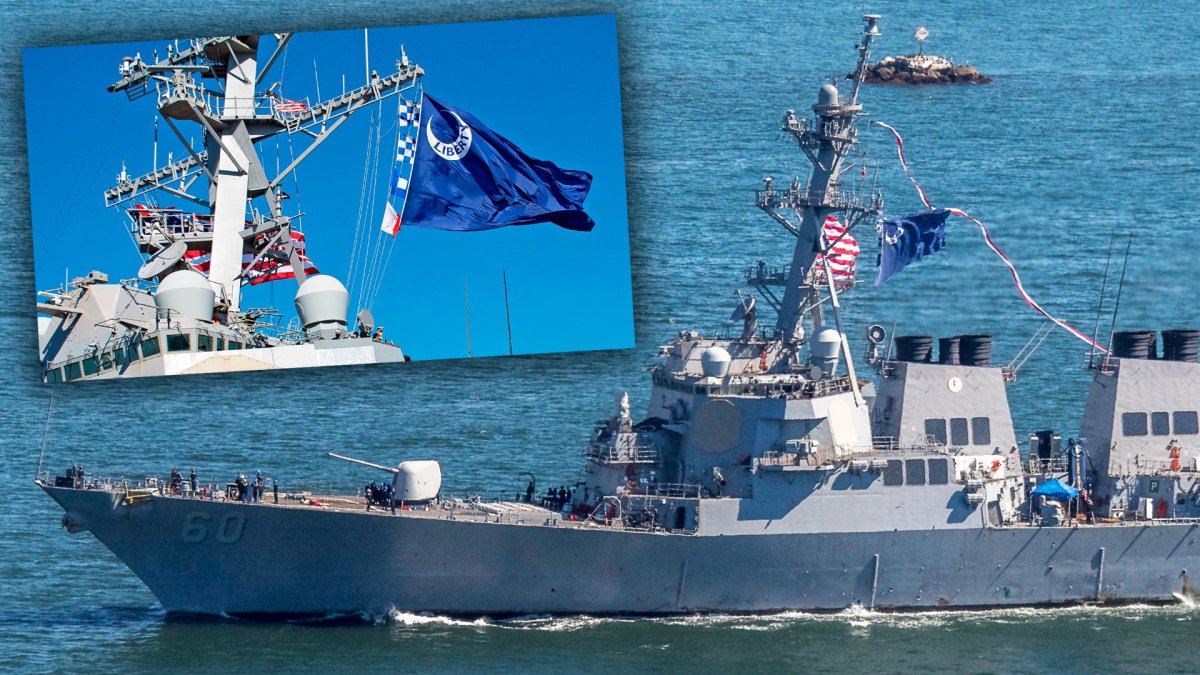
Why The Destroyer USS Paul Hamilton Came Home Flying A Crescent Moon Flag And A Long Pennant为什么驱逐舰“保罗·汉密尔顿”号返航时悬挂着新月旗和长三角旗
The banners have to do with the history of the ship's namesake and Navy traditions regarding particularly long deployments.
新闻视频
By Joseph Trevithick
Updated Nov 27, 2020 6:12 PM EST
Last month, the U.S. Navy’s Arleigh Burke class destroyer USS Kidd returned to its homeport flying a huge Jolly Roger pirate flag, something the ship is uniquely authorized to do for reasons you can read about in this subsequent War Zone piece . Earlier this week, another destroyer in this class, the USS Paul Hamilton , finished up its latest deployment flying a large blue flag with a crescent moon-shaped symbol with the word “LIBERTY” written inside, as well as a very long pennant with a stars-and-stripes motif, both of which have their own fascinating backstories.
Paul Hamilton , also known by its hull number DDG-60, returned to Naval Base San Diego in California on Oct. 13, 2020. The ship had left its homeport in January and spent some nine months at sea, primarily in the Middle East and Western Pacific, traveling approximately 54,422 nautical miles, in total, according to the Navy .
The ship originally left port as part of the Theodore Roosevelt Carrier Strike Group (CSG), which was tasked with conducting operations in the Western Pacific. The destroyer was detached from that CSG after the crew of the Nimitz class aircraft carrier USS Theodore Roosevelt became stricken with an outbreak of the COVID-19 novel coronavirus, which forced the flattop to head for an extended stay in port in Guam.
A picture taken from the USS Paul Hamilton of the Arleigh Burke class destroyer USS Pinckney and the Nimitz class aircraft carrier USS Theodore Roosevelt somewhere in the Pacific Ocean in January 2020., USN
Paul Hamilton subsequently conducted other operations in the Pacific region, including in the contested South China Sea, before moving on to the Middle East. There it served for a time as the 5th Fleet Ballistic Missile Defense Commander and in the support of the International Maritime Security Construct aimed at deterring Iran.
The Navy says the destroyer spent time attached to four different carrier groups, in total, throughout the course of the deployment to these two regions, but did not identify any beyond the Theodore Roosevelt CSG.
“I could not be more proud of this crew and the great work they did in support of American interests in two strategic regions,” Navy Commander Mark Lawrence, the Paul Hamilton ’s commanding officer, said in a statement. The crew “adapted to the challenges of operating in a COVID environment and performed brilliantly, demonstrating remarkable self-sufficiency and the will to fight that our nation expects from its Navy.”
By the time the ship returned to San Diego, it had spent exactly 270 days, or nine months, away from home, which brings us to the long-flowing pennant that it was flying. Navy ships are authorized to hoist this streamer, known as the “ Homeward-Bound Pennant ,” after spending that amount of time, or more, deployed.
The USS Paul Hamilton arriving in San Diego on Oct. 13 flying the Homeward-Bound Pennant., USN
The U.S. Navy inherited this tradition from the British Royal Navy. Historically British crews returning from long voyages would fly long streamers to celebrate that they were heading for their “paying off,” meaning that were headed home, at which time they would receive their wages.
The practice of flying these pennants continued among American ships unofficially through World War II , after which the Navy formally added it to the service’s regulations and defined rules for when and how the streamers could be displayed. An online copy of one Navy manual lays out these stipulations:
“The homeward-bound pennant is flown by ships returning from extended overseas tours. The pennant is authorized for display by a ship that has been on duty outside the limits of the United States continuously for at least 9 months. It is hoisted on getting under way for the United States and may be flown until sunset on the day of arrival in a port of destination. The pennant is similar to the commission pennant, but instead of the usual seven stars, there is one star for the first 9 months of overseas duty and one star for each additional 6 months. Total length of the pennant customarily is 1 foot for each officer and enlisted crew member who served overseas for a period in excess of 9 months. When the number of personnel produces an unwieldy pennant, the length of the pennant is restricted to the length of the ship.” “Upon arrival in a port of the United States, the blue portion containing the stars is presented to the commanding officer. The remainder of the pennant is divided equally among the officers and enlisted crew.”
“The homeward-bound pennant is flown by ships returning from extended overseas tours. The pennant is authorized for display by a ship that has been on duty outside the limits of the United States continuously for at least 9 months. It is hoisted on getting under way for the United States and may be flown until sunset on the day of arrival in a port of destination. The pennant is similar to the commission pennant, but instead of the usual seven stars, there is one star for the first 9 months of overseas duty and one star for each additional 6 months. Total length of the pennant customarily is 1 foot for each officer and enlisted crew member who served overseas for a period in excess of 9 months. When the number of personnel produces an unwieldy pennant, the length of the pennant is restricted to the length of the ship.”
“Upon arrival in a port of the United States, the blue portion containing the stars is presented to the commanding officer. The remainder of the pennant is divided equally among the officers and enlisted crew.”
This is actually not the first time Paul Hamilton has flown the Homeward-Bound Pennant. The ship’s crew has raised it at least twice before , in 2003 and in 2013, after deployments lasting 10 months and a little over nine months, respectively.
The USS Paul Hamilton flies the Homeward-Bound Pennant in 2013., USN
But when the Paul Hamilton entered the Port of San Diego this time, she was also flying the previously-mentioned large blue flag with crescent moon-shaped symbol containing the word “LIBERTY.” This is known as the Moultrie Flag or Liberty flag and traces its roots to the American Revolutionary War . The “moon” is actually a representation of a gorget , a piece collar armor that, at the time, was worn symbolically by officers in the Continental Army, as well as many European armies, and denoted their rank. Colonel William Moultrie, a South Carolinian and head of the 2nd South Carolina Regiment, had the banner made up in 1775.
The Moultrie Flag flying on the USS Paul Hamilton on Oct. 13., USN
His troops prominently flew the flag during the Battle of Sullivan’s Island in 1776, where revolutionary forces held their ground against the Royal Navy’s attempt to dislodge them, an action that is credited with saving the state’s nearby capital, Charleston, from being captured by British Forces. Moultrie went on to lead continental troops in other successful engagements with the British until his capture in 1780.
The Moultrie Flag, K. Aainsqatsi via Wikimedia
An image depicting continental forces raising the Moultrie Flag after the successful defense of Sullivan’s Island in 1776, Johannes Oertel via Wikimedia
While in captivity, he rejected attempts by the British to turn him to their side and was eventually released in a prisoner exchange in 1782. After the revolutionary war, he became a notable politician in South Carolina’s early history. His flag became the basis for the official South Carolina state flag .
The Paul Hamilton ‘s namesake was another South Carolinian who served in the Revolutionary War and went on to become the third Secretary of the Navy, as well as a notable politician in his own right. Three destroyers have been named after him, beginning with the Clemson class USS Paul Hamilton , which was commissioned in 1919 and served in the inter-war period before it was scrapped in 1931. In 1943, the Navy commissioned a Fletcher class destroyer bearing his name. There was also a Liberty Ship named after him during World War II.
A portrait of the third Secretary of the Navy and American statesman Paul Hamilton., G.B. Matthews via Wikimedia
The Navy decommissioned the Fletcher class USS Paul Hamilton in 1968. A quarter of a century later, the service brought the name back when it commissioned DDG-60 in Charleston, South Carolina. Based on the heritage of its namesake, this Arleigh Burke class destroyer is authorized to fly the Moultrie Flag as its battle flag.
“The Navy values its heritage and traditions, and this is ever-reflected in our ship and crew,” Navy Lieutenant J.G. Tyler Kesthely, a surface warfare officer serving on the Paul Hamilton , said in an interview for an official news piece earlier this year. “ Paul Hamilton and previous ships with the same namesake help shape our identity. Our battle flag, the Moultrie Flag, dates back to the very beginning of the Revolutionary War. It’s a fierce tradition that Paul Hamilton sailors still identify with.”
As with USS Kidd ‘s formal approval to fly its pirate flag, Paul Hamilton’s official sanction to fly the Moultrie flag is now additionally notable as it comes after Pentagon declared new policies for the display of flags and other symbols for the entire U.S. military in July. Though intended primarily to ban service members from displaying flags and other items with the stars-and-bars battle flag of the Confederacy, as well as other divisive symbols, there were fears that ships’ crews could be prevented from hoisting the Jolly Roger and other morale-boosting banners .
Though concerns certainly remain about how the Pentagon will apply and enforce those regulations, it does not appear to have had any impact on the Paul Hamilton ‘s ability to continue flying the Moultrie flag or that of Kidd ‘s crew to raise their skull-and-crossbones banner. These instances seem to be good indications that the Navy, at least, is perfectly able to preserve its traditions within the parameters of the new flag rules.
After nine months away from home, the sailors of the Paul Hamilton certainly earned the right to show off the Moultrie Flag, as well as hoist the Homeward-Bound Pennant, in our minds.
Contact the author: joe@thedrive.com
Comments couldn’t be loaded. Please refresh the page.
作者:约瑟夫·特雷维西克
更新于美国东部时间2020年11月27日下午6:12
上个月,美国海军阿利·伯克级驱逐舰“基德”号返回母港时,舰上悬挂着一面巨大的海盗旗——骷髅旗。该舰获准悬挂骷髅旗,个中缘由详见后续的“战区”专题报道。本周早些时候,同级的另一艘驱逐舰“保罗·汉密尔顿”号结束了最近一次部署,舰上悬挂着一面巨大的蓝色旗帜,旗帜中央绘有新月形图案,并写着“自由”字样。此外,舰上还悬挂着一面饰有星条图案的长三角旗。这两面旗帜背后都有着引人入胜的故事。
保罗·汉密尔顿号(舷号 DDG-60)于 2020 年 10 月 13 日返回加利福尼亚州圣地亚哥海军基地。据海军称,该舰于 1 月离开母港,在海上航行了约 9 个月,主要在中东和西太平洋地区,总航程约 54,422 海里。
该舰最初作为“西奥多·罗斯福”号航母打击群(CSG)的一部分离开港口,该打击群的任务是在西太平洋执行作战任务。在“尼米兹”级航空母舰“西奥多·罗斯福”号的船员感染新冠病毒后,这艘驱逐舰脱离了该打击群,迫使该航母前往关岛港口长期停留。
这张照片由美国海军“保罗·汉密尔顿”号两栖攻击舰拍摄,照片中是2020年1月在太平洋某处的阿利·伯克级驱逐舰“平克尼”号和尼米兹级航空母舰“西奥多·罗斯福”号。
保罗·汉密尔顿随后在太平洋地区执行了其他任务,包括在有争议的南海,之后前往中东。在那里,他曾担任第五舰队弹道导弹防御司令部司令,并参与支持旨在威慑伊朗的国际海上安全体系。
海军方面表示,这艘驱逐舰在部署到这两个地区期间,总共曾隶属于四个不同的航母战斗群,但没有透露除西奥多·罗斯福航母战斗群之外的其他战斗群。
“我为这支舰艇的全体官兵感到无比自豪,他们为维护美国在两个战略地区的利益做出了卓越贡献,”保罗·汉密尔顿号驱逐舰舰长、海军中校马克·劳伦斯在一份声明中表示。“舰员们适应了在新冠疫情环境下作战的挑战,表现出色,展现了我们国家期望海军所具备的非凡的自主作战能力和战斗意志。”
当这艘军舰返回圣地亚哥时,它已经离家整整270天,也就是九个月,这也解释了为什么它当时悬挂着一面飘扬的旗帜。海军舰艇在部署时间达到或超过这个时长后,就可以升起这面被称为“返航旗”的旗帜。
10月13日,保罗·汉密尔顿号驱逐舰抵达圣地亚哥,舰上悬挂着返航旗。(美国海军)
美国海军从英国皇家海军继承了这一传统。历史上,英国船员在完成长途航行返回时,会悬挂长长的彩带庆祝他们即将“领薪返航”,也就是即将回家领取薪水。
二战期间,美国舰艇上非正式地继续悬挂这些旗帜,之后海军正式将其纳入海军规章,并制定了何时以及如何悬挂这些旗帜的规则。一份海军手册的在线版本列出了这些规定:
“返航旗由结束长期海外服役任务的舰船悬挂。凡在美国境外连续服役至少9个月的舰船,均有权悬挂此旗。返航旗在舰船启航返回美国时升起,可悬挂至抵达目的地港口当日日落。此旗与委任旗相似,但并非通常的七颗星,而是每颗星代表海外服役的前9个月,之后每增加6个月再加一颗星。通常情况下,每位在海外服役超过9个月的军官和士兵,其旗帜长度均为1英尺。若人员过多导致旗帜过长,则旗帜长度限制为舰船长度。” “抵达美国港口后,带有星星的蓝色部分将呈交给舰长。旗帜的其余部分则由所有军官和士兵均分。”
“返航旗”由结束长期海外服役任务返回的舰船悬挂。凡在美国境外连续服役至少9个月的舰船,均有权悬挂此旗。返航旗在舰船启航返回美国时升起,并可悬挂至抵达目的港当日日落。此旗与服役旗相似,但并非通常的七颗星,而是每颗星代表海外服役的前9个月,之后每增加6个月再加一颗星。通常情况下,旗帜的总长度为每位在海外服役超过9个月的军官和士兵1英尺。如果人员数量过多导致旗帜过长,则旗帜的长度限制为舰船的长度。
“抵达美国港口后,带有星星的蓝色部分将献给指挥官。旗帜的其余部分则平均分配给军官和士兵。”
这其实并非保罗·汉密尔顿号第一次升起返航旗。该舰的船员此前至少升起过两次,分别是在 2003 年和 2013 年,当时的部署时间分别为 10 个月和 9 个多月。
2013年,保罗·汉密尔顿号驱逐舰悬挂返航旗。(美国海军)
但当“保罗·汉密尔顿”号这次驶入圣地亚哥港时,它同样悬挂着之前提到的那面大型蓝色旗帜,旗帜上绘有新月形图案,内含“自由”(LIBERTY)字样。这面旗帜被称为莫尔特里旗或自由旗,其历史可以追溯到美国独立战争时期。旗帜上的“月亮”实际上是护颈甲(gorget)的图案,这是一种领状盔甲,当时大陆军以及许多欧洲军队的军官都会佩戴,象征着他们的军衔。这面旗帜由南卡罗来纳州人、南卡罗来纳州第二团团长威廉·莫尔特里上校于1775年制作。
10月13日,美国海军“保罗·汉密尔顿”号驱逐舰上飘扬着莫尔特里旗。
1776年,在苏利文岛战役中,他的部队高举旗帜,抵抗英国皇家海军的进攻,成功守住了阵地。这场战役被认为使附近的州府查尔斯顿免遭英军攻占。此后,穆尔特里继续率领大陆军与英军作战,屡战屡胜,直至1780年被俘。
莫尔特里旗帜,K. Aainsqatsi via Wikimedia
图片描绘了1776年成功守住苏利文岛后,大陆军升起莫尔特里旗的情景,图片来自约翰内斯·厄特尔(Johannes Oertel)的维基媒体。
在被俘期间,他拒绝了英国人试图拉拢他的企图,最终于1782年在一次战俘交换中获释。美国独立战争结束后,他成为南卡罗来纳州早期历史上的一位著名政治家。他设计的旗帜后来成为南卡罗来纳州州旗的原型。
“保罗·汉密尔顿”号驱逐舰的命名者是另一位南卡罗来纳州人,他曾参加美国独立战争,后来成为美国第三任海军部长,同时也是一位杰出的政治家。共有三艘驱逐舰以他的名字命名,最早的是克莱姆森级“保罗·汉密尔顿”号,该舰于1919年服役,在两次世界大战期间服役,直至1931年拆解。1943年,海军建造了一艘以他名字命名的弗莱彻级驱逐舰。二战期间,还有一艘自由轮以他的名字命名。
美国第三任海军部长、政治家保罗·汉密尔顿的肖像。(图片来自Wikimedia,由GB Matthews提供)
美国海军于1968年退役了弗莱彻级驱逐舰“保罗·汉密尔顿”号。四分之一世纪后,海军在南卡罗来纳州查尔斯顿为DDG-60号驱逐舰举行了服役仪式,并重新启用了“保罗·汉密尔顿”这个名字。这艘阿利·伯克级驱逐舰秉承了其命名舰艇的传统,获准悬挂莫尔特里旗作为其战斗旗。
“海军珍视自身的历史传承和传统,这一点始终体现在我们的舰艇和船员身上,”海军少尉泰勒·凯斯泰利(Tyler Kesthely)说道。他是一名水面作战军官,目前在“保罗·汉密尔顿”号上服役。今年早些时候,他在接受官方新闻稿采访时表示:“‘保罗·汉密尔顿’号以及之前同名的舰艇共同塑造了我们的身份认同。我们的战旗——莫尔特里旗——可以追溯到美国独立战争初期。这是‘保罗·汉密尔顿’号水兵们至今仍然引以为豪的一项崇高传统。”
正如“基德”号驱逐舰获准正式悬挂海盗旗一样,保罗·汉密尔顿号获准悬挂“莫尔特里”旗也格外引人注目,因为此前五角大楼于7月宣布了针对全美军旗帜及其他标志展示的新政策。虽然该政策的主要目的是禁止军人展示带有南方邦联星条旗图案的旗帜及其他物品,以及其他具有分裂性的标志,但人们担心舰艇上的船员可能也会被禁止升起“骷髅旗”和其他鼓舞士气的旗帜。
尽管人们仍然担忧五角大楼将如何应用和执行这些规定,但这似乎并未影响“保罗·汉密尔顿”号继续悬挂穆尔特里旗,也未影响“基德”号船员升起骷髅旗。这些例子似乎有力地表明,至少海军完全有能力在新旗帜规定的框架内保留其传统。
在离家九个月之后,“保罗·汉密尔顿”号的水手们在我们心中当然有资格展示穆尔特里旗,并升起归途旗。
联系作者:joe@thedrive.com
评论加载失败,请刷新页面。