Russia sends bones of medieval warrior prince to Ukraine front to boost morale俄罗斯将中世纪武士王子的遗骸送往乌克兰前线以鼓舞士气
Bone fragments from the sword hand of a medieval Russian prince who won a famous victory over the Mongols have been sent to the front in Ukraine.
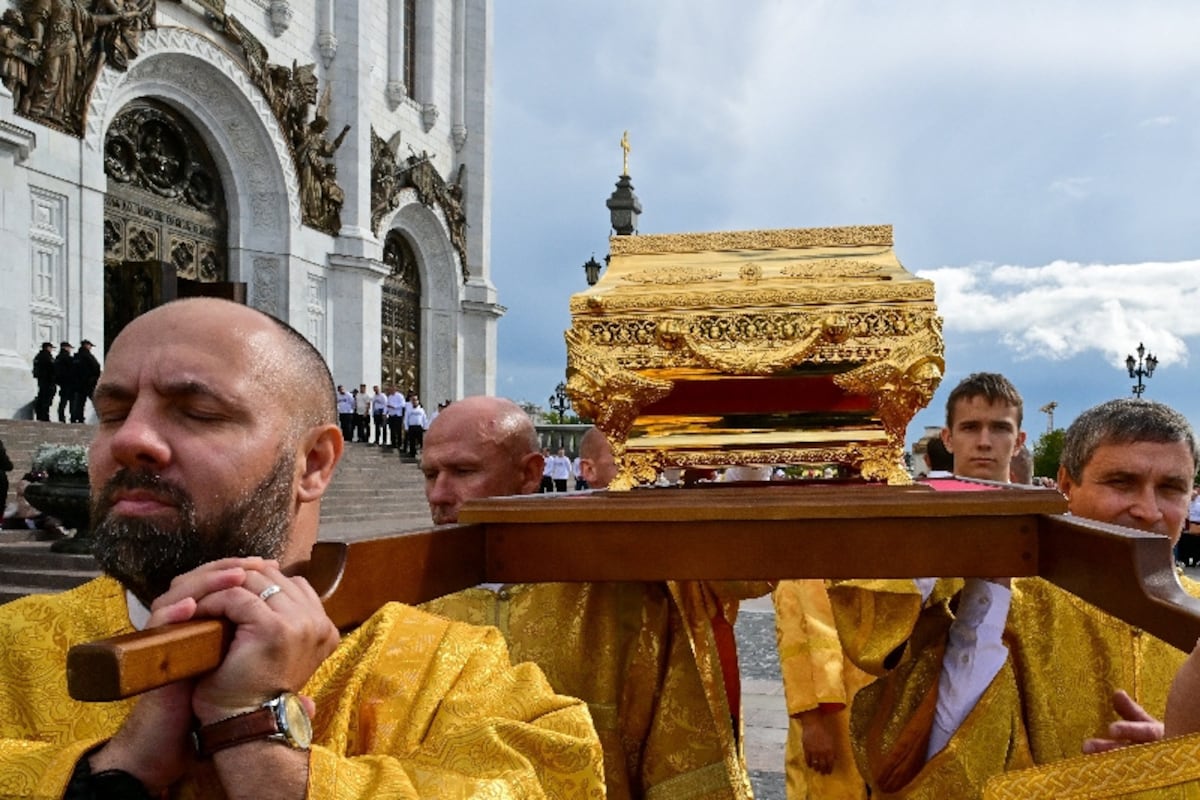
Bone fragments from the sword hand of a medieval Russian prince who won a famous victory over the Mongols have been sent to the front in Ukraine to raise army morale in the Russian Orthodox Church’s latest show of support for President Vladimir Putin’s war.
The sarcophagus of Grand Prince Dmitry Donskoy, who died in 1389 and is revered by Russian nationalists for defeating the Mongol Golden Horde at the 1380 Battle of Kulikovo, was uncovered this summer during restoration work at Moscow’s Cathedral of the Archangel inside the Kremlin.
Putin personally inspected what experts said were the prince’s well-preserved remains in August, hailing them as “an absolutely unique and marvellous discovery” which reinforced the foundations of Russian history.
The Russian Orthodox Church, which has backed Putin throughout the conflict, said it had dispatched a fragment of Donskoy’s right hand to Donetsk, one of four Ukrainian regions Putin said he had incorporated into Russia in 2022, a move Kyiv rejected as an illegal land grab.
Referring to Donskoy as “the holy commander,” the Moscow Patriarchate of the Russian Orthodox Church said part of his remains had been sent to the front to stand invisibly shoulder-to-shoulder with Russian troops.
“A fragment of the Grand Prince’s right hand – the very same right hand with which he wielded his sword on Kulikovo Field – has been sent to the front to strengthen the soldiers’ spirits,” it said in a statement.
The relic, held in a small ornate casket beneath toughened glass, will be shown to Russian combat units along the more than 1,000-km front line, it said.
Donskoy, whose name was given to a Soviet tank column funded by the church in World War Two, was declared a saint by the Russian Orthodox Church in 1988.
The carefully choreographed effort to use his remains in a public relations exercise to boost patriotism and morale comes ahead of a parliamentary election later this month.
Russian military and church officials have presented the discovery as a fortuitous find that could help Russian forces prevail in Ukraine, now in the fifth year of a grinding war.
The tour also comes as Russian forces seek full control of the Donetsk region in eastern Ukraine and as diplomatic efforts to end the war have yet to yield a breakthrough.
Donskoy’s relics were carried through the streets of Moscow at the weekend in a huge Orthodox procession.
At a ceremony at a World War Two memorial in Donetsk on Tuesday, Sergei Kiriyenko, Putin’s first deputy Kremlin chief of staff, joined military commanders and the Russian-installed regional head in kissing the relic and making the sign of the cross as a priest read a prayer.
“Both our military personnel and the people who live in Donbas need strengthening from above, need God’s help and the blessing of our saints,” Metropolitan Vladimir of Donetsk and Mariupol, a senior Moscow-appointed cleric, said. Donbas is a broader area incorporating Donetsk and neighbouring Luhansk which Russia controls almost in its entirety.
Elsewhere, commanders have presented Donskoy’s remains as evidence that God is on Russia’s side.
The Defence Ministry on Wednesday released footage of troops in the Sverdlovsk region attending a church service carrying icons and Orthodox flags, alongside an interview with a commander who said the relics would support Russia’s victory.
Critics, however, have accused the Church of breaking with religious protocol to please the Kremlin. They have also questioned why Donskoy’s remains, whose location was broadly known for decades, were recovered and venerated only now, 38 years after he was declared a saint.
“By the fifth year of war, the Church leadership in Moscow began to wonder what else it could do to show its support for what Russia terms its ‘special military operation’,” Alexander Zanemonets, an Orthodox priest and historian based outside Russia, wrote in a note for the Carnegie Russia Eurasia Center whose director Russia has designated a “foreign agent.”
“It had already sent priests to the front lines, instituted mandatory prayers for Russian victory in every church, and flown icons over cities. A state embroiled in war will try to compel all institutions, including religious ones, to participate in it.”
为了鼓舞乌克兰军队的士气,俄罗斯东正教教会将一位中世纪俄罗斯王子在战胜蒙古人后挥剑所用的骨头碎片送往乌克兰前线,这是该教会对俄罗斯总统弗拉基米尔·普京的战争表达支持的最新举措。
今年夏天,在莫斯科克里姆林宫内的天使长大教堂进行修复工作时,发现了德米特里·顿斯科伊大公的石棺。德米特里·顿斯科伊大公于 1389 年去世,因在 1380 年库利科沃战役中击败蒙古金帐汗国而受到俄罗斯民族主义者的尊崇。
8 月,普京亲自视察了专家所说的保存完好的王子遗骸,称赞这是“一项绝对独特而了不起的发现”,巩固了俄罗斯历史的基础。
在整个冲突中一直支持普京的俄罗斯东正教教会表示,已将顿斯科伊右手的一块碎片送往顿涅茨克,顿涅茨克是普京在 2022 年声称并入俄罗斯的四个乌克兰地区之一,但基辅方面拒绝承认此举是非法侵占土地。
俄罗斯东正教莫斯科宗主教区称顿斯科伊为“神圣的指挥官”,并表示已将他的一部分遗骸送往前线,与俄罗斯军队并肩作战,以无形的方式守护着他们。
声明中说:“大公右手的一块碎片——正是他在库利科沃战场上挥剑的那只右手——已被送往前线,以鼓舞士兵们的士气。”
声明称,这件圣物被放置在一个装饰精美的小棺材里,棺材上方覆盖着钢化玻璃,将向俄罗斯在超过1000公里长的战线上的作战部队展示。
二战期间,一支由教会资助的苏联坦克纵队以他的名字命名。1988 年,俄罗斯东正教教会宣布顿斯科伊为圣人。
在即将于本月晚些时候举行的议会选举之前,有人精心策划利用他的遗体进行公关活动,以提振爱国主义和士气。
俄罗斯军方和教会官员将这一发现描述为一项幸运的发现,可能有助于俄罗斯军队在乌克兰取得胜利。目前,乌克兰战争已持续五年之久。
此次访问正值俄罗斯军队寻求完全控制乌克兰东部顿涅茨克地区之际,而结束战争的外交努力尚未取得突破。
周末,顿斯科伊的遗物在莫斯科街头举行了一场盛大的东正教游行。
周二,在顿涅茨克二战纪念碑举行的仪式上,普京的克里姆林宫第一副总参谋长谢尔盖·基里延科与军事指挥官和俄罗斯任命的地区领导人一起亲吻圣物,并画十字,同时一名牧师诵读祷文。
“我们的军人和顿巴斯人民都需要来自上天的庇佑,需要上帝的帮助和圣人的祝福,”莫斯科任命的高级神职人员、顿涅茨克和马里乌波尔都主教弗拉基米尔说道。顿巴斯地区范围更广,包括顿涅茨克和邻近的卢甘斯克,几乎完全被俄罗斯控制。
在其他地方,指挥官们将顿斯科伊的遗骸作为上帝站在俄罗斯一边的证据展示出来。
周三,俄罗斯国防部发布了一段视频,视频中斯维尔德洛夫斯克地区的士兵们手持圣像和东正教旗帜参加教堂礼拜。同时,国防部还发布了一段对一名指挥官的采访,该指挥官表示,这些圣物将支持俄罗斯的胜利。
然而,批评人士指责教会为了讨好克里姆林宫而打破宗教礼仪。他们还质疑,顿斯科伊的遗骸下落早已广为人知,为何直到他被封圣38年后才被发现并受到敬奉。
“到了战争的第五年,莫斯科的教会领导层开始思考,还能做些什么来表示对俄罗斯所谓的‘特殊军事行动’的支持,”居住在俄罗斯境外的东正教牧师兼历史学家亚历山大·扎涅莫涅茨在给卡内基俄罗斯欧亚中心的一份报告中写道,该中心的主任已被俄罗斯认定为“外国代理人”。
“它已经派遣神父前往前线,强制所有教堂为俄罗斯的胜利祈祷,并在城市上空悬挂圣像。一个卷入战争的国家会试图强迫所有机构,包括宗教机构,都参与到战争中来。”