This Is What It Took To Defend A B-17 Bomber这就是保卫一架B-17轰炸机所需要的一切。
Manning the .50 caliber machine guns aboard a U.S. Army Air Force heavy bomber was a tough and at times terrifying job.
新闻视频
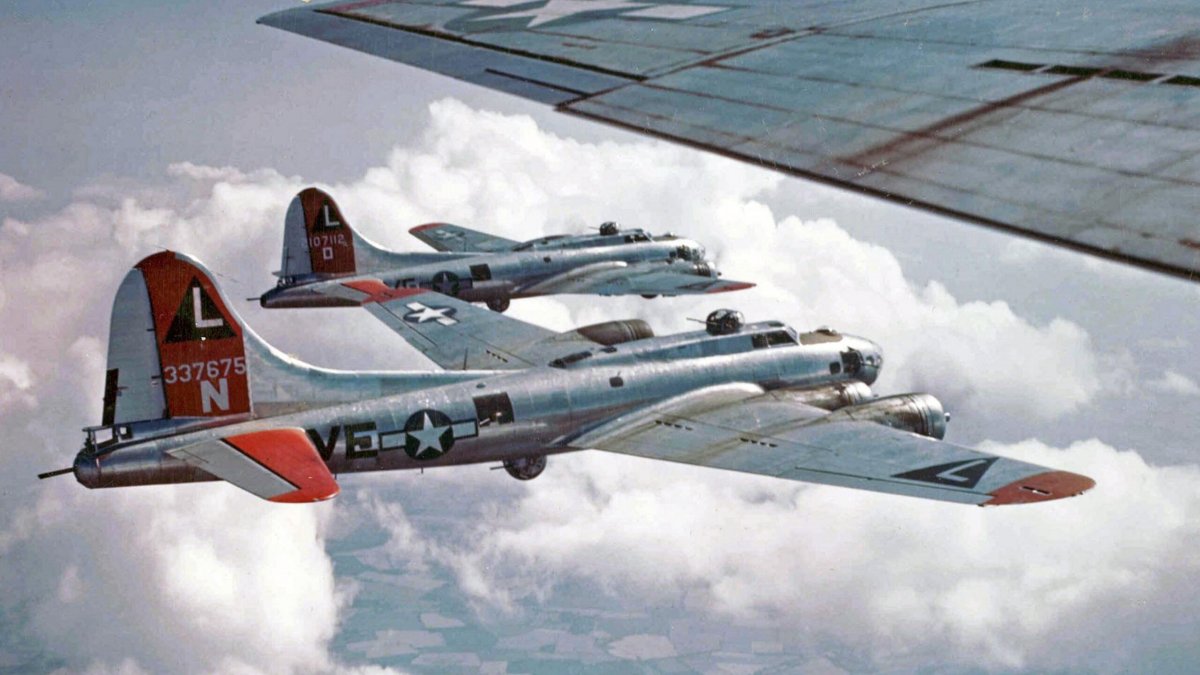
Published Jan 31, 2024 5:00 PM EST
Photo by PhotoQuest/Getty Images
With the first episodes of Masters Of The Air having received considerable praise for their air combat sequences especially, the story of the U.S. Army Air Forces (USAAF) in World War II is very much back in the public consciousness. In its initial review of the series , The War Zone noted its attention to detail, especially in the terrifying scenes of B-17s flying into flak or being attacked by Luftwaffe fighters.
The combination of simulated concussive blasts, shrapnel, and machine gun rounds very effectively summon up the chaos of the daytime bomber offensive. Meanwhile, the frantic efforts of B-17 gunners to defend their aircraft from enemy fighters that seemingly press home attacks from every quarter are also a signature motif within this drama.
With that in mind, it’s worth looking at what went into these defensive measures and how they changed as the bomber offensive developed, taking the war ever further into Nazi Germany and occupied Europe.
In the interwar period, proponents of the bomber were convinced that, according to the words of future U.K. Prime Minister Stanley Baldwin, speaking in 1932, “The bomber will always get through.”
With no truly effective defense against bombers, the defenses that armed the bombers themselves were understandably neglected.
In an expression of the “bomber will always get through” mantra, the initial service test version of the B-17, the Boeing Y1B-17, was armed with just five 0.3-inch machine guns in flexible mounts. Public Domain, U.S. Air Force
Broadly speaking, it was this thinking that saw the bombers of the U.S. Army Air Forces go to war in Europe without fighter escort. The British, for their part, had learned the hard way about the vulnerability of daylight bomber operations without escort and had switched primarily to nighttime raids.
As it was, the USAAF heavy bombers that began flying raids over Europe from their bases in England in the summer of 1942 relied on a combination of formation tactics — primarily the ‘combat box’ and variations of it — and the crew-operated 50-caliber machine guns that armed the B-17s, numerically the most important bomber of the Eighth Air Force flying from England.
A depiction of a combat box formation for a squadron of 12 B-17s. Annotations show: 1. Lead element 2. High element 3. Low element 4. Low low element. Anynobody/Wikimedia Commons
The growing realization that a heavy bomber operating in daylight, regardless of formation, could swiftly fall victim to an enemy fighter is reflected in the steady increase in the defensive firepower on the B-17. Defense of the B-17C model was initially entrusted to just four of the ubiquitous 50-caliber Browning M2 machine guns and a single 0.3-inch machine gun in the nose. The ultimate B-17G bristled with 13 50-caliber Brownings, firing at a rate of 750 rounds per minute out to an effective range of around 3,500 feet.
In the B-17G, these guns were located in a twin chin turret, a twin top turret above the fuselage, a twin ball turret below the belly, a twin tail turret, plus single trainable guns in ‘cheek’ positions on either side of the nose, in the radio compartment in the upper fuselage, and in ‘waist’ positions on either side of the rear fuselage. Typically, the ball turret and tail turret were manned by dedicated gunners, while the other guns were operated by other members of the crew as needed.
A B-17G of the 306th Bomb Group, fitted with a chin turret, from a photograph dated November 1943. The original caption read: “The new chin turret — so-called because it is fitted under the ‘chin’ of the aircraft — is the latest addition to the armor of the Flying Fortress.” United States Army Air Forces
A gunner sights his machine gun through the Plexiglass hood that was introduced over the radio compartment in the upper fuselage, amidships on the B-17, in a photo dated September 1944. Photo by PhotoQuest/Getty Images
The top turret and ball turret were electro-hydraulically powered and could bring the guns to bear on a target rapidly, traversing at some 50 degrees per second and electrically fed with ammunition. The tail turret was manually operated while the remaining trainable guns were on pivoted mounts, meaning the gunners had a limited field of fire and had to wrestle with the slipstream as they tried to get the enemy in their sights. Those sights were initially of the primitive ring-and-bead type, later superseded by reflector sights, making deflection shooting more reliable.
Bomber crew in the nose of a B-17 in the run-up to World War II. The limited traverse available on the gun mounted in the nose transparency is evident. Photo by Ivan Dmitri/Michael Ochs Archives/Getty Images
Despite the impressive concentration of firepower, an individual bomber remained highly exposed, especially during its run-in to the target, when it needed to fly straight and level.
A gunner sitting at his action station in a B-17 ball turret, September 1944. Photo by Mondadori via Getty Images
A wartime illustration of a Sperry Ball Turret, of the kind that armed versions of both the B-17 and B-24. The foetal position of the gunner and the ammunition feed mechanism are seen to good effect. Alfred D. Crimi, illustration for United States Army
The combat box was therefore soon developed to provide mutual protection, with interlocking arcs of fire provided by bombers flying in formation and staggered at different levels. This presented Luftwaffe fighters with a bigger problem and helped ensure that bombs were delivered close to the chosen target. This latter point was especially important bearing in mind the high altitudes from which these raids were typically flown. However, these tactics also required the bombers to stay in rigid formation if it was to be successful — counterintuitive when coming under attack from fighters or anti-aircraft fire from the ground.
Ultimately, as formations grew in size, the combat box was refined to become the ‘wing box,’ comprising three staggered 18-plane boxes for a total of 54 bombers. This was especially challenging for crews, with closely packed bombers running into each other’s turbulence and with a risk of bombs from a higher stack hitting aircraft flying below. When it worked, however, the wing box provided roughly 700 defensive machine guns that could be brought to bear on fighter opposition.
The view into a multi-ship B-17 bomber stream during World War II. These examples are purportedly from the 493rd Bomb Group, 3rd Bomb Division. U.S. Air Force photo
As well as falling bombs, there remained the risk of fratricide of another kind, too. While bombers’ gun turrets were designed to fire on arcs that ensured the aircraft’s tail, for example, would not be shot off, the same was not the case for other bombers flying nearby.
Other changes to the combat box tactics followed, including looser formations of 27 or 36 aircraft once flak superseded fighters as the primary threat to the bombers. The need for more spacing was driven by the fact that the detonation of a single anti-aircraft shell from a flak gun could potentially knock out more than one bomber. Once radar-guided Pathfinder groups became available, this also allowed bombers to operate with greater separation between them and still hit their target reasonably accurately, even in poor weather.
A B-17 crew of the 306th Bomb Group stand underneath the flak-damaged wing of their B-17, nicknamed Holy Hellcat , in 1943. United States Army Air Forces
Whatever the tactics, the process of getting bombers into compact formation was also far from easy. Considerable training was required beforehand and, for the missions themselves, assembling the bombers in their boxes needed a lot of time and energy on the part of the crews and consumed precious fuel. Some accounts suggested it took roughly an hour to get into formation at the start of a mission. Flamboyantly painted ‘assembly ships’ were among the initiatives developed to make the process easier.
At the same time, the Luftwaffe was adapting its tactics to deal with larger and better-armed USAAF bomber formations. In particular, German fighter pilots made high-speed ‘slashing’ attacks.
A model of a B-17E/F with latticework showing the directions of fire from its defensive machine guns, for the aid of a Luftwaffe Fw 190 fighter pilot, circa 1943–44. German Federal Archives
Despite the lack of fighter opposition at the start of the USAAF bombing campaign, it was far from easy for the Luftwaffe to bring down a big B-17 or B-24 bomber.
One Luftwaffe report indicated that around 20 hits from 20mm cannon shells (far more destructive than the bombers’ own machine guns) were needed to destroy a USAAF heavy bomber in an attack from the rear. At the same time, the average Luftwaffe pilot would hit a bomber with only around two percent of the rounds they fired; that translated to a requirement of 1,000 20mm rounds to ensure a bomber’s destruction. A Luftwaffe Fw 190 fighter carried only 500 rounds.
A Luftwaffe Fw 190 is loaded with 21-cm-Werfergranaten (WfG. 21) rockets, to be used to attack heavy bombers, in 1943. German Federal Archives
It’s notable, too, that as well as adding more defensive guns, the bombers also received more and improved armor, making the Luftwaffe’s task harder still.
Attacking a bomber head-on provided better odds for the Luftwaffe pilot, since the bomber’s forward-firing defensive armament was more limited, and its armor less effective. Destroying a bomber from head-on could be achieved with four or five 20mm hits, according to Luftwaffe studies. However, this was also addressed in the program to up-arm the USAAF ‘heavies,’ including the B-17’s chin turret.
A Focke-Wulf Fw 190 shoots down a USAAF B-17G during an attack on the AGO Flugzeugwerke Aircraft factory at Oschersleben, Germany, January 11, 1944. U.S. Air Force photo
Once again, as the USAAF bombers added guns, the Luftwaffe in turn increased its firepower, adding more ammunition, cannons in ever-heavier calibers, and later even air-to-air rockets. These initiatives may have been driven primarily by the requirement for heavy-hitting weapons that would be more likely to destroy a heavy bomber in a single pass, but they also increasingly out-ranged the bombers’ defensive guns. Fortunately for the Eight Air Force, the 21-cm rocket, despite its large warhead, was less than reliable.
In action, the 21-cm-Werfergranaten (WfG. 21) rocket proved relatively ineffective. “It downed few bombers, but it often damaged planes sufficiently to force them out of formation so that other fighters could finish them off,” the aviation historian Alfred Price recalled .
In October 1943, an Eighth Air Force raid against the ball-bearing production center at Schweinfurt, in southern Germany, demonstrated to USAAF leadership that a different approach would be needed if the bombers were to survive.
USAAF B-17Fs in formation over Schweinfurt, Germany, during an earlier raid on the ball-bearing production center on August 17, 1943. U.S. Air Force photo
By this stage, fighter escorts were available to the USAAF bombers, but, as the Schweinfurt raid of October 14, 1943, demonstrated these protective assets were too few in number and their range too short to ensure adequate protection.
The second Schweinfurt raid saw 291 B-17s sent against the target, of which 60 were lost outright, 17 damaged beyond repair, and another 121 damaged to one degree or another. A staggering 22 percent of the bomber crews involved — around 650 out of 2,900 men — were killed.
A B-17 of the Eighth Air Force heads back from the raid against Schweinfurt, Germany, on October 14, 1943, an operation that came to be known as known as ‘Black Thursday.’ U.S. Air Force photo
The USAAF responded by suspending unescorted daylight bomber raids deep into Germany until February 1944. When they recommenced, P-51B long-range escort fighters were available to provide the bombers with the close defensive protection they so badly needed. Flying ahead of the combat boxes, the P-51s would ultimately wrest control of the skies from the Luftwaffe’s fighter force. They would be aided in this by the tide of the war turning against Germany more generally, depriving it of the resources it needed to try and blunt the Allied bomber offensive.
Between February and June 1944, this combination of factors finally saw the B-17 emerge as a survivable asset. After the successful ‘Big Week’ raids of early 1944, Berlin was now in the USAAF’s sights. The first Eighth Air Force raid on the capital of the Third Reich came in March.
Tika IV , a P-51D flown by Lt. Vernon Richards, serving with the 374th Fighter Squadron, 361st Fighter Group. United States Army Air Force/361st FG Association, via Al Richards
The Luftwaffe’s response, from now on, was fairly tokenistic. The jet-powered Me 262 , armed with heavy cannons and also rockets, was a formidable bomber-destroyer but fielded in numbers too small to be meaningful and its operations were hampered by shortages of pilots and fuel. The rocket-powered Me 163 , on the other hand, offered blistering performance that allowed it to pass through bomber streams unscathed, but was arguably more lethal for its pilots than the Eighth Air Force.
Until the Eighth Air Force finally got the upper hand over Europe, survival had very much been down to the bravery and skill of the bomber crews themselves. While they were aided by the ability of the B-17, especially, to absorb a significant degree of battle damage, their machine gun armament was more than just a morale-booster.
“Hitler would like this man to go home and forget about the war. A good American non-com at the side machine gun of a huge B-17 bomber is a man who knows his business and works hard at it” — the original caption of a staged wartime propaganda photo showing a B-17 waist gunner. Collection Library of Congress, Transfer from U.S. Office of War Information, 1944
The bombers’ defensive armament and the tactics designed to best exploit it forced the Luftwaffe to change its approach. Gunners also achieved success, with the Eighth Air Force claiming 6,259 enemy aircraft destroyed by bomber gunners, more than for its fighter pilots. There is no doubt, however, that attributing fighter ‘kills’ was tricky in the heat of combat. Often, multiple gunners would open fire on the same target, observation of confirmed wreckage was far from guaranteed, and there was no gun-camera footage. Limited recognition of gunner aces reflected these realities, but at the same time, their enlisted status (for the most part), meant they were often also omitted from official lists of USAAF aces.
B-17s from the 398th Bombardment Group fly a bombing run to Neumunster, Germany, on April 13, 1945, less than one month before the German surrender on May 8. U.S. Air Force photo
Regardless, their job was a vital one and their mission among the most hazardous imaginable.
“When he was not shooting or being shot at, the gunner’s prime concern was survival,” Bruce D. Callander wrote in the April 1, 1991, issue of Air & Space Magazine .
“Missions lasted up to eight hours, with much of the flying taking place above 25,000 feet. Temperatures dropped as low as minus 60 degrees Fahrenheit in bombers that had no insulation and little heating outside the flight deck. Fleece-lined flight jackets were scant protection. The earliest electrically heated suits often shorted out and burned their occupants. Waist gunners worked through open windows, suffered frozen fingers, and slipped on the spent shells that piled up at their feet. Turret gunners had slightly more protection from the elements, but their cocoons allowed little room to move an aching arm or to stamp a cold foot.”
With hindsight, it’s clear that the availability of high-quality long-range escort fighters in sufficient numbers was the decisive factor in reducing Eighth Air Force bomber losses to a more acceptable level. But until those fighters were fielded, the bomber crews themselves more often than not provided their aircraft with the first and last line of defense.
1st Lt. George H. Heilig waves and gives the okay sign from the cockpit of the General Ike , a B-17 from the 401st Bomb Squadron, 91st Bomb Group, Eighth Air Force, England, circa 1944. Photo by PhotoQuest/Getty Images
Interestingly, there was a school of thought in the United Kingdom, at least, that suggested that the Royal Air Force might have been better off removing defensive guns from its World War II bombers altogether.
The theoretical physicist and mathematician Freeman Dyson, in 1943, proposed removing at least some of the gun turrets from Lancaster bombers, to provide what he claimed would be a 50 m.p.h. increase in cruising speed. The unarmed Mosquito relied on its speed for protection from Luftwaffe fighters, but it was a far higher-performing aircraft in general and it seems highly unlikely that an unarmed Lancaster would have been much more survivable.
August 1943: United States Army Air Forces bomber crewmen with their B-17. Visible are the left-side waist machine gun, as well as the ball turret and the gun protruding from the radio compartment in the upper fuselage. Photo by Hulton Archive/Getty Images
This brings us again to the morale factor and the very important fact that USAAF and Royal Air Force heavy bomber crews were able to fight back with defensive armament, even if their guns were still at a disadvantage against the Luftwaffe in terms of destructive power.
While precise tallies of the Eighth Air Force gunners’ successes can never be determined, their legacy was continued in the postwar U.S. Air Force, which continued to arm its strategic bombers with guns, finally only in the tail, right up until the B-52H . The B-52H still serves today, albeit with its tailguns now deleted. Fittingly, the B-52 and the service’s other strategic bombers come under the command of the Eighth Air Force — the very same formation whose gunners fought so valiantly for the liberation of Europe back in World War II.
With thanks to Mark Russell.
Contact the author: thomas@thedrive.com
Comments couldn’t be loaded. Please refresh the page.
发布于 2024 年 1 月 31 日下午 5:00(美国东部时间)
图片来源:PhotoQuest/Getty Images
《空中霸主》第一季播出后,其空战场景尤其广受好评,二战时期美国陆军航空队(USAAF)的故事再次引起公众关注。《战区》杂志在对该剧进行初步评论时,特别指出其对细节的把控,尤其是在B-17轰炸机冲入高射炮火或遭到德国空军战斗机攻击的惊险场景中。
模拟的冲击波、弹片和机枪子弹的组合,非常有效地再现了白昼轰炸机进攻的混乱场面。与此同时,B-17轰炸机炮手拼命防御敌方战斗机的攻击,这些敌方战斗机似乎从四面八方发起猛攻,这也是这部剧的标志性主题。
考虑到这一点,值得研究一下这些防御措施的构成,以及随着轰炸攻势的发展,这些措施发生了怎样的变化,战争也因此不断深入纳粹德国和被占领的欧洲。
在两次世界大战之间的时期,轰炸机的支持者们坚信,正如未来的英国首相斯坦利·鲍德温在 1932 年所说,“轰炸机总能突破防线”。
由于没有真正有效的防御措施来抵御轰炸机,因此,用于武装轰炸机本身的防御措施自然被忽视了。
为了体现“轰炸机总能突破防线”的信条,B-17轰炸机的初始服役测试版本——波音Y1B-17——仅配备了五挺0.3英寸机枪,安装在灵活的枪架上。(公共领域,美国空军)
总的来说,正是这种想法导致美国陆军航空队的轰炸机在没有战斗机护航的情况下参与欧洲战场的战斗。而英国方面则从惨痛的教训中吸取了教训,认识到白天轰炸行动缺乏护航的脆弱性,因此主要转向夜间空袭。
事实上,1942 年夏天,美国陆军航空队的重型轰炸机从英国的基地开始对欧洲进行空袭,它们依靠的是编队战术——主要是“战斗箱”及其变体——以及 B-17 轰炸机上由机组人员操作的 50 口径机枪。B-17 是第八航空队从英国起飞的最重要的轰炸机。
图中描绘了一个由12架B-17轰炸机组成的飞行中队的战斗方位阵型。标注如下:1. 领头单元 2. 高位单元 3. 低位单元 4. 低低位单元。图片来源:Anynobody/Wikimedia Commons
人们逐渐意识到,无论编队如何,在白天执行任务的重型轰炸机都可能迅速成为敌方战斗机的猎物,这体现在B-17轰炸机防御火力的不断增强上。B-17C型轰炸机最初的防御火力仅依靠四挺常见的50口径勃朗宁M2机枪和机头的一挺0.3英寸机枪。而最终的B-17G型则配备了13挺50口径勃朗宁机枪,射速高达每分钟750发,有效射程约为3500英尺。
在B-17G轰炸机上,这些机枪分别位于双联装机枪下巴炮塔、机身上方双联装机枪上部炮塔、机腹下方双联装球形炮塔、尾部双联装机枪上部炮塔,以及机头两侧“脸颊”位置、上部机身无线电舱内和后机身两侧“腰部”位置的单联装可旋转机枪。通常情况下,球形炮塔和尾部炮塔由专职炮手操作,而其他机枪则根据需要由机组其他成员操作。
一架隶属于第306轰炸大队的B-17G轰炸机,加装了下颚炮塔,照片拍摄于1943年11月。原图说明文字为:“新型下颚炮塔——因其安装在飞机‘下颚’下方而得名——是‘飞行堡垒’装甲的最新补充。” 美国陆军航空队
这张摄于1944年9月的照片显示,一名炮手正透过B-17轰炸机上部机身中部无线电舱上方安装的有机玻璃罩瞄准机枪。照片由PhotoQuest/Getty Images提供。
顶部炮塔和球形炮塔采用电液动力,能够快速将火炮转向目标,旋转速度约为每秒50度,并由电力供弹。尾部炮塔为手动操作,其余可旋转火炮则安装在枢轴式炮架上,这意味着炮手的射击范围有限,并且必须克服气流的影响才能将敌人纳入瞄准范围。这些瞄准具最初是原始的环形珠状瞄准器,后来被反射式瞄准器取代,使偏转射击更加可靠。
二战前夕,一架B-17轰炸机机头内的机组人员。透过机头透明罩可以看到,机炮的旋转角度非常有限。照片由Ivan Dmitri/Michael Ochs Archives/Getty Images提供。
尽管火力集中,但单架轰炸机仍然非常容易受到攻击,尤其是在接近目标时,需要保持直线平飞。
1944年9月,一名炮手坐在B-17轰炸机球形炮塔的射击位上。照片由Mondadori通过Getty Images提供。
这是一幅战时插图,描绘了斯佩里球形炮塔,这种炮塔曾装备于B-17和B-24轰炸机的某些型号上。图中清晰地展现了炮手蜷缩的姿势和弹药输送机构。插图作者:阿尔弗雷德·D·克里米,美国陆军
因此,战斗区域很快发展起来,以提供相互掩护:轰炸机编队飞行,错落有致地飞行在不同高度,形成环环相扣的火力网。这给德国空军战斗机带来了更大的麻烦,并有助于确保炸弹精准投送到目标附近。考虑到这些空袭通常从高空进行,后一点尤为重要。然而,这些战术也要求轰炸机必须保持严格的队形才能奏效——这在遭到战斗机或地面防空炮火攻击时,显然是违背常理的。
随着编队规模的扩大,作战单元最终演变为“翼盒”,由三个交错排列的18架飞机单元组成,总共54架轰炸机。这对机组人员来说尤其具有挑战性,因为密集排列的轰炸机容易相互碰撞,而且高处投下的炸弹也有可能击中下方飞行的飞机。然而,一旦部署得当,翼盒可以提供大约700挺防御性机枪,用于对抗敌方战斗机。
二战期间多架B-17轰炸机编队飞行的景象。据称这些飞机来自第3轰炸师第493轰炸大队。美国空军照片
除了炸弹落下之外,还存在另一种误伤的风险。虽然轰炸机的炮塔设计成弧线射击,以确保飞机的尾翼等部件不会被击落,但附近飞行的其他轰炸机却并非如此。
随后,战斗战术也发生了其他变化,例如,当高射炮取代战斗机成为轰炸机的主要威胁时,轰炸机编队变得更加松散,每队27架或36架飞机。之所以需要更大的间距,是因为一枚高射炮弹的爆炸就可能击落不止一架轰炸机。雷达制导的探路者编队投入使用后,轰炸机可以在更大的间距下作战,即使在恶劣天气下也能相当准确地击中目标。
1943年,美国陆军航空兵第306轰炸大队的B-17机组人员站在他们绰号为“圣地狱猫”(Holy Hellcat)的B-17轰炸机被高射炮击伤的机翼下。
无论采用何种战术,轰炸机编队成紧凑队形绝非易事。事先需要进行大量的训练,而且在执行任务时,机组人员需要花费大量时间和精力将轰炸机编入各自的机库,并消耗宝贵的燃料。一些记载表明,每次任务开始时,编队就需要大约一个小时。为了简化这一过程,人们还开发了涂装鲜艳的“集结船”等措施。
与此同时,德国空军也在调整战术,以应对规模更大、装备更精良的美国陆军航空队轰炸机编队。特别是,德国战斗机飞行员经常发动高速“突袭”攻击。
一架B-17E/F轰炸机的模型,带有网格状图案,标示着其防御机枪的射击方向,用于辅助德国空军Fw 190战斗机飞行员,约1943-1944年。德国联邦档案馆藏品。
尽管美国陆军航空队轰炸行动开始时缺乏战斗机抵抗,但德国空军要击落大型 B-17 或 B-24 轰炸机也绝非易事。
一份德国空军报告指出,从后方攻击一架美国陆军航空队的重型轰炸机,大约需要20发20毫米机炮炮弹命中(其威力远超轰炸机自身的机枪)。与此同时,德国空军飞行员平均只有约2%的炮弹能够击中轰炸机;这意味着需要1000发20毫米炮弹才能确保将其摧毁。而一架德国空军的Fw 190战斗机仅携带500发炮弹。
1943年,一架德国空军Fw 190战斗机装载着21厘米Werfergranaten(WfG. 21)火箭弹,用于攻击重型轰炸机。(德国联邦档案馆)
值得注意的是,除了增加更多防御性火炮外,轰炸机还获得了更多改进的装甲,这使得德国空军的任务更加困难。
对于德国空军飞行员来说,正面攻击轰炸机的胜算更大,因为轰炸机的前向防御武器较为有限,装甲防护也较弱。根据德国空军的研究,正面攻击只需四到五发20毫米炮弹就能摧毁一架轰炸机。然而,美国陆军航空队也曾考虑过提升重型轰炸机的火力,例如为B-17轰炸机加装机头炮塔。
1944年1月11日,在对德国奥舍斯莱本AGO飞机制造厂的空袭中,一架福克-沃尔夫Fw 190战斗机击落了一架美国陆军航空队的B-17G轰炸机。(美国空军照片)
随着美国陆军航空队轰炸机不断加装机炮,德国空军也随之提升火力,增加了弹药量,装备了口径更大的机炮,后来甚至还装备了空空火箭。这些举措或许主要是出于对威力强大的武器的需求,希望能够一击摧毁重型轰炸机,但这些武器的射程也越来越远,超过了轰炸机防御机炮的射程。幸运的是,对于第八航空队而言,尽管21厘米火箭弹拥有巨大的弹头,但其可靠性却不尽如人意。
在实战中,21厘米火箭弹(WfG. 21)的效果相对较差。“它击落的轰炸机不多,但经常能对飞机造成足够的损伤,迫使它们脱离编队,以便其他战斗机能够将其击落,”航空史学家阿尔弗雷德·普莱斯回忆道。
1943 年 10 月,美国陆军航空队第八航空队对德国南部施韦因富特的滚珠轴承生产中心发动空袭,向美国陆军航空队领导层表明,如果轰炸机想要生存下来,就需要采取不同的方法。
1943年8月17日,美国陆军航空队B-17F轰炸机编队飞越德国施韦因富特上空,此前他们曾对一家滚珠轴承生产中心进行过一次空袭。(美国空军照片)
到那时,美国陆军航空队的轰炸机已经有了战斗机护航,但是,正如 1943 年 10 月 14 日施韦因富特空袭所表明的那样,这些保护力量的数量太少,航程也太短,无法确保足够的保护。
第二次施韦因富特空袭共出动291架B-17轰炸机,其中60架当场损失,17架损毁严重无法修复,另有121架不同程度受损。参与此次行动的轰炸机机组人员中,高达22%——约2900名机组人员中的650人——阵亡。
1943年10月14日,美国空军第八航空队的一架B-17轰炸机从对德国施韦因富特的空袭中返航,这次行动后来被称为“黑色星期四”。(美国空军照片)
美国陆军航空队随即暂停了对德国纵深地区的无护航昼间轰炸,直至1944年2月。轰炸任务恢复后,P-51B远程护航战斗机随时待命,为轰炸机提供急需的近距离防御保护。P-51战斗机在作战编队前方飞行,最终从德国空军战斗机手中夺取了制空权。战争形势对德国整体的不利也助其一臂之力,德国因此无力调动资源来阻击盟军的轰炸攻势。
1944年2月至6月间,多种因素的共同作用最终使B-17轰炸机展现出强大的生存能力。在1944年初成功的“大周”空袭之后,柏林正式进入了美国陆军航空队的视线。第八航空队对第三帝国首都的首次空袭发生在3月。
“蒂卡四号”(Tika IV),一架由弗农·理查兹中尉驾驶的P-51D战斗机,隶属于第361战斗机大队第374战斗机中队。图片来自美国陆军航空兵/第361战斗机大队协会,经由阿尔·理查兹提供。
从此以后,德国空军的回应相当敷衍。喷气式Me 262配备重型机炮和火箭弹,是一款威力强大的轰炸机歼击机,但其装备数量太少,难以发挥实际作用,而且飞行员和燃料短缺也限制了其作战行动。另一方面,火箭动力Me 163拥有惊人的性能,能够毫发无损地穿过轰炸机群,但可以说,它对飞行员的威胁甚至超过了第八航空队。
在第八航空队最终掌控欧洲战场之前,轰炸机机组人员的生存很大程度上取决于他们的勇气和技能。虽然B-17轰炸机,尤其是其自身强大的抗击打能力,极大地提升了机组人员的生存能力,但他们的机枪火力远不止是鼓舞士气那么简单。
“希特勒希望这个人回家后能忘记战争。一名优秀的美国士官,在巨型B-17轰炸机的侧机枪位上,就是一个业务精湛、勤奋努力的人。”——这是一张摆拍的战时宣传照片的原图说明,照片中是一位B-17轰炸机的腰部机枪手。美国国会图书馆藏,1944年由美国战争信息办公室移交。
轰炸机的防御武器及其战术迫使德国空军改变了作战方式。机枪手也取得了成功,第八航空队声称轰炸机机枪手击落了6259架敌机,比战斗机飞行员的击落数量还要多。然而,毫无疑问,在激烈的战斗中,确定战斗机的“击落”数量非常困难。通常情况下,多名机枪手会向同一目标开火,确认残骸的观察也远非易事,而且当时也没有机枪摄像机拍摄的影像。机枪王牌的认可度有限反映了这些现实情况,但与此同时,由于他们(大多)是士兵,这意味着他们通常也被排除在美国陆军航空队王牌飞行员的官方名单之外。
1945年4月13日,隶属于第398轰炸大队的B-17轰炸机对德国诺伊明斯特进行轰炸,距离德国于5月8日投降不到一个月。(美国空军照片)
无论如何,他们的工作至关重要,他们的任务也是最危险的任务之一。
“当他没有开枪或被枪击时,炮手最关心的是生存,”布鲁斯·D·卡兰德在1991年4月1日出版的《航空航天杂志》上写道。
“飞行任务持续时间长达八小时,大部分飞行都在25000英尺以上的高空进行。轰炸机内温度低至零下60华氏度,驾驶舱外几乎没有隔热层和暖气。抓绒内衬的飞行夹克几乎起不到任何防护作用。最早的电加热服经常发生短路,导致穿着者被烫伤。腰部机枪手透过敞开的窗户工作,手指冻僵,还经常踩到脚边堆积的弹壳滑倒。炮塔机枪手虽然能得到一些额外的防护,但他们的防护服空间狭小,连酸痛的手臂都难以活动,冰冷的脚也难以跺脚。”
事后看来,高质量远程护航战斗机的充足配备显然是第八航空队轰炸机损失降至可接受水平的决定性因素。但在这些战斗机投入使用之前,轰炸机机组人员往往是飞机的第一道也是最后一道防线。
1944年左右,驻扎在英国的美国陆军中尉乔治·H·海利格(George H. Heilig)在“艾克将军号”(General Ike)B-17轰炸机的驾驶舱内挥手并做出“OK”手势。该机隶属于美国陆军第八航空队第91轰炸大队第401轰炸中队。照片由PhotoQuest/Getty Images提供。
有趣的是,至少在英国,有一种观点认为,皇家空军或许应该完全从二战轰炸机上移除防御性武器。
1943年,理论物理学家兼数学家弗里曼·戴森提议拆除兰开斯特轰炸机上的至少一部分炮塔,他声称这样可以提高50英里/小时的巡航速度。虽然没有武装的蚊式轰炸机依靠速度来躲避德国空军战斗机的攻击,但它的整体性能远胜于兰开斯特轰炸机,因此,即使兰开斯特轰炸机没有武装,其生存能力也不太可能大幅提升。
1943年8月:美国陆军航空兵轰炸机机组人员与他们的B-17轰炸机合影。照片中可以看到左侧腰部机枪、球形炮塔以及从上部机身无线电舱伸出的机枪。照片由Hulton Archive/Getty Images提供。
这再次让我们想到了士气因素,以及一个非常重要的事实:美国陆军航空队和英国皇家空军的重型轰炸机机组人员能够用防御性武器进行反击,即使他们的武器在破坏力方面仍然不如德国空军。
虽然第八航空队机枪手的战绩无法精确统计,但他们的功绩在战后美国空军中得以延续。美国空军继续为其战略轰炸机配备机枪,最终仅限于尾部,直至B-52H轰炸机。B-52H至今仍在服役,只是尾部机枪已被拆除。颇具讽刺意味的是,B-52以及空军的其他战略轰炸机均隶属于第八航空队——正是这支部队的机枪手在二战期间为解放欧洲而英勇奋战。
感谢马克·罗素。
联系作者:thomas@thedrive.com
评论加载失败,请刷新页面。