Operational F-15EXs Drop Live Bombs For The First Time作战型F-15EX战机首次投掷实弹
The first unit to get the F-15EX is already moving away from its exclusive air-to-air mission roots. The Oregon Air National Guard’s 142nd Wing dropped the live air-to-ground weapons during Weapons Instructor Course training at Nellis.
Published Sep 10, 2026 12:49 PM EDT
U.S. Air National Guard photo by Master Sgt. Steph Sawyer
The Oregon Air National Guard’s 142nd Wing has taken another significant step toward turning the F-15EX Eagle II into a true multirole fighter , conducting the first live-bomb drops from operational F-15EXs during training at Nellis Air Force Base , Nevada. The milestone came during a roughly three-week deployment to Nellis in late August and early September in support of the U.S. Air Force’s Weapons Instructor Course (WIC).
Weapons technicians from the 142nd Aircraft Maintenance Squadron load a bomb onto an F-15EX at Nellis Air Force Base, Nevada on August 27, 2026. U.S. Air National Guard photo by Master Sgt. Steph Sawyer
Photographs released by the Air National Guard yesterday show F-15EXs from the 142nd Wing carrying live bombs on the flight line and departing Nellis with the weapons loaded. Official imagery shows the jets armed with a single 500-pound Mk 82 freefall bomb on the fuselage centerline, while spotters also captured F-15EXs carrying a 2,000-pound Mk 84 freefall bomb in the same position.
View this post on Instagram
The 142nd’s F-15EXs are only now acquiring a capability that was deliberately absent from the wing’s previous F-15C fleet . The Portland, Oregon-based unit was an air-superiority organization when it operated the F-15C, while the F-15EX is ultimately derived from the F-15E Strike Eagle and has considerably more inherent multirole potential.
As we reported in July , the wing had already begun laying the groundwork for this transition. In May, 142nd personnel traveled to Mountain Home Air Force Base, Idaho, where they loaded and dropped inert BDU-50 and BDU-56 training bombs from their F-15EXs. Those weapons replicate the size and weight of 500-pound-class Mk 82-series and 2,000-pound-class Mk 84-series bombs. Over 10 missions, the crews dropped 24 BDU-50s and 12 BDU-56s.
A BDU-56 is loaded onto an F-15EX assigned to the 142nd Wing during a training mission at Mountain Home Air Force Base, Idaho, in May 2026. U.S. Air Force
While the F-15EX had already been tested in an air-to-ground role by the Air Force’s test community, the Mountain Home deployment was the first time an operational Eagle II unit had loaded and dropped bombs. The next step, the wing said at the time, would be live weapons employment at Nellis.
The Air Force has emphasized that the F-15EX’s primary mission remains defensive and offensive counter-air, particularly in the homeland-defense role. At the same time, the service’s plans call for the aircraft to provide combatant commanders with strike packages capable of operating in contested environments.
An F-15EX fires an AIM-120D missile during a test mission near Eglin Air Force Base, Florida. The F-15EX can carry up to 12 AIM-120 missiles. U.S. Air Force photo by Tech. Sgt. John Raven
The F-15EX is inherently well suited to such a mission . Derived from the Strike Eagle lineage, it combines that aircraft’s large payload capacity and long range with substantially modernized avionics and electronic warfare systems. The aircraft’s design leaves considerable room for additional weapons and mission equipment, making an expansion into air-to-ground operations relatively straightforward compared with trying to add that capability to the F-15C.
The 142nd has been building the institutional knowledge required to make that transition. Three of its pilots underwent a nine-month course covering the science, tactics, and procedures associated with air-to-ground weapons employment before returning to help establish the wing’s training program. Weapons personnel also traveled to Nellis earlier this year to work with F-15Es assigned to the 59th Test and Evaluation Squadron and become certified in bomb loading procedures.
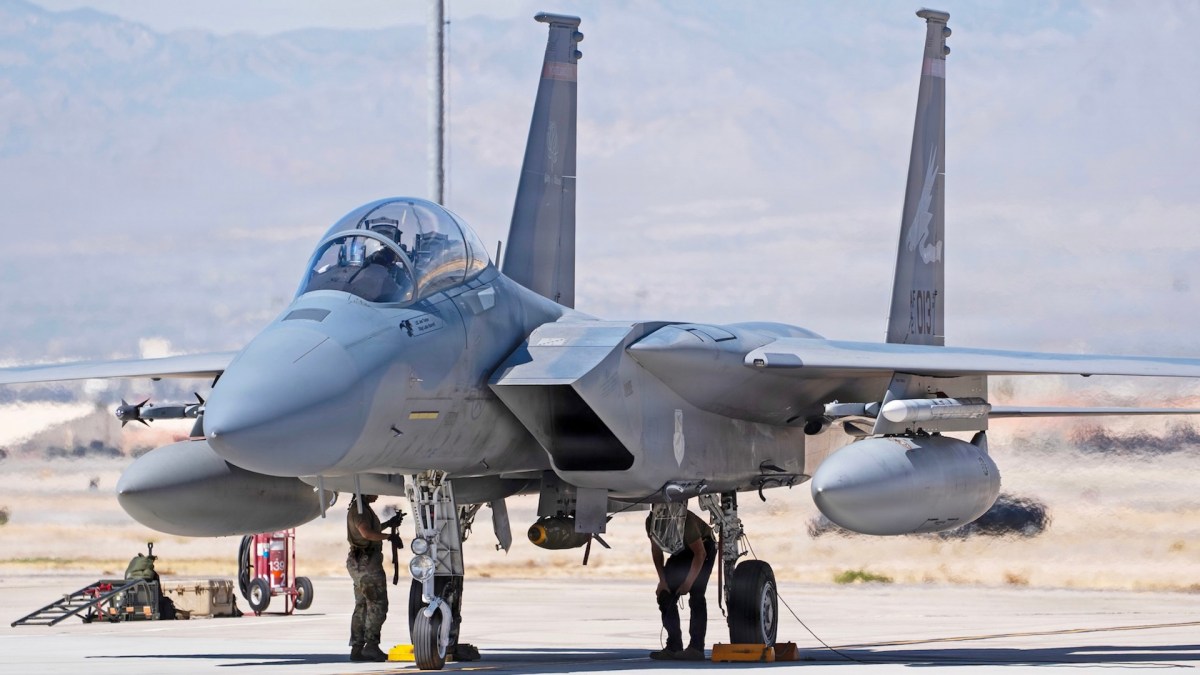
An F-15EX Eagle II assigned to the Oregon Air National Guard’s 142nd Wing sits on the flight line at Nellis Air Force Base, Nevada with a live bomb attached to its belly as it prepares for takeoff on August 27, 2026. U.S. Air National Guard photo by Master Sgt. Steph Sawyer \
As well as teaching pilots how to release a weapon, the wing had to develop an entirely new air-to-ground training pipeline for pilots, maintainers, and weapons personnel at a unit that had not previously operated an aircraft with an operational bombing mission.
Nellis is home to the Air Force’s Weapons School and is central to the Weapons Instructor Course, making it one of the most important locations in the service for developing and evaluating advanced tactics. The 142nd’s participation therefore places its emerging F-15EX air-to-ground capability in an environment specifically focused on integrating advanced weapons, tactics, and mission planning.
A weapons loader assigned to the 142nd Aircraft Maintenance Squadron prepares a bomb to be loaded onto an F-15EX at Nellis Air Force Base. U.S. Air National Guard photo by Master Sgt. Steph Sawyer
The wing’s new live bomb-dropping capability also comes as the Air Force continues to explore how broadly the Eagle II can be employed.
Test and evaluation units have already demonstrated that the aircraft can accommodate sophisticated air-to-ground weapons. Earlier this year, an F-15EX from the 85th Test and Evaluation Squadron participated in a munitions-load training event at Kadena Air Base in Japan , where Air Force personnel practiced loading live GBU-53/B Small Diameter Bomb IIs onto the aircraft.
GBU-53/B Small Diameter Bomb IIs sit on a dolly in front of an F-15EX from the 85th Test and Evaluation Squadron during a training event at Kadena Air Base, Japan, on July 8, 2026. U.S. Air Force
The F-15EX is also capable of carrying the conformal fuel tanks used by the F-15E, which can provide additional fuel as well as additional weapons stations. The operational F-15EXs delivered to the 142nd have so far been seen without CFTs, however, and the status of the plan to equip the Oregon aircraft with them remains unclear.
CFTs could become increasingly important if the Air Force moves toward more demanding air-to-ground missions for the Eagle II, particularly those requiring substantial weapons loads and long-range operations.
Another unresolved question is how the Air Force will ultimately crew F-15EXs when they are performing more complex multirole missions.
A weapons loader assigned to the 142nd Aircraft Maintenance Squadron loads a bomb onto an F-15EX at Nellis Air Force Base. U.S. Air National Guard photo by Master Sgt. Steph Sawyer
The Eagle II retains the F-15E family’s two-seat cockpit, although the Air Force’s initial operational concept has generally involved flying the aircraft with a single pilot. That leaves an unused cockpit that could potentially become an important asset as the mission set expands.
Former 142nd Wing commander Col. Michael Kosderka previously told TWZ that the addition of a weapons systems officer or other specialist in the rear cockpit could open the door to more air-to-ground capabilities.
“We can start talking about putting all kinds of air-to-ground capabilities into the airplane, potentially putting WSOs or other experts in the backseat as well to have us do any number of multi-role capabilities that it’s just physically not possible to in the C model,” Kosderka told TWZ in an interview back in 2024 . “So the X has tremendous growth capability. It’s really exciting.”
Two crew would be particularly relevant to complex strike missions, where managing sensors, weapons , communications, electronic warfare , and other mission systems can place substantial demands on a single pilot. As we have discussed in the past , a back-seater would also be highly beneficial for the emerging drone controller role .
The Weapons School has also been associated with developing two-seat F-15EX operations, indicating that the second cockpit’s utility is already being considered at the tactical-development level.
142nd Aircraft Maintenance Squadron weapons loaders transport a bomb to an F-15EX at Nellis Air Force Base. U.S. Air National Guard photo by Master Sgt. Steph Sawyer
For now, it would be premature to characterize the F-15EX as an operational replacement for the F-15E Strike Eagle in the air-to-ground role. The 142nd’s newly demonstrated bombing capability remains part of an ongoing training and development process.
Meanwhile, the Air Force is preparing to field substantially larger numbers of F-15EXs . Beyond the 142nd, additional Guard units are planned to receive the type, in California and Louisiana , as well as Michigan .
The Air Force has announced plans to base F-15EXs at Seymour Johnson Air Force Base, North Carolina, where they will eventually replace older F-15Es, which, in turn, are slated to move to Whiteman Air Force Base, Missouri , as part of a broader realignment of the Eagle fleet.
Another two active-duty F-15EX squadrons are slated to replace the former F-15C force at Kadena . The first F-15EX for permanent assignment at Kadena recently departed Boeing’s St. Louis, Missouri, facility for the 142nd Wing, where it will undergo final preparations before its eventual deployment to sprawling Okinawa.
An F-15EX assigned to the 142nd Wing takes off from Nellis Air Force Base with a bomb attached to its belly, August 27, 2026. U.S. Air National Guard photo by Master Sgt. Steph Sawyer
The operational implications of the air-to-ground training therefore extend well beyond Portland.
The Eagle II’s generous weapons payload, long range, modern sensors and electronic warfare systems, and ability to carry both air-to-air and air-to-ground weapons give the Air Force a platform that can potentially perform several missions without sacrificing the characteristics that make the F-15 attractive for homeland defense and counter-air operations. The same characteristics are also extremely relevant to any export operator , which would expect to operate the Eagle II in a multirole capacity .
As well as a weapons-training milestone, the first live-bomb drops by the 142nd Wing provide more evidence that the F-15EX’s mission is continuing to evolve.
Contact the author: thomas@thewarzone.com
Comments couldn’t be loaded. Please refresh the page.
发布于美国东部时间2026年9月10日下午12:49
美国空军国民警卫队照片,由一级军士长斯蒂芬·索耶拍摄
俄勒冈州空中国民警卫队第142联队在将F-15EX“鹰II”战斗机打造成为真正的多用途战斗机方面又迈出了重要一步,在内华达州内利斯空军基地进行的训练中,首次使用作战型F-15EX战斗机进行了实弹投弹。这一里程碑事件发生在8月下旬至9月初,该联队在内利斯基地进行了大约三周的部署,以支持美国空军的武器教官课程(WIC)。
2026年8月27日,内华达州内利斯空军基地,第142飞机维修中队的武器技师正在将一枚炸弹装载到一架F-15EX战斗机上。美国空军国民警卫队照片,由一级军士长斯蒂芬·索耶拍摄。
美国空中国民警卫队昨日发布的照片显示,第142联队的F-15EX战机携带实弹炸弹在跑道上进行训练,并装载武器后从内利斯空军基地起飞。官方图片显示,这些战机在机身中心线上挂载了一枚500磅重的Mk 82自由落体炸弹;而观察员也拍到F-15EX战机在相同位置挂载了一枚2000磅重的Mk 84自由落体炸弹。
在 Instagram 上查看此帖子
第142战斗机联队的F-15EX战机如今才具备了该联队此前F-15C机队所特意缺失的能力。这支驻扎在俄勒冈州波特兰市的部队在装备F-15C时是一支空中优势作战部队,而F-15EX最终源自F-15E“攻击鹰”战斗机,并拥有更强的多用途作战潜力。
正如我们7月份报道的那样,该联队已经开始为此次转型做准备。5月份,第142联队的人员前往爱达荷州山地之家空军基地,在那里,他们使用F-15EX战斗机装载并投掷了BDU-50和BDU-56惰性训练炸弹。这些武器模拟了500磅级Mk 82系列炸弹和2000磅级Mk 84系列炸弹的尺寸和重量。在10次任务中,机组人员共投掷了24枚BDU-50和12枚BDU-56。
2026年5月,在爱达荷州芒廷霍姆空军基地的一次训练任务中,一架隶属于第142联队的F-15EX战斗机正在装载BDU-56作战服。美国空军
虽然F-15EX此前已由空军测试机构进行过对地攻击测试,但此次在芒廷霍姆空军基地的部署是“鹰II”作战部队首次装载并投掷炸弹。该联队当时表示,下一步将在内利斯空军基地进行实弹武器实战演练。
空军强调,F-15EX的主要任务仍然是防御性和进攻性空中打击,尤其是在国土防御方面。与此同时,空军计划让该型战机为作战指挥官提供能够在对抗环境中作战的打击编队。
一架F-15EX战斗机在佛罗里达州埃格林空军基地附近的一次测试任务中发射了一枚AIM-120D导弹。F-15EX最多可携带12枚AIM-120导弹。美国空军技术军士约翰·雷文摄
F-15EX 本身就非常适合执行此类任务。它源自“攻击鹰”战机系列,结合了该系列战机的大载荷能力和远航程,并配备了大幅现代化的航空电子设备和电子战系统。该机的设计预留了充足的空间,可加装额外的武器和任务设备,因此与 F-15C 相比,将其扩展为空对地作战能力相对容易。
第142联队一直在积累转型所需的专业知识。该联队的3名飞行员接受了为期9个月的课程,学习了空对地武器运用相关的科学原理、战术和程序,之后返回部队协助建立联队的训练计划。武器人员也于今年早些时候前往内利斯空军基地,与隶属于第59测试评估中队的F-15E战斗机飞行员一起工作,并获得了炸弹装载程序的认证。
2026年8月27日,一架隶属于俄勒冈州空中国民警卫队第142联队的F-15EX“鹰II”战斗机停在内华达州内利斯空军基地的停机坪上,机腹挂载着一枚实弹炸弹,准备起飞。美国空中国民警卫队照片,由一级军士长斯蒂芬·索耶拍摄。
除了教飞行员如何投放武器外,该联队还必须为飞行员、维护人员和武器人员开发一套全新的空对地训练流程,因为该部队以前从未操作过执行作战轰炸任务的飞机。
内利斯空军基地是美国空军武器学校的所在地,也是武器教官培训课程的核心基地,使其成为空军研发和评估先进战术最重要的场所之一。因此,第142战斗机联队的参与,使其正在发展中的F-15EX空对地作战能力,得以在一个专门用于整合先进武器、战术和任务规划的环境中得到充分锻炼。
隶属于第142飞机维修中队的武器装填员正在内利斯空军基地准备将一枚炸弹装载到F-15EX战斗机上。美国空军国民警卫队照片,摄影:一级军士长斯蒂芬·索耶
随着空军继续探索鹰 II 型无人机的广泛应用范围,该联队也获得了新的实弹投弹能力。
测试和评估部队已经证明,该型飞机能够搭载先进的空对地武器。今年早些时候,隶属于第85测试评估中队的F-15EX战斗机在日本嘉手纳空军基地参加了一次弹药装载训练,空军人员在训练中演示了如何将实弹GBU-53/B小直径炸弹II型装载到飞机上。
2026年7月8日,在日本嘉手纳空军基地,美国空军第85测试评估中队的一架F-15EX战斗机前方放置着GBU-53/B小直径炸弹II型,当时正值训练活动期间。
F-15EX 也能够携带 F-15E 使用的保形油箱,该油箱可提供额外的燃料以及额外的武器挂点。然而,目前交付给第 142 战斗机联队的 F-15EX 战机均未配备保形油箱,俄勒冈州战机加装保形油箱的计划进展情况仍不明朗。
如果空军将鹰 II 型战斗机推向要求更高的空对地任务,特别是那些需要大量武器载荷和远程作战的任务,那么保形变材料 (CFT) 的重要性可能会日益凸显。
另一个尚未解决的问题是,当 F-15EX 执行更复杂的多用途任务时,空军最终将如何配备机组人员。
隶属于第142飞机维修中队的武器装填员正在内利斯空军基地将一枚炸弹装载到一架F-15EX战斗机上。美国空军国民警卫队照片,摄影:一级军士长斯蒂芬·索耶
“鹰II”战斗机保留了F-15E系列的双座驾驶舱,尽管空军最初的作战概念通常是由一名飞行员驾驶该机。这使得一个闲置的驾驶舱在任务范围扩大后可能成为一项重要的资产。
前第 142 联队指挥官迈克尔·科斯德卡上校此前告诉 TWZ,在后座舱增加一名武器系统官或其他专家可能会打开通往更多空对地作战能力的大门。
科斯德卡在2024年接受TWZ采访时表示:“我们可以开始讨论在飞机上安装各种空对地攻击能力,甚至可能在后座配备武器系统操作员或其他专家,以便我们能够执行C型飞机在物理上无法实现的各种多用途任务。因此,X型飞机具有巨大的发展潜力,这真的令人兴奋。”
双人机组对于复杂的打击任务尤为重要,因为在执行此类任务时,飞行员需要管理传感器、武器、通信、电子战和其他任务系统,这对其能力要求极高。正如我们之前讨论过的,后座飞行员对于新兴的无人机控制员角色也大有裨益。
武器学校也参与了双座 F-15EX 作战的开发,这表明第二个座舱的用途已经在战术发展层面上被考虑。
美国空军国民警卫队第142飞机维修中队的武器装填员正在内利斯空军基地将一枚炸弹运送到一架F-15EX战斗机上。照片由美国空军国民警卫队一级军士长斯蒂芬·索耶拍摄。
目前就将F-15EX视为F-15E“攻击鹰”在空对地作战中的作战替代机型还为时尚早。第142战斗机联队新近展示的轰炸能力仍处于持续的训练和发展过程中。
与此同时,空军正准备部署数量大幅增加的F-15EX战斗机。除了第142战斗机联队之外,加利福尼亚州、路易斯安那州和密歇根州的其他国民警卫队部队也计划接收该型战机。
美国空军宣布计划将 F-15EX 部署在北卡罗来纳州的西摩·约翰逊空军基地,最终将取代老旧的 F-15E。而老旧的 F-15E 则计划转移到密苏里州的怀特曼空军基地,这是鹰式战斗机机队更广泛调整的一部分。
另有两个现役F-15EX中队计划取代驻扎在嘉手纳空军基地的原F-15C部队。首架永久部署在嘉手纳的F-15EX战机近日已从波音公司位于密苏里州圣路易斯的工厂出发,前往第142联队,在那里进行最后的准备工作,之后将部署到幅员辽阔的冲绳岛。
2026年8月27日,一架隶属于第142联队的F-15EX战斗机从内利斯空军基地起飞,机腹挂载一枚炸弹。美国空军国民警卫队照片,摄影:一级军士长斯蒂芬·索耶
因此,空对地训练的作战意义远远超出了波特兰的范围。
鹰II战斗机拥有强大的武器载荷能力、远航程、先进的传感器和电子战系统,以及空空和空地武器的携带能力,这使其成为美国空军能够执行多种任务的平台,同时又不失F-15战斗机在国土防御和反空战作战中的优势。这些优势对于任何希望将鹰II战斗机用于多用途作战的出口用户来说也至关重要。
除了是武器训练的一个里程碑之外,第 142 联队的首次实弹投掷也进一步证明了 F-15EX 的任务正在不断发展。
联系作者:thomas@thewarzone.com
评论加载失败,请刷新页面。