Bank of Thailand warns economic potential is falling with a severe crisis in the small business sector泰国央行警告称,小企业部门遭遇严重危机,经济潜力正在下降
Thailand faces a widening economic split as exports surge but SMEs buckle under falling sales, costly credit and rising bad debts. Growth potential has dropped… Read More ›
新闻视频
September 11, 2026 at 1:17 am
in Economy , Living , Politics , Thailand
Thailand’s economic growth potential has almost halved in two decades, while SMEs remain locked in their worst credit squeeze since the 1997 crisis. The Bank of Thailand now puts potential growth at just 2.7%, with GDP forecast at 2.3% this year and 1.8% in 2027. Meanwhile, SME lending has contracted for 16 straight quarters, retail sales have fallen 7.1% and loan rejection rates have reached 86%. Yet exports and technology investment remain strong, exposing an increasingly divided economy. Assistant Governor Don Nakornthab warns that ageing, weak investment and slow productivity could drive Thailand’s economic ceiling lower still.
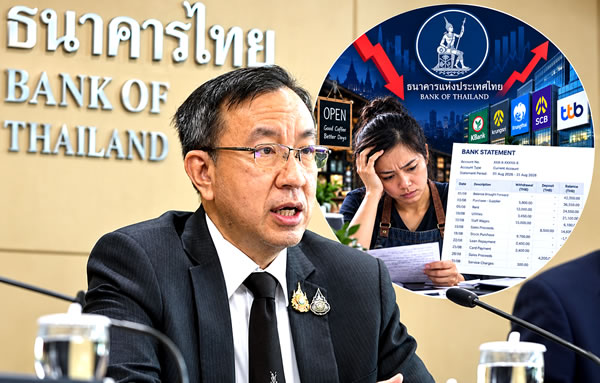
Thailand’s growth potential falls to 2.7% as SMEs face a four-year credit squeeze, warns Bank of Thailand Assistant Governor Don Nakornthab as loan rejections hit 86%. ( Source: Khaosod )
Thailand’s economic growth potential has fallen to 2.7%, while smaller businesses remain trapped in a four-year credit contraction. The Bank of Thailand now sees growth of 2.3% in 2026 and only 1.8% in 2027. Crucially, both rates sit below an economic potential which has itself fallen sharply.
Thailand’s potential growth stood near 5% between 2003 and 2007. After the global financial crisis, that rate fell to about 3.5%. Today, the central bank puts the figure at only 2.7%. Notably, this is not a growth target or a level the bank considers satisfactory.
Bank of Thailand Assistant Governor for Monetary Policy Don Nakornthab said Thailand could still grow. However, he warned that structural weaknesses were steadily reducing its capacity. Without stronger competitiveness, even the current 2.7% potential rate could fall further.
Thailand’s growth potential falls to 2.7% as ageing, weak investment and slow productivity bite hard
Three major forces are driving that decline. First, Thailand’s workforce is shrinking as the population ages. Second, overall investment has weakened from earlier levels. Finally, productivity and technology adoption have advanced too slowly.
Taken together, those pressures have lowered Thailand’s sustainable economic speed. Moreover, current GDP growth is struggling to reach even that reduced ceiling. The central bank forecasts 2.3% growth this year, followed by 1.8% next year.
Investment sits at the centre of the problem. Thailand needs investment approaching 30% of GDP to push growth sustainably above 3%. Yet overall investment remains below levels seen during stronger growth periods. At the same time, the composition of new investment has changed markedly.
Much of the latest investment is capital-intensive. Therefore, large projects do not necessarily create large numbers of jobs. Foreign labour has also become increasingly important in parts of the economy. In parallel, relatively low labour costs reduce pressure for some companies to invest heavily in productivity.
The structural list extends well beyond investment. High household debt continues to weaken consumption and financial resilience. An ageing society is shrinking the labour pool. Educational weaknesses also constrain the supply of higher-skilled workers.
Chinese competition, inequality and political instability weigh as technology exports drive growth
Separately, inequality in assets and opportunities remains another drag on economic participation. Competition from Chinese products is adding further pressure on Thai producers. Corruption and political instability are also among the weaknesses weighing on longer-term growth.
Despite that backdrop, parts of the economy remain strong. Exports continue to provide one of Thailand’s main growth engines. Recent export growth has reached double-digit rates, driven heavily by technology-related products.
Artificial intelligence-related demand is also supporting that technology cycle. Meanwhile, private investment has received a lift from investment-promotion applications. Digital businesses, data centres and software projects feature prominently among those applications.
Exports rose 22.3% year-on-year in July. Private investment, meanwhile, increased 12.9%. By comparison, industrial production advanced by only 0.5%. That contrast exposes the narrow base beneath some of Thailand’s stronger headline numbers.
Large companies and technology exporters are performing much better than many domestic firms. Consequently, strong export figures are not feeding evenly into wages, sales or household spending. Nor are new projects creating jobs on the scale seen in older industrial investment.
Weak household purchasing power hits SMEs as sales fall 7.1% and lending shrinks for four straight years
On another front, private consumption is slowing. Weak domestic purchasing power has become increasingly visible. Household debt continues absorbing income which could otherwise flow into shops, restaurants and other businesses.
Inflation has recently reached about 2.5%. Looking ahead, fresh food prices may rise towards year-end because of El Niño conditions. Even so, businesses have limited room to pass higher costs onto consumers.
Mr Don said most businesses cannot raise prices by more than 10%. Consumers simply lack the financial capacity to absorb such increases. As a result, companies face squeezed margins when their own costs climb.
This weakness hits smaller businesses particularly hard. SMEs rely heavily on domestic customers and household spending. Large exporters, by contrast, can draw substantial revenue from foreign markets. Accordingly, weak Thai purchasing power falls disproportionately on smaller firms.
The figures now show a severe divide. SME retail sales have fallen 7.1%. Large businesses, however, have recorded sales growth of 9.6%. The gap between the two groups exceeds 16 percentage points.
More significantly, SME lending has contracted for 16 consecutive quarters. That amounts to four straight years of shrinking credit. Such a prolonged contraction has not been seen since the 1997 crisis.
SMEs employ 70% of Thai workers but face bank loan rejection rates reaching 86% and far higher costs
SMEs remain central to employment. They employ approximately 13.6 million people, representing about 70% of total employment. Yet they generate only around 35% of Thailand’s GDP. That employment concentration makes their prolonged weakness economically significant.
SME economic growth has slipped towards 1%. Previously, smaller businesses expanded around 1.9% when national growth averaged closer to 3.5%. Thus, their deterioration has outpaced the broader decline in Thailand’s economic performance.
Credit conditions have intensified the pressure. Banks are rejecting around 60% to 70% of SME credit applications. For new businesses without established financial histories, rejection reaches 78%.
The situation is worse for firms already carrying bad-debt records. Their rejection rate reaches 86%. In effect, conventional bank credit becomes extremely difficult once financial problems appear.
Even stronger SMEs face tight financing conditions. Among the best-performing 30%, only 21% obtain credit. Large companies fare far better, with around 61% securing financing.
Borrowing costs widen the divide further. SMEs face average financing costs of around 6.9%. Large businesses pay approximately 3%. Hence, smaller firms pay more than twice the average financing cost faced by larger competitors.
SME bad debts mount as Stage 3 loans reach ฿195.7 billion while the banking system remains sound
At the same time, those businesses are dealing with weaker sales. Credit availability is also shrinking. Rising borrowing costs therefore strike companies already facing diminished domestic demand.
Bad debts show the accumulated strain. Approximately ฿195.7 billion of SME loans are classified as Stage 3. These loans are non-performing. Another ฿336.9 billion is classified as Stage 2.
Stage 2 loans have experienced a significant increase in credit risk. Together, the two categories show heavy financial pressure concentrated among smaller borrowers. They also help explain why banks remain cautious about extending new loans.
By contrast, Thailand’s banking system overall remains considerably stronger. Total non-performing loans stood at ฿534.8 billion during the second quarter. The overall NPL ratio was 2.82%. Banks also remain well capitalised.
Therefore, the central bank is not describing a system-wide banking crisis. Rather, financial weakness is concentrated among heavily indebted households and smaller companies. That distinction is critical to understanding Thailand’s uneven economy.
Smaller firms struggle for capital as closures rise and weak investment drags on national productivity
Large corporations retain much greater access to capital. SMEs, meanwhile, face falling sales, higher borrowing costs and stricter credit tests. In turn, those conditions restrict expansion, investment and working capital.
The Bank of Thailand’s SME survival figures add another measure of the pressure. Its research covered about 130,000 SME legal entities. Half had closed within ten years. Only around 30% survived for 25 years.
More recently established SMEs are also expanding more slowly than older generations. This creates another obstacle to stronger productivity growth. Thailand needs smaller businesses to invest, yet those businesses face growing financing barriers.
The problem becomes particularly sharp because SMEs employ most Thai workers. Investment is needed for machinery, software, technology and expansion. However, weaker earnings reduce creditworthiness and make banks less willing to lend.
In response, businesses postpone investment or abandon it. Working capital can also become harder to secure. Lower investment then restricts productivity gains across the SME sector.
At the national level, slow productivity directly affects Thailand’s potential growth. A shrinking workforce means each worker must generate more output. Without stronger productivity, demographic decline exerts an increasing brake on GDP.
Advanced investment grows in AI, data centres and software but remains too low to lift growth potential
Education is tied directly to that challenge. Advanced industries require more skilled employees. Technology adoption also demands workers capable of operating increasingly sophisticated systems. Yet educational quality remains among the structural weaknesses identified by the central bank.
Simultaneously, Thailand is attracting more advanced investment. Electronics, artificial intelligence, automation, data centres and software are drawing new capital. However, these sectors are often much more capital-intensive than traditional manufacturing.
Consequently, new investment can raise headline figures without producing equivalent gains in employment. That weakens the link between investment growth and household income. It also limits the immediate benefit for businesses dependent on local consumers.
There is another divide between foreign investment and domestic economic conditions. Promotion applications point towards stronger investment in selected modern industries. Overall investment, however, remains below the level required to lift potential growth substantially.
For that reason, the central bank has stressed productive investment. Thailand needs investment capable of raising output per worker. Merely adding capital without broader productivity gains will not restore earlier growth rates.
Household debt, shrinking credit and weak borrowers limit what lower interest rates can achieve alone
Household debt creates another major brake. Debt repayments absorb disposable income before households can spend it. Smaller businesses then receive less revenue from domestic consumers.
Thereafter, weaker business revenues reduce debt-servicing capacity. Non-performing loans rise and lenders become more cautious. New credit becomes harder to obtain. The 16-quarter SME lending contraction reflects that chain of financial pressure.
Monetary policy cannot resolve all these problems. Interest-rate reductions can lower some borrowing costs. However, they cannot expand the working-age population or directly improve education.
Likewise, lower rates cannot automatically make weak borrowers creditworthy. The policy interest rate currently stands at 1%. The Monetary Policy Committee held it there again on August 26.
Against this backdrop, Mr Don warned against expecting the central bank to carry the burden alone. “Don’t expect too much from the Bank of Thailand, because one agency can’t do much,” Mr Don said.
“If we rely solely on the Bank of Thailand, the country won’t progress,” Mr Don added. He said the central bank would continue performing its crucial role. However, stronger growth also requires government fiscal policy and private-sector action.
Bank of Thailand turns to SME credit support as Don warns monetary policy cannot carry growth alone
As part of this effort, the Bank of Thailand is developing targeted SME measures. Its SME Credit Boost programme seeks to reduce credit risks faced by lenders. A Credit Portal is also planned before the end of 2026.
The portal aims to connect smaller companies with alternative lenders. Additionally, a new credit-guarantee mechanism is being developed for 2027. Banks are also being encouraged to use alternative data when assessing borrowers.
That approach could help businesses without lengthy conventional credit histories. At present, those companies face rejection rates of 78%. Firms with existing bad-debt records face rejection rates of 86%.
Nevertheless, targeted credit programmes address only part of the wider weakness. Thailand’s larger problem is a sustained decline in underlying growth capacity. The economy’s potential has fallen from about 5% to 2.7% within two decades.
That decline has occurred alongside weaker investment, demographic change and slow productivity growth. Meanwhile, the economy has become increasingly divided between strong and weak sectors.
Technology exporters pull ahead as SME sales, lending and credit quality continue to deteriorate
At the top, technology exports and major corporations continue expanding. At the bottom, many SMEs remain squeezed by weak consumption and scarce credit. The sales figures capture that split clearly.
Large-business sales are up 9.6%. SME retail sales are down 7.1%. In contrast, exports rose 22.3% year-on-year in July. Industrial production rose only 0.5%.
This uneven pattern also appears in financing. Large businesses can obtain credit more easily and at much lower average costs. Smaller firms face rejection rates reaching 70% under ordinary applications.
For new businesses, almost four out of five applications are rejected. Among borrowers with bad-debt histories, nearly nine out of ten applications fail. Even the best-performing SMEs obtain credit at a much lower rate than large companies.
Meanwhile, non-performing SME loans continue rising. Stage 3 loans stand near ฿195.7 billion. Another ฿336.9 billion sits in Stage 2, where credit risk has increased significantly.
Private consumption is also weakening. Household debt remains high, while inflation has reached approximately 2.5%. Fresh food prices may add further pressure towards year-end.
Businesses face weak pricing power as capital-intensive investment creates fewer jobs and less spillover
Even then, businesses have limited pricing power. Consumers cannot easily absorb higher prices. Therefore, companies face higher costs without a straightforward way to protect margins.
From another angle, Thailand still has strong export momentum. Technology and AI-linked products are driving substantial overseas sales. Data centres and software investments are also attracting new capital.
Yet that strength is concentrated. New investment is often capital-intensive and less dependent on Thai labour. Thus, impressive investment figures may deliver fewer jobs than comparable spending once did.
The demographic picture makes that issue more urgent. Thailand has fewer workers available as the population ages. At the same time, low productivity growth limits gains from those who remain in employment.
To push sustainable GDP growth above 3%, investment would need to approach 30% of GDP. Current investment remains below that level. Therefore, Thailand has yet to rebuild the investment base needed for materially faster growth.
There is also an output gap left by previous weak growth. Merely returning to 2.7% would not immediately close it. Growth would probably need to stay around 3% for a period.
Growth is forecast to slow to 1.8% in 2027 as SME credit contraction exposes Thailand’s widening divide
The forecast instead points in the opposite direction. GDP growth is expected at 2.3% in 2026. It is then forecast to slow to 1.8% in 2027.
In other words, growth is falling below a potential rate which has already deteriorated sharply. That rate once stood near 5%. It later fell to 3.5%. It now stands at 2.7%.
At the same time, the businesses employing roughly 70% of Thai workers remain under intense pressure. Their lending has contracted for 16 straight quarters. Retail sales are down 7.1%, while large-business sales are up 9.6%.
Financing costs also remain heavily skewed. SMEs pay around 6.9% on average, against approximately 3% for large businesses. Credit rejection rates can reach 78% for new companies and 86% for troubled borrowers.
Thailand therefore enters the next year with a widening economic divide. Exports and selected technology investments remain strong. However, domestic purchasing power, SME lending and smaller-business sales remain weak.
Most importantly, the central bank’s 2.7% figure marks diminished economic capacity, not a target. The 2027 growth forecast stands even lower, at only 1.8%.
Meanwhile, four years of contracting SME credit continues beneath those headline numbers. That contraction reaches businesses employing around 13.6 million people across Thailand.
Petrol and diesel rise as inflation for August comes in at 2.53%. However confidence is also seen rising
GDP up, highest in eleven years but so is runaway inflation. Finance Minister warns of high oil prices
Eye of an economic storm as Thai government insists 400 billion loan must go ahead despite opposition
Finance Minister defends 400 billion baht loan decree as opposition files Constitutional Court challenge
Thai cabinet approves 400 billion baht loan to combat the Middle East War energy crisis and inflation
Thai government to steady the ship with a 500 billion loan decree as public finances come under pressure
Budget Bureau warns Finance Minister that Thailand’s economy faces acute crisis with rising public debt
Hardline foreign tourism confirmed by new minster. More charges, shorter visas and mandatory insurance
Visa entry period to go from 60 to 30 days. Agreement in principle as foreign tourism numbers fall by 10%
60-day visa regime to be ended confirms Minister responding to rising industry security concerns
Tourism boss warns Thailand it is facing a Chinese blacklist if another security controversy erupts
Ung Ing finally gives the order. Thailand pulls the plug on scam centre electricity in Burma. Cut at 9 am
Joseph Anthony is an expat from Ireland who has lived in Thailand for the last decade. He has worked extensively in the media including editorial positions in Ireland and Thailand. He is focused on economic and business stories in Thailand as well as the expat lifestyle.
All posts by Joseph O' Connor
Israeli detained for deportation as PM signs order to deport now missing French zoo owner Kevin Dimino September 7, 2026 Frenchman Kevin Dimino disappears as immigration
US servicemen left behind a financial windfall in Pattaya but also a spirit of optimism and generosity September 7, 2026 Farewell Pattaya! USS Abraham Lincoln sails after
PM Anutin laughs off what political pundits see as rising threats to the stability of his government September 7, 2026 Anutin faces a gathering storm as Sondhi threatens
UK Nigerian influencer wanted for drug trafficking died in Bangkok due to genital enlargement therapy September 6, 2026 Luxury Bangkok holiday ends in tragedy as Igho
Finance Minister Ekniti outlines the government’s economic plan but behind the buzzwords are risks September 6, 2026 Thailand’s economic reset faces an early reality
Motorist’s shocked horror after 6 million baht luxury car rolls across a motorway and into a deep irrigation canal September 5, 2026 Owner watches in horror as ฿6m luxury EV rolls
17 year old legal fight for schoolboy who is now a grown man against the Police finally ends in victory and pay day September 5, 2026 Wrongly arrested at 18, assaulted and pushed to
Turn Grey capital into White capital. Senator calls for 100% foreign owned firms to eliminate corruption September 5, 2026 Let foreigners own what they pay for, Senator Prathum
Ring of steel protects USS Abraham Lincoln as huge security operation polices US sailors on shore leave September 4, 2026 Security locks down coastal Chonburi as 5,000 USS
Widening Chinese trade gap cannot be ignored as it distorts economic data of an underlying GDP struggle September 4, 2026 Thai-Chinese businesses raise the alarm as
Fears grow for 33 year old single mother who is missing from her Kanchanaburi home since Friday August 28 September 4, 2026 Missing mother Ms Wichuda, 33, disappears after CCTV
Boss heir free to return to Thailand next year unless he gives himself up or is arrested by Interpol abroad September 4, 2026 The clock is running out on Red Bull heir Vorayuth
Defence Minister halts his cavalcade to assist injured after spotting a road traffic accident in Bangkok September 3, 2026 A Bangkok road crash stops Defence Minister Adul
64 year old German on the run in Thailand since 2024 hunted down and arrested by police in Mae Hong Son September 3, 2026 A three-year hunt ends at a Mae Hong Son guesthouse as
Cash is the name of game as the US Navy returns to its old Pattaya stomping ground in a 4 day city boost September 3, 2026 Mobile ATMs roll into Pattaya as 5,000 US sailors hit
Thai wife’s nose smelt out her husband’s infidelity and proved it in court to finalise ‘smelly underwear’ case September 2, 2026 Wife sniffs out her husband’s adultery after perfume
Stock market 2026 recovery not built on a sound footing. Depends on foreign capital and one company September 2, 2026 Bangkok’s stock market roared back 26% after three
Chaos still reigns at the NBTC as Chairman wins right to court review. Board members move to work on September 7, 2026
Vicious attack on UK man in Jomtien Pattaya leads to arrest of Thai man. 70 year old kicked in the face September 7, 2026
USS Abraham Lincoln departs Thailand after a special visit. Captain gave thanks for the very warm welcome September 6, 2026
Tourism sector starkly divided over 30 days visa from September 15th. Top tycoon says it’s a big mistake September 6, 2026
Missing Kanchanaburi mother found on southbound bus after 7 day northern stay shrouded in mystery September 6, 2026
Koh Samui Israeli expat the first to be deported under Prime Minister Anutin’s new deportation regime September 5, 2026
US Navy’s Pattaya visit is plain sailing with strong spending breeze. Chonburi governor hails it a success September 5, 2026
Paying AI users in Thailand had a nightmare week online just as the government waded into the market September 5, 2026
Malaysian online gambling boss arrested in Bangkok raid. 48 year old was a UFA network Master agent September 4, 2026
Crazed ex lover rams former girlfriend and her new boyfriend on a motorbike to their death with pickup September 4, 2026
Blunder over Indian visa policy saw Thailand lose tourists in August. Quick volte face to a 30 day visa September 4, 2026
Data centre projects on hold in Bangkok as officials scramble to examine the impact of the industry on resources September 3, 2026
HIV and AIDS still lurk behind the neon signs of Thailand’s sex industry especially as it moves online September 3, 2026
Younger brother kills sibling after finding him drinking as their mother fought for life in hospital September 3, 2026
Former PM Paetongtarn files police complaint over false social media post linking her with Israeli land September 2, 2026
People’s Party firebrand attacks flagship TH AI project launched this week with corruption agency filing of claims September 2, 2026
The boys are back in town. US servicemen return to Pattaya, a town they helped create, for wartime R&R September 2, 2026
Pot shop worker attacks UK man on his motorbike over 29,200 baht fraud on Monday in broad daylight September 1, 2026
Woman in northern Thailand builds thriving concern farming and selling live cockroaches for fishing in nearby rivers September 1, 2026
Pattaya police probe a nightclub shooting on the city’s Southside in the early hours of Monday morning August 31, 2026
Anutin begins week with twin economic headaches as car makers and rail consortium threaten to walk August 31, 2026
American man arrested in Phuket on US state and federal warrants relating to sexual abuse of minors at home August 31, 2026
© 2026 Thai Examiner. All rights reserved.
2026年9月11日凌晨1点17分
经济、生活、政治、泰国
泰国经济增长潜力在过去二十年几乎减半,而中小企业仍深陷自1997年危机以来最严重的信贷紧缩之中。泰国央行目前将潜在增长率预测为仅2.7%,预计今年GDP增速为2.3%,2027年为1.8%。与此同时,中小企业贷款已连续16个季度萎缩,零售额下降7.1%,贷款拒贷率高达86%。然而,出口和技术投资依然强劲,这暴露出泰国经济日益分化的问题。泰国央行助理行长唐·纳空塔布警告称,人口老龄化、投资疲软和生产力低下可能会进一步压低泰国的经济上限。
泰国央行助理行长敦·纳空塔布警告称,由于中小企业面临长达四年的信贷紧缩,泰国经济增长潜力已降至2.7%,贷款拒贷率高达86%。(来源:Khaosod)
泰国经济增长潜力已降至2.7%,而小型企业仍深陷长达四年的信贷紧缩之中。泰国央行目前预测,2026年经济增长率为2.3%,2027年仅为1.8%。关键在于,这两个增长率均低于已大幅下降的经济潜力。
2003年至2007年间,泰国的潜在经济增长率接近5%。全球金融危机后,这一数字降至约3.5%。如今,泰国央行给出的数字仅为2.7%。值得注意的是,这并非央行设定的增长目标,也并非其认为令人满意的水平。
泰国央行货币政策助理行长敦·纳空塔布表示,泰国经济仍有增长潜力。但他警告称,结构性缺陷正在稳步削弱其增长能力。如果缺乏更强的竞争力,即使是目前2.7%的潜在增长率也可能进一步下降。
泰国经济增长潜力因人口老龄化、投资疲软和生产力低下而大幅下降至2.7%。
导致泰国经济下滑的主要原因有三点。首先,随着人口老龄化,泰国劳动力正在萎缩。其次,整体投资水平较以往有所下降。最后,生产率和技术应用的发展速度过于缓慢。
综合来看,这些压力降低了泰国经济的可持续增长速度。此外,目前的GDP增速甚至难以达到下调后的上限。泰国央行预测今年经济增长率为2.3%,明年为1.8%。
投资是问题的核心。泰国需要投资接近GDP的30%才能推动经济增长持续高于3%。然而,总体投资水平仍低于以往经济增长强劲时期的水平。与此同时,新增投资的构成也发生了显著变化。
近期的大部分投资都是资本密集型的。因此,大型项目未必能创造大量就业机会。此外,外籍劳工在部分经济领域的重要性日益凸显。与此同时,相对较低的劳动力成本也降低了部分企业在提高生产率方面进行大量投资的压力。
结构性问题远不止投资领域。高企的家庭债务持续削弱消费和金融韧性。人口老龄化导致劳动力市场萎缩。教育水平的不足也制约了高技能人才的供给。
中国的竞争、不平等和政治不稳定对技术出口推动增长构成压力
此外,资产和机会的不平等仍然是制约经济参与的另一大因素。来自中国产品的竞争进一步加剧了泰国生产商的压力。腐败和政治不稳定也是制约长期增长的弱点之一。
尽管面临这样的背景,泰国经济的部分领域依然保持强劲。出口仍然是泰国经济增长的主要引擎之一。近期出口增速已达到两位数,这主要得益于科技相关产品的出口增长。
人工智能相关的需求也在支撑着这一技术周期。与此同时,投资促进政策的出台也提振了私人投资。数字企业、数据中心和软件项目在这些政策中占据了显著地位。
7月份泰国出口同比增长22.3%。与此同时,私人投资增长12.9%。相比之下,工业生产仅增长0.5%。这种对比暴露出泰国一些强劲的经济数据背后基数较窄的问题。
大型企业和技术出口商的业绩远优于许多国内企业。因此,强劲的出口数据并未均衡地转化为工资增长、销售额提升或家庭支出增加。新项目创造的就业岗位规模也远不及以往的工业投资。
家庭购买力疲软冲击中小企业,销售额下降7.1%,贷款额连续四年萎缩
另一方面,私人消费正在放缓。国内购买力疲软的问题日益凸显。家庭债务持续吞噬着原本可以流入商店、餐馆和其他企业的收入。
近期通货膨胀率已达到约2.5%。展望未来,受厄尔尼诺现象影响,年底前新鲜食品价格可能上涨。即便如此,企业将成本上涨转嫁给消费者的空间仍然有限。
唐先生表示,大多数企业无法将价格提高超过10%。消费者根本没有足够的经济能力来承受这样的涨幅。因此,当企业自身成本上升时,利润空间就会受到挤压。
这种疲软态势对小型企业的打击尤为沉重。中小企业严重依赖国内客户和家庭支出。相比之下,大型出口商可以从海外市场获得可观的收入。因此,泰国购买力疲软对小型企业的影响尤为严重。
数据显示,中小企业零售额与大型企业零售额之间存在显著差距。中小企业零售额下降了7.1%,而大型企业零售额却增长了9.6%。两组企业之间的差距超过16个百分点。
更重要的是,中小企业贷款已连续16个季度萎缩,相当于连续四年信贷规模缩减。如此长时间的萎缩是自1997年金融危机以来从未出现过的。
中小企业雇佣了70%的泰国工人,但却面临高达86%的银行贷款拒贷率和更高的成本。
中小企业仍然是就业的重要组成部分。它们雇佣了约1360万人,约占总就业人数的70%。然而,它们仅创造了泰国国内生产总值(GDP)的约35%。这种就业集中度使得中小企业的长期疲软具有重要的经济意义。
中小企业经济增长已下滑至1%左右。此前,在全国平均经济增长接近3.5%的情况下,小型企业的增长率约为1.9%。因此,它们的下滑速度超过了泰国整体经济表现的下滑速度。
信贷环境加剧了中小企业面临的压力。银行拒绝了约60%至70%的中小企业信贷申请。对于没有既定财务记录的新企业,拒贷率高达78%。
对于已有不良贷款记录的公司而言,情况更加糟糕。它们的贷款拒贷率高达86%。实际上,一旦出现财务问题,获得传统银行信贷就变得极其困难。
即使是实力较强的中小企业也面临着融资环境紧张的局面。在业绩最好的30%的企业中,只有21%能够获得信贷。大型企业的情况则好得多,约有61%的企业能够获得融资。
借贷成本进一步拉大了差距。中小企业面临的平均融资成本约为6.9%,而大型企业则约为3%。因此,小型企业支付的平均融资成本是大型竞争对手的两倍多。
中小企业不良贷款不断增加,第三阶段贷款总额达到1957亿泰铢,但银行体系依然稳健。
与此同时,这些企业正面临销售疲软的困境。信贷渠道也在收紧。因此,不断上升的借贷成本给本已面临国内需求下降的企业雪上加霜。
不良贷款反映了累积的压力。约有1957亿泰铢的中小企业贷款被列为第三阶段,这些贷款属于不良贷款。另有3369亿泰铢被列为第二阶段。
第二阶段贷款的信用风险显著增加。这两类贷款加在一起,都显示出小型借款人面临着巨大的财务压力。这也解释了为什么银行在发放新贷款方面仍然保持谨慎。
相比之下,泰国银行体系整体依然稳健。第二季度不良贷款总额为5348亿泰铢,不良贷款率仅为2.82%。各银行资本充足率也保持良好。
因此,央行并非在描述一场系统性的银行业危机。相反,金融疲软主要集中在负债累累的家庭和小型企业中。这种区别对于理解泰国经济的不平衡至关重要。
随着倒闭潮的增加和投资疲软拖累国家生产力,小型企业难以获得资金。
大型企业更容易获得资金。与此同时,中小企业则面临销售额下降、借贷成本上升和信贷审查更加严格的困境。反过来,这些情况又限制了它们的扩张、投资和营运资金。
泰国银行公布的中小企业生存数据进一步凸显了中小企业面临的压力。该机构的研究涵盖了约13万家中小企业,其中一半在十年内倒闭,仅有约30%的企业存活了25年。
新近成立的中小企业扩张速度也比老一代企业慢。这给生产力增长带来了又一障碍。泰国需要小型企业进行投资,但这些企业却面临着融资壁垒。
由于中小企业雇佣了泰国大部分劳动力,这个问题变得尤为突出。中小企业需要投资用于机械设备、软件、技术和扩张。然而,盈利能力下降会降低企业的信用评级,使银行放贷意愿降低。
受此影响,企业会推迟投资或放弃投资。营运资金的获取也会变得更加困难。投资减少进而限制了中小企业整体的生产力提升。
在国家层面,生产力低下直接影响泰国的潜在增长。劳动力萎缩意味着每个劳动者必须创造更多产出。如果生产力没有提高,人口下降将对国内生产总值(GDP)构成越来越大的抑制作用。
人工智能、数据中心和软件领域的先进投资有所增长,但仍不足以提升增长潜力。
教育与这一挑战息息相关。先进产业需要更多技能娴熟的员工。技术应用也需要能够操作日益复杂系统的员工。然而,教育质量仍然是中央银行指出的结构性薄弱环节之一。
与此同时,泰国正吸引更多高端投资。电子、人工智能、自动化、数据中心和软件等领域正吸引着新的资本。然而,这些行业的资本密集度通常远高于传统制造业。
因此,新增投资可能会提升经济数据,但却未必能带来同等的就业增长。这削弱了投资增长与家庭收入之间的联系,也限制了依赖本地消费者的企业能够立即获得的收益。
外国投资与国内经济状况之间还存在另一层差距。促进投资的申请表明,部分现代化产业的投资力度有所加大。然而,总体投资水平仍然低于大幅提升潜在增长所需的水平。
因此,央行强调生产性投资。泰国需要能够提高劳动生产率的投资。仅仅增加资本而不提高整体生产率,无法恢复到之前的增长率。
家庭债务、信贷紧缩和借款人信用状况不佳限制了低利率单独能带来的影响。
家庭债务构成另一大阻碍。偿还债务会消耗掉家庭的可支配收入,使其无法用于消费。因此,小型企业从国内消费者那里获得的收入也会减少。
此后,企业收入疲软导致偿债能力下降,不良贷款增加,贷款机构更加谨慎,新信贷获取难度加大。中小企业贷款连续16个季度萎缩,正是这一系列金融压力的体现。
货币政策无法解决所有这些问题。降低利率可以降低部分借贷成本,但无法扩大劳动年龄人口或直接改善教育。
同样,降低利率并不能自动提升信用状况不佳的借款人的信誉度。目前的政策利率为1%。货币政策委员会于8月26日再次维持该利率不变。
在此背景下,唐先生警告说,不要指望央行独自承担所有重担。“不要对泰国央行抱有过高的期望,因为一个机构能做的非常有限,”唐先生说。
“如果我们仅仅依赖泰国央行,国家将无法取得进步,”唐先生补充道。他表示,央行将继续发挥其关键作用。然而,更强劲的经济增长也需要政府财政政策和私营部门的共同努力。
泰国央行转向中小企业信贷支持,此前Don警告称,仅靠货币政策无法支撑经济增长。
作为这项工作的一部分,泰国银行正在制定针对中小企业的专项措施。其“中小企业信贷促进计划”旨在降低贷款机构面临的信贷风险。此外,泰国银行还计划在2026年底前推出信贷门户网站。
该平台旨在连接小型企业与另类贷款机构。此外,一项新的信用担保机制正在开发中,预计将于2027年推出。同时,也鼓励银行在评估借款人时使用替代数据。
这种方法或许能帮助那些缺乏长期传统信用记录的企业。目前,这类企业的拒贷率高达78%。而那些已有不良债务记录的企业,拒贷率则高达86%。
然而,有针对性的信贷计划只能解决部分更广泛的经济疲软问题。泰国更大的问题是其潜在增长能力持续下降。在过去二十年里,泰国经济的潜在增长率已从约5%降至2.7%。
这一下滑伴随着投资疲软、人口结构变化和生产率增长缓慢。与此同时,经济中强弱部门之间的分化日益加剧。
随着中小企业销售、贷款和信贷质量持续恶化,科技出口企业脱颖而出。
在经济顶层,科技出口企业和大型公司持续扩张。而在经济底层,许多中小企业仍然受到消费疲软和信贷紧缩的挤压。销售数据清晰地反映了这种分化。
大型企业销售额增长9.6%,中小企业零售额下降7.1%。相比之下,7月份出口同比增长22.3%,而工业生产仅增长0.5%。
这种不平衡的模式也体现在融资领域。大型企业更容易获得信贷,而且平均成本也低得多。小型企业在常规贷款申请中面临的拒绝率高达70%。
对于新企业而言,近五分之四的贷款申请会被拒绝。在有不良债务记录的借款人中,近九成的申请都会被驳回。即使是业绩最好的中小企业,其贷款审批通过率也远低于大型企业。
与此同时,中小企业不良贷款持续攀升。第三阶段不良贷款总额接近1957亿泰铢。另有3369亿泰铢处于第二阶段,该阶段贷款的信用风险已显著增加。
私人消费也在疲软。家庭债务依然高企,而通胀率已达到约2.5%。年底前,生鲜食品价格可能会进一步加剧通胀压力。
由于资本密集型投资创造的就业机会减少,溢出效应也减弱,企业面临定价权疲弱的困境。
即便如此,企业的定价权仍然有限。消费者难以承受更高的价格。因此,企业面临成本上升的困境,却没有直接有效的方法来保障利润率。
从另一个角度来看,泰国的出口势头依然强劲。科技和人工智能相关产品正推动着海外销售额的显著增长。数据中心和软件投资也在吸引新的资本。
然而,这种优势是集中的。新的投资往往是资本密集型的,对泰国劳动力的依赖程度较低。因此,令人瞩目的投资额可能比以往同等规模的投资所创造的就业机会要少。
人口结构的变化使这个问题更加紧迫。随着人口老龄化,泰国可用的劳动力减少。与此同时,低生产率增长限制了现有就业人员的收入增长。
要使可持续的GDP增长率超过3%,投资需要接近GDP的30%。目前的投资水平仍低于这一水平。因此,泰国尚未重建实现更快增长所需的投资基础。
此外,此前疲软的经济增长也造成了产出缺口。仅仅恢复到2.7%的增速并不能立即弥补这一缺口。经济增长可能需要在一段时间内保持在3%左右。
预计到2027年,泰国经济增长将放缓至1.8%,中小企业信贷紧缩将加剧泰国日益扩大的贫富差距。
然而,预测结果却指向相反的方向。预计2026年GDP增长率为2.3%,随后预计2027年将放缓至1.8%。
换句话说,经济增长率已经低于潜在水平,而且这一潜在水平已经急剧下降。该水平一度接近5%,后来降至3.5%,现在则为2.7%。
与此同时,雇佣了约70%泰国劳动力的企业仍然面临巨大压力。它们的贷款额已连续16个季度萎缩。零售额下降了7.1%,而大型企业销售额则增长了9.6%。
融资成本仍然存在显著差异。中小企业的平均融资成本约为6.9%,而大型企业的平均融资成本约为3%。新公司的贷款拒绝率可高达78%,而陷入困境的借款人的贷款拒绝率则高达86%。
因此,泰国进入新的一年时,经济差距将进一步扩大。出口和部分技术投资依然强劲,但国内购买力、中小企业贷款和小微企业销售额依然疲软。
最重要的是,央行2.7%的数字反映的是经济潜力的下降,而非目标。2027年的增长预测甚至更低,仅为1.8%。
与此同时,在这些表面数据背后,中小企业信贷萎缩的趋势仍在持续四年。这种萎缩影响到泰国约1360万个就业岗位。
受8月份通胀率2.53%的影响,汽油和柴油价格上涨。但与此同时,市场信心也在增强。
国内生产总值增长,创十一年来新高,但通货膨胀也失控。财政部长警告称,油价将居高不下。
尽管遭到反对,泰国政府仍坚持4000亿贷款必须继续进行,经济风暴的中心正处于风口浪尖。
财政部长为4000亿泰铢贷款法令辩护,反对派向宪法法院提起诉讼
泰国内阁批准4000亿泰铢贷款,用于应对中东战争、能源危机和通货膨胀。
泰国政府将通过一项5000亿泰铢的贷款法令来稳定财政,以应对公共财政压力。
预算局警告财政部长,随着公共债务不断攀升,泰国经济正面临严峻危机。
新任部长确认将对外国旅游采取强硬措施。增加收费、缩短签证期限并强制购买保险。
签证入境期限由60天缩短至30天。鉴于外国游客数量下降10%,该方案已原则上达成一致。
部长确认将取消60天签证制度,以回应日益增长的行业安全担忧
泰国旅游业负责人警告称,如果再次爆发安全争议,泰国将面临被中国列入黑名单的风险。
翁英终于下达了命令。泰国切断了缅甸诈骗中心的电力供应。上午9点结束
约瑟夫·安东尼是一位来自爱尔兰的侨民,过去十年一直居住在泰国。他曾在爱尔兰和泰国的媒体行业担任过编辑职务,拥有丰富的媒体从业经验。他主要关注泰国的经济和商业新闻,以及侨民的生活方式。
约瑟夫·奥康纳的所有帖子
以色列人因涉嫌移民问题被拘留,等待遣返;总理签署命令遣返目前失踪的法国动物园园主凯文·迪米诺(2026年9月7日);法国人凯文·迪米诺在移民局的调查中失踪
美国军人在芭堤雅留下了一笔意外之财,同时也留下了乐观和慷慨的精神。2026年9月7日,再见了,芭堤雅!“亚伯拉罕·林肯”号航空母舰启航
2026年9月7日,阿努廷总理对政治评论员认为对其政府稳定日益增长的威胁一笑置之。桑迪的威胁让阿努廷面临一场风暴。
一名因涉嫌贩毒而被英国通缉的尼日利亚裔网红于2026年9月6日在曼谷因接受生殖器增大疗法而死亡。豪华曼谷之旅以悲剧告终,伊戈
财政部长埃克尼蒂概述了政府的经济计划,但华丽的辞藻背后隐藏着风险 2026年9月6日 泰国经济重置计划或将提前面临现实
2026年9月5日,一辆价值600万泰铢的豪华轿车在高速公路上翻滚坠入深水渠,车主惊恐万分。车主眼睁睁地看着这辆价值600万泰铢的豪华电动车翻滚。
一名17岁少年(现已成年)与警方进行了一场旷日持久的法律诉讼,最终以胜诉和赔偿告终。2026年9月5日,这名少年18岁时被错误逮捕,遭到殴打和推搡。
将灰色资本转化为白色资本。参议员呼吁允许外资100%控股企业以消除腐败。2026年9月5日,参议员普拉图姆表示:“让外国人拥有他们出资购买的东西。”
2026年9月4日,美国海军“亚伯拉罕·林肯”号航空母舰在严密安保下安全航行,5000名美国海军水兵在岸上休假。与此同时,春武里府沿海地区也实施了封锁。
不断扩大的中国贸易逆差不容忽视,因为它扭曲了经济数据,掩盖了泰国GDP面临的潜在困境。2026年9月4日,泰中企业发出警告。
一名33岁的单身母亲自2026年8月28日星期五起在北碧府失踪,人们越来越担心她的安危。9月4日,失踪母亲维楚达女士(33岁)的监控录像显示她失踪。
红牛继承人沃拉育明年即可自由返回泰国,除非他主动投案或被国际刑警组织在海外逮捕。2026年9月4日,沃拉育的命运岌岌可危。
2026年9月3日,国防部长阿杜尔在曼谷目睹一起交通事故后,暂停车队行程,救助伤者。曼谷的一起交通事故使国防部长阿杜尔的行程戛然而止。
一名64岁的德国男子自2024年起在泰国潜逃,最终于2026年9月3日在湄宏顺府被警方抓获。长达三年的追捕行动在湄宏顺府一家旅馆落下帷幕。
2026年9月3日,美国海军重返其位于芭堤雅的老地盘,展开为期四天的城市振兴行动,现金交易成为关键。随着5000名美国海军官兵抵达芭堤雅,移动ATM机也随之投入使用。
泰国妻子凭借嗅觉嗅出丈夫不忠,并在法庭上证明其行为,最终结案“内裤异味案”(2026年9月2日)。妻子通过香水嗅出丈夫的婚外情。
2026年股市复苏并非建立在稳固的基础之上,而是依赖于外资和一家公司。2026年9月2日,曼谷股市在经历了三个月的低迷后强劲反弹,涨幅达26%。
国家广播电视和电信委员会(NBTC)内部依然混乱,主席赢得诉诸法庭的权利。委员会成员将于2026年9月7日开始工作。
一名英国男子在芭堤雅中天区遭到恶性袭击,一名泰国男子被捕。一名70岁老人于2026年9月7日被踢中面部。
“亚伯拉罕·林肯”号航空母舰结束对泰国的特别访问后离开。舰长对泰国的热情接待表示感谢。2026年9月6日
旅游业对9月15日起实施的30天签证政策存在严重分歧。一位顶级大亨称此举是一个巨大的错误。(2026年9月6日)
2026年9月6日,一名失踪的北碧府母亲在北部逗留7天后,在一辆南行巴士上被发现,失踪原因至今成谜。
2026年9月5日,苏梅岛一名以色列侨民成为总理阿努廷新驱逐制度下首位被驱逐出境者。
美国海军芭堤雅之行进展顺利,消费强劲。春武里府府尹称此行圆满成功。2026年9月5日
就在泰国政府于2026年9月5日正式介入人工智能市场之际,泰国的付费人工智能用户经历了噩梦般的一周。
马来西亚网络赌博头目在曼谷突袭行动中被捕。这名48岁的男子是UFA网络的高级代理人。2026年9月4日
2026年9月4日,一名疯狂的前男友驾驶皮卡撞向骑摩托车的前女友及其新男友,致其死亡。
由于印度签证政策失误,泰国8月份流失了大量游客。2026年9月4日,泰国迅速调整政策,改为30天签证。
曼谷数据中心项目暂停,官员们正紧急评估该行业对资源的影响 2026年9月3日
艾滋病毒和艾滋病仍然潜伏在泰国色情行业的霓虹灯招牌背后,尤其是在其转向线上之后。(2026年9月3日)
2026年9月3日,弟弟发现哥哥酗酒后将其杀害,当时他们的母亲正在医院与死神搏斗。
前总理佩通坦就社交媒体上有关她与以色列土地有关联的虚假帖子向警方报案 2026年9月2日
人民党激进派人士抨击本周启动的旗舰人工智能项目TH AI,并向反腐机构提交索赔申请(2026年9月2日)
士兵们回来了。2026年9月2日,美国军人返回他们曾参与创建的芭堤雅城,进行战时休假。
2026年9月1日星期一,光天化日之下,一名大麻店店员因29200泰铢的诈骗案袭击了一名骑摩托车的英国男子。
2026年9月1日,泰国北部一名女子通过养殖和出售活蟑螂供附近河流的渔民捕鱼,建立了一项蓬勃发展的生意。
芭堤雅警方正在调查2026年8月31日星期一凌晨发生在芭堤雅南区一家夜总会的枪击案。
阿努廷本周伊始就面临双重经济难题:汽车制造商和铁路财团威胁要退出合作。2026年8月31日
2026年8月31日,一名美国男子在普吉岛被捕,他因涉嫌在家中性侵未成年人而被美国州和联邦政府通缉。
© 2026 Thai Examiner。版权所有。